NEET UG · Video

Chromosomal Disorders NEET Guide
Understand chromosomal disorders with clear examples for NEET UG with TopAll.
5 min video

NEET UG · Biology
Revise the concepts. Try a question. Understand your next step.
176 medium questions available · Try answers free. Sign in to save progress or take a quiz.
NEET UG · Biology
Understand the concept, practise questions and check your learning.
Understand
Separate genotype and phenotype, solve conditional probabilities and count recombinant test-cross offspring from a stated parental phase. Inheritance: choose the probability model before using a ratio
Read the guidePractise
Try 176 medium chapter MCQs. Untimed; check answers and available explanations as you go.
Practise chapter MCQsCheck your learning
Prepare a timed chapter quiz. Choose the available question count and pace before starting.
Prepare a chapter quizThis is chapter practice, not a full-length NEET mock paper.
These are playable question counts after quality and duplicate checks.
The practice player uses single-correct-answer MCQs. Chapter quizzes are not full-length NEET mock papers. Check the practice guide and official syllabus sources.
Revise before you practise
NEET UG · Video
Understand chromosomal disorders with clear examples for NEET UG with TopAll.
5 min video
NEET UG · Video
Master test cross concepts and genotype analysis for NEET UG with TopAll.
4 min video
NEET UG · Video
Learn Mendelian disorders and inheritance examples for NEET UG with TopAll.
6 min video
NEET UG · PDF notes
Read PDF · 8 pages →Master test cross concepts and genotype analysis for NEET UG with TopAll.
8 pages
NEET UG · PDF notes
Read PDF · 11 pages →Understand chromosomal disorders with clear examples for NEET UG with TopAll.
11 pages
NEET UG · PDF notes
Read PDF · 9 pages →Learn Mendelian disorders and inheritance examples for NEET UG with TopAll.
9 pages
NEET UG · Mind map
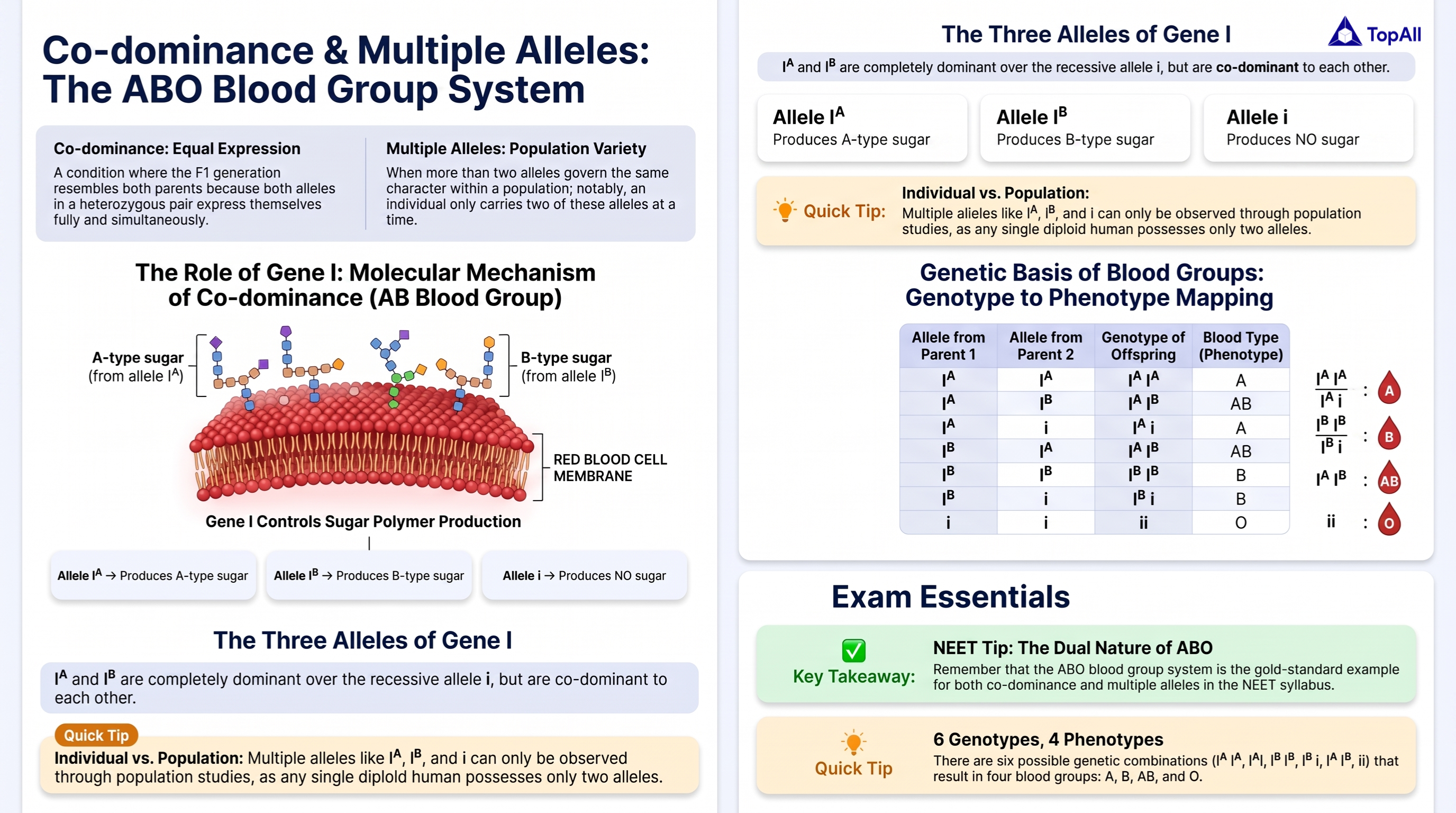
Master codominance and multiple alleles for NEET UG with TopAll.
NEET UG · Mind map
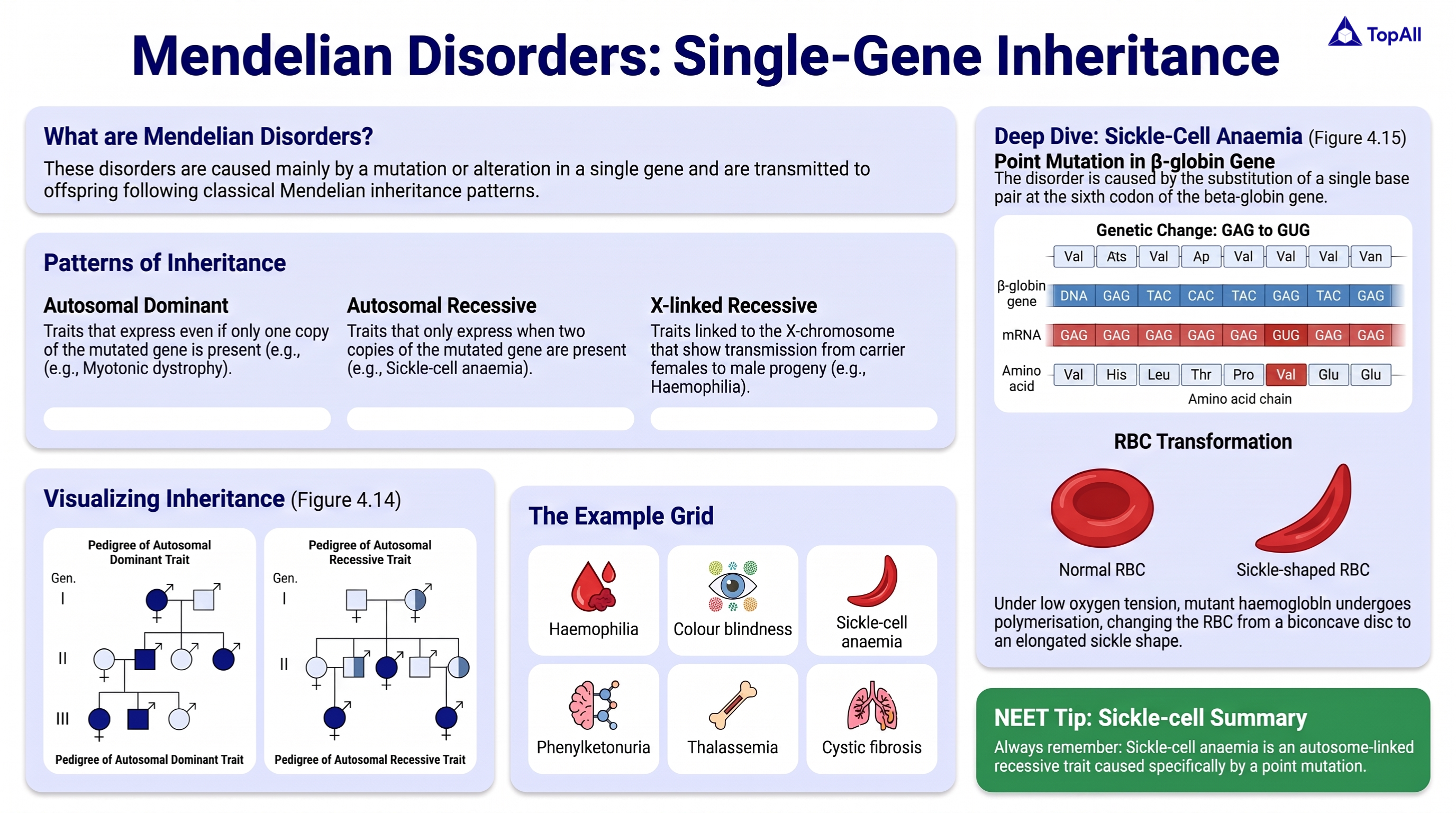
Learn Mendelian disorders and inheritance patterns for NEET UG with TopAll.
NEET UG · Mind map
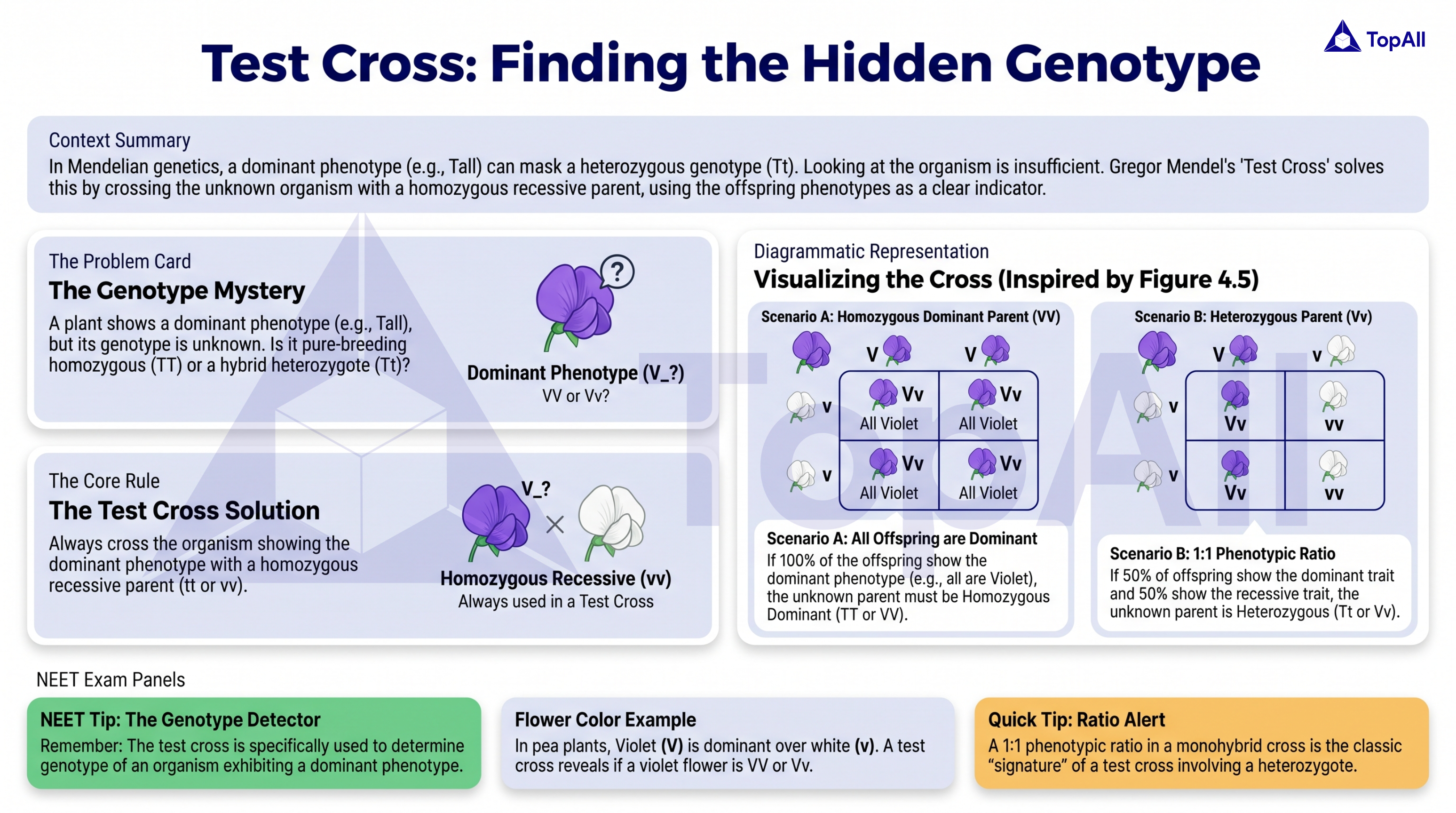
Master test cross concepts and genotype analysis for NEET UG with TopAll.
Separate genotype and phenotype, solve conditional probabilities and count recombinant test-cross offspring from a stated parental phase.
For NEET UG Biology students: build a probability from gametes, distinguish genotype from phenotype and use test-cross phase before counting recombinant classes.
A cross describes gamete combinations; dominance determines how genotypes map to phenotype in a particular model. For Aa×Aa with equally likely gametes and random fertilisation, genotype probabilities are one-quarter AA, one-half Aa and one-quarter aa. A three-to-one phenotype ratio additionally assumes complete dominance and comparable survival and expression. Dominant does not mean more common, stronger or inherently advantageous.
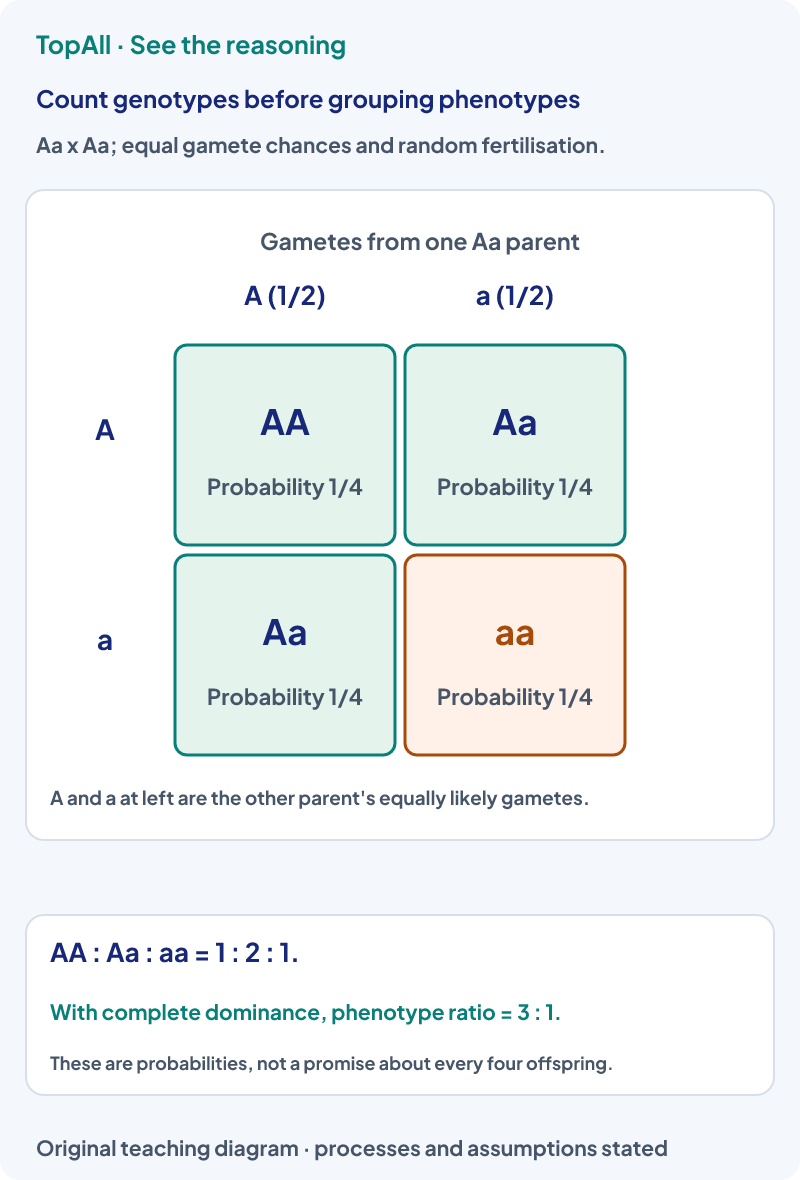
In the stated complete-dominance Aa×Aa model, choose an offspring known to show the dominant phenotype. The eligible outcomes are AA, Aa and Aa. Therefore
For a suitable AaBb parent with independently assorting loci, AB, Ab, aB and ab gametes each have probability one-quarter. Linked loci can deviate from that model. Before multiplying one-locus probabilities, check whether the problem supplies independence, linkage information or observed gamete frequencies. Complete dominance and independent assortment are different assumptions.
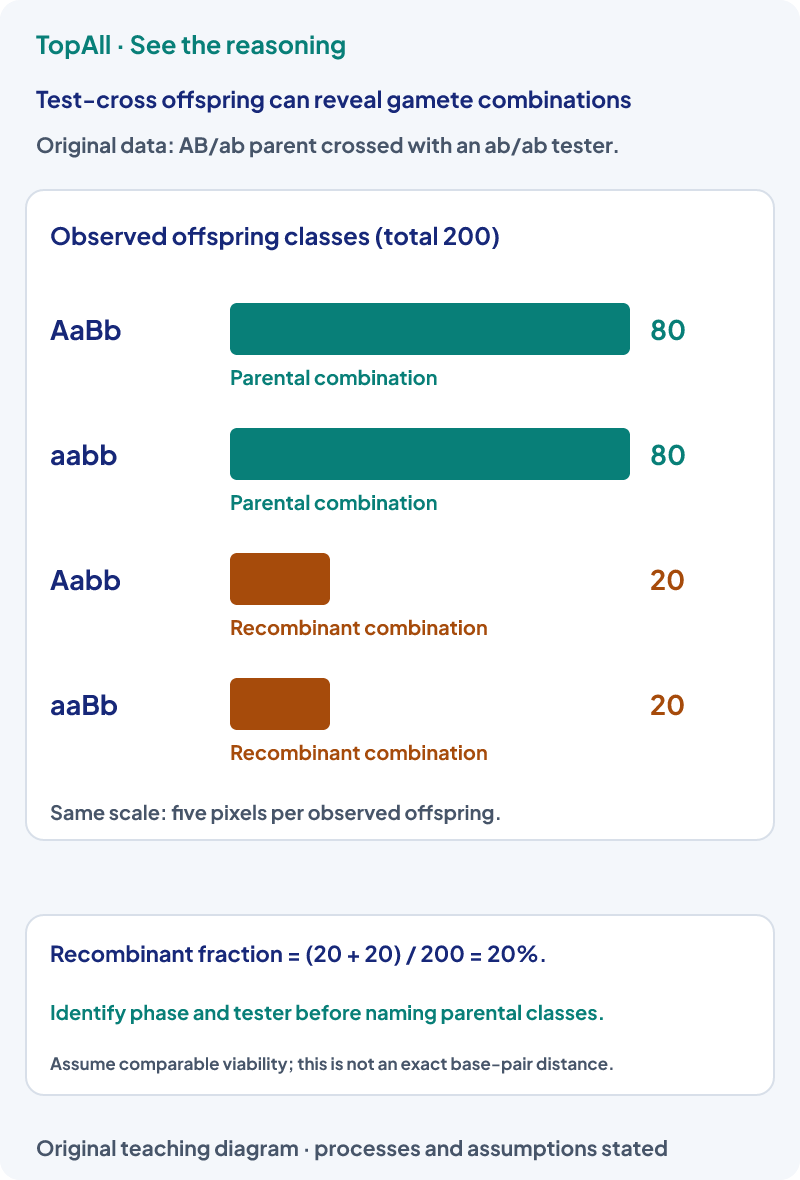
In the illustrated data, both recombinant classes must be included: 20 + 20 = 40 out of 200 offspring. The observed recombinant fraction is 0.20, or 20%. Counting only one small class gives 10% and misses half the recombinant observations. The value is not a count of all crossover events, and a two-point percentage should not be reported as an exact base-pair distance.
A diploid heterozygote carries two allele versions at a locus; ordinary gametes receive one allele at that locus. The recessive version is not erased simply because a dominant phenotype is expressed. A population can contain more than two alleles at a locus even though a standard diploid individual carries at most two copies there. Keep the individual and population levels distinct.
In an original Aa×Aa model, each independently produced offspring has probability one-quarter of aa. For two specified offspring, both being aa has probability one-sixteenth. It is not one-half merely because two outcomes were requested. The multiplication uses the stated independent events; it does not mean that earlier outcomes force later offspring to balance a ratio.
Crossing a dominant-phenotype individual with an appropriate homozygous recessive tester can reveal information about its gametes. A self cross combines two gamete draws from the same genotype and has a different expected distribution. Match the actual parental genotypes before recalling a ratio. The same visible phenotype can be produced by different genotypes in a complete-dominance model.
List the eligible outcomes and state whether a condition has removed any. For two loci, check phase and independence. For recombinant counts, include both relevant classes. Keep an expected probability separate from an observed small-sample ratio, and do not use a dominant phenotype alone as proof of homozygosity.
Under independent assortment, AaBb is crossed with aabb. What is the probability of aabb and what is the probability of AaBb?
The heterozygous parent makes AB, Ab, aB and ab equally. The tester contributes ab. Each requested genotype therefore has probability one-quarter. The familiar nine-to-three-to-three-to-one phenotype ratio belongs to a different two-heterozygote cross with additional dominance assumptions.
A stated Aa×Aa model predicts 25% aa. Must a sample of twenty offspring contain exactly five aa?
No. Five is the expected count, obtained from twenty times one-quarter. Actual random samples can differ. The model gives a probability distribution; it does not allocate one recessive outcome after every three dominant ones.
Rebuild the four outcomes and then condition on the dominant phenotype. Identify the two recombinant classes in a phase-labelled test cross. Connect allele counting to Evolution, or distinguish inheritance of a construct from its verification in Biotechnology Principles and Processes.
Practice opens the broad inheritance pool, not a guaranteed linkage-only set.
Technical review: Codex (automated), 24 October 2026. Core mechanisms were compared with the linked primary textbooks and university or government references. All diagrams, problem inputs and explanations are original. Numerical balances and diagram directions are checked separately. Independent human subject review is not claimed. These focused guides support the existing chapter catalogue; they do not claim complete current exam or syllabus coverage.
Choose a conditional-probability or linkage question after writing its eligible outcomes, parental phase and assumptions. Use the explanation to identify the step that changed your denominator.

