NEET UG · Video

Melvin Calvin Scientist Spotlight
Learn Melvin Calvin's contribution to photosynthesis for NEET UG with TopAll.
5 min video

NEET UG · Biology
Revise the concepts. Try a question. Understand your next step.
87 medium questions available · Try answers free. Sign in to save progress or take a quiz.
NEET UG · Biology
Understand the concept, practise questions and check your learning.
Understand
Compare cyclic and linear electron flow, account for Calvin-cycle regeneration and avoid confusing net triose with glucose equivalents. Photosynthesis: trace electrons and balance the carbon
Read the guidePractise
Try 87 medium chapter MCQs. Untimed; check answers and available explanations as you go.
Practise chapter MCQsCheck your learning
Prepare a timed chapter quiz. Choose the available question count and pace before starting.
Prepare a chapter quizThis is chapter practice, not a full-length NEET mock paper.
These are playable question counts after quality and duplicate checks.
The practice player uses single-correct-answer MCQs. Chapter quizzes are not full-length NEET mock papers. Check the practice guide and official syllabus sources.
Revise before you practise
NEET UG · Video
Learn Melvin Calvin's contribution to photosynthesis for NEET UG with TopAll.
5 min video
NEET UG · Video
Start Photosynthesis in Higher Plants with clarity for NEET UG with TopAll.
4 min video
NEET UG · Video
Learn the role of water in photosynthesis and plant growth for NEET UG with TopAll.
4 min video
NEET UG · PDF notes
Read PDF · 8 pages →Start Photosynthesis in Higher Plants with clarity for NEET UG with TopAll.
8 pages
NEET UG · PDF notes
Read PDF · 8 pages →Learn the role of water in photosynthesis and plant growth for NEET UG with TopAll.
8 pages
NEET UG · PDF notes
Read PDF · 8 pages →Study how temperature affects photosynthesis for NEET UG with TopAll.
8 pages
NEET UG · Mind map
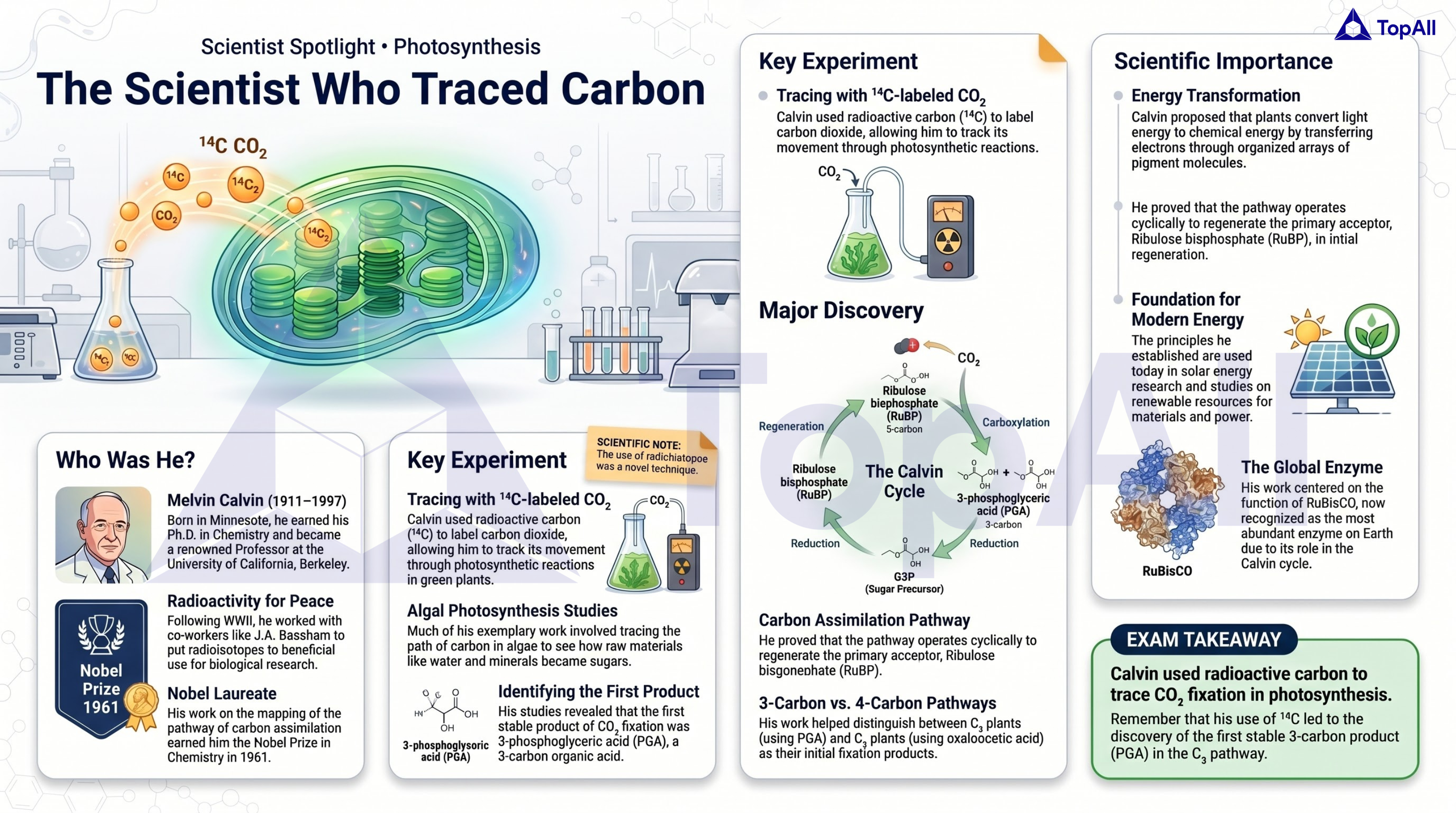
Learn Melvin Calvin's contribution to photosynthesis for NEET UG with TopAll.
NEET UG · Mind map
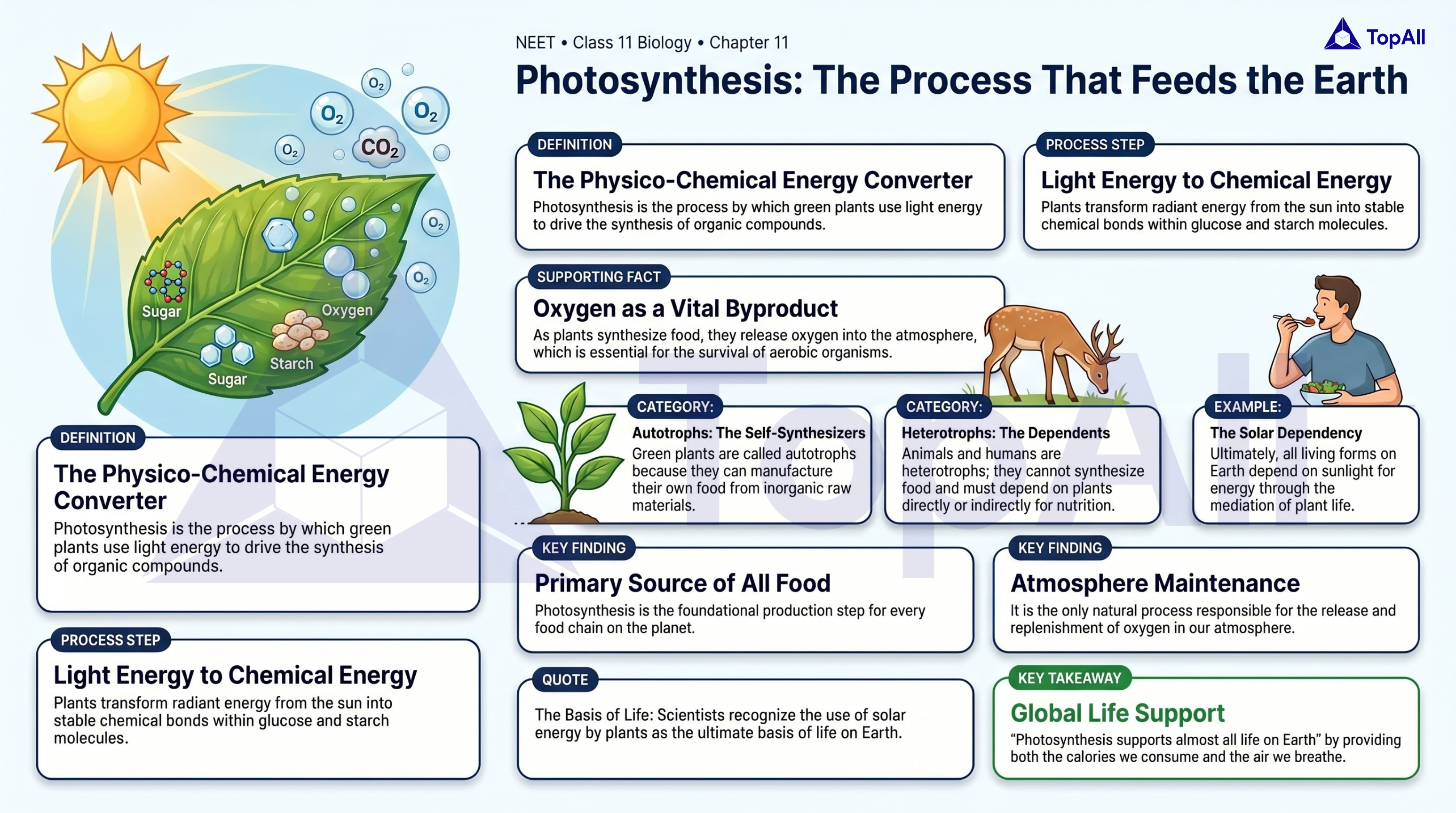
Start Photosynthesis in Higher Plants with clarity for NEET UG with TopAll.
NEET UG · Mind map
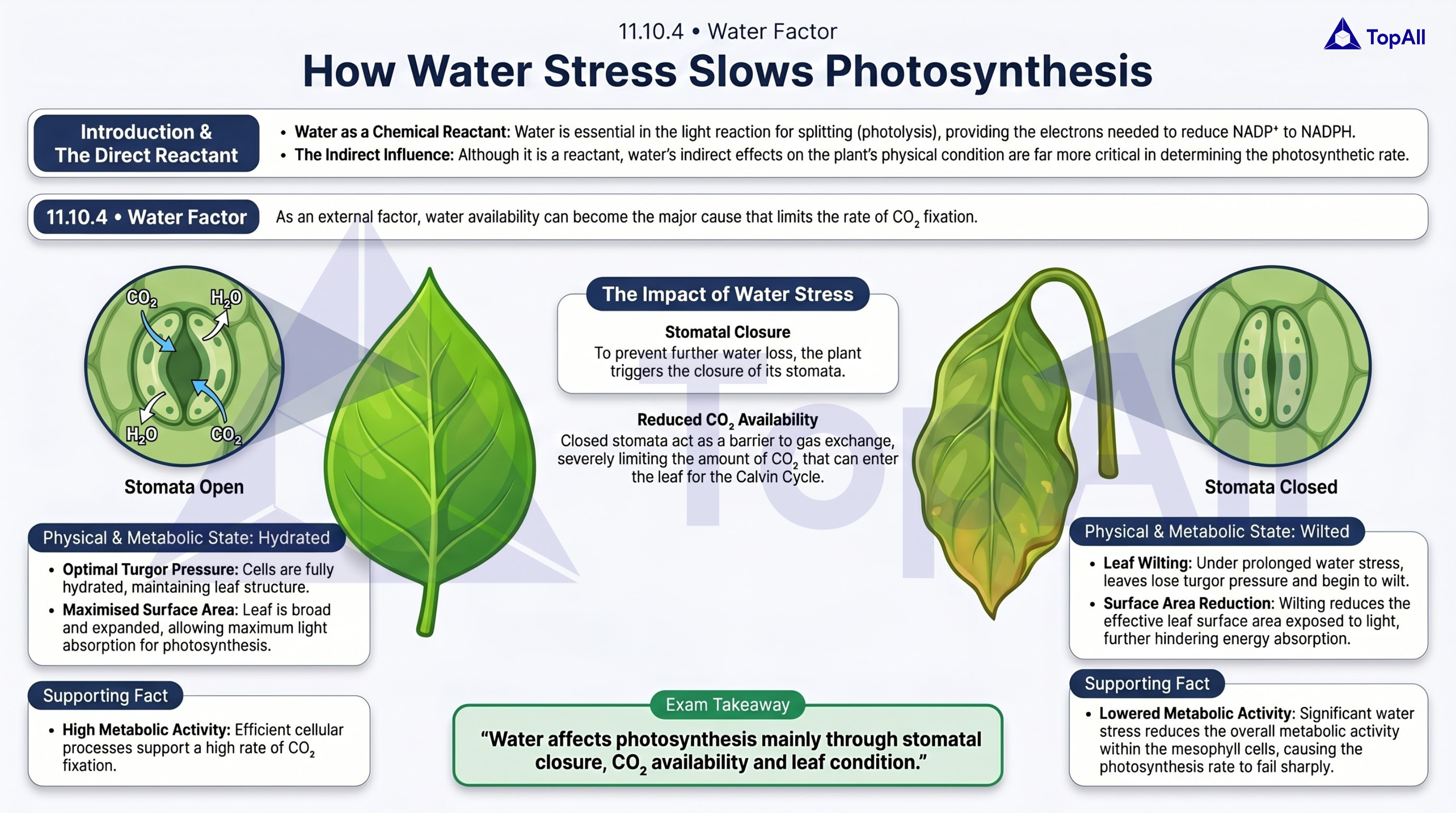
Learn the role of water in photosynthesis and plant growth for NEET UG with TopAll.
Compare cyclic and linear electron flow, account for Calvin-cycle regeneration and avoid confusing net triose with glucose equivalents.
For NEET UG Biology students: follow the electron route, separate ATP from reducing power and check carbon regeneration before choosing a photosynthesis answer.
Linear electron transfer connects water, PS II, carriers, PS I and NADP⁺ reduction. It supports ATP and NADPH formation and releases oxygen from water. Cyclic transfer around PS I supplements ATP formation without net NADPH or oxygen from that route. Photosystem numbering records discovery history; it does not put PS I first in the linear sequence.
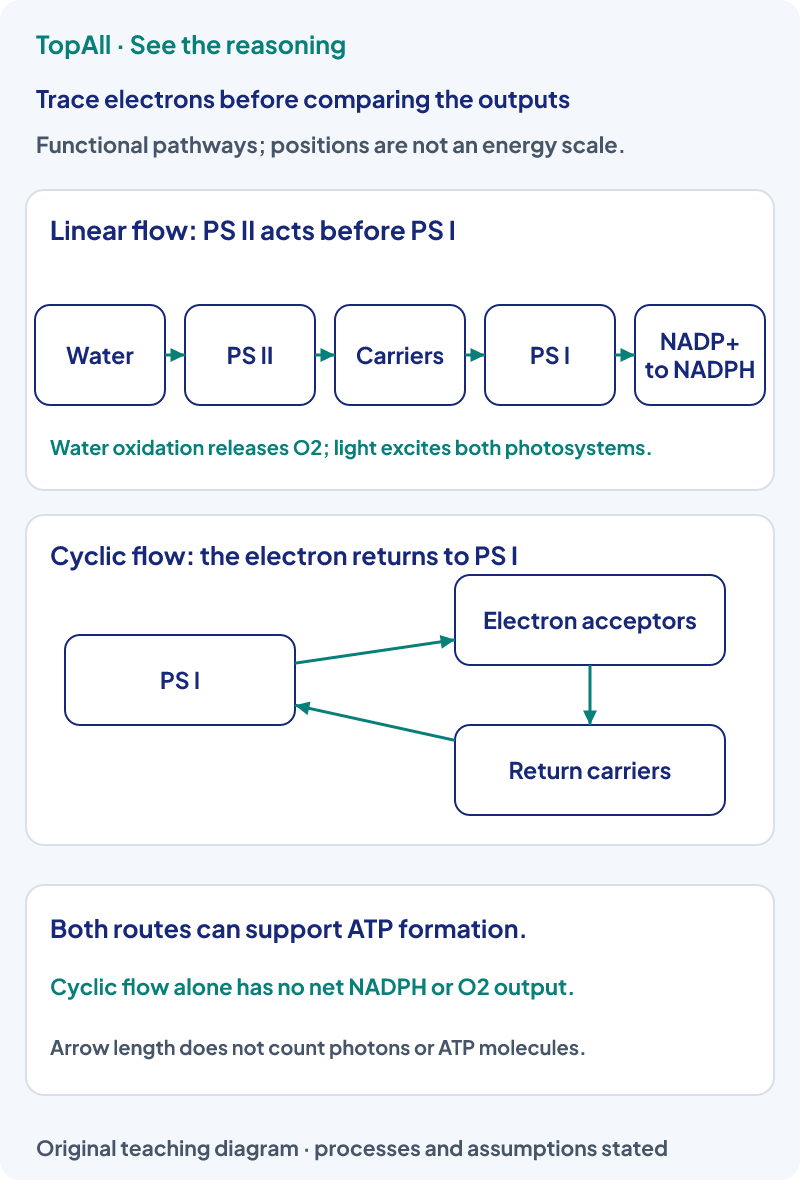
A supplied preparation shows light-dependent ATP formation but no net NADPH increase and no oxygen released by the route being tested. Among the standard textbook electron routes, cyclic flow is consistent with that description. This evidence alone does not prove that a whole living leaf has stopped all linear flow: the conclusion belongs to the stated preparation and measured route.
In chloroplasts, protons accumulate in the thylakoid lumen. Their return through ATP synthase toward the stroma supports ATP formation. Calvin-cycle reactions occur in the stroma and use ATP and NADPH. Calling them light-independent describes the absence of direct photon capture in those steps; it does not mean that the pathway is unrestricted in darkness or occurs only at night.
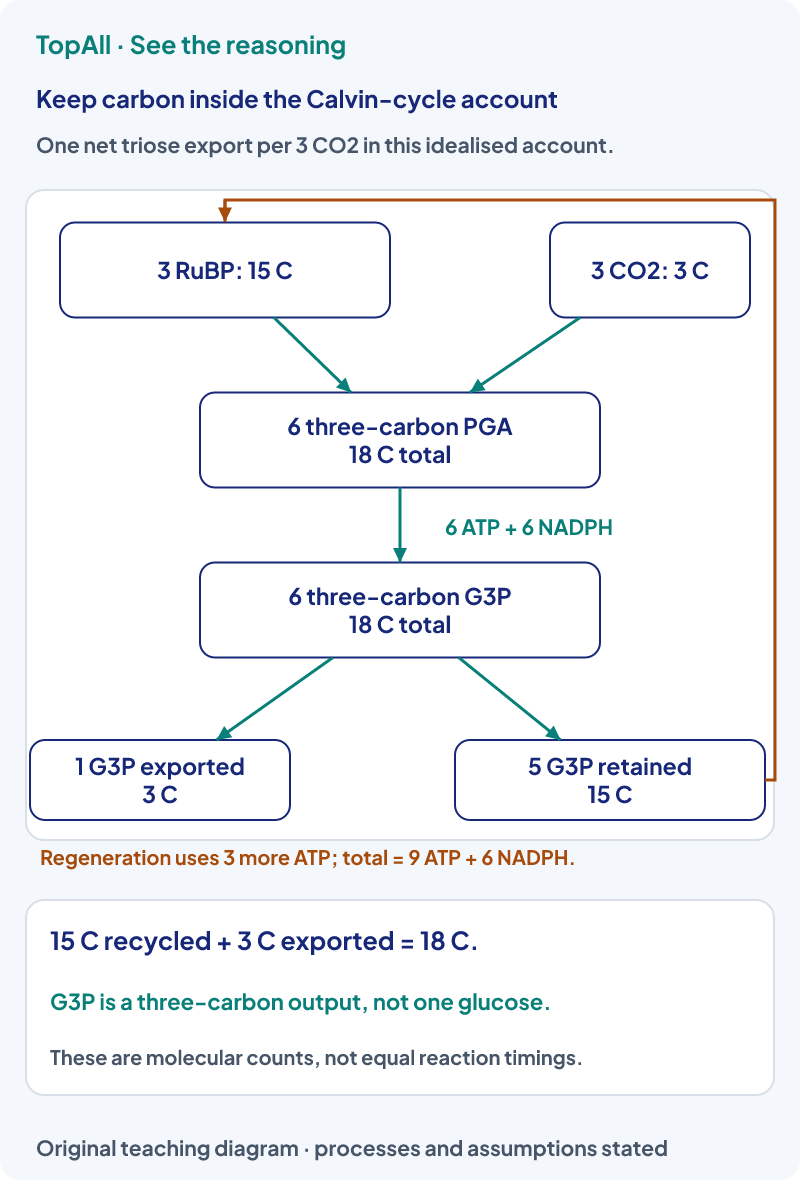
Use the standard Calvin-cycle requirement of three ATP and two NADPH per CO₂, with sufficient acceptor and all other conditions satisfied. Twelve CO₂ therefore require 36 ATP and 24 NADPH. Net fixed carbon is twelve atoms, equivalent to four three-carbon triose outputs or two six-carbon carbohydrate equivalents. Do not call every G3P in the reduction stage a net export; most carbon must regenerate RuBP.
In the standard C4 arrangement, initial fixation forms a four-carbon compound in mesophyll cells. CO₂ is subsequently supplied near Rubisco in bundle-sheath cells, where the Calvin pathway operates. Thus a question asking for the first stable fixation product differs from one asking which pathway makes carbohydrate. The extra concentrating steps also mean that a Calvin-only ATP count is not a full C4 energy bill.
A student starts with three RuBP and three CO₂, then claims that all six G3P can be exported while the same three RuBP are regenerated for free. The starting carbon account contains 18 atoms. Six exported G3P would remove all 18, leaving zero for the 15 atoms in regenerated acceptors. Retaining five G3P and exporting one closes this specified cycle account.
A net triose contains three carbon atoms; a glucose equivalent contains six. In the standard Calvin-only account, correspond to 9 ATP and 6 NADPH per net triose, while twice that carbon requires twice those carriers. This bookkeeping does not specify a leaf’s measured photosynthetic rate or include every ancillary cost.
Label the electron starting point, the terminal acceptor and the net output before choosing an option. For a cyclic pathway, check what returns. For a carbon cycle, mark the part retained for regeneration. A successful calculation needs a stated molecular basis such as per CO₂, per net triose or per glucose equivalent.
An ideal Calvin-only model has 27 ATP and 12 NADPH available, with CO₂, acceptor and all other requirements sufficient. What maximum number of net triose molecules can this stock support?
One net triose needs nine ATP and six NADPH. ATP could support three, but NADPH supports only two. The model therefore permits two net triose outputs, using 18 ATP and 12 NADPH and leaving nine ATP. This is stock accounting, not a prediction of rate or a claim that real chloroplast pools are isolated.
Does the name mean that a leaf carries out the Calvin cycle only at night, with no reliance on products of the light reactions?
No. The cycle does not capture photons directly in its carbon reactions, but it uses ATP and NADPH associated with light-driven processes and is regulated in living cells. The name does not justify night-only timing or unlimited operation after the light supply is removed.
Without looking, draw water→PS II→carriers→PS I→NADPH and a separate return loop around PS I. Then reconstruct the 18-carbon ledger. Compare proton movement in Respiration in Plants, or connect leaf gas exchange with Transport in Plants.
Chapter practice opens the broad photosynthesis pool, not a guaranteed Calvin-only question set.
Technical review: Codex (automated), 24 October 2026. Core mechanisms were compared with the linked primary textbooks and university or government references. All diagrams, problem inputs and explanations are original. Numerical balances and diagram directions are checked separately. Independent human subject review is not claimed. These focused guides support the existing chapter catalogue; they do not claim complete current exam or syllabus coverage.
If you confuse products, redraw the electron route. If you lose a numerical mark, state the carbon basis and count retained carbon before trying another chapter question.