
NEET UG · Biology
NEET UG · Biology
Living world
Revise the concepts. Try a question. Understand your next step.
65 medium questions available · Try answers free. Sign in to save progress or take a quiz.
NEET UG · Biology
Continue studying Living World
Understand the concept, practise questions and check your learning.
Understand
Read taxonomic categories and binomial names correctly, then test which relationships the supplied information actually establishes. The living world: distinguish the rank, the taxon and the scientific name
Read the guidePractise
Try 65 medium chapter MCQs. Untimed; check answers and available explanations as you go.
Practise chapter MCQsCheck your learning
Prepare a timed chapter quiz. Choose the available question count and pace before starting.
Prepare a chapter quizThis is chapter practice, not a full-length NEET mock paper.
No revision resources are published for this chapter yet. Use your textbook alongside the guide and practice.
Choose your practice
All Biology chapters →These are playable question counts after quality and duplicate checks.
How practice and quizzes work
The practice player uses single-correct-answer MCQs. Chapter quizzes are not full-length NEET mock papers. Check the practice guide and official syllabus sources.
Revise before you practise
Study resources 0
No revision resources are published for this chapter yet. Use your textbook alongside the available practice questions.
The living world: distinguish the rank, the taxon and the scientific name
Read taxonomic categories and binomial names correctly, then test which relationships the supplied information actually establishes.
What you will understand
For NEET UG Biology students: separate a rank from a named group, read both parts of a scientific name and use the hierarchy without turning it into an evolutionary ladder. The examples follow the current NCERT chapter.
Quick answer: the rank and the group name answer different questions
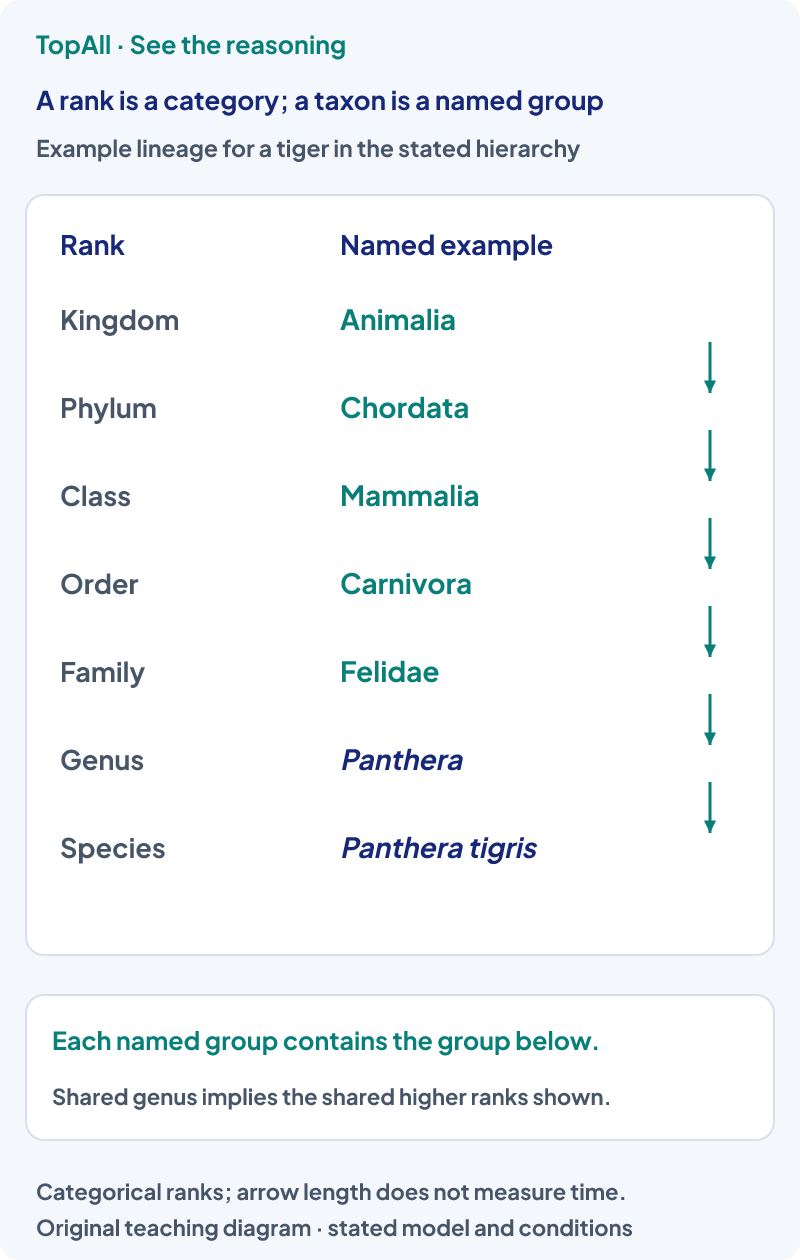
Genus is a taxonomic category, or rank. Panthera is a named taxon at that rank. A species name such as Panthera tigris contains the genus name and a specific epithet; tigris alone is not its complete binomial. When an MCQ asks for a category, answer with a rank such as family. When it asks for a taxon at that rank, supply a named group such as Felidae.
Read a taxonomic rank beside one actual example
Find the most specific shared category in the supplied information
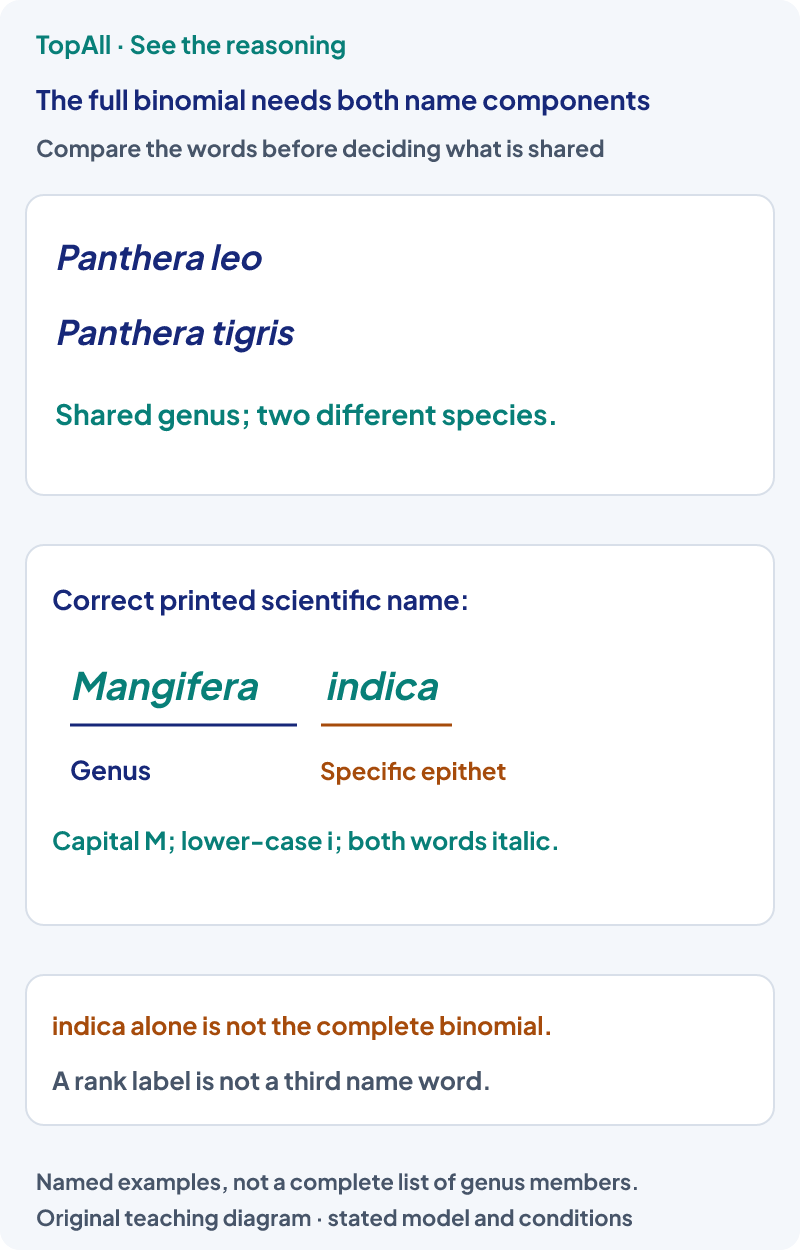
Compare Panthera leo and Panthera tigris. Both names begin with Panthera, so the examples share a genus. Their different specific epithets distinguish two species within that genus. In the stated hierarchy, sharing this genus also places them together in the higher ranks shown. The most specific shared rank established here is genus; saying they share a species would discard the second part of each name.
A broader category is not a numerical similarity score
Moving from species towards kingdom broadens the group in the stated hierarchy. Moving in the other direction narrows it. This is a nesting relationship, not a rule assigning an exact percentage of similarity to each rank. Two taxa at the same rank need not have equal numbers of species or the same age. A genus can contain just one species, so rank alone does not determine its size. A rank diagram also does not say that a living lion is the ancestor of a living tiger.
The first word is a genus; the pair identifies a species
Repair a name without changing which organism it identifies
A learner types “mangifera Indica” as the scientific name of mango. Write Mangifera indica: capitalise the genus, lower-case the epithet and italicise both words in print. In handwriting, underline the two words separately. If an author abbreviation is added after a scientific name, it is not a third part of the binomial and is not italicised with those two words. Formatting a name correctly does not by itself identify an unknown specimen.
Identification, nomenclature and classification are related tasks
Identification asks which known organism or group a specimen matches. Nomenclature supplies names under naming conventions. Classification arranges organisms into groups using evidence about their characters and relationships. Treat a statement about one of these tasks as evidence for that task, rather than assuming that naming an organism has already demonstrated its complete evolutionary history.
Do not infer a shared genus from a shared family
The NCERT example places the genera Panthera and Felis in the family Felidae. Given only that two specimens belong to Felidae, you can conclude that they share a family, but not that they share a genus: one could be Panthera and the other Felis. A family contains related genera. To choose a more specific common rank, look for additional genus or species information rather than reversing the containment arrow.
Read a biological species definition within its intended use
For many sexually reproducing organisms, reproductive relationships help distinguish species, alongside other evidence. A simple interbreeding test cannot be applied directly to a fossil or an asexual lineage. In a naming question, distinguish the species taxon from its specific epithet. In a specimen question, use the supplied characters and the framework requested; a familiar common name alone may be ambiguous.
Common mistakes: confusing a category with one of its members
Do not answer genus when a question asks which named genus is shared, call tigris a complete two-part name, or treat two members of one family as automatically members of the same genus. First underline the requested rank or task in the question, then compare the actual names and characters provided.
Try it: same epithet, different genera
Two hypothetical names in a supplied exercise are Alpha alba and Beta alba. Does the shared second word establish that they belong to the same species? Which part of each binomial differs?
Reveal the answer
No. These invented names illustrate the naming rule, not actual accepted taxa. The genus components Alpha and Beta differ, so the full species names are different. A specific epithet is not a globally unique species label by itself. The exercise supplies no shared family or evolutionary-distance information.
Try it: distinguish the rank from the named taxon
A supplied record reads “Family: Felidae; Genus: Panthera; Species: Panthera leo.” Which entry is the category, which is the family taxon, and what is the complete species name?
Reveal the answer
Family is the category requested in the first field. Felidae is the named taxon at that rank. The complete species name is Panthera leo, with Panthera as the genus and leo as the specific epithet; both name words are italicised in print. Panthera is also a named taxon, but at a different rank.
Come back tomorrow: compare before memorising
Reconstruct the rank-and-example column, then explain why a shared family does not force a shared genus. Continue to NEET Biological Classification for the criteria behind kingdom assignments, or NEET Animal Kingdom to apply structural characters.
Chapter practice opens the broad Living World pool.
Sources and review
Technical review: Codex (automated). Primary textbook definitions and methods checked on 24 October 2026. Worked examples, diagrams, counterexamples and self-checks are original. Human subject review is not claimed. This focused lesson supports the existing chapter catalogue; it does not claim complete current exam coverage.
Choose your next chapter task
After an error, label it as a naming-format problem, an incomplete binomial, a rank-versus-taxon mix-up or an unsupported inference from a broader group. Repair that specific step before attempting another question.
Sources and reading
- NCERT Biology: The Living World (2026–27 reprint) — Sections1.1–1.2: binomial nomenclature and the major taxonomic categories
- OpenStax Biology 2e: Organizing Life on Earth — Ranks, named taxa and the distinction between a classification diagram and a phylogenetic hypothesis