NEET UG · Video

Respiratory Volumes and Capacities
Master respiratory volumes and capacities for NEET UG with TopAll.
3 min video

NEET UG · Biology
Revise the concepts. Try a question. Understand your next step.
123 medium questions available · Try answers free. Sign in to save progress or take a quiz.
NEET UG · Biology
Understand the concept, practise questions and check your learning.
Understand
Distinguish ventilation from diffusion, predict haemoglobin loading and compare minute with alveolar ventilation using clear compartment diagrams. Breathing and gas exchange: follow the pressure gradient and the oxygen journey
Read the guidePractise
Try 123 medium chapter MCQs. Untimed; check answers and available explanations as you go.
Practise chapter MCQsCheck your learning
Prepare a timed chapter quiz. Choose the available question count and pace before starting.
Prepare a chapter quizThis is chapter practice, not a full-length NEET mock paper.
These are playable question counts after quality and duplicate checks.
The practice player uses single-correct-answer MCQs. Chapter quizzes are not full-length NEET mock papers. Check the practice guide and official syllabus sources.
Revise before you practise
NEET UG · Video
Master respiratory volumes and capacities for NEET UG with TopAll.
3 min video
NEET UG · Video
Learn Alfonso Corti's contribution to biology for NEET UG with TopAll.
4 min video
NEET UG · Video
Learn occupational respiratory disorders for NEET UG with TopAll.
6 min video
NEET UG · PDF notes
Read PDF · 10 pages →Master respiratory volumes and capacities for NEET UG with TopAll.
10 pages
NEET UG · PDF notes
Read PDF · 7 pages →Learn Alfonso Corti's contribution to biology for NEET UG with TopAll.
7 pages
NEET UG · PDF notes
Read PDF · 8 pages →Learn occupational respiratory disorders for NEET UG with TopAll.
8 pages
NEET UG · Mind map
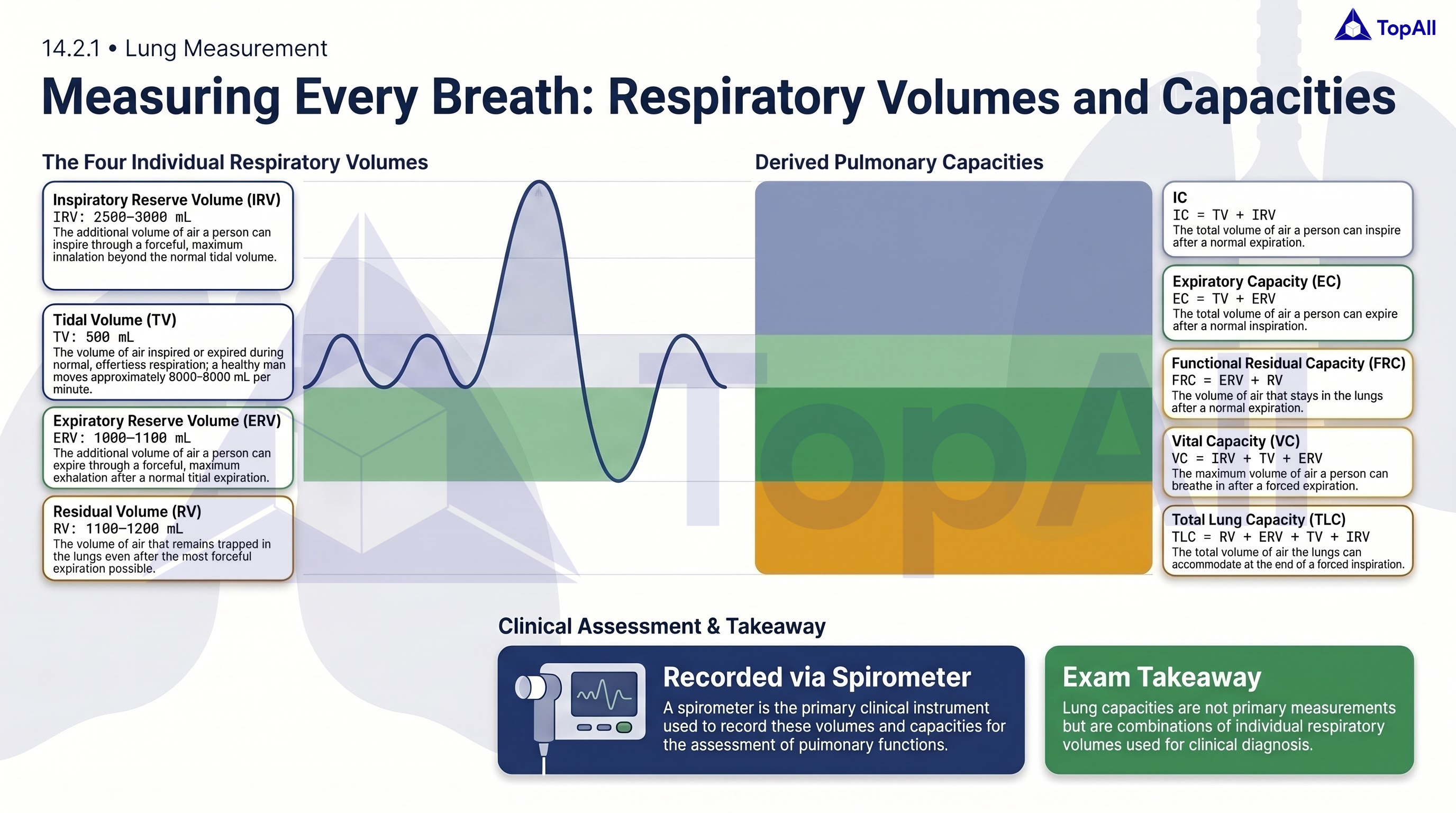
Master respiratory volumes and capacities for NEET UG with TopAll.
NEET UG · Mind map
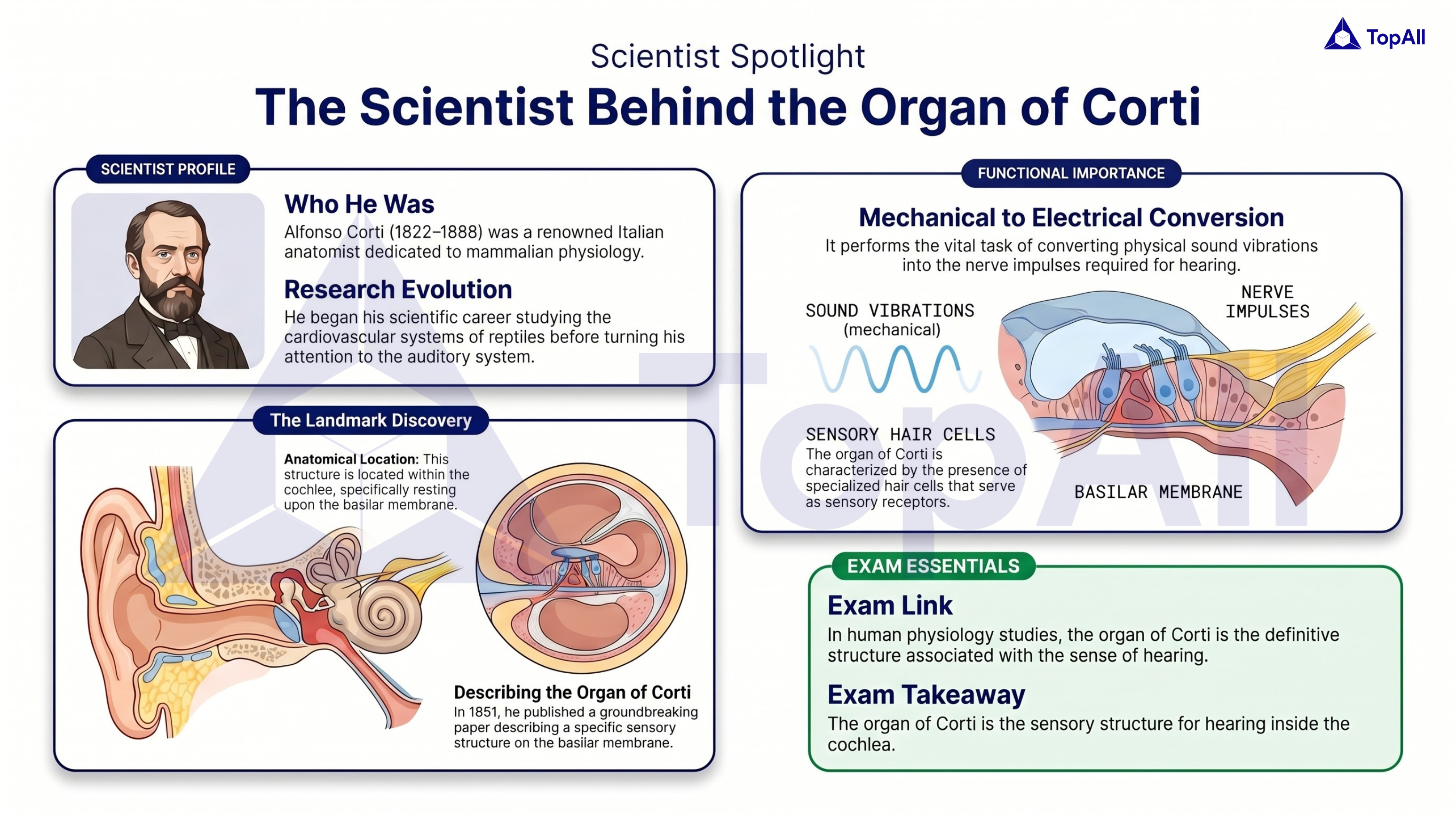
Learn Alfonso Corti's contribution to biology for NEET UG with TopAll.
NEET UG · Mind map
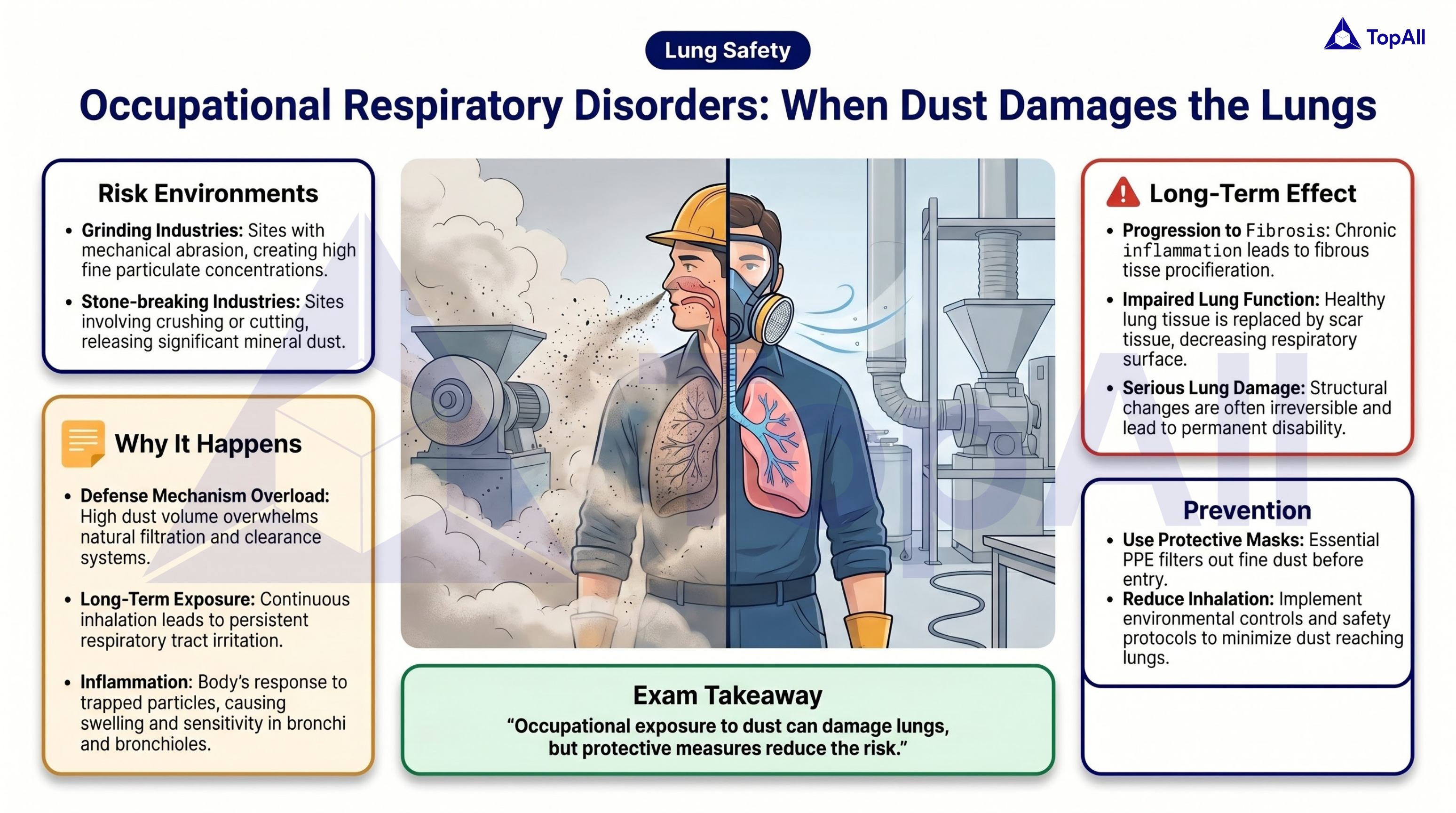
Learn occupational respiratory disorders for NEET UG with TopAll.
Distinguish ventilation from diffusion, predict haemoglobin loading and compare minute with alveolar ventilation using clear compartment diagrams.
For NEET UG Biology students: separate movement of air from diffusion of gases, compare each gas’s partial pressure across a barrier and distinguish total minute ventilation from the portion reaching exchange surfaces.
Ventilation moves air into and out of the lungs through pressure differences. Alveolar gas exchange is diffusion of O₂ and CO₂ across the respiratory surface, driven by each gas’s own partial-pressure gradient. Blood then transports gases between lungs and tissues. Cellular respiration refers to the reactions by which cells obtain energy from substrates. A description of air entering the lungs is not, by itself, a description of oxygen being used by cells.
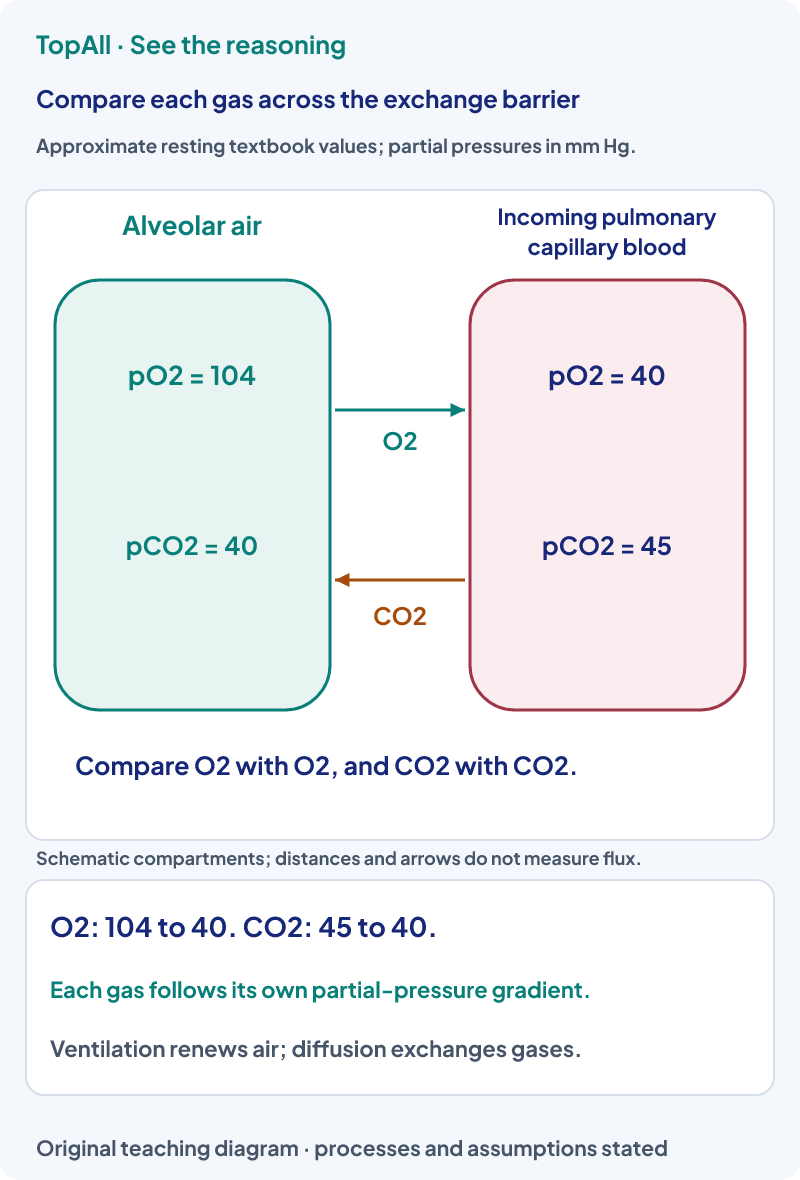
The diaphragm contracts and flattens, increasing the vertical dimension of the thorax. With the associated expansion of the lungs, intrapulmonary pressure becomes slightly lower than atmospheric pressure, so air flows inward. The pressure difference moves air; the diaphragm does not directly pull individual oxygen molecules through the alveolar membrane. During quiet expiration, relaxation and elastic recoil reduce lung volume and raise intrapulmonary pressure enough for outward airflow. Forced expiration can recruit additional muscles.
For the given resting example, the O₂ pressure difference is 104−40=64 mm Hg from alveolar air to arriving blood. The CO₂ difference is 45−40=5 mm Hg in the opposite direction. Comparing in one compartment with in another does not establish either gas’s diffusion direction. Diffusion also depends on solubility, membrane thickness and surface area; NCERT describes CO₂ as much more soluble than O₂. A smaller CO₂ pressure difference does not mean that CO₂ cannot be exchanged effectively.
A question gives alveolar pO₂=104, incoming blood pO₂=40, alveolar pCO₂=40 and incoming blood pCO₂=45 mm Hg. Compare oxygen first: 104>40, so its net diffusion is from alveolus to blood. Compare carbon dioxide separately: 45>40, so its net diffusion is from blood to alveolus. The opposite directions can occur across the same surface at the same time. Using 104−45 would incorrectly subtract partial pressures of different gases.
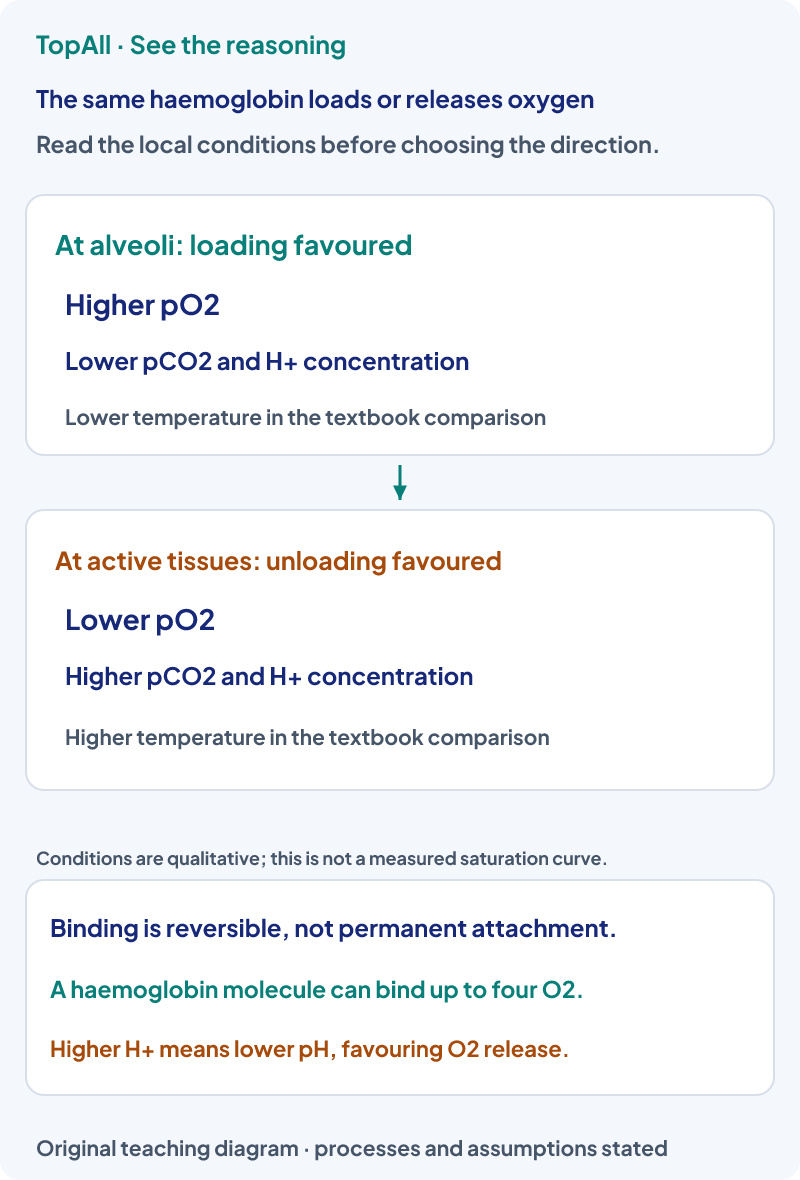
About 97% of transported O₂ is carried with haemoglobin and about 3% dissolved in plasma in the NCERT description. Haemoglobin binding is reversible, and a molecule can carry up to four O₂ molecules. Oxygenated blood is not simply plasma full of freely dissolved oxygen. CO₂ is transported mainly as bicarbonate, with smaller carbaminohaemoglobin and dissolved fractions. Carbonic anhydrase helps reversible CO₂ conversion; do not label all CO₂ transport as oxygen binding to haemoglobin.
In an illustrative problem, tidal volume is 500 mL, breathing rate 12 breaths/min and conducting dead-space volume 150 mL per breath. Total minute ventilation is
Tidal volume is an ordinary breath volume. Inspiratory and expiratory reserve volumes are additional volumes moved beyond a usual inspiration or expiration. Vital capacity is IRV+TV+ERV; total lung capacity adds residual volume. Residual volume remains after maximal expiration and cannot be measured directly by simple spirometry. A capacity calculation needs the appropriate sum, not every volume mentioned in a question.
Name the compartment on each side of the barrier. Compare O₂ with O₂ and CO₂ with CO₂. For ventilation, follow volume change, pressure change and airflow in order. In a numerical, distinguish volume per breath from volume per minute and state whether dead space has been deducted. Use the local environment to predict haemoglobin loading rather than treating binding as permanent.
Relative to the lung-loading comparison, a tissue has lower pO₂, higher pCO₂, higher H⁺ concentration and higher temperature. Is oxygen binding or release favoured, and what happens to pH?
Oxygen release from oxyhaemoglobin is favoured. Lower oxygen partial pressure and the other listed tissue conditions favour dissociation. Higher H⁺ concentration corresponds to lower pH, not higher pH. The prediction is qualitative under the stated conditions; it does not calculate a unique saturation percentage.
Given IRV=2.5 L, TV=0.5 L, ERV=1.0 L and RV=1.1 L, calculate vital capacity and total lung capacity.
Vital capacity is 2.5+0.5+1.0=4.0 L. Total lung capacity is 4.0+1.1=5.1 L. RV belongs in total lung capacity but not vital capacity. These supplied volumes are illustrative. Simple spirometry measures moved volumes; it does not directly measure the gas remaining as RV.
Draw two compartments and one arrow for each gas, then write the pressure comparison that justifies it. Trace delivery through Body Fluids and Circulation, or compare a different transport direction in Excretory Products and their Elimination.
Practice opens the broad Breathing and Exchange of Gases chapter pool, not a guaranteed partial-pressure-only set.
Technical review: Codex (automated), 24 October 2026. Definitions and conventions checked against the linked primary textbooks. Numerical examples, self-checks and diagrams are original; calculations and diagram coordinates are checked separately. Human subject review is not claimed. These focused lessons support the existing NEET Biology chapter catalogue and do not claim complete current exam or syllabus coverage.
After an exchange error, identify the gas and its two compartments. After a ventilation error, check pressure direction and volume-rate units before returning to chapter practice.

