
NEET UG · Biology
NEET UG · Biology
Environmental issues
Revise the concepts. Try a question. Understand your next step.
115 medium questions available · Try answers free. Sign in to save progress or take a quiz.
NEET UG · Biology
Continue studying Environmental Issues
Understand the concept, practise questions and check your learning.
Understand
Trace nutrient enrichment and oxygen demand, distinguish pollutant accumulation from magnification and compare concentrations consistently. Environmental mechanisms: oxygen demand and concentration
Read the guidePractise
Try 115 medium chapter MCQs. Untimed; check answers and available explanations as you go.
Practise chapter MCQsCheck your learning
Prepare a timed chapter quiz. Choose the available question count and pace before starting.
Prepare a chapter quizThis is chapter practice, not a full-length NEET mock paper.
No revision resources are published for this chapter yet. Use your textbook alongside the guide and practice.
Choose your practice
All Biology chapters →These are playable question counts after quality and duplicate checks.
How practice and quizzes work
The practice player uses single-correct-answer MCQs. Chapter quizzes are not full-length NEET mock papers. Check the practice guide and official syllabus sources.
Revise before you practise
Study resources 0
No revision resources are published for this chapter yet. Use your textbook alongside the available practice questions.
Environmental mechanisms: oxygen demand and concentration
Trace nutrient enrichment and oxygen demand, distinguish pollutant accumulation from magnification and compare concentrations consistently.
What you will understand
For NEET UG Biology students: trace one nutrient-enrichment pathway, separate oxygen demand from oxygen remaining and compare pollutant concentrations on a common basis.
Quick answer: name the quantity and the causal step
Dissolved oxygen is oxygen present in water; biochemical oxygen demand concerns oxygen consumed during specified microbial decomposition conditions. Nutrient enrichment can promote algal production and eventually increase decomposable organic material. These linked quantities are not interchangeable. This guide keeps the existing Environmental Issues catalogue label and explains selected mechanisms without claiming complete current syllabus coverage.
Follow a conditional pathway rather than a slogan
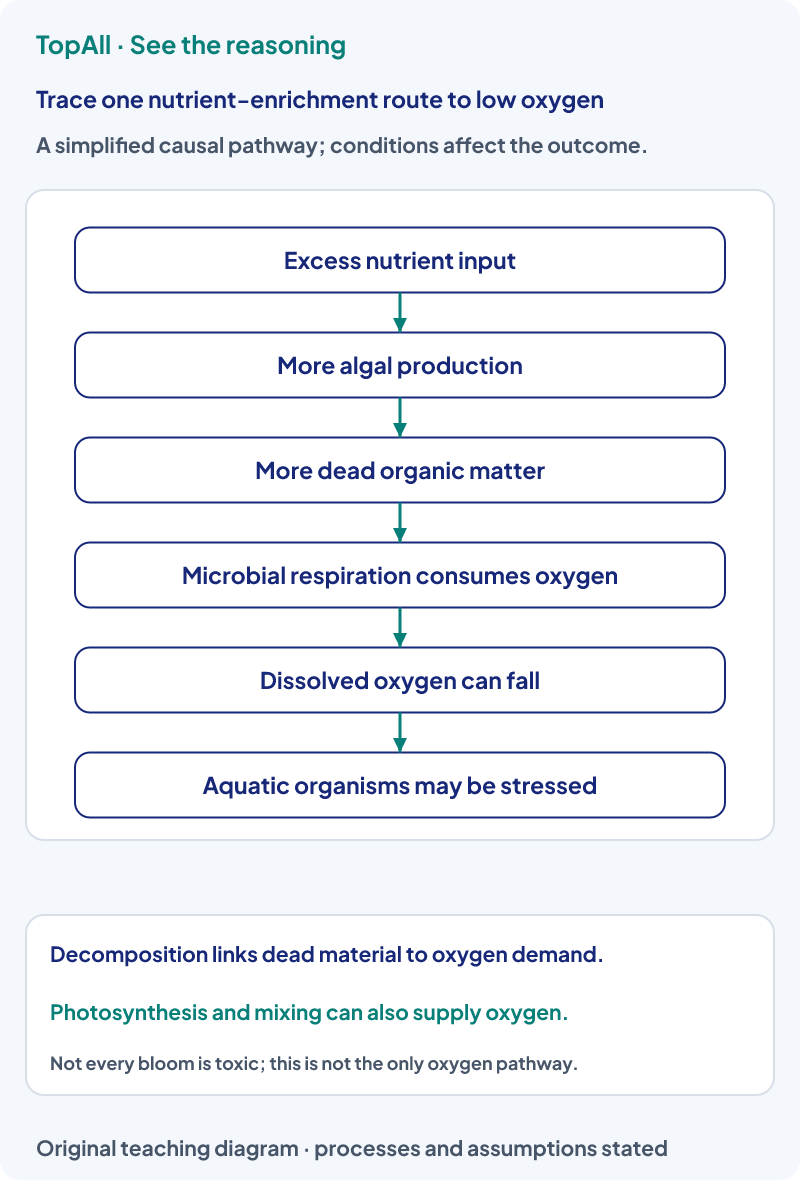
Correct the missing decomposition step
An original answer claims that added nutrients directly remove oxygen as their defining effect. The more useful causal explanation is that increased production can lead to more dead organic material, whose aerobic microbial breakdown consumes oxygen. If demand exceeds replenishment, dissolved oxygen can decline. The result depends on conditions rather than following inevitably from every nutrient addition.
Bioaccumulation and biomagnification use different comparisons
Bioaccumulation concerns a substance building up within an organism over time. Biomagnification concerns increasing concentration across feeding levels in the relevant food chain. Persistence, uptake and elimination properties matter. A rise within one individual is not by itself evidence of magnification across levels, and not every contaminant behaves like the supplied persistent-contaminant model.
Use one tissue concentration basis throughout
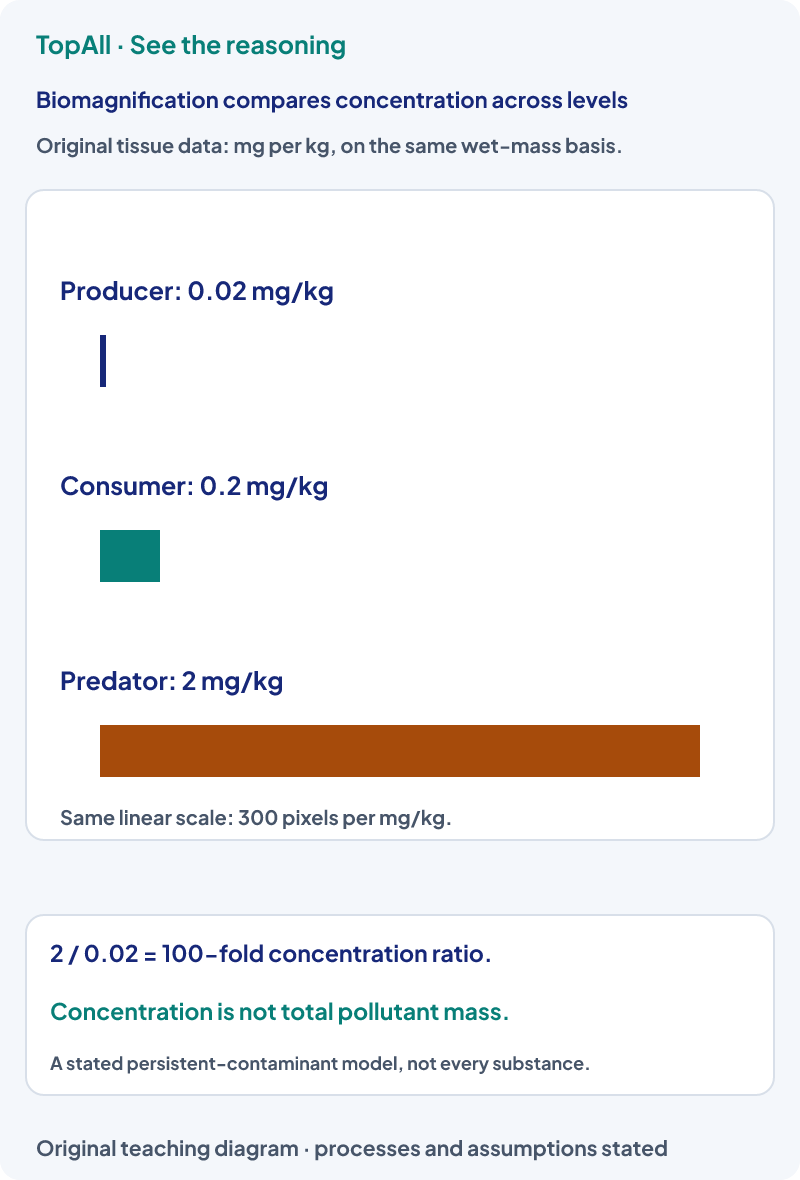
Calculate a concentration ratio without an energy rule
The predator-to-producer concentration ratio is 2/0.02 = 100. The consumer-to-producer ratio is10. These numbers come from supplied concentrations. The ten-percent trophic energy approximation cannot predict pollutant magnification. Total pollutant mass would additionally require the relevant tissue masses and an appropriate account of what is sampled.
Keep biochemical demand separate from the oxygen stock
A high microbial oxygen demand can help explain low dissolved oxygen when replenishment is insufficient. The two terms do not become identical: photosynthesis and exchange can supply oxygen, while temperature and other conditions affect the system. A field concentration measured at one instant is not a complete laboratory BOD result.
Interpret a deliberately simplified oxygen account
A supplied closed-bottle model begins at 8 mg/L dissolved oxygen and ends at 5 mg/L after a stated interval, with no other oxygen sources or sinks allowed by the problem. The model oxygen decrease is 3 mg/L. This subtraction alone is not a complete standard BOD5 determination: specified conditions, dilution and relevant blank or seed corrections would need to be handled where applicable.
Ozone depletion and greenhouse warming have different mechanisms
Stratospheric ozone absorbs ultraviolet radiation. Greenhouse gases affect the transfer of infrared energy in the atmosphere. These mechanisms should not be replaced with the claim that an ozone-layer opening is the basic cause of greenhouse warming. A substance can participate in more than one atmospheric process, but the question still needs the correct causal chain.
Common mistakes: mix units or skip a mechanism
Keep mg/kg tissue separate from mg/L water unless the problem supplies a justified conversion and account. Distinguish concentration from total mass, one-organism change from cross-level comparison, and oxygen demand from oxygen remaining. A causal diagram describes a mechanism under conditions; it is not a universal forecast for every ecosystem.
Try it: classify the comparison
The same organism’s tissue concentration rises between two dates, with no data from other feeding levels. Does this alone establish biomagnification?
Reveal the answer
No. It can support accumulation within that organism under the supplied observations. Biomagnification needs a relevant comparison across feeding levels on a consistent basis. Different dates within one organism do not supply that comparison.
Try it: compare like units
Two feeding levels have tissue concentrations 0.2 and 4 mg/kg on the same basis. What is their concentration ratio, and does it give the ratio of total pollutant masses?
Reveal the answer
The concentration ratio is4/0.2 = 20. It does not establish the total-mass ratio because the tissue masses represented are unknown. A smaller amount of tissue can have a higher concentration while containing less total pollutant.
Come back tomorrow: write each arrow as a sentence
Explain how microbial respiration connects organic material to oxygen demand, then calculate a concentration ratio. Revisit energy accounting in Eco-system, or connect consequences to Biodiversity and Conservation.
The practice action opens the broad existing environmental pool, not a water-pollution-only set.
Sources and review
Technical review: Codex (automated), 24 October 2026. Core mechanisms were compared with the linked primary textbooks and university or government references. All diagrams, problem inputs and explanations are original. Numerical balances and diagram directions are checked separately. Independent human subject review is not claimed. These focused guides support the existing chapter catalogue; they do not claim complete current exam or syllabus coverage.
Choose your next chapter task
After an error, name the measured quantity, unit and causal step. Then use chapter practice to check whether the same confusion appears in a new scenario.
Sources and reading
- US EPA: Nutrient Pollution—Effects on the Environment — Nutrient enrichment, algal production, decomposition and low oxygen. Only the conditional ecological mechanism is used, not contemporary place names or counts.
- US EPA CADDIS: Dissolved Oxygen — Dissolved oxygen concentration, atmospheric exchange, photosynthesis, respiration and modifying conditions.
- USGS Water Science School: Biochemical Oxygen Demand and Water — Oxygen consumed by microorganisms during aerobic breakdown of organic matter under specified conditions; distinguish demand from dissolved oxygen remaining.
- US EPA: How People Are Exposed to Mercury — Only ecological concentration across feeding levels is used. The guide supplies generic original tissue data, without food-consumption or treatment advice.
- US EPA: Basic Ozone Layer Science — Stratospheric ozone and ultraviolet absorption; separate from the greenhouse mechanism. No regulatory or current atmospheric trend claims.