NEET UG · Video

Cloning Vectors Plants Animals
Learn cloning vectors for plants and animals for NEET UG with TopAll.
5 min video

NEET UG · Biology
Revise the concepts. Try a question. Understand your next step.
96 medium questions available · Try answers free. Sign in to save progress or take a quiz.
NEET UG · Biology
Understand the concept, practise questions and check your learning.
Understand
Distinguish Bt protein action, RNA-guided silencing and precursor processing while separating DNA evidence from functional protein outcomes. Biotechnology applications: trace the molecule and its consequence
Read the guidePractise
Try 96 medium chapter MCQs. Untimed; check answers and available explanations as you go.
Practise chapter MCQsCheck your learning
Prepare a timed chapter quiz. Choose the available question count and pace before starting.
Prepare a chapter quizThis is chapter practice, not a full-length NEET mock paper.
These are playable question counts after quality and duplicate checks.
The practice player uses single-correct-answer MCQs. Chapter quizzes are not full-length NEET mock papers. Check the practice guide and official syllabus sources.
Revise before you practise
NEET UG · Video
Learn cloning vectors for plants and animals for NEET UG with TopAll.
5 min video
NEET UG · Video
Study vector features used in biotechnology for NEET UG with TopAll.
5 min video
NEET UG · Video
Learn recombinant selection by insertional inactivation for NEET UG with TopAll.
5 min video
NEET UG · PDF notes
Read PDF · 8 pages →Learn cloning vectors for plants and animals for NEET UG with TopAll.
8 pages
NEET UG · PDF notes
Read PDF · 8 pages →Study vector features used in biotechnology for NEET UG with TopAll.
8 pages
NEET UG · PDF notes
Read PDF · 7 pages →Learn recombinant selection by insertional inactivation for NEET UG with TopAll.
7 pages
NEET UG · Mind map
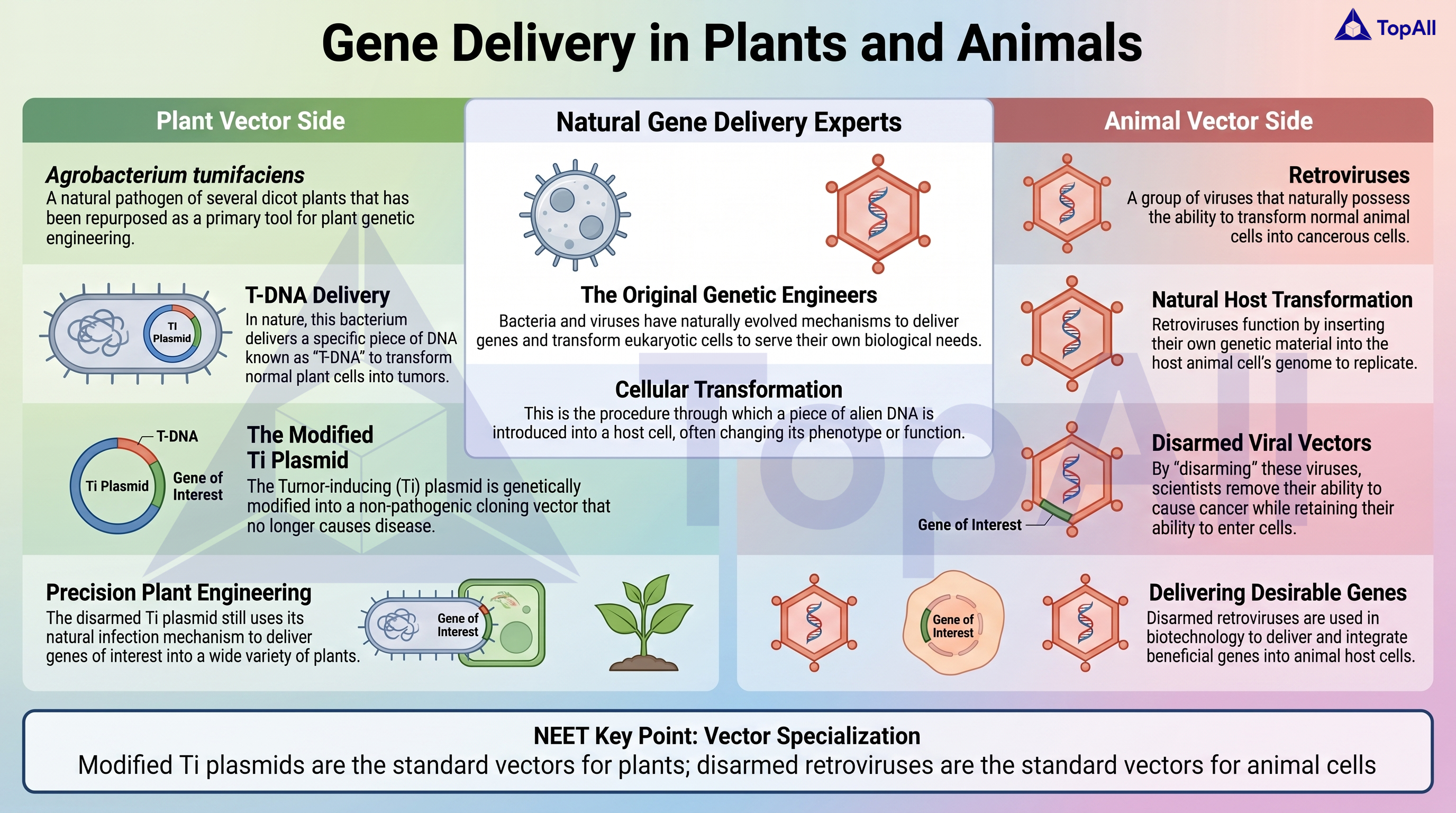
Learn cloning vectors for plants and animals for NEET UG with TopAll.
NEET UG · Mind map
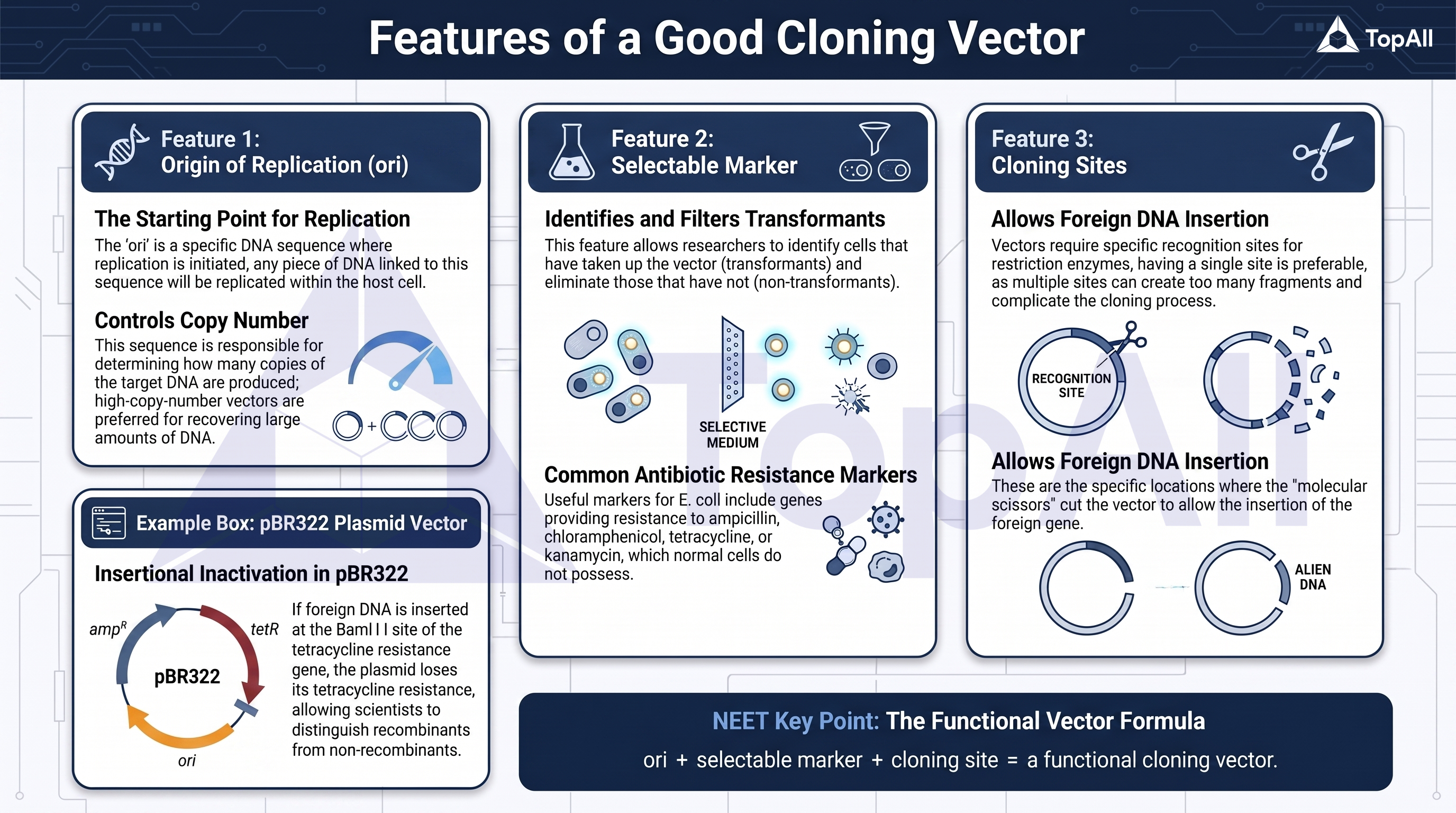
Study vector features used in biotechnology for NEET UG with TopAll.
NEET UG · Mind map
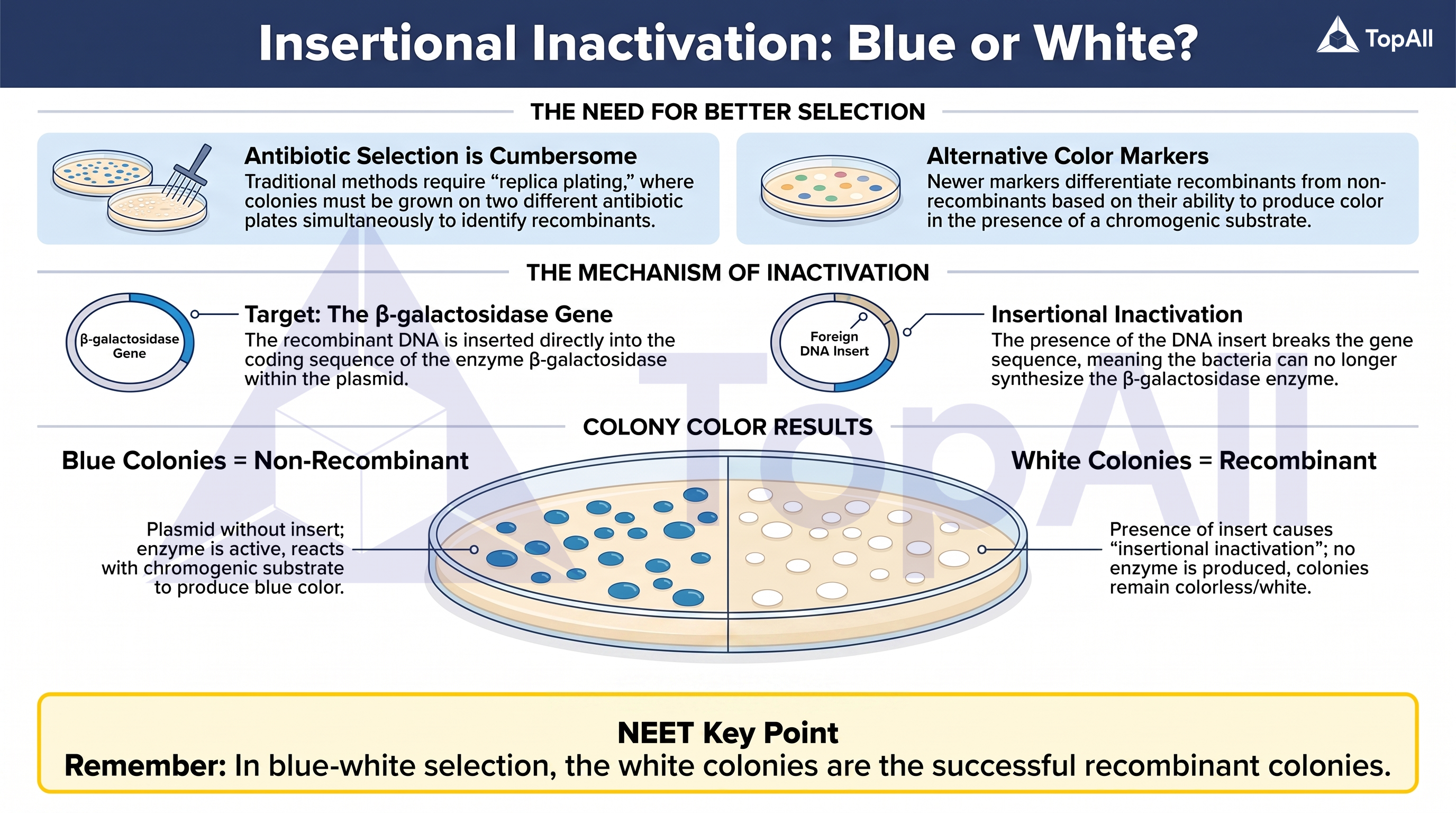
Learn recombinant selection by insertional inactivation for NEET UG with TopAll.
Distinguish Bt protein action, RNA-guided silencing and precursor processing while separating DNA evidence from functional protein outcomes.
For NEET UG Biology students: identify the molecule that acts, distinguish target-RNA silencing from protein action and explain why a precursor account differs from a finished protein.
A DNA construct can support production of a protein or an RNA with a particular effect. In the relevant Bt example, a Cry protein acts in a susceptible target context. In a target-RNA cleavage example, an RNA-guided silencing pathway reduces a messenger RNA and its protein output. Neither description alone means that the target DNA sequence has been deleted.
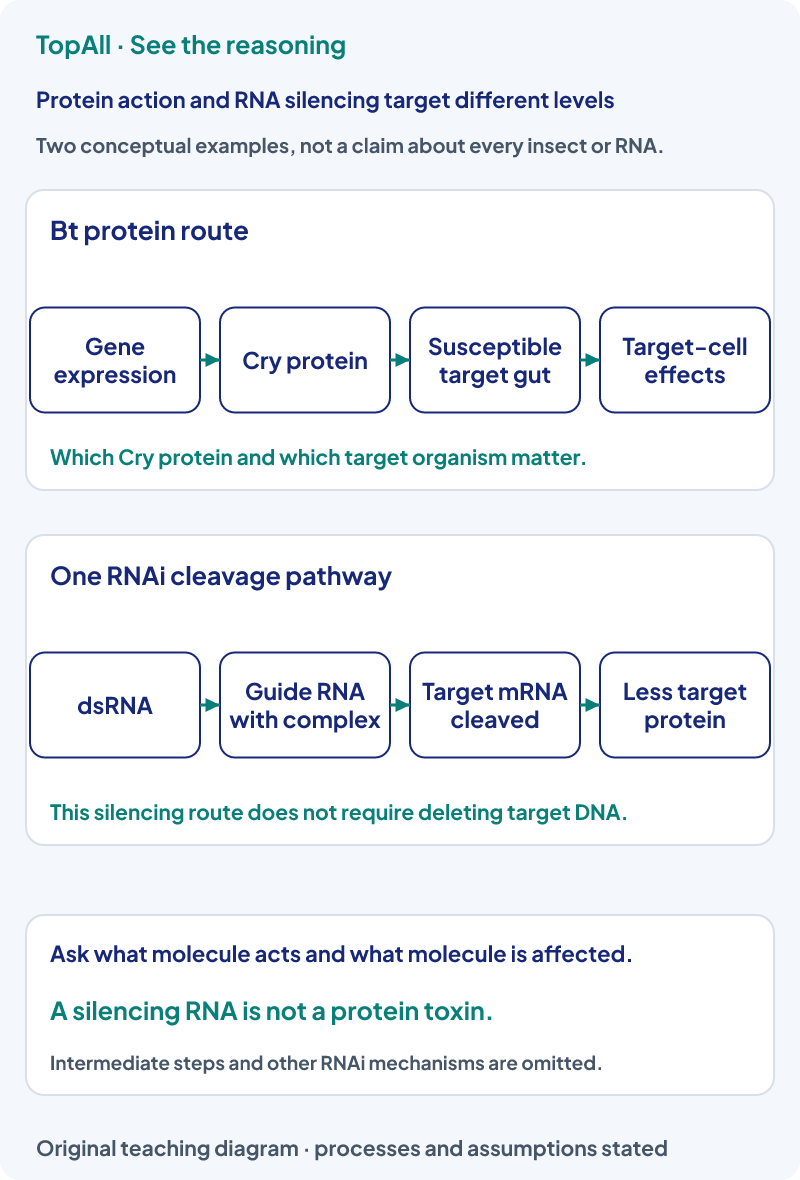
An original description gives reduced target mRNA and protein after a complementary RNA-silencing intervention. It then claims that the target gene must have been cut out of the genome. That conclusion does not follow: target-RNA reduction can occur while the DNA remains present. The observation concerns expression at the RNA/protein level, so DNA alteration would need its own evidence.
Cry proteins differ in the organisms and physiological contexts in which they act. The textbook route includes ingestion and activity in a susceptible insect gut, rather than an assertion that every Cry protein acts equally on all insects. A crop label or one organism’s response does not by itself establish universal activity against unrelated targets.
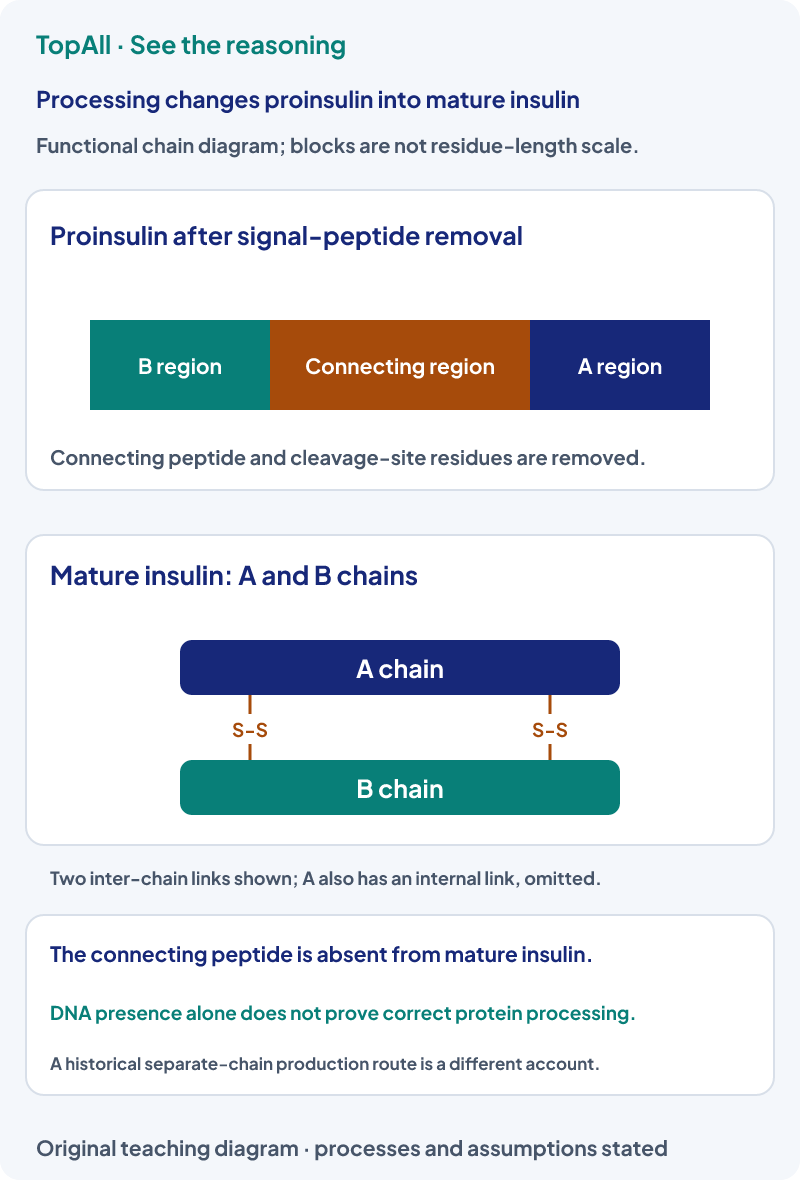
A proposed answer says mature insulin is formed by adding the C peptide between already mature A and B chains. That reverses the precursor account. Proinsulin contains the connecting region; maturation removes it while producing the mature chain arrangement. The diagram’s functional blocks should not be used to count residues or assume that the connecting region is retained in the final hormone.
The NCERT example describes expression of A and B chains separately, followed by recovery and combination with the appropriate disulphide arrangement. That historical route is distinct from saying that an ordinary bacterial host automatically performs every normal human precursor-processing step. Recombinant DNA presence, chain production, folding, processing and purified functional product are separate stages.
An original construct is verified to contain the desired coding DNA, but the question asks whether a functional processed protein has been obtained. DNA verification alone cannot settle that. Evidence is still needed about expression and the relevant protein properties. A correct insert and a correctly folded, processed product are related achievements, but they are not the same measurement.
A method that amplifies a DNA region can help detect or study that region. A method that changes gene expression has a different molecular aim, and producing a recombinant protein is another. Do not equate detecting a target sequence with correcting it, or a conceptual textbook application with a guaranteed result for every organism. This guide explains curriculum mechanisms rather than individual treatment decisions.
Write construct→RNA or protein→target molecule or cell→observed effect. Mark where an inference needs extra evidence. Keep the C peptide out of the mature-chain account, and distinguish a historical separate-chain production route from precursor processing. Specificity and molecular level should remain visible in the explanation.
A target transcript decreases in a stated RNAi cleavage model, but a genomic DNA assay still detects the target sequence. Does that observation alone show the silencing failed?
No. The stated pathway reduces the RNA target without requiring removal of its DNA. Detection of genomic sequence and measurement of transcript abundance ask different questions. The actual amount and effect of silencing would need appropriate RNA/protein evidence.
Which description matches a protein-action route and which matches an RNA-silencing route: a Cry protein interacting with a susceptible gut target, or a guide-containing complex promoting target-mRNA cleavage?
The Cry description is the protein-action route. The guide-containing complex and mRNA cleavage describe the stated RNAi route. Both may begin with an engineered DNA context, but their acting molecules and immediate targets differ. Neither label alone establishes a universal response across organisms.
Explain why a target DNA assay can remain positive after transcript silencing. Then redraw the precursor and mature-chain distinction. Revisit the evidence stages in Biotechnology Principles and Processes, or connect heritable target responses to Evolution.
The action opens the broad applications pool rather than an RNAi-only or insulin-only set.
Technical review: Codex (automated), 24 October 2026. Core mechanisms were compared with the linked primary textbooks and university or government references. All diagrams, problem inputs and explanations are original. Numerical balances and diagram directions are checked separately. Independent human subject review is not claimed. These focused guides support the existing chapter catalogue; they do not claim complete current exam or syllabus coverage.
After an application error, state the acting molecule, immediate target and supported observation. Return to practice once the missing inference is explicit.

