NEET UG · Video

Urine Characteristics Diagnosis
Study urine characteristics and clinical diagnosis for NEET UG with TopAll.
4 min video

NEET UG · Biology
Revise the concepts. Try a question. Understand your next step.
125 medium questions available · Try answers free. Sign in to save progress or take a quiz.
NEET UG · Biology
Understand the concept, practise questions and check your learning.
Understand
Distinguish filtration, reabsorption and secretion, check a solute balance and trace how ADH changes water recovery and urine volume. Excretion: follow the transport direction and separate filtrate from urine
Read the guidePractise
Try 125 medium chapter MCQs. Untimed; check answers and available explanations as you go.
Practise chapter MCQsCheck your learning
Prepare a timed chapter quiz. Choose the available question count and pace before starting.
Prepare a chapter quizThis is chapter practice, not a full-length NEET mock paper.
These are playable question counts after quality and duplicate checks.
The practice player uses single-correct-answer MCQs. Chapter quizzes are not full-length NEET mock papers. Check the practice guide and official syllabus sources.
Revise before you practise
NEET UG · Video
Study urine characteristics and clinical diagnosis for NEET UG with TopAll.
4 min video
NEET UG · Video
Learn nephron as the functional unit of kidney for NEET UG with TopAll.
5 min video
NEET UG · Video
Master JGA and GFR regulation concepts for NEET UG with TopAll.
5 min video
NEET UG · PDF notes
Read PDF · 8 pages →Study urine characteristics and clinical diagnosis for NEET UG with TopAll.
8 pages
NEET UG · PDF notes
Read PDF · 10 pages →Learn nephron as the functional unit of kidney for NEET UG with TopAll.
10 pages
NEET UG · PDF notes
Read PDF · 8 pages →Master JGA and GFR regulation concepts for NEET UG with TopAll.
8 pages
NEET UG · Mind map
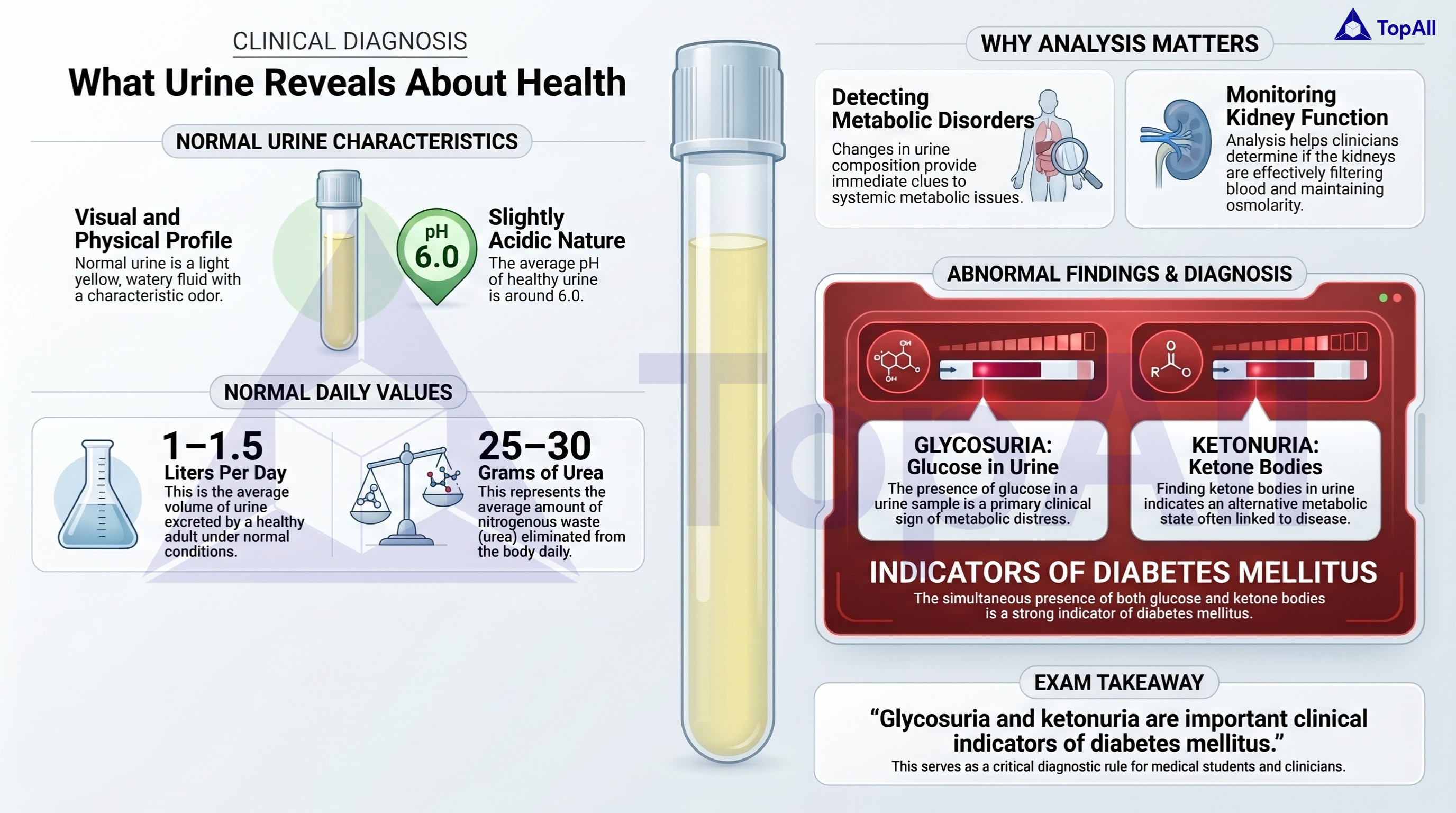
Study urine characteristics and clinical diagnosis for NEET UG with TopAll.
NEET UG · Mind map
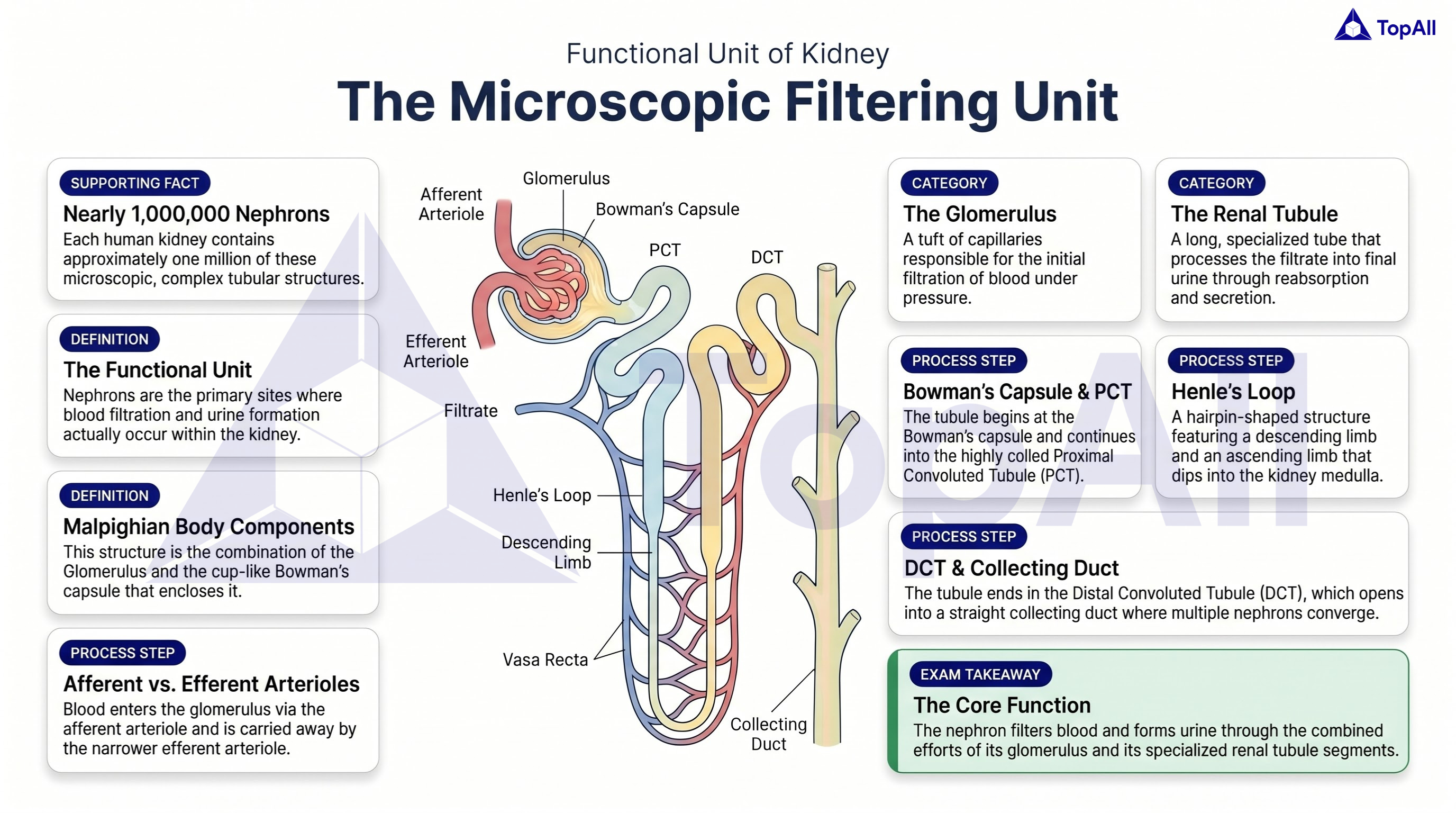
Learn nephron as the functional unit of kidney for NEET UG with TopAll.
NEET UG · Mind map
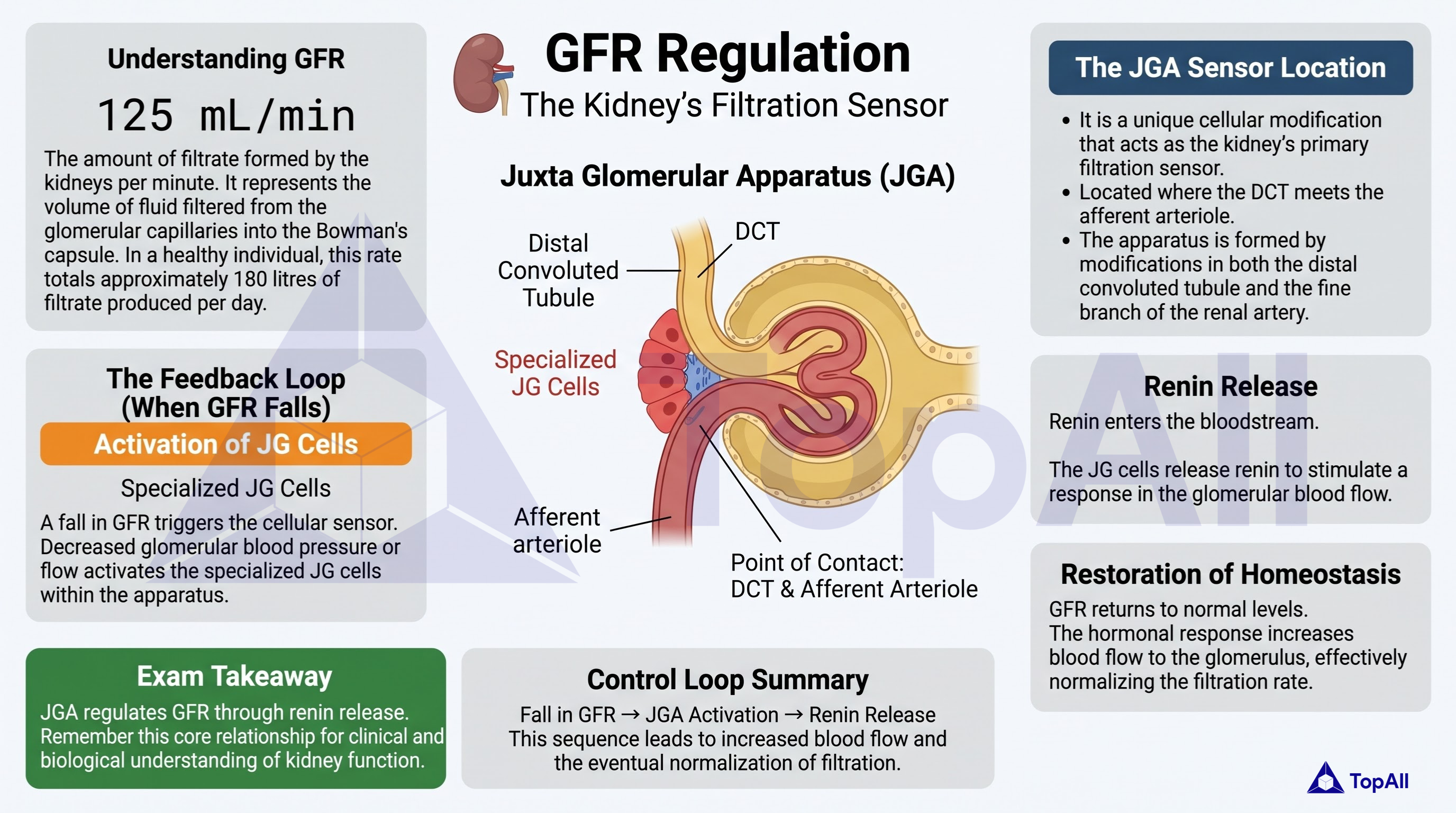
Master JGA and GFR regulation concepts for NEET UG with TopAll.
Distinguish filtration, reabsorption and secretion, check a solute balance and trace how ADH changes water recovery and urine volume.
For NEET UG Biology students: separate filtration, reabsorption and secretion by their directions, conserve one solute in a rate calculation and trace ADH’s effect without confusing filtered fluid with final urine.
Glomerular filtration moves water and small solutes from blood plasma into Bowman’s space across the filtration barrier. Selective reabsorption returns useful material from tubular fluid toward blood. Secretion transfers selected substances from blood into tubular fluid. Blood cells and most plasma proteins are normally retained by the filtration barrier. The large volume first filtered is not the volume of final urine; its composition changes along the tubule and collecting system.
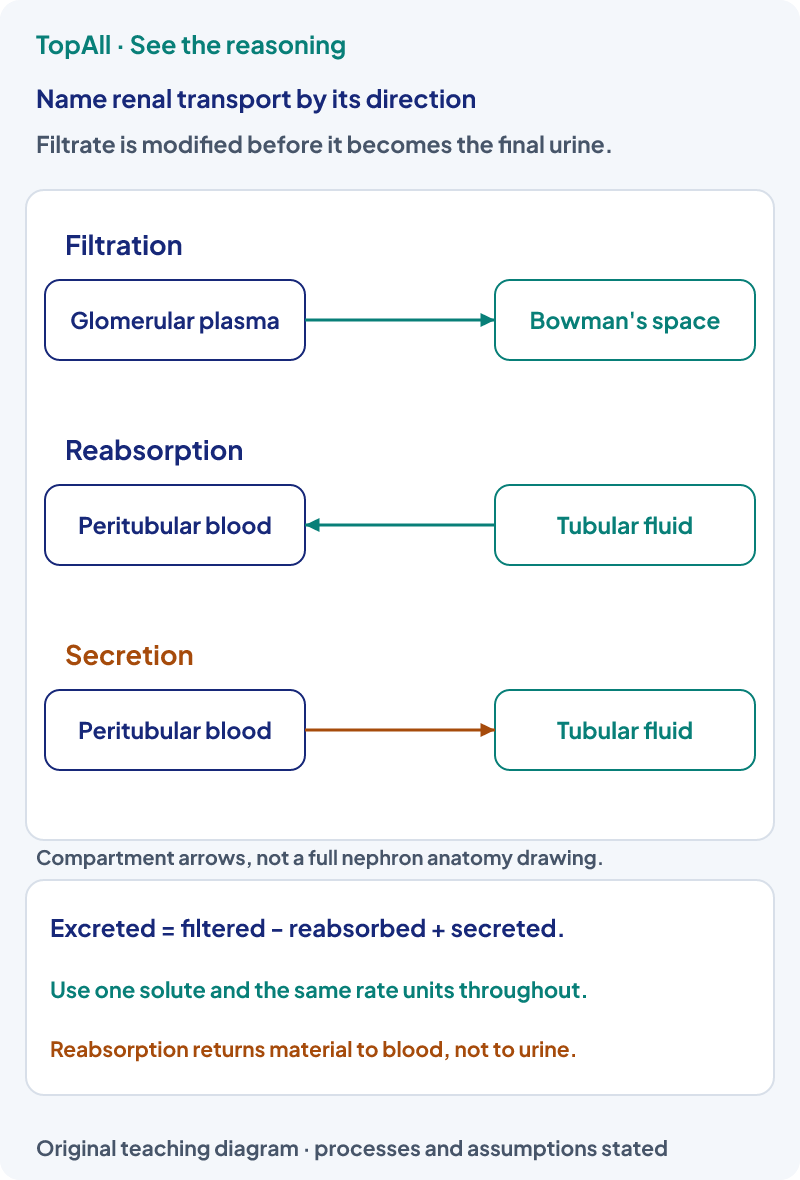
A labelled arrow takes a solute from tubular lumen into the surrounding interstitium and then peritubular capillary blood: this is reabsorption. An arrow from that blood toward the tubular lumen represents secretion. The first glomerular transfer into Bowman’s space is filtration. A substance may participate in more than one process, so its name alone does not fix the direction. Reabsorption reduces its tubular amount, while secretion adds to it before excretion.
Blood enters a glomerulus through the afferent arteriole and leaves through the efferent arteriole, which gives rise to the peritubular network and, in juxtamedullary nephrons, vasa recta. Filtrate enters Bowman’s space and flows through the proximal tubule, loop of Henle, distal tubule and collecting pathway. Blood leaving the glomerulus has not become urine. The two routes interact across barriers rather than merging into one continuous pipe.
A hypothetical solute is filtered at 100 mg/min, reabsorbed at 90 mg/min and secreted at 5 mg/min, with no tubular production or metabolism. Thus . Subtract reabsorption because material leaves the tubular fluid; add secretion because it enters the tubular fluid. All terms refer to the same solute and time interval. The values are supplied model inputs, not normal rates for a named biological solute.
The descending limb of the loop is permeable to water and relatively less permeable to electrolytes. The ascending limb is effectively impermeable to water and permits electrolyte transport; the thin and thick portions differ in transport mechanisms. Transport in the loop contributes to establishing the gradient; countercurrent exchange in the vasa recta helps preserve it, and urea also contributes. ADH increases water permeability where it acts; it does not create an effective concentrating gradient from nothing.
Suppose 180 L of fluid is filtered over a day and 1.8 L appears as urine, with negligible net tubular secretion of water and volume changes treated approximately. Net water returned is about 180−1.8=178.2 L/day. The returned fraction is 178.2/180=0.99, or 99%. It is incorrect to label all 180 L as daily urine or to say that a large filtered volume demands an equally large water loss. The supplied numbers form an illustrative volume-balance model, not a fixed daily output for every person.
ADH primarily promotes water recovery in its responsive distal segments. Aldosterone from adrenal cortex promotes sodium recovery and potassium secretion in appropriate distal nephron cells, with water balance also depending on permeability and gradients. Renin-related signalling, atrial natriuretic signals and other controls affect renal function. A statement that every hormone simply “makes more urine” misses their different targets, stimuli and directions.
Write source and destination next to each arrow. Keep blood and tubular routes separate. For a balance equation, use the same solute and compatible amount-per-time units, subtract reabsorption and add secretion. In a water-regulation question, distinguish ADH synthesis, release, target permeability and the medullary conditions required for the response.
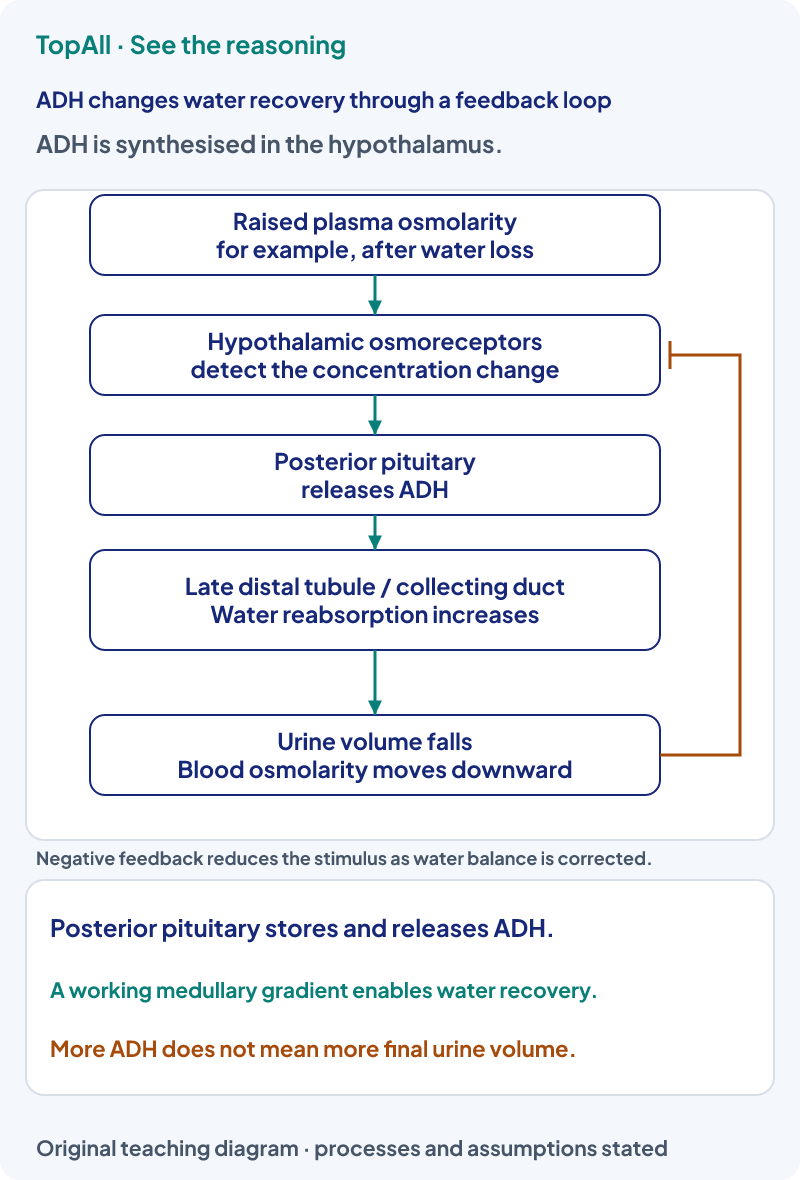
Under the diagram’s assumptions, water loss raises plasma osmolarity. Predict the ADH-release response and the direction of change in final urine volume.
The osmotic stimulus increases ADH release from the posterior pituitary, with the hormone having been synthesised in hypothalamic neurons. Increased water reabsorption in responsive distal and collecting segments tends to lower urine volume and increase urine concentration when the kidney and medullary gradient are functioning. As plasma osmolarity is corrected, the osmotic stimulus to ADH release falls. Do not infer a change in every solute’s excretion from this water effect alone.
In a ureotelic human, which organ converts much of the ammonia into urea, and which organs eliminate that urea in urine?
The liver converts ammonia into urea, which enters the blood. The kidneys handle and eliminate urea through urine formation. Urea being excreted by kidneys does not mean that the kidneys are the principal site of the hepatic urea cycle. Some urea participates in renal medullary recycling, so its presence there is not evidence that it was produced there.
Sketch blood and tubular fluid separately, label all three transport directions and solve one conservation example. Use Body Fluids and Circulation to trace the incoming blood route, or Chemical Coordination and Integration to distinguish a hormone’s synthesis site from its release and target sites.
Practice opens the broad Excretory Products and their Elimination pool, not a guaranteed ADH-only set.
Technical review: Codex (automated), 24 October 2026. Definitions and conventions checked against the linked primary textbooks. Numerical examples, self-checks and diagrams are original; calculations and diagram coordinates are checked separately. Human subject review is not claimed. These focused lessons support the existing NEET Biology chapter catalogue and do not claim complete current exam or syllabus coverage.
After an excretion error, identify the compartment, transport direction and conserved quantity. State the hormone and gradient assumptions before returning to chapter practice.

