
NEET UG · Biology
NEET UG · Biology
Reproduction in organisms
Revise the concepts. Try a question. Understand your next step.
40 medium questions available · Try answers free. Sign in to save progress or take a quiz.
NEET UG · Biology
Continue studying Reproduction In Organisms
Understand the concept, practise questions and check your learning.
Understand
Separate sexual and vegetative routes, place meiosis in a plant life cycle and count ideal fission rounds without mixing organisation levels. Reproduction: distinguish the mechanism, stage and new individual
Read the guidePractise
Try 40 medium chapter MCQs. Untimed; check answers and available explanations as you go.
Practise chapter MCQsCheck your learning
Prepare a timed chapter quiz. Choose the available question count and pace before starting.
Prepare a chapter quizThis is chapter practice, not a full-length NEET mock paper.
No revision resources are published for this chapter yet. Use your textbook alongside the guide and practice.
Choose your practice
All Biology chapters →These are playable question counts after quality and duplicate checks.
How practice and quizzes work
The practice player uses single-correct-answer MCQs. Chapter quizzes are not full-length NEET mock papers. Check the practice guide and official syllabus sources.
Revise before you practise
Study resources 0
No revision resources are published for this chapter yet. Use your textbook alongside the available practice questions.
Reproduction: distinguish the mechanism, stage and new individual
Separate sexual and vegetative routes, place meiosis in a plant life cycle and count ideal fission rounds without mixing organisation levels.
What you will understand
For NEET UG Biology students: classify reproduction by its mechanism, place meiosis at the correct life-cycle stage and distinguish a new individual from growth within an existing one.
Quick answer: gamete fusion defines the sexual route
Sexual reproduction involves gamete fusion within a life cycle that includes reduction of chromosome sets. The two gametes can originate from the same individual in relevant organisms, so two parent individuals are not a universal requirement. Asexual routes produce new individuals without gamete fusion. Counting parents alone or seeing a flower or spore does not establish the mechanism.
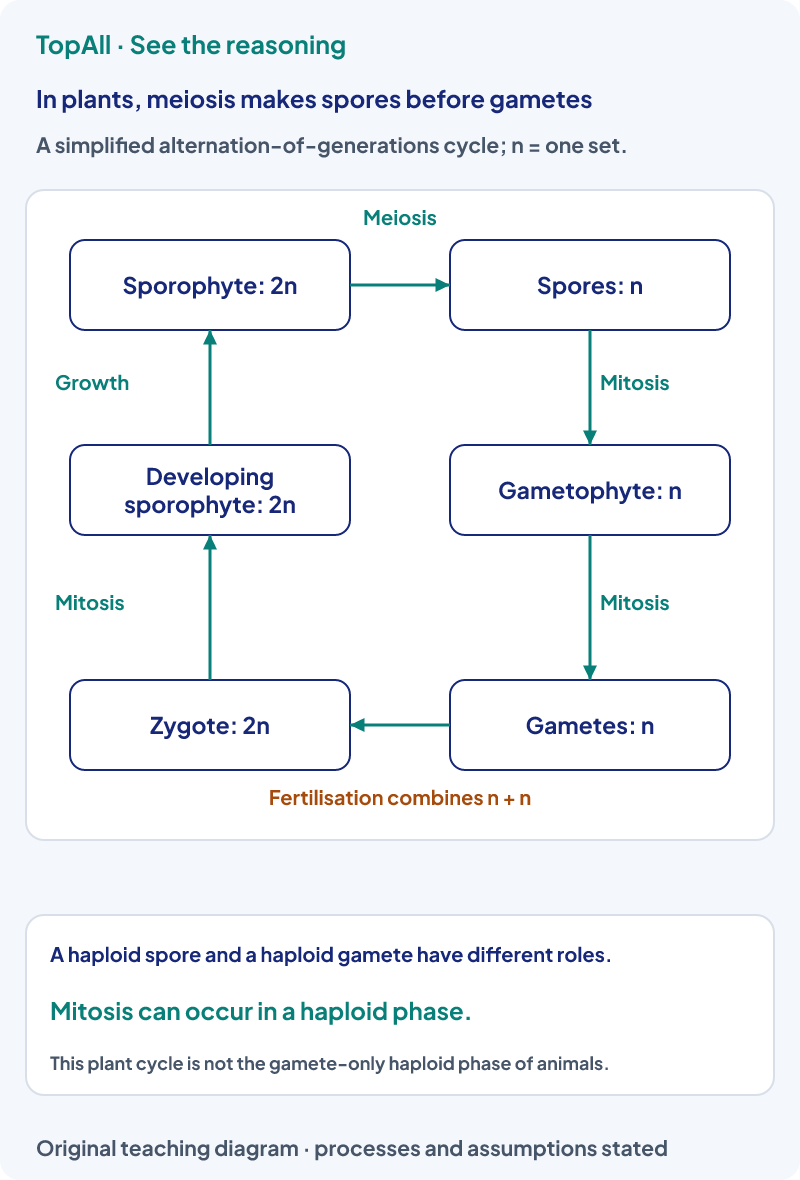
Locate meiosis before naming a haploid product
Infer ploidy without putting meiosis at every arrow
A normal plant sporophyte is stated to have . Its meiotic spores have eight chromosomes, and mitotic development preserves that haploid count in the gametophyte and its ordinary gametes. Fusion of two gametes restores sixteen in the zygote. Mitosis does not require a diploid starting state; adding a second meiosis between haploid gametophyte and gamete would solve the wrong life cycle.
Asexual mechanisms are different physical processes
Binary fission divides a unicellular organism into two new individuals in the relevant model. Budding develops an outgrowth that can form another individual; suitable fragments can establish in organisms capable of fragmentation. These are not interchangeable names for every instance of cell division. Repair or cell multiplication inside a multicellular individual is not automatically reproduction of the whole organism.
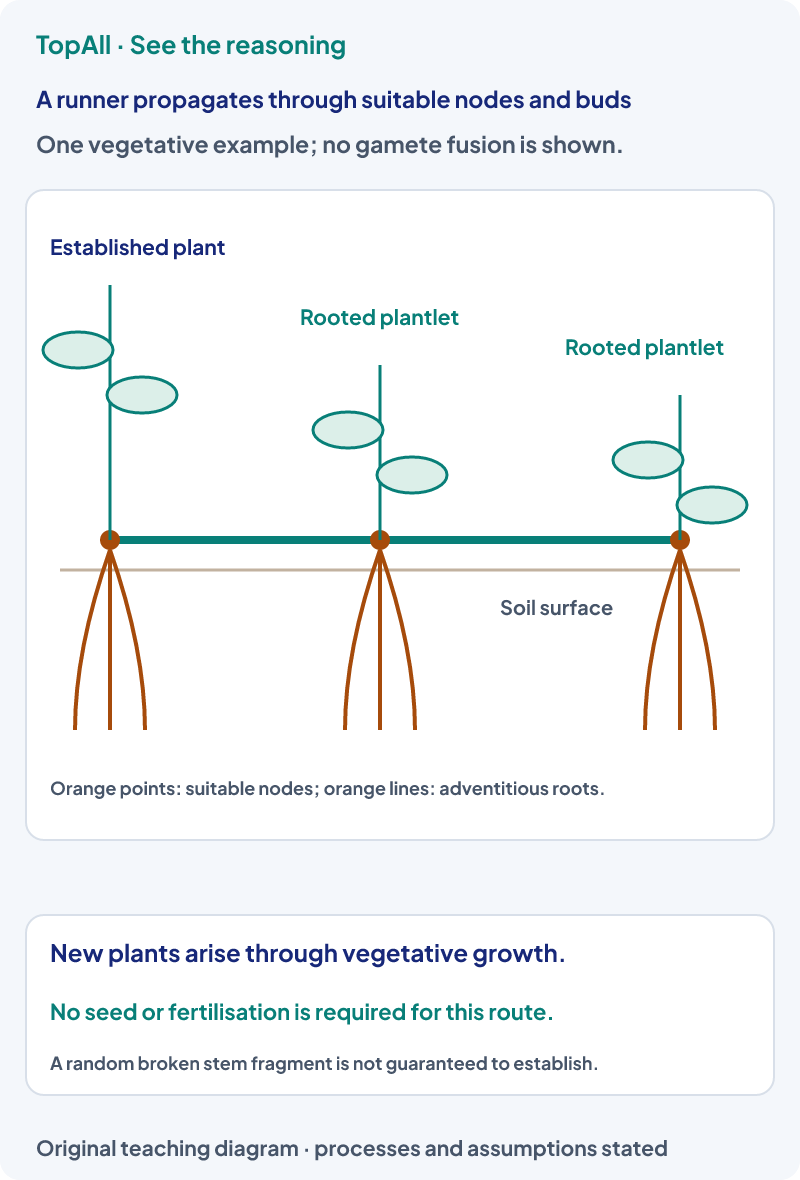
Follow a runner through suitable nodes
Separate fission rounds from individual division events
Assume one unicellular organism completes five synchronous binary-fission rounds with no death, fusion or failed division. gives 32 individuals. The rounds are five, but the total individual fission events are 1 + 2 + 4 + 8 + 16 = 31. Each successful event adds one to the population, so final minus initial also gives 31. The ideal doubling model is not a real population forecast.
Clonal continuity does not mean absolutely no variation
Vegetative propagation can preserve a starting genotype much more directly than a meiotic sexual route. Mutation can still occur, and the same genotype can show different traits under different environments. A statement that a route avoids gamete fusion therefore does not prove that every descendant is permanently identical in all observable characteristics or equally suited to every future environment.
Classify self-fertilisation by the event rather than parent number
A stated flowering plant forms pollen and an embryo sac, and a sperm from its own pollen fuses with its egg. The route remains sexual because gamete formation and fusion occur. It is not vegetative propagation merely because one individual supplied both gametes. By contrast, a rooted runner plantlet develops without that fusion event in the illustrated route.
A spore label needs a life-cycle context
In the plant cycle shown, spores are meiotic products that grow without fusing; gametes fuse to form the zygote. Other organisms can make spores by other mechanisms, including asexual routes. Thus “spore present” alone does not identify whether meiosis occurred or what kind of reproduction the whole cycle represents. Name the organism and stage before choosing a division type.
Common mistakes: confuse multiplication at different levels
State whether the new unit is a cell, a whole individual, a gamete, a spore or a plantlet. Then identify the mechanism and chromosome stage. A selfed seed, a runner plantlet and extra cells in a healing tissue are different outcomes even if one parent organism is involved in each description.
Try it: count descendants and fissions in a supplied model
Three unicellular organisms each complete four synchronous binary-fission rounds, with no loss. How many individuals and how many individual fission events are present in the model?
Reveal the answer
There are 3 × 2⁴ = 48 individuals. Total individual fission events are 48 − 3 = 45, also 3 + 6 + 12 + 24. Four is the number of rounds, not the total number of individual organisms that divided.
Try it: distinguish growth from reproduction of an individual
Cells divide to repair a leaf, while a suitable runner node establishes as an independent plantlet. Do both observations necessarily mean that a new whole plant has been produced?
Reveal the answer
No. Cell division used in repair is growth or restoration within the existing individual. The independently established plantlet is a new individual in the described vegetative route. The conclusion depends on organisation level and outcome, not the word “mitosis” alone.
Come back tomorrow: mark the stage before naming the process
Draw a plant cycle and mark one meiosis event, the mitotic haploid phase and fertilisation. Contrast a rooted runner with a selfed seed. Use Flowering-Plant Reproduction for the two sperm outcomes, or Plant Growth and Development to distinguish rate measurements from new-individual formation.
Practice opens the existing broad reproduction catalogue. The legacy chapter label does not assert a standalone chapter in the current NCERT edition.
Sources and review
Technical review: Codex (automated), 24 October 2026. Core mechanisms were compared with the linked primary textbooks and university or government references. All diagrams, problem inputs and explanations are original. Numerical balances and diagram directions are checked separately. Independent human subject review is not claimed. These focused guides support the existing chapter catalogue; they do not claim complete current exam or syllabus coverage.
Choose your next chapter task
If a term seems ambiguous, name the organism, stage and new unit first. Then revisit its mechanism and ploidy before attempting another chapter question.
Sources and reading
- OpenStax Biology 2e: Sexual Reproduction — Meiosis and fertilisation at different stages in diploid-dominant, haploid-dominant and plant alternation-of-generations cycles.
- OpenStax Biology 2e: Asexual Reproduction — Runner/stolon nodes and adventitious rooting, vegetative routes and genotype continuity. No copied species plate or universal establishment claim.
- OpenStax Biology 2e: Reproduction Methods — Distinguish gamete fusion from asexual fission, budding and fragmentation; parent count alone does not define the mechanism.