NEET UG · Video

Isobilateral Monocot Leaf Guide
Study isobilateral monocot leaf structure for NEET UG with TopAll.
4 min video

NEET UG · Biology
Revise the concepts. Try a question. Understand your next step.
196 medium questions available · Try answers free. Sign in to save progress or take a quiz.
NEET UG · Biology
Understand the concept, practise questions and check your learning.
Understand
Identify radial and conjoint arrangements, distinguish open and closed bundles using cambium, and check the common ring-versus-radial mix-up. Read vascular-bundle diagrams with confidence
Read the guidePractise
Try 196 medium chapter MCQs. Untimed; check answers and available explanations as you go.
Practise chapter MCQsCheck your learning
Prepare a timed chapter quiz. Choose the available question count and pace before starting.
Prepare a chapter quizThis is chapter practice, not a full-length NEET mock paper.
These are playable question counts after quality and duplicate checks.
The practice player uses single-correct-answer MCQs. Chapter quizzes are not full-length NEET mock papers. Check the practice guide and official syllabus sources.
Revise before you practise
NEET UG · Video
Study isobilateral monocot leaf structure for NEET UG with TopAll.
4 min video
NEET UG · Video
Master dorsiventral dicot leaf anatomy for NEET UG with TopAll.
4 min video
NEET UG · Video
Learn monocotyledonous stem anatomy clearly for NEET UG with TopAll.
6 min video
NEET UG · PDF notes
Read PDF · 10 pages →Study isobilateral monocot leaf structure for NEET UG with TopAll.
10 pages
NEET UG · PDF notes
Read PDF · 10 pages →Master dorsiventral dicot leaf anatomy for NEET UG with TopAll.
10 pages
NEET UG · PDF notes
Read PDF · 9 pages →Learn monocotyledonous stem anatomy clearly for NEET UG with TopAll.
9 pages
NEET UG · Mind map
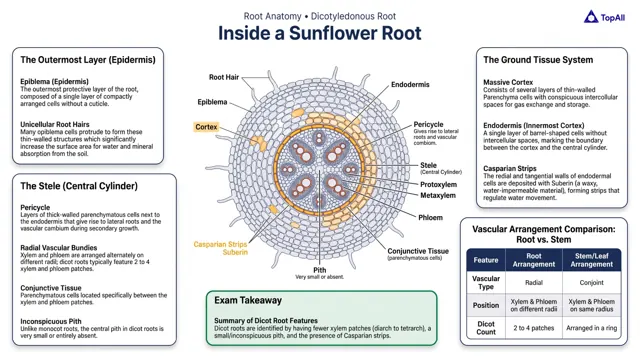
Learn dicotyledonous root anatomy for NEET UG with TopAll.
NEET UG · Mind map
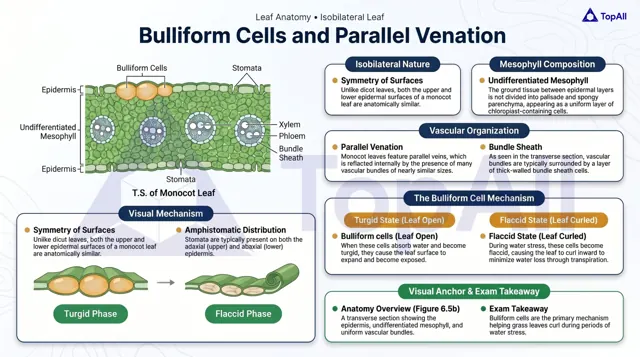
Study isobilateral monocot leaf structure for NEET UG with TopAll.
NEET UG · Mind map
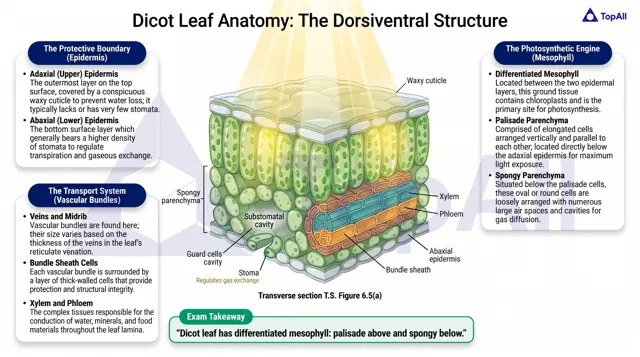
Master dorsiventral dicot leaf anatomy for NEET UG with TopAll.
Identify radial and conjoint arrangements, distinguish open and closed bundles using cambium, and check the common ring-versus-radial mix-up.
Classify a vascular arrangement from the positions of xylem and phloem, decide whether a conjoint bundle is open or closed, and separate a ring of whole bundles from radial xylem/phloem arrangement. Focus for this session: vascular bundles and typical young stems.
First ask where xylem and phloem sit. When they alternate on different radii, the arrangement is radial, as in roots. When they lie together along one radius, it is conjoint. For the conjoint stem examples here, ask whether cambium lies between phloem and xylem: cambium present means open; cambium absent means closed. “Closed” describes this cambium condition; it does not say that transport has stopped.
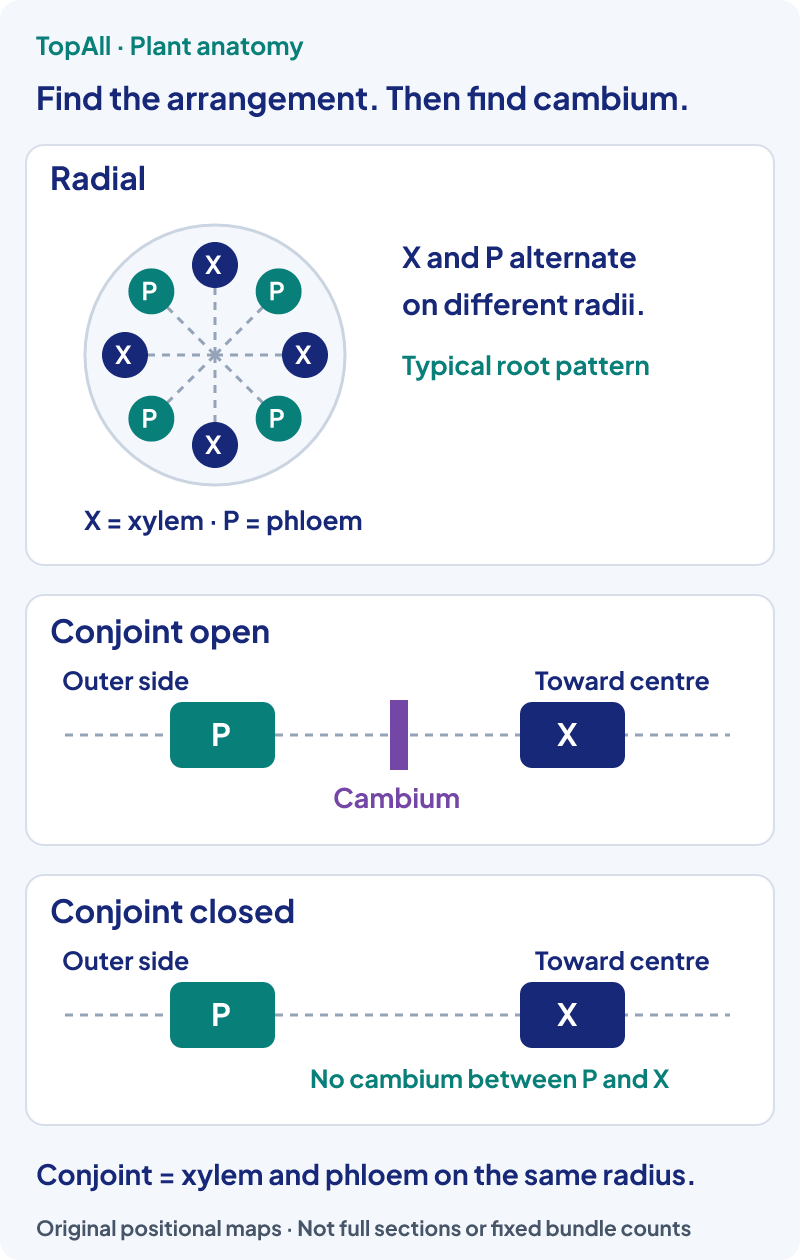
A stem bundle has phloem toward the outside, xylem toward the centre and a cambium layer between them.
In a typical young dicot stem, whole vascular bundles form a ring and each bundle is conjoint open. In a typical monocot stem, bundles are scattered and conjoint closed. This is a comparison of the textbook stem examples. A ring of whole bundles does not make their xylem/phloem arrangement radial; the two observations describe different levels of organisation.
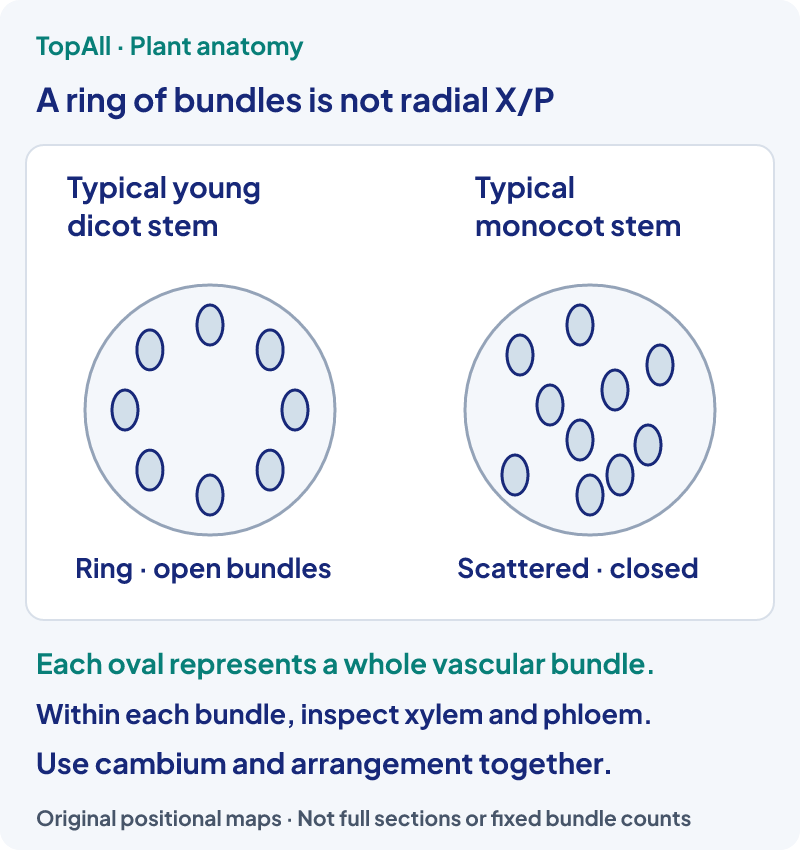
A section is identified as a young stem. Its bundles are scattered through the ground tissue, and there is no cambium between xylem and phloem in each bundle. These two clues fit the typical monocot stem described in NCERT.
Now change the organ: a root shows xylem and phloem alternating on different radii. That establishes a radial arrangement, but does not by itself distinguish a monocot root from a dicot root. Both root types have radial vascular organisation.
A young stem has a ring of vascular bundles. Inside each bundle, phloem and xylem lie along the same radius, separated by cambium. Which label follows?
A. Radial, because the bundles form a ring
B. Conjoint open
C. Conjoint closed
B: conjoint open. The same-radius position establishes conjoint arrangement; the intervening cambium establishes open. A describes the ring made by whole bundles but uses the wrong criterion for radial xylem/phloem arrangement. C would require absence of the intervening cambium.
A conjoint stem bundle has no cambium between its xylem and phloem. Which statement is supported?
A. It is closed, so xylem and phloem cannot transport materials.
B. It is radial, because cambium is absent.
C. It is conjoint closed; the name does not mean that conduction has stopped.
C. Cambium absence makes this conjoint bundle closed. It does not turn a same-radius arrangement into a radial one, or imply that the conducting tissues have stopped functioning. Keep arrangement, cambium and transport as separate questions.
Cover the diagram labels and redraw radial, conjoint open and conjoint closed arrangements. Explain which observation changes each name, then check your sketch against NCERT. If you confused a ring of whole bundles with radial xylem/phloem, revisit the two diagrams before another question.
Technical review: Codex (automated). Source checked on 23 October 2026 against NCERT Biology, Chapter 6, sections 6.1.3, 6.2.1–6.2.4. The diagrams, worked examples and self-checks are original teaching material. Human subject review is not claimed.

