NEET UG · Video

Class Osteichthyes NEET Guide
Learn Osteichthyes traits and examples clearly for NEET UG with TopAll.
5 min video

NEET UG · Biology
Revise the concepts. Try a question. Understand your next step.
282 medium questions available · Try answers free. Sign in to save progress or take a quiz.
NEET UG · Biology
Understand the concept, practise questions and check your learning.
Understand
Separate germ layers from coelom, keep adult and larval symmetry distinct and use notochord evidence without assuming a backbone. Animal kingdom: read the body boundary and the life stage
Read the guidePractise
Try 282 medium chapter MCQs. Untimed; check answers and available explanations as you go.
Practise chapter MCQsCheck your learning
Prepare a timed chapter quiz. Choose the available question count and pace before starting.
Prepare a chapter quizThis is chapter practice, not a full-length NEET mock paper.
These are playable question counts after quality and duplicate checks.
The practice player uses single-correct-answer MCQs. Chapter quizzes are not full-length NEET mock papers. Check the practice guide and official syllabus sources.
Revise before you practise
NEET UG · Video
Learn Osteichthyes traits and examples clearly for NEET UG with TopAll.
5 min video
NEET UG · Video
Master Chondrichthyes features and examples for NEET UG with TopAll.
6 min video
NEET UG · Video
Learn Cyclostomata features and examples for NEET UG with TopAll.
4 min video
NEET UG · PDF notes
Read PDF · 9 pages →Distinguish acoelomate, pseudocoelomate and coelomate body plans using original diagrams, three worked examples and six self-checks. Continue with NEET Animal Kingdom practice.
9 pages
NEET UG · PDF notes
Read PDF · 9 pages →Master vertebrata classification with simple clarity for NEET UG with TopAll.
9 pages
NEET UG · PDF notes
Read PDF · 9 pages →Understand protochordates and vertebrata clearly for NEET UG with TopAll.
9 pages
NEET UG · Mind map
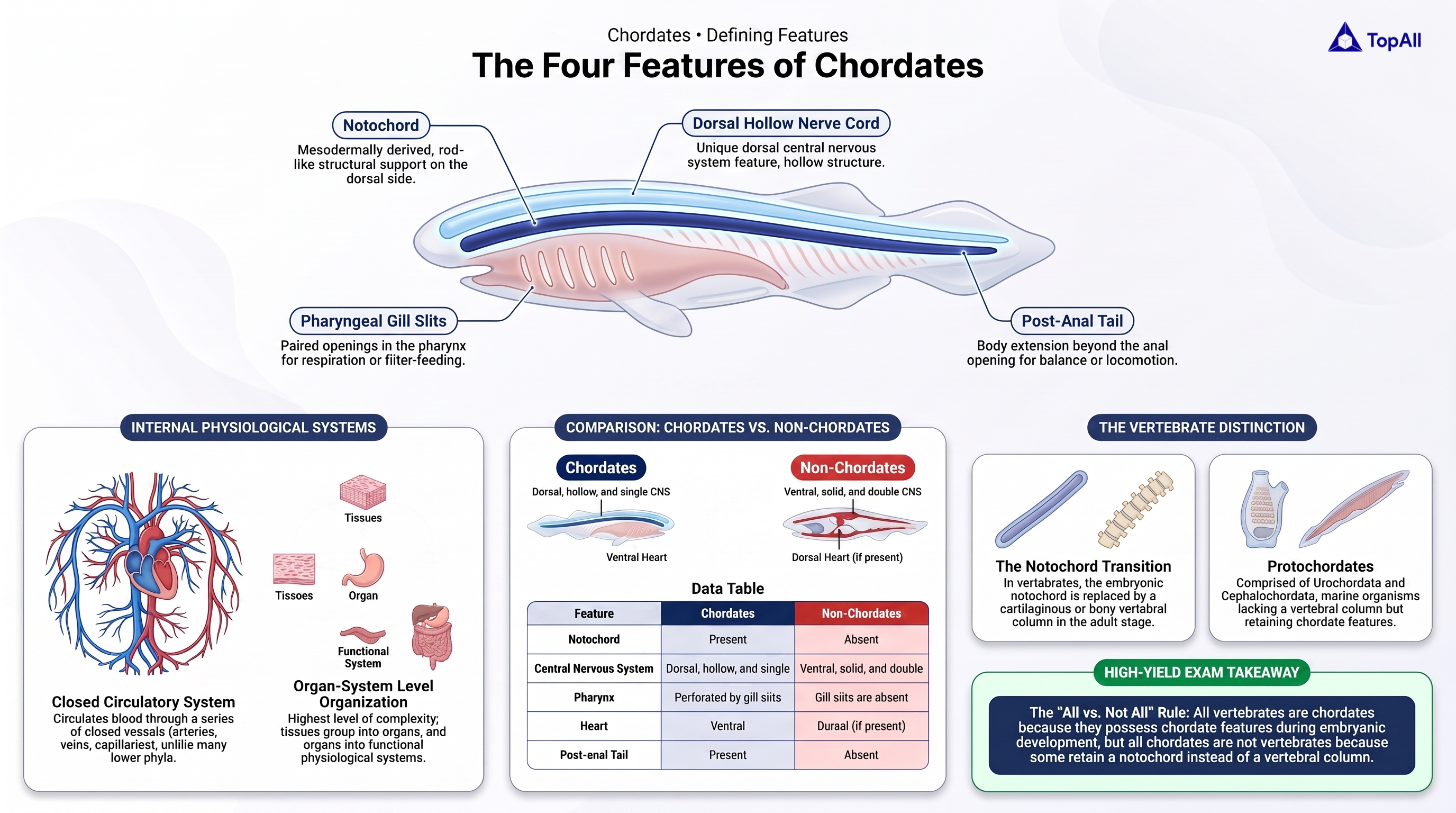
Learn phylum classification in biology for NEET UG with TopAll.
NEET UG · Mind map
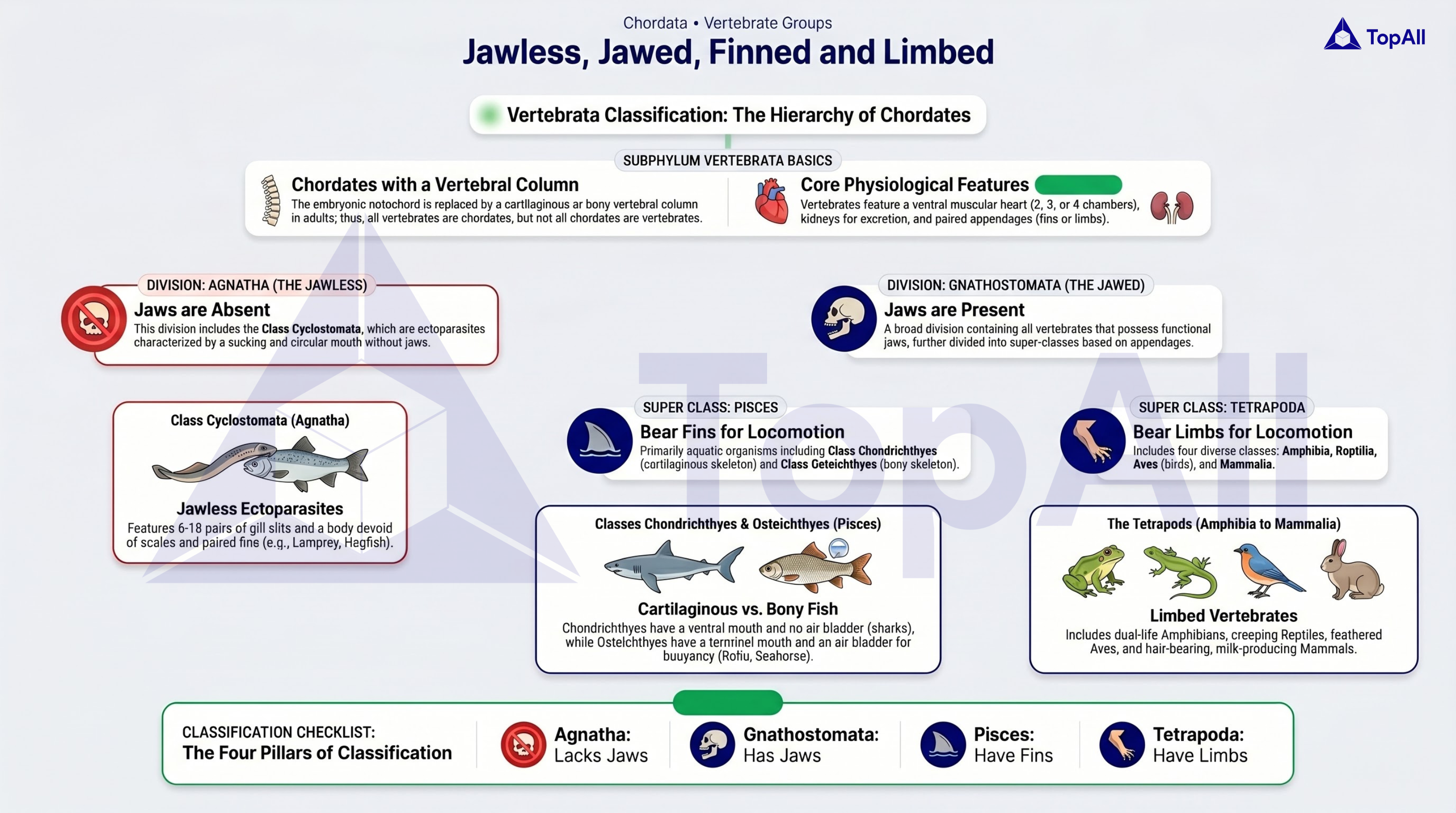
Master vertebrata classification with simple clarity for NEET UG with TopAll.
NEET UG · Mind map
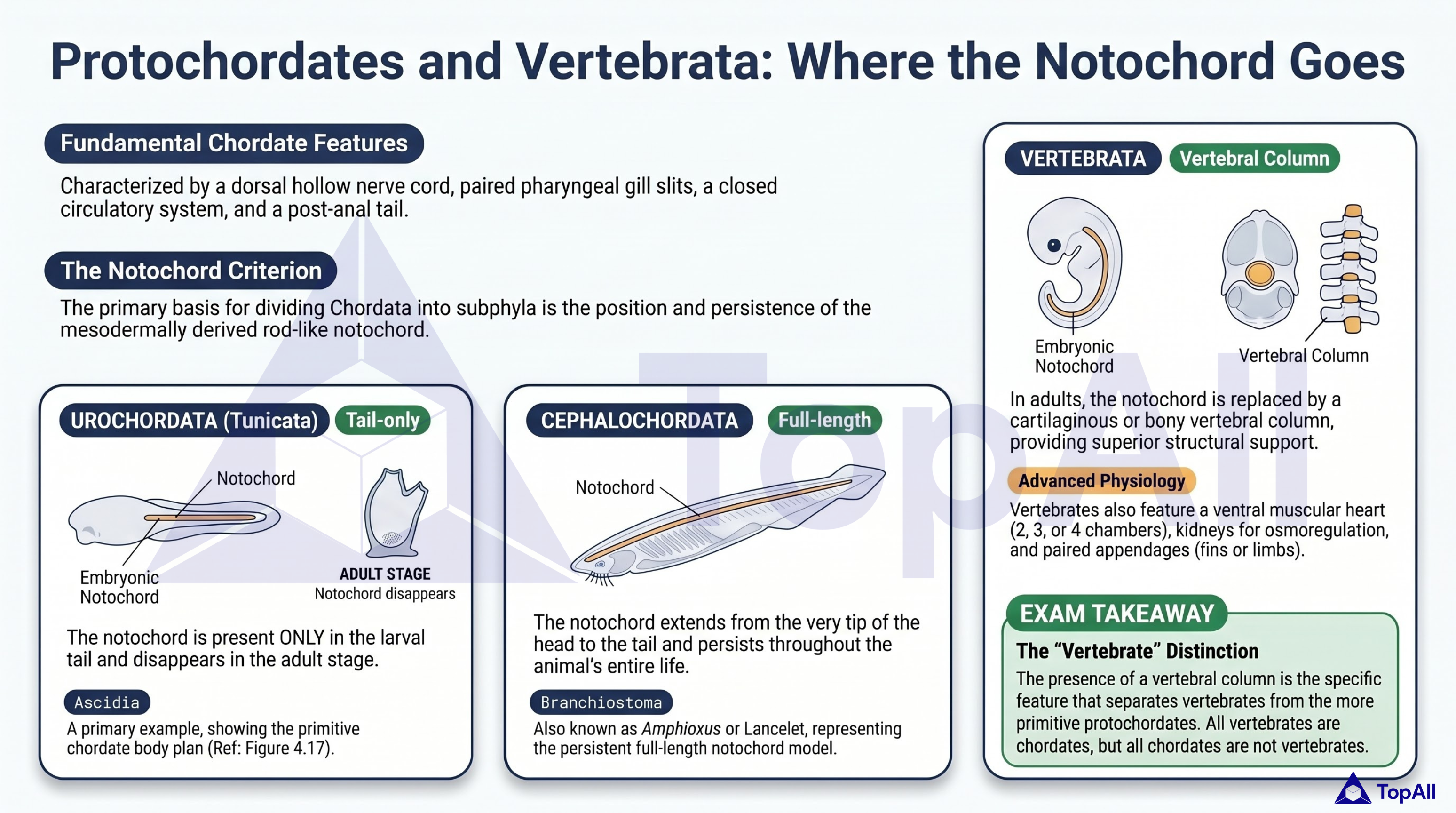
Understand protochordates and vertebrata clearly for NEET UG with TopAll.
Separate germ layers from coelom, keep adult and larval symmetry distinct and use notochord evidence without assuming a backbone.
For NEET UG Biology students: read germ layers and body-cavity lining separately, attach symmetry to the correct life stage and avoid treating every chordate as a vertebrate. These are focused reasoning tasks within the NCERT framework.
For triploblastic animals, coelom descriptions concern the space between the body wall and the digestive tract. A true coelom is completely lined by mesoderm; a pseudocoelom lacks that complete lining. An acoelomate has no such intervening body cavity. The digestive lumen remains a different space. Three germ layers do not by themselves guarantee a true coelom.
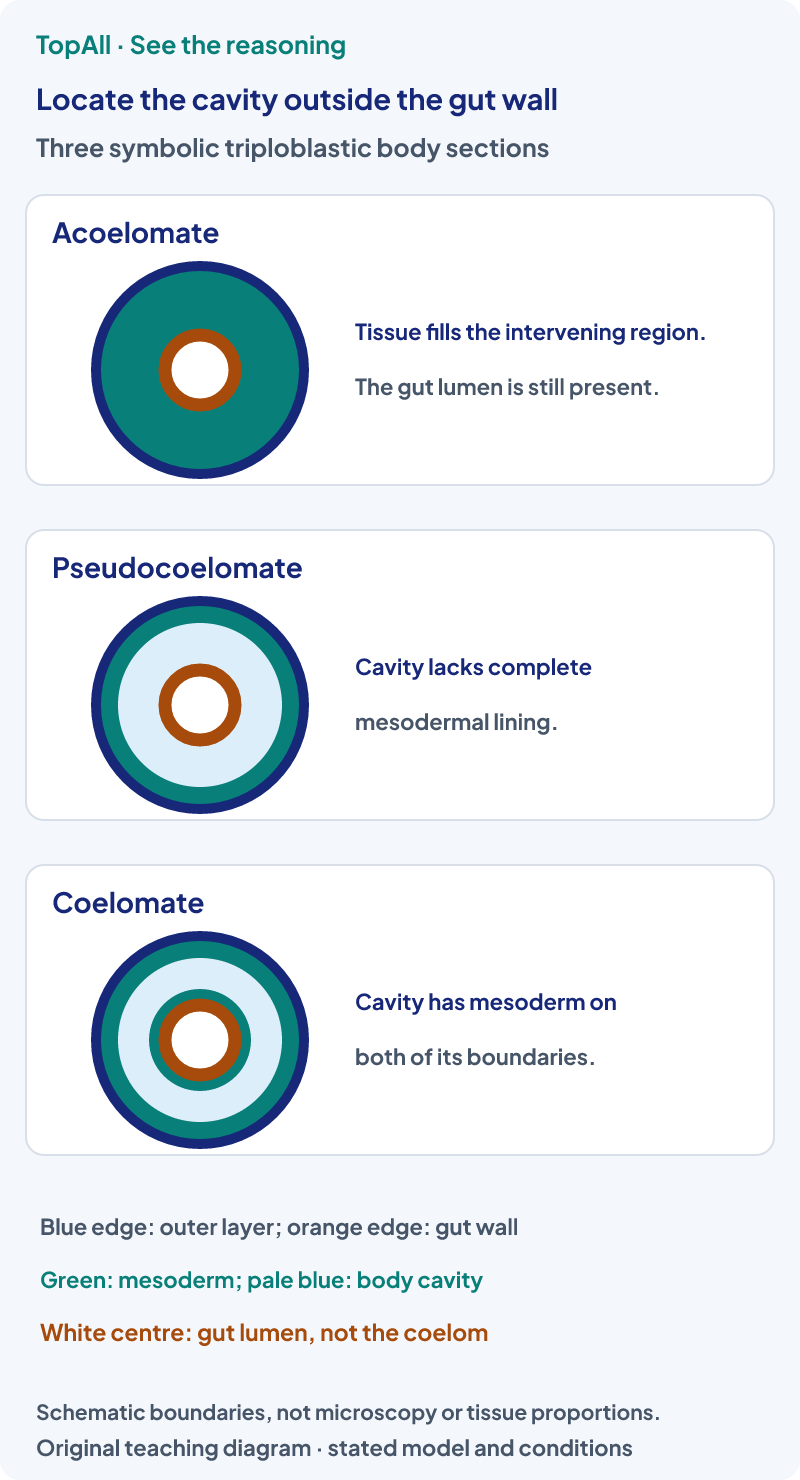
A supplied triploblastic body plan has a space between the body wall and gut, but that space is not completely bounded by mesoderm. Choose pseudocoelomate among the three cavity descriptions. Calling it acoelomate would ignore the supplied intervening cavity, while calling it a true coelom would ignore the lining condition. NCERT uses aschelminthes as a pseudocoelomate example; the structural description alone does not identify a species.
NCERT describes sponges at a cellular level of organisation, without the true tissue organisation used in the diploblastic-versus-triploblastic comparison. Cnidarians illustrate the two principal germ layers, with mesoglea between them; mesoglea is not simply a third germ layer. A triploblastic flatworm can still be acoelomate. Keep level of organisation, germ layers and coelom as separate entries.
An adult echinoderm is described as radially symmetrical, but its larva is bilateral. If an MCQ asks about the adult, answer radial; if it asks about the larva, answer bilateral. Radial symmetry alone does not establish that an animal is a cnidarian. Add other supplied characters, such as germ layers, skeletal features or a water vascular system, before selecting a phylum.
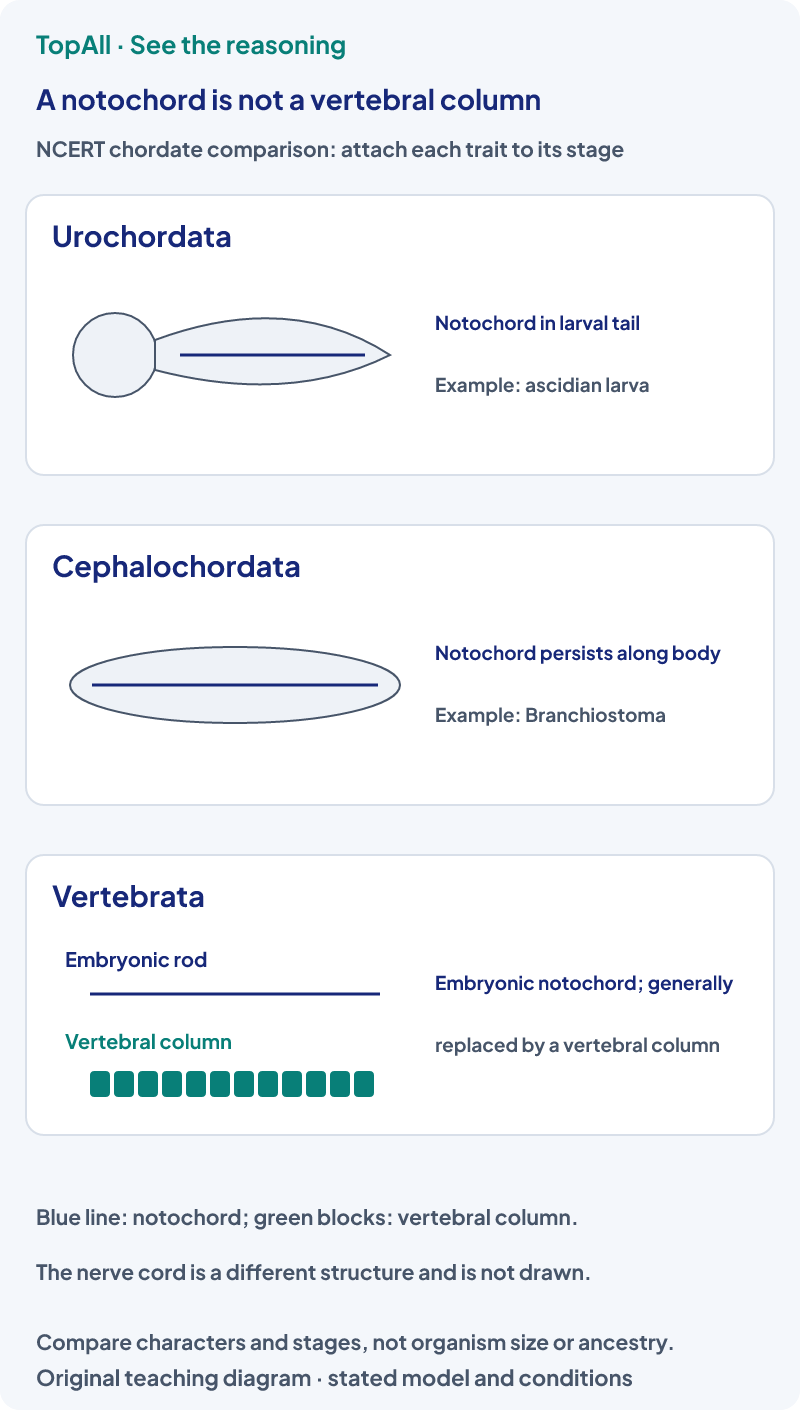
A notochord is a supporting rod derived from mesoderm, while the dorsal hollow nerve cord belongs to the nervous system. Do not use their similar names as synonyms. Chordate characters may be expressed at a particular developmental stage, so their absence from a photograph of one adult is not by itself a complete classification test.
A supplied animal is identified as an ascidian whose larva has a notochord confined to its tail. Within the NCERT comparison, it is a urochordate, not a vertebrate simply because a notochord was present. The larval observation supports chordate identity even though the adult is very different in appearance. Reverse the implication carefully: vertebrates are chordates, but membership of Chordata does not force membership of Vertebrata.
A worm-like outline does not settle segmentation, coelom type or phylum. Bilateral symmetry does not automatically imply a closed circulatory system. Use the actual collection of traits in the question, and retain qualifiers such as mostly, adult or larval when the textbook uses them. A limited schematic cannot show every organ or exception within a phylum.
Do not count the gut lumen as a coelom, infer true coelom from three germ layers, call mesoglea mesoderm, or transfer adult echinoderm symmetry to its larva. Likewise, do not replace notochord with nerve cord or assume that the word chordate means an adult backbone is present.
A simplified flatworm section shows a central digestive lumen, while tissue fills the region between the gut wall and body wall. A student calls it coelomate because there is an empty central space. Which boundary did the student misread?
The central space is the digestive lumen, inside the gut wall. A coelom would be a different space outside the gut, between the tract and body wall, completely lined by mesoderm. The supplied section is an acoelomate model even though the gut has a lumen; triploblastic does not mean coelomate.
An MCQ names Branchiostoma and describes a notochord extending along the body and persisting throughout life. In the stated NCERT comparison, choose Urochordata, Cephalochordata or Vertebrata, and give the decisive distinction.
Choose Cephalochordata. Its persistent body-length notochord matches the supplied description. The urochordate comparison confines the notochord to the larval tail. A notochord is not itself a vertebral column, so its persistence alone does not justify Vertebrata.
Reconstruct the three cavity models and explain why a gut lumen is not a coelom. Use NEET Living World to separate named taxa from ranks, or NEET Biological Classification to practise multi-character decisions.
Chapter practice opens the broad Animal Kingdom pool, rather than a separate body-plan-only set.
Technical review: Codex (automated). Primary textbook definitions and methods checked on 24 October 2026. Worked examples, diagrams, counterexamples and self-checks are original. Human subject review is not claimed. This focused lesson supports the existing chapter catalogue; it does not claim complete current exam coverage.
For every missed comparison, state the exact boundary, layer or developmental stage you overlooked. Then check another supplied character before assigning a group; a single familiar word is rarely the entire argument.

