NEET UG · Video

Respiratory Quotient NEET Guide
Master respiratory quotient values and concepts for NEET UG with TopAll.
4 min video

NEET UG · Biology
Revise the concepts. Try a question. Understand your next step.
88 medium questions available · Try answers free. Sign in to save progress or take a quiz.
NEET UG · Biology
Understand the concept, practise questions and check your learning.
Understand
Locate carbon loss, calculate net glycolytic ATP, interpret fermentation and use respiratory quotient with explicit assumptions. Plant respiration: keep carbon, ATP and NAD accounts separate
Read the guidePractise
Try 88 medium chapter MCQs. Untimed; check answers and available explanations as you go.
Practise chapter MCQsCheck your learning
Prepare a timed chapter quiz. Choose the available question count and pace before starting.
Prepare a chapter quizThis is chapter practice, not a full-length NEET mock paper.
These are playable question counts after quality and duplicate checks.
The practice player uses single-correct-answer MCQs. Chapter quizzes are not full-length NEET mock papers. Check the practice guide and official syllabus sources.
Revise before you practise
NEET UG · Video
Master respiratory quotient values and concepts for NEET UG with TopAll.
4 min video
NEET UG · Video
Learn the amphibolic pathway and its role in metabolism for NEET UG with TopAll.
4 min video
NEET UG · Video
Understand respiratory balance in plant respiration for NEET UG with TopAll.
6 min video
NEET UG · PDF notes
Read PDF · 9 pages →Master respiratory quotient values and concepts for NEET UG with TopAll.
9 pages
NEET UG · PDF notes
Read PDF · 10 pages →Learn the amphibolic pathway and its role in metabolism for NEET UG with TopAll.
10 pages
NEET UG · PDF notes
Read PDF · 9 pages →Understand respiratory balance in plant respiration for NEET UG with TopAll.
9 pages
NEET UG · Mind map
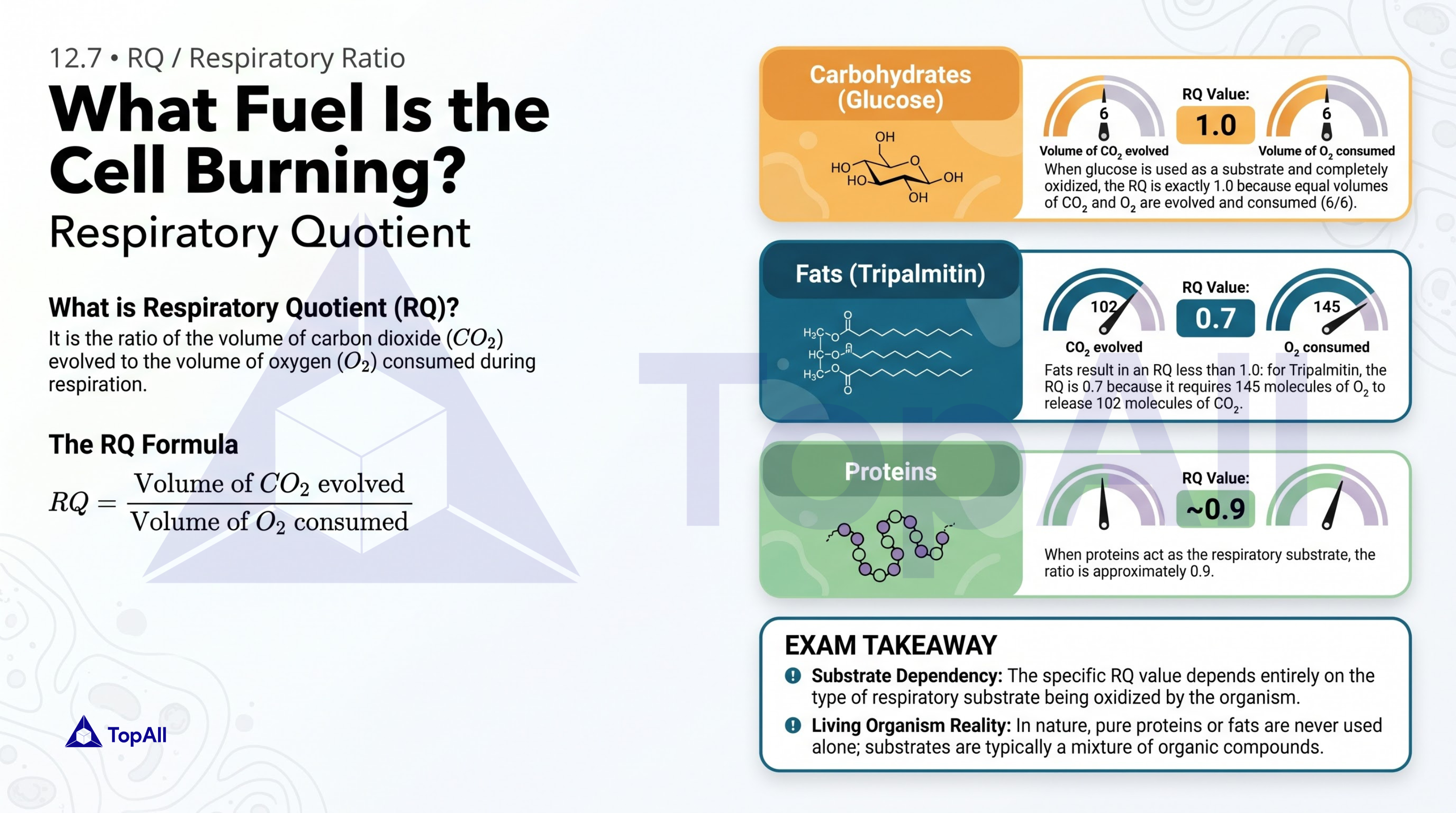
Master respiratory quotient values and concepts for NEET UG with TopAll.
NEET UG · Mind map
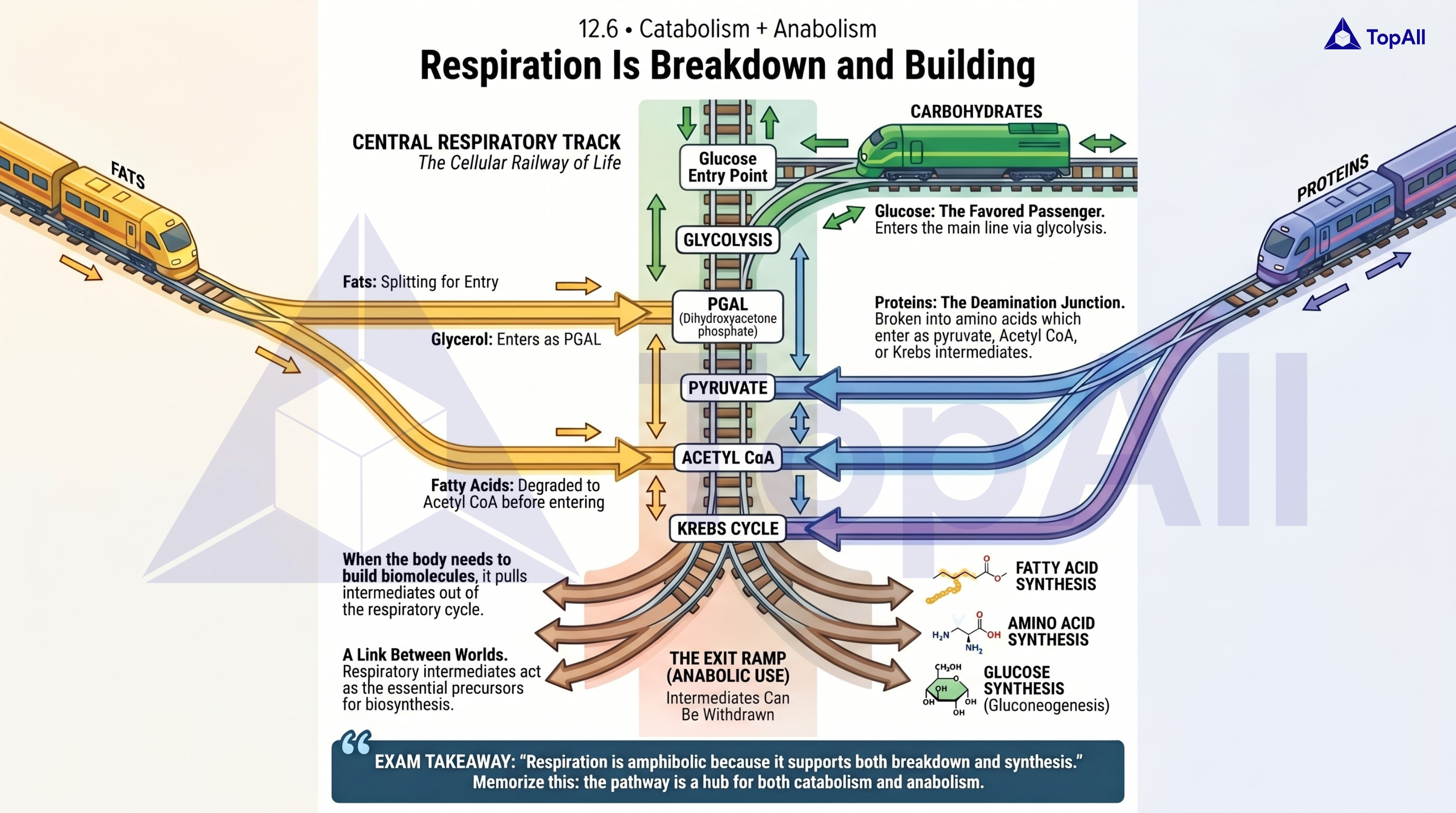
Learn the amphibolic pathway and its role in metabolism for NEET UG with TopAll.
NEET UG · Mind map
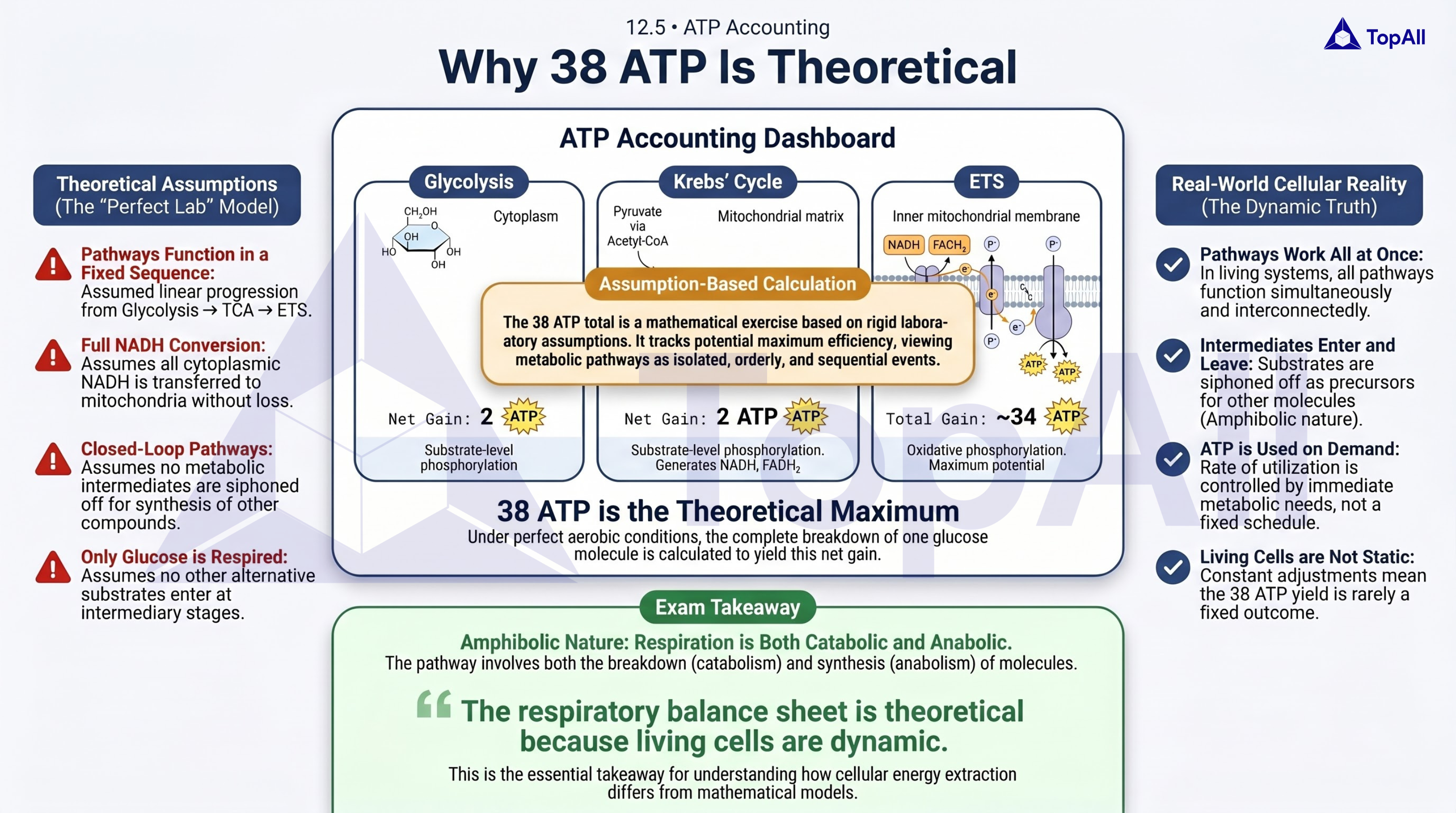
Understand respiratory balance in plant respiration for NEET UG with TopAll.
Locate carbon loss, calculate net glycolytic ATP, interpret fermentation and use respiratory quotient with explicit assumptions.
For NEET UG Biology students: locate carbon loss, calculate a net ATP balance and explain why fermentation regenerates a carrier rather than supplying a second ATP prize.
Glycolysis in the cytosol converts one six-carbon glucose to two three-carbon pyruvate molecules. Subsequent aerobic oxidation includes carbon loss in pyruvate oxidation and the citric acid cycle. ATP can form by substrate-level phosphorylation or by chemiosmotic coupling. Following carbon alone will not tell you how many ATP are captured, and counting a reduced carrier as an ATP molecule mixes two accounts.
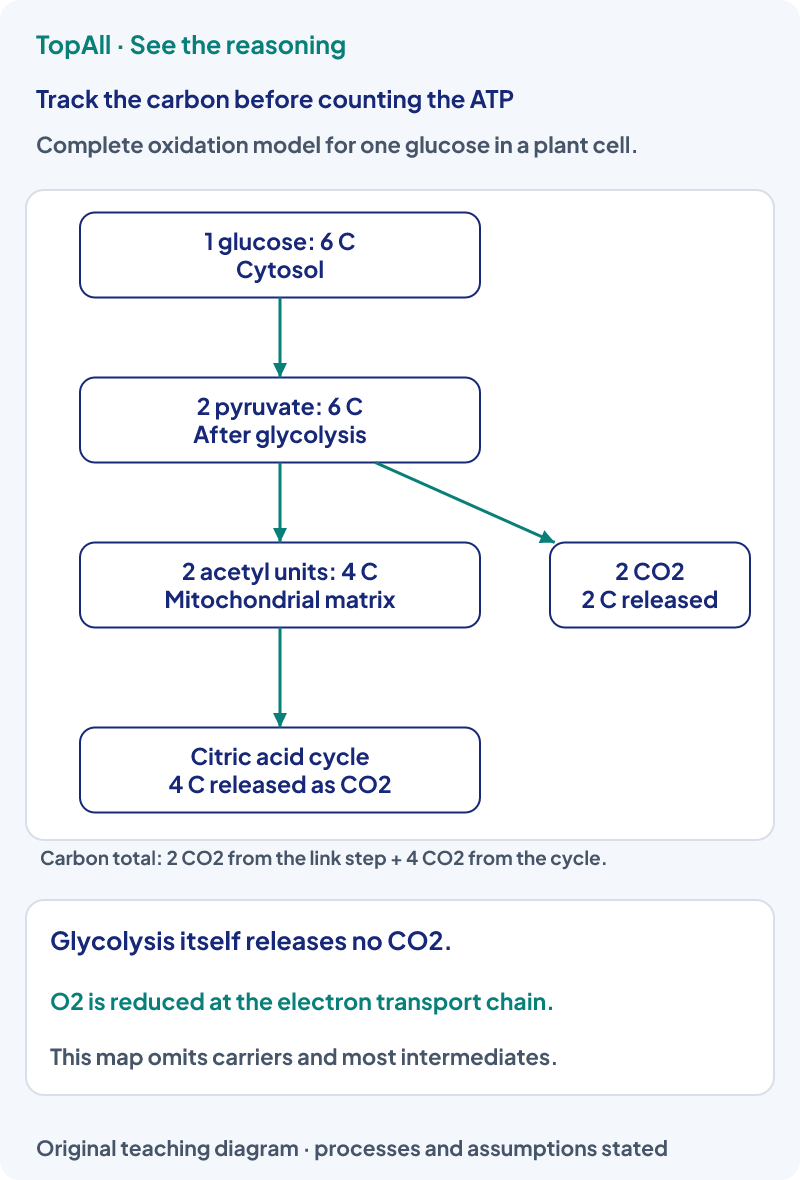
Assume three glucose molecules proceed completely through the standard aerobic account, with no intermediates withdrawn. Glycolysis gives six pyruvate; the link step releases six CO₂ and supplies six acetyl units. The citric acid-cycle account releases twelve further CO₂. Eighteen carbon atoms entered in glucose and eighteen leave as CO₂. This balance does not calculate ATP yield or predict a reaction rate.
The respiratory electron transport chain lies in the inner mitochondrial membrane. Electron transfer to oxygen supports proton-gradient formation; protons return toward the matrix through ATP synthase. Glycolysis does not directly require oxygen. If oxygen becomes limiting, later electron transfer and carrier regeneration can be affected even though oxygen is not written into every earlier reaction.
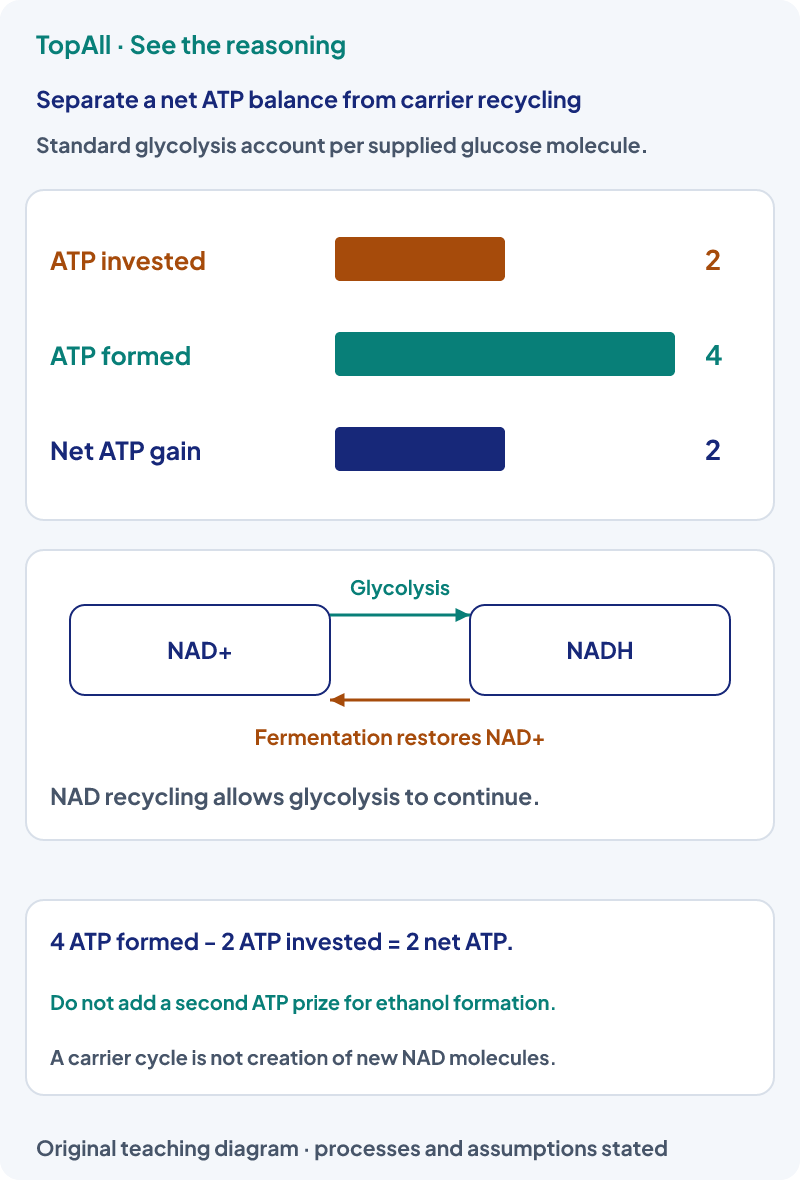
Suppose five glucose molecules complete glycolysis and the resulting pyruvate undergoes standard ethanol fermentation. Glycolysis invests ten ATP and forms twenty, leaving ten net ATP. The later conversion to ethanol restores NAD⁺ without an additional ATP yield in this model. Adding another ten ATP for the word “fermentation” would count the glycolytic gain twice.
In the standard ethanol route, pyruvate loses CO₂ to form acetaldehyde. Acetaldehyde is reduced to ethanol as NADH is reoxidised. The recovered NAD⁺ can support the oxidation step in glycolysis again. Fermentation is distinct from an electron transport chain using a non-oxygen terminal acceptor in some prokaryotes; the shared absence of oxygen does not make the mechanisms identical.
A corrected respiration-only measurement gives 42 mL CO₂ evolved and 60 mL O₂ consumed at comparable temperature and pressure.
Textbook whole-glucose ATP balances depend on conventions about carriers, shuttles, coupling and intermediate withdrawal. A question that states a convention should be solved within it. A memorised total should not replace a ledger for a question asking only about glycolysis, fermentation or substrate-level formation. Living pathways also supply biosynthetic precursors, so complete oxidation is a stated model rather than every molecule’s compulsory fate.
State whether the prompt asks for carbon dioxide, ATP or NAD regeneration. Mark cytosol, matrix and inner membrane before matching a stage. Write gross production minus investment for a net gain. In a gas ratio, divide CO₂ output by O₂ uptake, keeping units and measurement conditions comparable.
Four supplied glucose molecules finish standard glycolysis. How many ATP are invested, formed and gained net, and how many pyruvate molecules result?
Investment is eight ATP; production is sixteen; net gain is eight. Eight pyruvate molecules contain the original 24 carbon atoms. NADH is also formed, but it is not included as if it were directly another ATP molecule. The calculation ends at glycolysis and does not include mitochondrial oxidation.
A fermentation-only model releases CO₂ but has no oxygen uptake. Can its CO₂/O₂ ratio be reported as zero?
No. With zero oxygen uptake, the stated ratio has a zero denominator and is not a finite numerical quotient; it is not zero. Older simplified accounts may describe this as an infinite RQ, but a measured respiration ratio should not be calculated as an ordinary finite value from a zero uptake.
Draw a six-carbon starting molecule and label carbon loss. Separately list invested ATP, ATP formed and carrier regeneration. Compare the chloroplast account in Photosynthesis, or distinguish root nutrient uptake from metabolic energy in Mineral Nutrition.
The practice action opens the whole respiration chapter pool rather than a fermentation-only set.
Technical review: Codex (automated), 24 October 2026. Core mechanisms were compared with the linked primary textbooks and university or government references. All diagrams, problem inputs and explanations are original. Numerical balances and diagram directions are checked separately. Independent human subject review is not claimed. These focused guides support the existing chapter catalogue; they do not claim complete current exam or syllabus coverage.
Choose the account behind your last mistake: location, carbon, ATP or redox. Rebuild that account before using the explanation in chapter practice.

