NEET UG · Video
Cloning Vectors Plants Animals
Study cloning vectors for genes in plants and animals for NEET UG with TopAll.
5 min video

NEET UG · Biology
Revise the concepts. Try a question. Understand your next step.
22 easy questions available · Try answers free. Sign in to save progress or take a quiz.
NEET UG · Biology
Understand the concept, practise questions and check your learning.
Understand
Match cloning tools to their roles, separate selection from verification and reason through PCR direction and ideal copy counts. Biotechnology tools: distinguish the action from the evidence
Read the guidePractise
Try 22 easy chapter MCQs. Untimed; check answers and available explanations as you go.
Practise chapter MCQsCheck your learning
Prepare a timed chapter quiz. Choose the available question count and pace before starting.
Prepare a chapter quizThis is chapter practice, not a full-length NEET mock paper.
These are playable question counts after quality and duplicate checks.
The practice player uses single-correct-answer MCQs. Chapter quizzes are not full-length NEET mock papers. Check the practice guide and official syllabus sources.
Revise before you practise
NEET UG · Video
Study cloning vectors for genes in plants and animals for NEET UG with TopAll.
5 min video
NEET UG · Video
Learn separation and isolation of DNA fragments for NEET UG with TopAll.
4 min video
NEET UG · Video
Master selection by insertional inactivation clearly for NEET UG with TopAll.
5 min video
NEET UG · PDF notes
Read PDF · 8 pages →Study cloning vectors for genes in plants and animals for NEET UG with TopAll.
8 pages
NEET UG · PDF notes
Read PDF · 9 pages →Learn separation and isolation of DNA fragments for NEET UG with TopAll.
9 pages
NEET UG · PDF notes
Read PDF · 7 pages →Master selection by insertional inactivation clearly for NEET UG with TopAll.
7 pages
NEET UG · Mind map
Study cloning vectors for genes in plants and animals for NEET UG with TopAll.
NEET UG · Mind map
Learn separation and isolation of DNA fragments for NEET UG with TopAll.
NEET UG · Mind map
Master selection by insertional inactivation clearly for NEET UG with TopAll.
Match cloning tools to their roles, separate selection from verification and reason through PCR direction and ideal copy counts.
For NEET UG Biology students: match each molecular tool to its role, distinguish candidate selection from verification and orient ordinary PCR primers before using an ideal copy-count model.
Restriction enzymes recognise and cut appropriate DNA sites; ligase joins the DNA backbone; polymerase synthesises DNA from a suitable primer-template context. Transformation introduces DNA into a host cell. A selectable marker helps recover candidates under the relevant conditions, while insert verification and functional expression require further evidence. One successful step does not prove all the later steps.
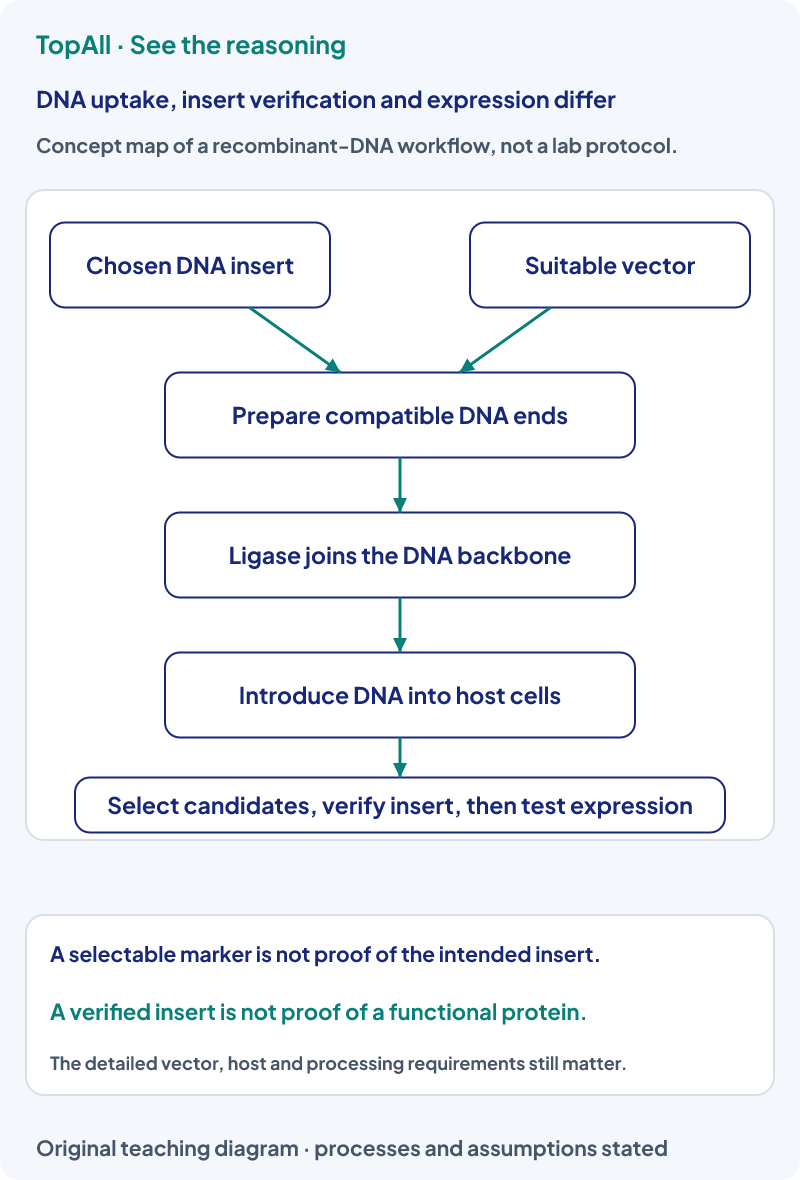
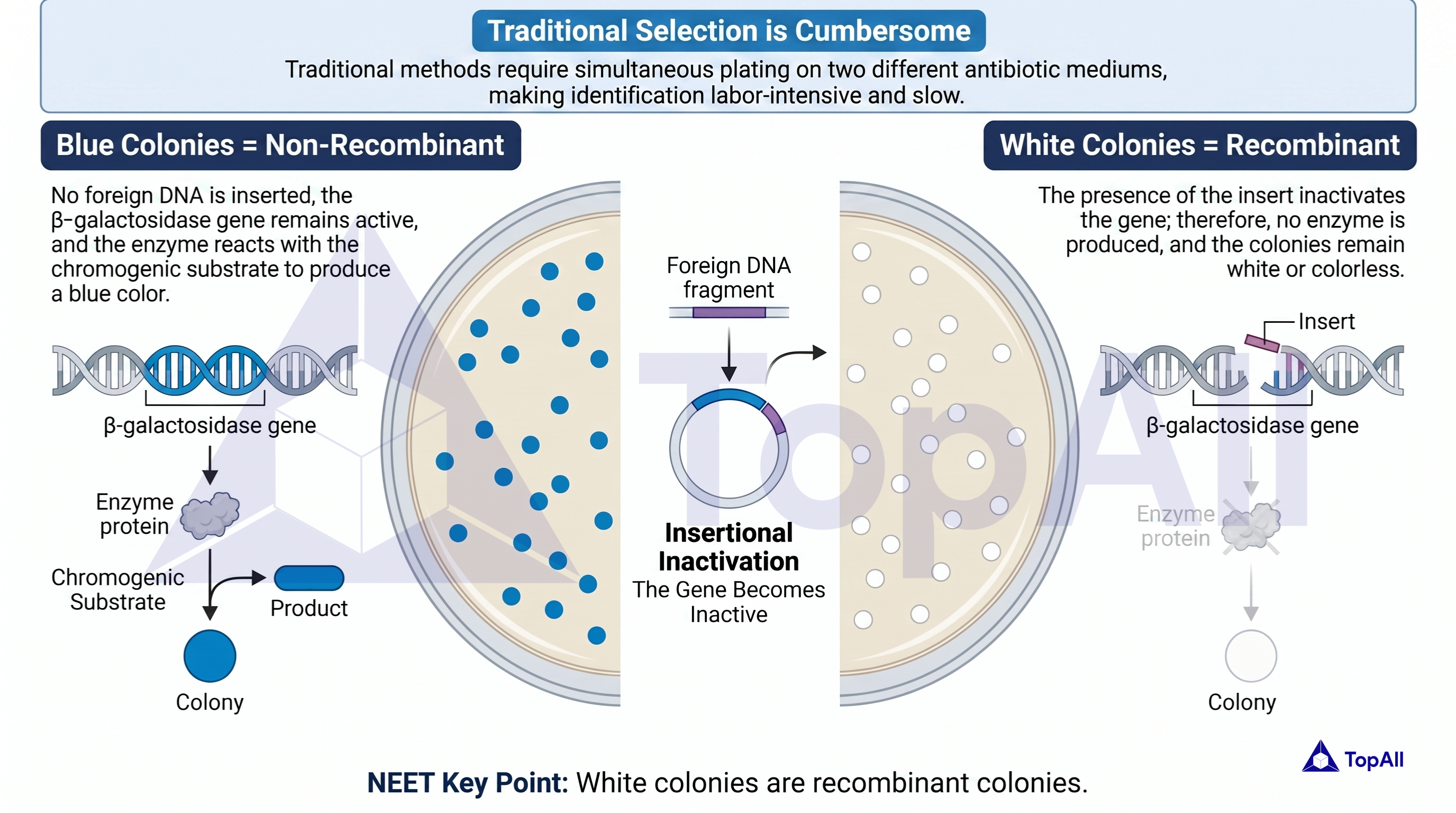
An original question states that host cells grow under a marker-based selection, but the insert has not been checked. The result supports candidate recovery under those selection conditions. It does not establish the insert’s identity, orientation, sequence or expression. A conclusion that the desired protein must already be present skips several evidence stages shown in the workflow.
Complementary overhangs can associate through base pairing, while ligase establishes covalent backbone continuity in the appropriate DNA context. A restriction-enzyme name identifies a recognition and cleavage behaviour, not a universal ability to join any two fragments. Check the ends and the intended product before assigning the enzyme’s role.
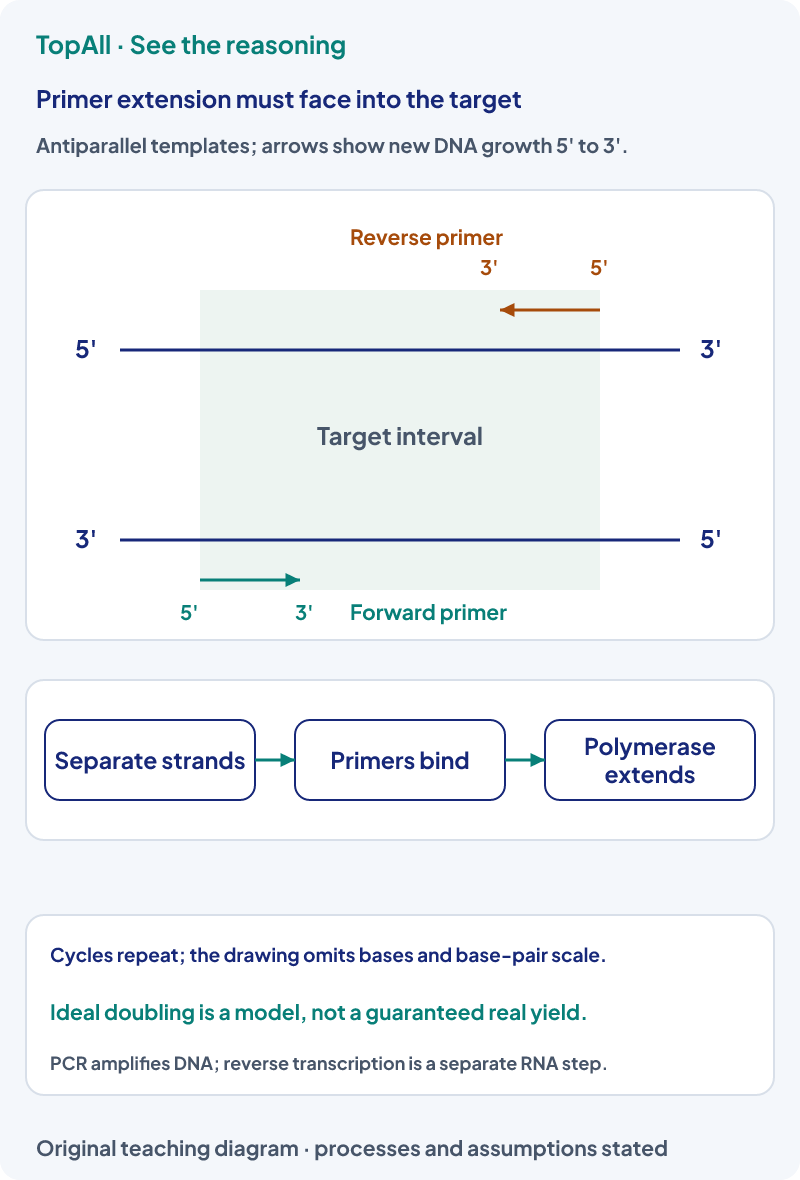
In a supplied ideal model, three counted double-stranded templates are copied successfully in every cycle. gives 3 × 2⁶ = 192 after six cycles, a 64-fold increase. Real amplification can depart from perfect doubling. This count is an ideal copy account, not a guarantee that 192 exact primer-bounded molecules appear when starting from arbitrary long templates; defined-end products have an early-cycle history.
Ordinary PCR uses DNA templates. Reverse transcription can first make complementary DNA from an RNA template before a PCR step. Amplifying a genomic DNA segment is not the same measurement as establishing how much transcript or functional protein was present. Identify the molecule being measured before drawing an expression conclusion.
An original model joins a 6.0 kb vector backbone with one 1.2 kb insert, with no bases removed or added elsewhere. The recombinant length is 7.2 kb. Copying that molecule changes the number of molecules, not the length of each copy. If a restriction-digest question is asked later, use the actual cut-site layout rather than equating molecule length with the number of gel bands.
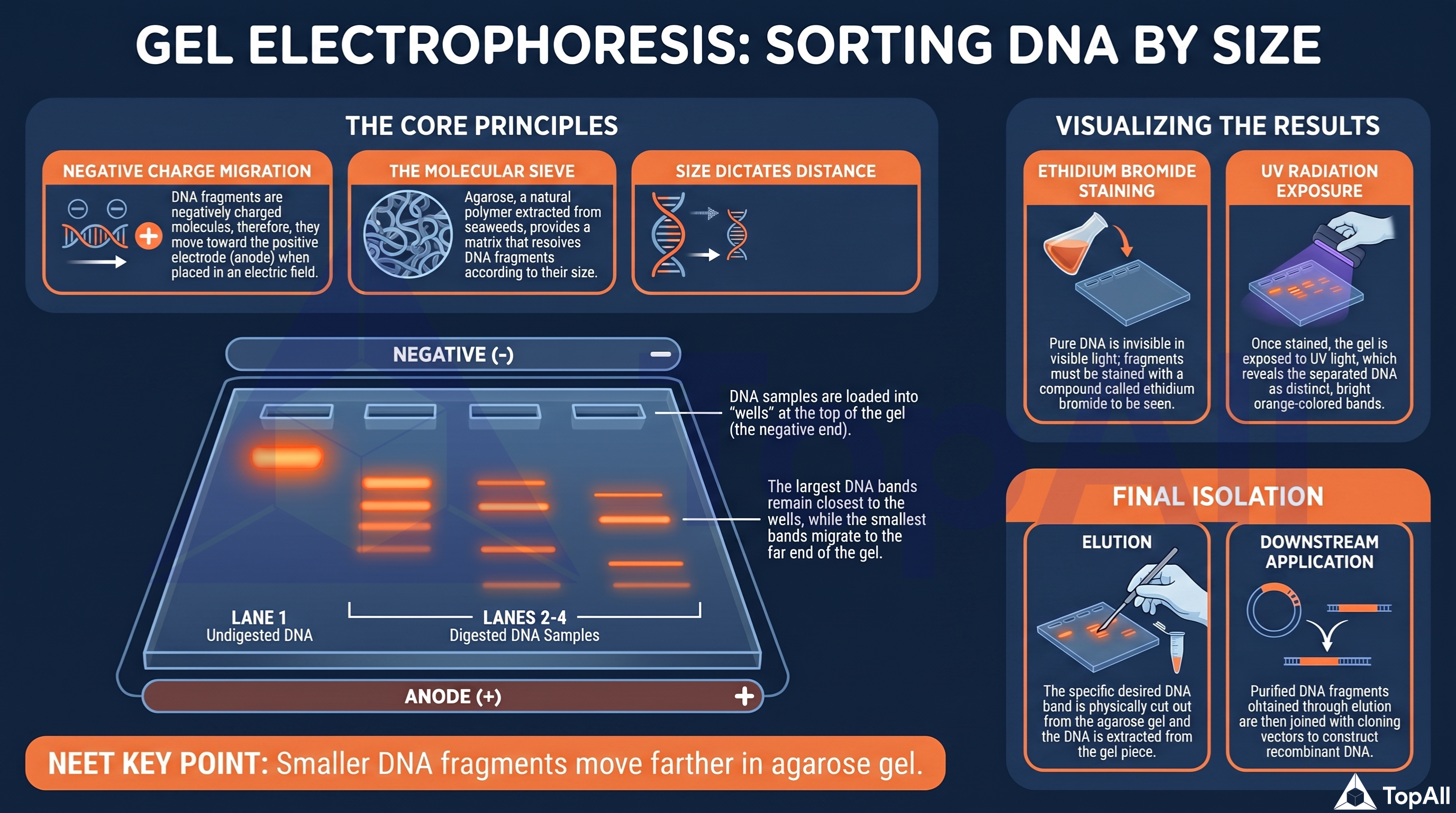
For comparable linear double-stranded DNA fragments under the same gel conditions, smaller fragments generally migrate farther toward the positive electrode. Size standards help interpretation. Different fragments of similar length can occupy the same band, and uncut plasmid forms can migrate differently. One expected-size band alone does not prove sequence identity or correct expression.
For every observation, write the molecule, action and conclusion supported. Keep restriction, ligation, copying, uptake, candidate recovery and verification distinct. For PCR, check primer direction and the copy-count assumptions. For a gel, distinguish size evidence from sequence or function evidence.
Four counted templates undergo four perfect doubling cycles in a supplied model. How many copies result, and how many more is that than the starting count?
The model gives 4 × 2⁴ = 64 copies. The increase is 64 − 4 = 60 copies, while the multiplication factor is sixteen. Final count, increase and factor answer different questions. The calculation does not establish a measured laboratory efficiency.
For an ordinary target interval, a diagram places both primer3′ extension directions away from that interval. Does a claim of perfect doubling repair the orientation problem?
No. The intended ordinary PCR design requires the relevant primer extensions to face across the target interval on opposite strands. A numerical doubling assumption cannot repair a wrong target definition. Other specialised amplification designs have different aims and should not be silently substituted for the stated ordinary model.
For a selected colony, list what remains unknown about the insert and protein. Draw the antiparallel templates and primer directions. Connect construct inheritance to Inheritance and Variation, or follow molecular consequences in Biotechnology Applications.
Practice opens the broad biotechnology principles pool, not a PCR-only set.
Technical review: Codex (automated), 24 October 2026. Core mechanisms were compared with the linked primary textbooks and university or government references. All diagrams, problem inputs and explanations are original. Numerical balances and diagram directions are checked separately. Independent human subject review is not claimed. These focused guides support the existing chapter catalogue; they do not claim complete current exam or syllabus coverage.
Choose a tool-role question after stating its action, or a numerical question after stating its model. Identify exactly which result would justify the next conclusion.

