NEET UG · Video
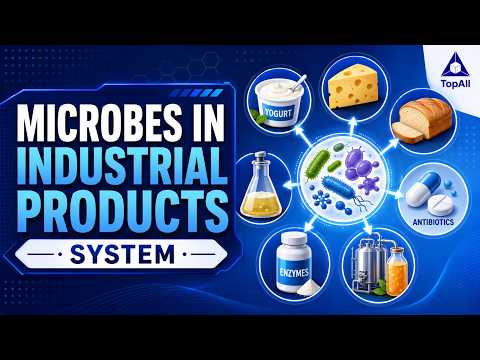
Microbes in Industrial Products
Study microbes in industrial products clearly for NEET UG with TopAll.
5 min video

NEET UG · Biology
Revise the concepts. Try a question. Understand your next step.
35 easy questions available · Try answers free. Sign in to save progress or take a quiz.
NEET UG · Biology
Understand the concept, practise questions and check your learning.
Understand
Match microbial roles, separate aeration and anaerobic digestion and interpret BOD reduction with the correct denominator. Useful microbes: distinguish the product, process and oxygen context
Read the guidePractise
Try 35 easy chapter MCQs. Untimed; check answers and available explanations as you go.
Practise chapter MCQsCheck your learning
Prepare a timed chapter quiz. Choose the available question count and pace before starting.
Prepare a chapter quizThis is chapter practice, not a full-length NEET mock paper.
These are playable question counts after quality and duplicate checks.
The practice player uses single-correct-answer MCQs. Chapter quizzes are not full-length NEET mock papers. Check the practice guide and official syllabus sources.
Revise before you practise
NEET UG · Video
Study microbes in industrial products clearly for NEET UG with TopAll.
5 min video
NEET UG · Video
Learn microbes as biofertilisers and their uses for NEET UG with TopAll.
6 min video
NEET UG · Video
Study microbes as biocontrol agents clearly for NEET UG with TopAll.
5 min video
NEET UG · PDF notes
Read PDF · 9 pages →Learn microbes as biofertilisers and their uses for NEET UG with TopAll.
9 pages
NEET UG · PDF notes
Read PDF · 10 pages →Study microbes as biocontrol agents clearly for NEET UG with TopAll.
10 pages
NEET UG · PDF notes
Read PDF · 9 pages →Learn how microbes help in biogas production for NEET UG with TopAll.
9 pages
NEET UG · Mind map
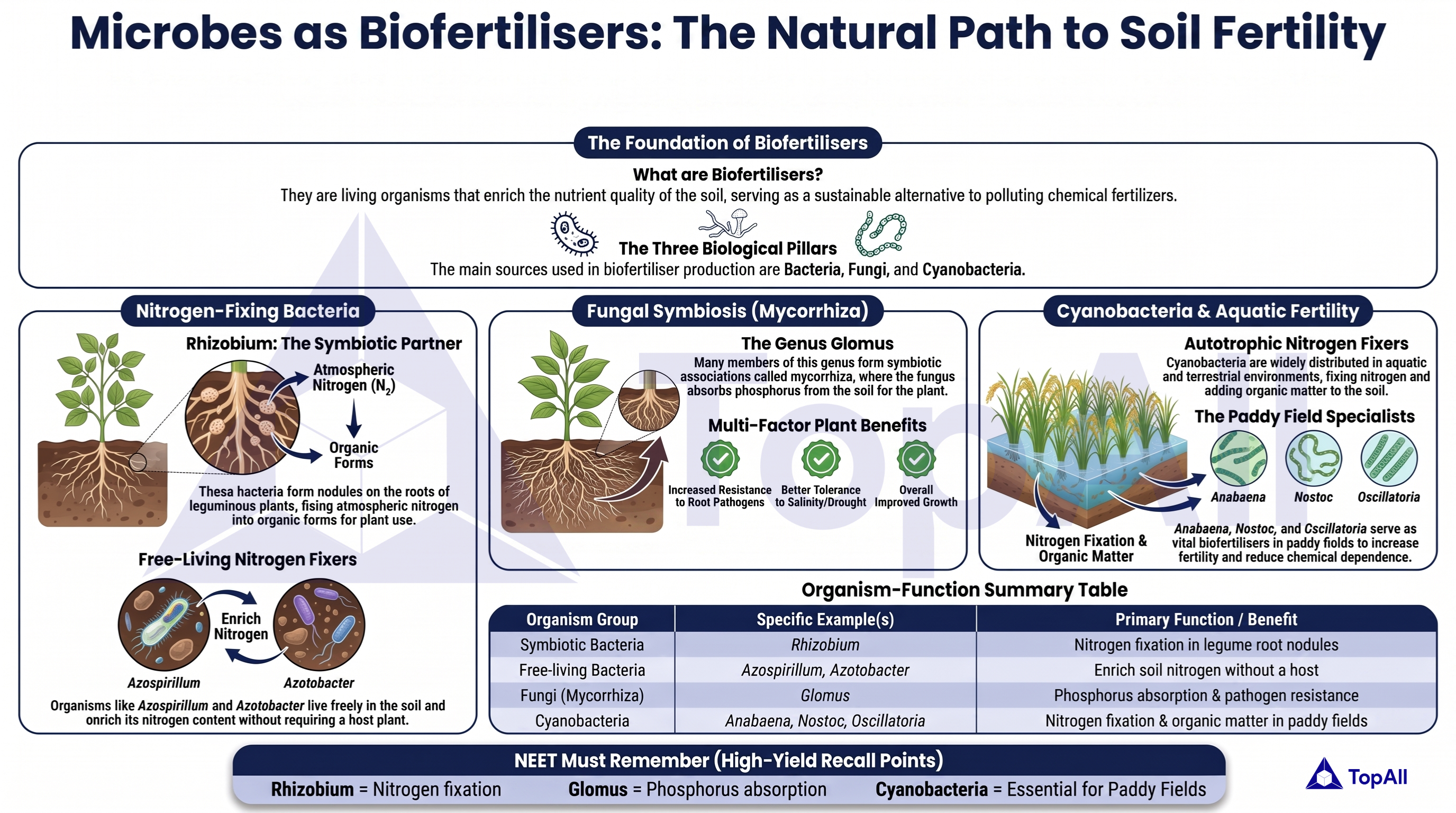
Learn microbes as biofertilisers and their uses for NEET UG with TopAll.
NEET UG · Mind map
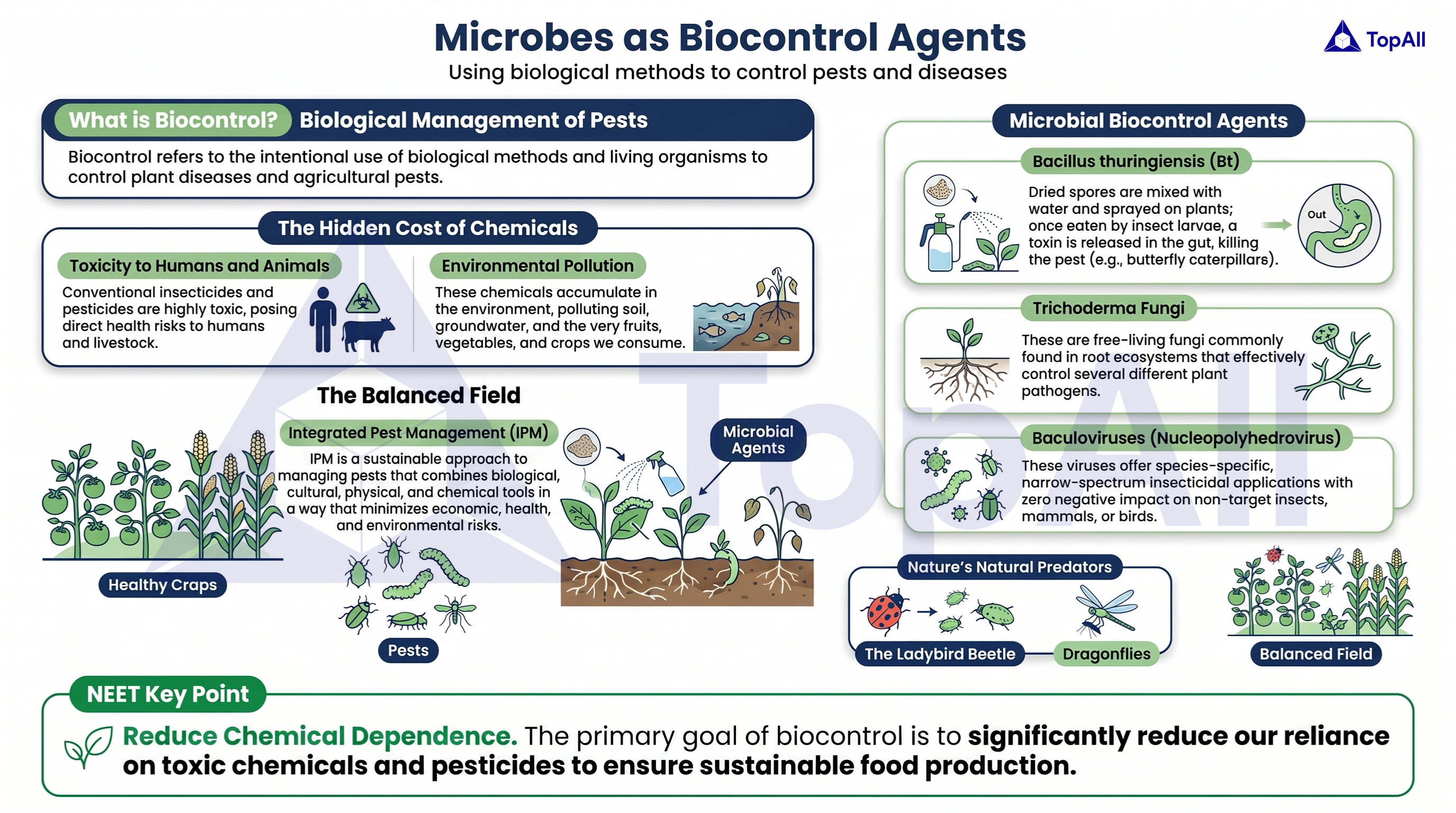
Study microbes as biocontrol agents clearly for NEET UG with TopAll.
NEET UG · Mind map
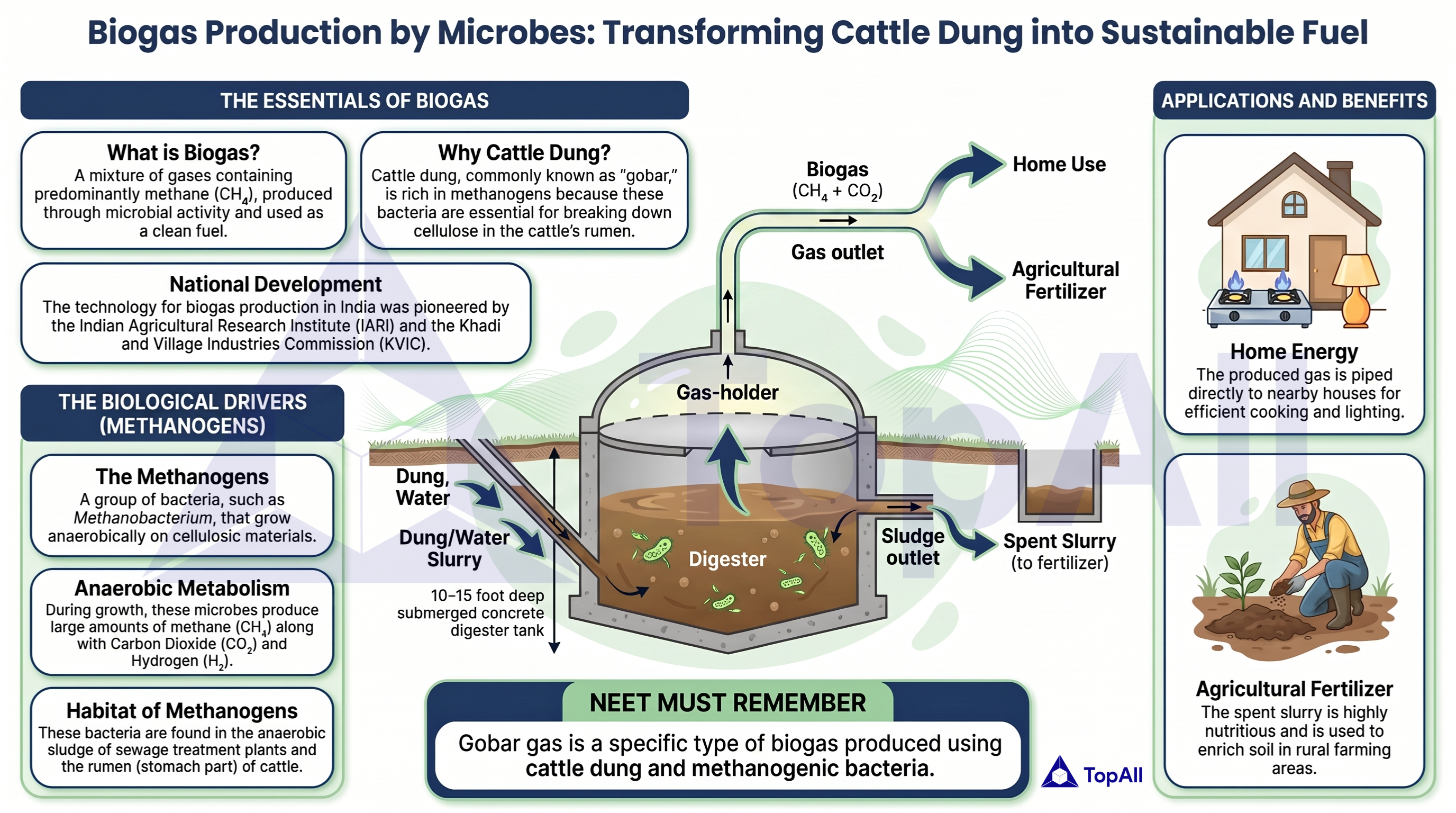
Learn how microbes help in biogas production for NEET UG with TopAll.
Match microbial roles, separate aeration and anaerobic digestion and interpret BOD reduction with the correct denominator.
For NEET UG Biology students: match microbes to products, separate aerobic treatment from anaerobic digestion and interpret a BOD change without inventing a safety conclusion.
A useful microbial example connects a group to an action in specified conditions. Yeast carbon dioxide can contribute to dough rising, while acidification is central to curd formation. An aerated treatment tank and an anaerobic digester have different oxygen contexts. A name associated with one useful role is not a claim that every strain performs every role safely.
Original comparable test results are 200 mg/L before a treatment stage and 40 mg/L after it. The decrease is 160 mg/L, or 80% of the initial result. Forty is the remaining demand result, not40% removal. These supplied measurements do not establish the absence of pathogens, metals or every other pollutant.
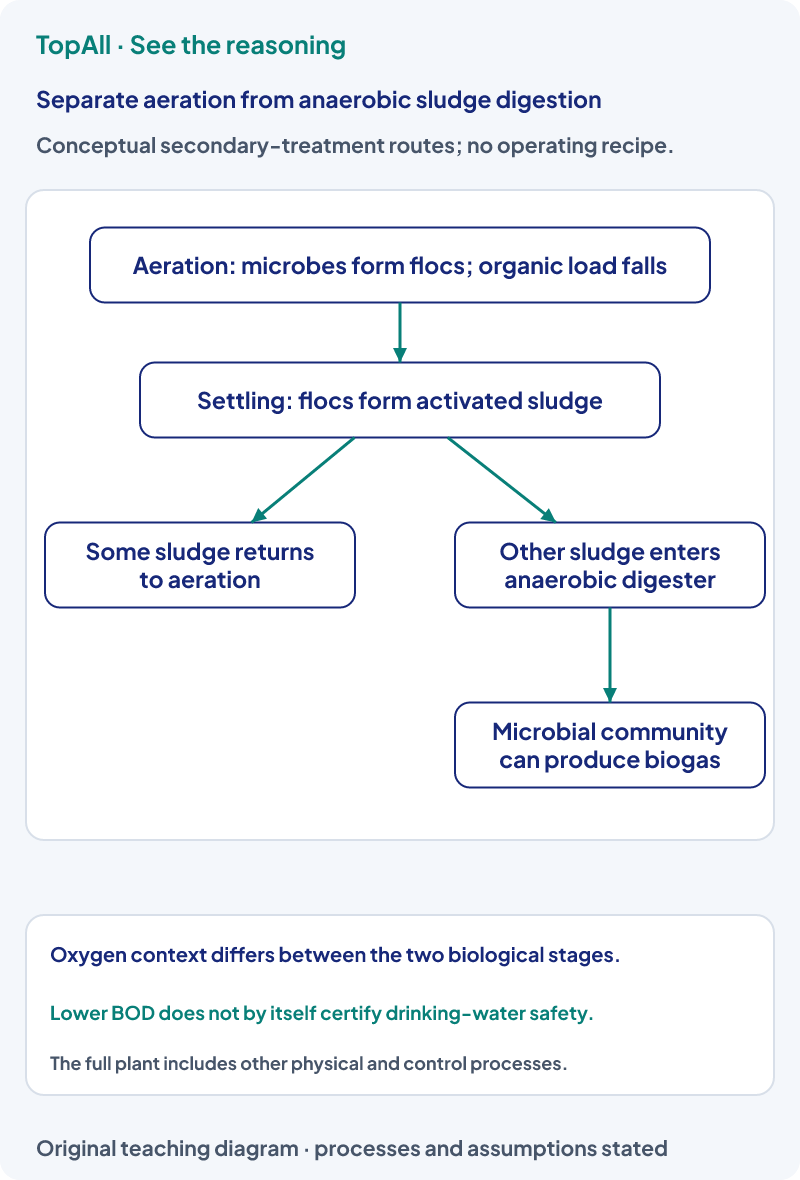
Screening and sedimentation remove selected physical materials. Biological secondary treatment changes organic matter through microbial activity under the relevant conditions. Settling flocs and digesting sludge do different jobs. A complete treatment system requires more information than one diagram, so a question’s stated stage should stay visible in the explanation.
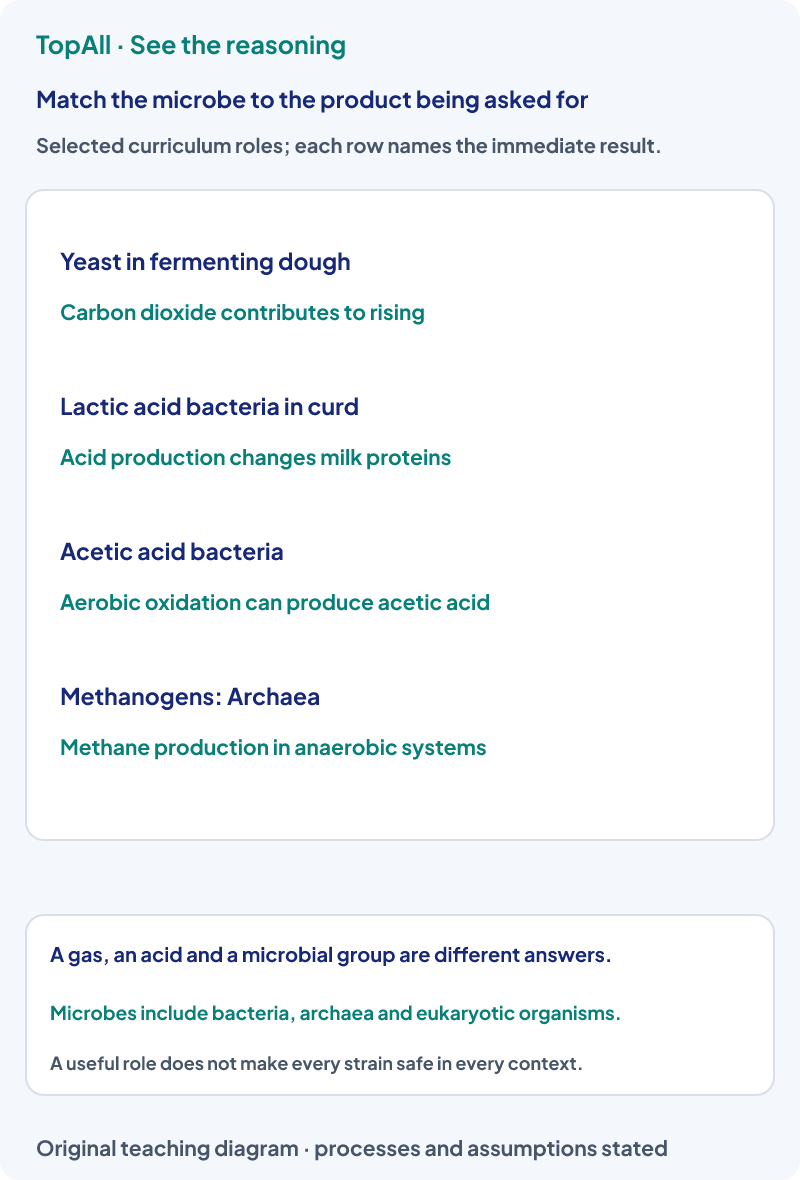
An original question asks what directly contributes to the expansion of fermenting dough and offers ethanol as a tempting fermentation-associated answer. Carbon dioxide is the relevant gas. Ethanol and carbon dioxide can belong to the same yeast fermentation account, but the question asks about expansion rather than every product. Match the physical effect to the requested product.
Aerobic respiration and anaerobic processes are different metabolic contexts. The acetic acid bacterial oxidation example should not be silently assigned the same oxygen requirement as yeast alcoholic fermentation or a methanogenic digester. A generic instruction to add oxygen to every useful-microbe example would erase the mechanism that distinguishes them.
A proposed explanation places the methane-producing community in the vigorously oxygenated floc stage simply because both stages contain microbes. The textbook concept assigns biogas production to the anaerobic digestion context. Microbial presence alone does not tell you the product. The figure separates the oxygen contexts to prevent that shortcut.
A biocontrol example concerns reducing the effect of a target organism through the relevant biological interaction. A biofertiliser example concerns nutrient availability or associated biological processes. The category is defined by the role being asked about, not merely by whether the organism is microscopic. The same broad group can contain organisms with different roles.
Check group, product, oxygen context and measured outcome. Keep BOD demand separate from dissolved oxygen present and from safety certification. Avoid assuming all fungi are harmful or all bacteria are useful. A catalogue question should be answered from its actual mechanism rather than a positive or negative label attached to all microbes.
A supplied comparable BOD result falls from 150 to 30 mg/L. Find the percentage decrease.
The decrease is 120 and the percentage is 120/150 × 100 = 80%. Thirty is 20% of the original result. This calculation concerns the supplied demand measurement; it does not certify total pollutant removal or potability.
A question asks whether a methane-producing methanogen belongs to Bacteria merely because its genus name includes “bacterium”. Is the name sufficient?
No. Methanogens are Archaea in modern classification. A historical genus name is not a reliable shortcut to domain membership. Use the biological classification rather than interpreting a word fragment as a taxonomic proof.
Explain the different oxygen contexts and calculate a removal percentage with its original denominator. Follow propagation and selection in Food Production, or compare host responses in Human Health and Diseases.
Practice opens the broad microbes chapter pool, not a sewage-treatment-only set.
Technical review: Codex (automated), 24 October 2026. Core mechanisms were compared with the linked primary textbooks and university or government references. All diagrams, problem inputs and explanations are original. Numerical balances and diagram directions are checked separately. Independent human subject review is not claimed. These focused guides support the existing chapter catalogue; they do not claim complete current exam or syllabus coverage.
Write organism group→action→product→context. After a numerical error, label the initial measurement, remaining result and percentage decrease separately.

