
NEET UG · Biology
NEET UG · Biology
Transport in plants
Revise the concepts. Try a question. Understand your next step.
102 easy questions available · Try answers free. Sign in to save progress or take a quiz.
NEET UG · Biology
Continue studying Transport In Plants
Understand the concept, practise questions and check your learning.
Understand
Use signed water potentials, pressure changes and source–sink roles to explain plant transport without misleading direction shortcuts. Plant transport: compare water potentials and identify source–sink flow
Read the guidePractise
Try 102 easy chapter MCQs. Untimed; check answers and available explanations as you go.
Practise chapter MCQsCheck your learning
Prepare a timed chapter quiz. Choose the available question count and pace before starting.
Prepare a chapter quizThis is chapter practice, not a full-length NEET mock paper.
No revision resources are published for this chapter yet. Use your textbook alongside the guide and practice.
Choose your practice
All Biology chapters →These are playable question counts after quality and duplicate checks.
How practice and quizzes work
The practice player uses single-correct-answer MCQs. Chapter quizzes are not full-length NEET mock papers. Check the practice guide and official syllabus sources.
Revise before you practise
Study resources 0
No revision resources are published for this chapter yet. Use your textbook alongside the available practice questions.
Plant transport: compare water potentials and identify source–sink flow
Use signed water potentials, pressure changes and source–sink roles to explain plant transport without misleading direction shortcuts.
What you will understand
For NEET UG Biology students: compare signed water potentials, test pressure effects and explain source-to-sink movement without guessing an up-or-down rule.
Quick answer: total potential decides water movement
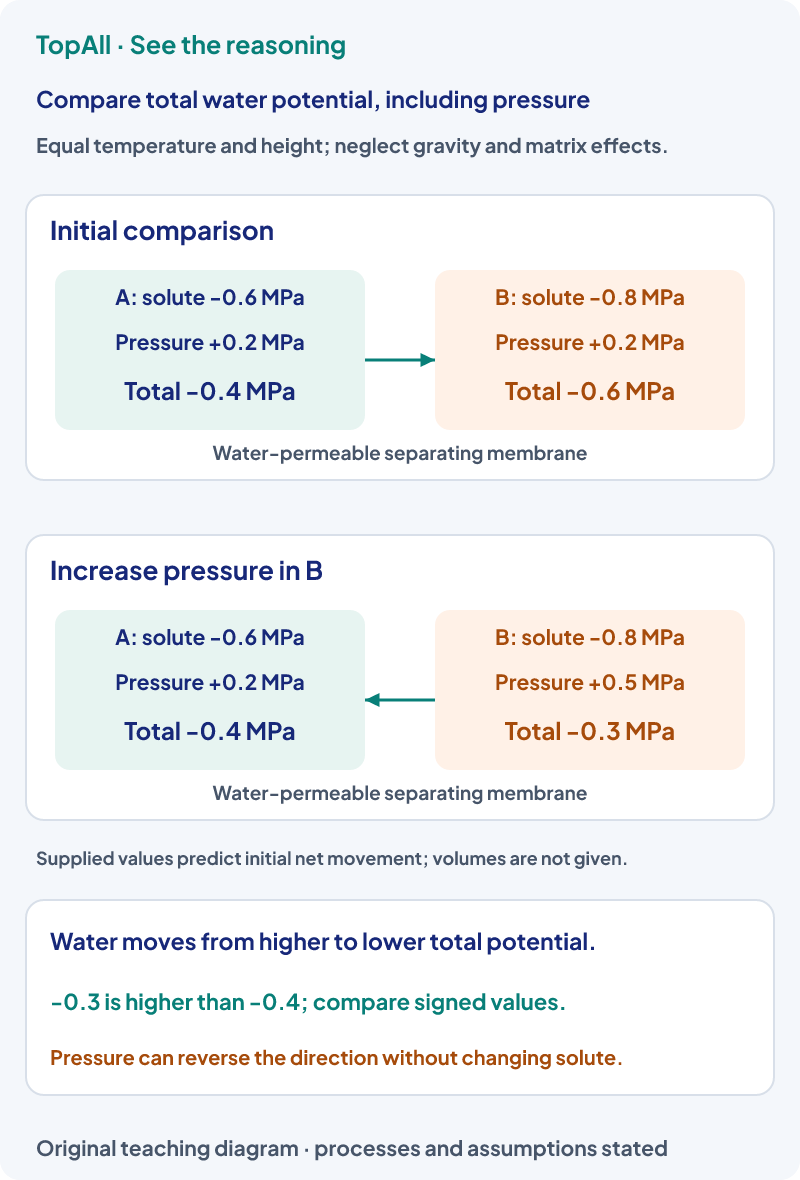
Across a water-permeable connection, initial net water movement follows higher total water potential toward lower total water potential. Solute potential alone is insufficient if pressure differs. For the small, equal-height examples here, gravity and matric contributions are neglected. In long-distance transport, distinguish water movement associated with xylem from sugar-containing sap movement through phloem.
Predict a reversal when only pressure changes
Add the signed terms before comparing compartments
Use for the stated simplified model. X has −0.9 MPa solute potential and +0.4 MPa pressure, so its total is −0.5 MPa. Y has −0.6 MPa and zero pressure, total −0.6 MPa. Water initially moves X→Y across a water-permeable membrane because −0.5 is higher than −0.6. Comparing only solute values would give the wrong direction.
Separate a driving difference from a measured rate
Equal total water potentials give no net water movement at equilibrium, although molecular exchange continues. A potential difference alone does not specify how fast water crosses: permeability and the physical pathway matter. Similarly, a transpiration pull explanation concerns tension transmitted through a cohesive water column, not each water molecule being actively pumped up the entire xylem by ATP.
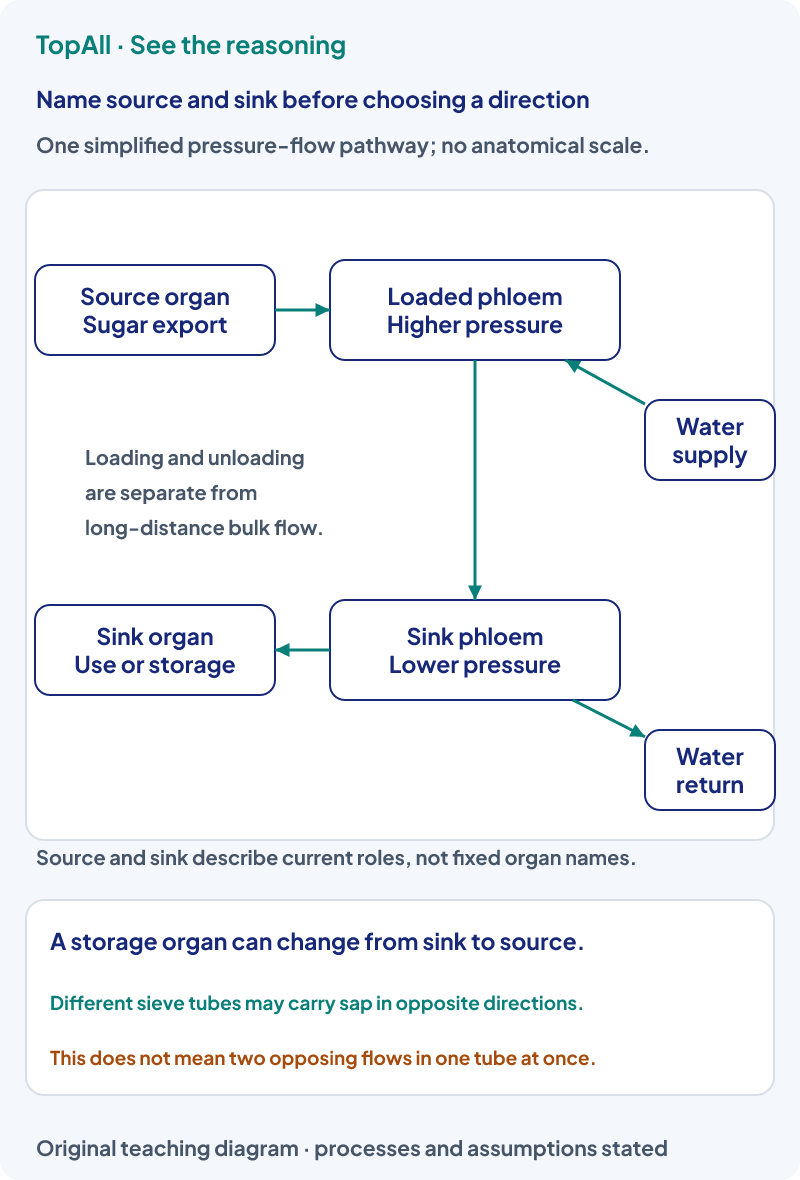
Follow one pressure-flow route from loading to unloading
Explain why a storage organ can reverse its role
During storage accumulation, an underground organ receiving sugars acts as a sink. During renewed growth, mobilisation of its stored carbon can make it a source supplying new shoots. The transport can therefore be upward in one situation and downward in another without changing the definition. Identify what exports and what receives at the stated time, rather than memorising “phloem always goes downward”.
Keep bulk flow separate from membrane transport
Loading and unloading can involve membrane transport and metabolic work. Once a pressure difference exists, long-distance phloem sap movement is bulk flow. Root ion uptake, osmotic water entry and xylem transport are also distinct steps. An ATP requirement at one membrane does not mean that every centimetre of water or sap movement is produced by a separate ATP-driven pump.
Find the pressure needed to balance a model
A fixed reference compartment has total potential −0.35 MPa. A model cell has solute potential −0.80 MPa. Neglect other contributions and ask what pressure gives the same total: −0.80 + P = −0.35, so P = +0.45 MPa. This is a target state calculation; without cell volume and solute-change information it does not predict how an initially different cell reaches that state.
Interpret a transpiration observation with its controls
A change in water loss after changing humidity is an observation, not an automatic proof that humidity was the only variable. Keep leaf area, temperature, light, air movement and plant condition comparable in a model experiment. Stomatal behaviour also changes gas exchange. A single environmental label cannot replace the actual conditions supplied in an MCQ.
Common mistakes: compare magnitudes or fix organ roles
For negative potentials, the number closer to zero is higher. Add pressure before deciding direction. Distinguish initial net flow from final equilibrium. For phloem, label source and sink for the stated developmental stage; do not infer the direction from “leaf”, “root”, “up” or “down” alone.
Try it: find equal totals with unequal solutes
A has solute potential −0.7 MPa and pressure +0.3 MPa. B has solute potential −0.4 MPa and zero pressure. With a water-permeable membrane and neglected other terms, what is the initial net direction?
Reveal the answer
Both totals are −0.4 MPa, so this model predicts no initial net water movement. The solute components differ but their total driving potentials are equal. Molecules still exchange; equilibrium does not mean that water molecules stop moving.
Try it: interpret opposing phloem arrows
A diagram shows sap travelling toward a growing shoot in one sieve tube and toward a root sink in a different tube. Does that contradict source-to-sink flow?
Reveal the answer
No. Both paths can run from their current source toward a sink. Different tubes can have different directions. The diagram should not be interpreted as two simultaneous opposing bulk flows in one tube. Check which tube each arrow belongs to and which organs are currently exporting or receiving.
Come back tomorrow: solve one sign comparison
Write two solute-plus-pressure accounts, change only one pressure and predict whether the direction reverses. Connect water supply to Photosynthesis, or distinguish ion supply and nutrient roles in Mineral Nutrition.
Practice opens the broad transport catalogue. This legacy chapter label does not assert that it is a separate chapter in the current NCERT edition.
Sources and review
Technical review: Codex (automated), 24 October 2026. Core mechanisms were compared with the linked primary textbooks and university or government references. All diagrams, problem inputs and explanations are original. Numerical balances and diagram directions are checked separately. Independent human subject review is not claimed. These focused guides support the existing chapter catalogue; they do not claim complete current exam or syllabus coverage.
Choose your next chapter task
For a water-potential error, write the signed totals first. For a direction error, label the current source, sink and transport pathway before returning to practice.
Sources and reading
- OpenStax Biology 2e: Transport of Water and Solutes in Plants — Water potential components and direction; transpiration-cohesion; source/sink changes and pressure flow. Supplied model neglects gravity and matric effects.
- NCERT Biology: Photosynthesis in Higher Plants (2026–27 reprint) — Sections 11.6–11.9: electron routes, chemiosmosis, Calvin-cycle requirements and C4 comparison.
- NCERT Biology: Respiration in Plants (2026–27 reprint) — Sections 12.2–12.7: glycolysis, fermentation, respiratory locations, balance assumptions and respiratory quotient.