NEET UG · Video

Thyroid Disorders NEET Biology Guide
Understand thyroid disorders and key hormone effects for NEET UG using TopAll.
5 min video

NEET UG · Biology
Revise the concepts. Try a question. Understand your next step.
149 easy questions available · Try answers free. Sign in to save progress or take a quiz.
NEET UG · Biology
Understand the concept, practise questions and check your learning.
Understand
Trace hormone synthesis and release, compare receptor locations and predict feedback under explicit thyroid, glucose and water-balance assumptions. Hormonal coordination: separate source, receptor and negative feedback
Read the guidePractise
Try 149 easy chapter MCQs. Untimed; check answers and available explanations as you go.
Practise chapter MCQsCheck your learning
Prepare a timed chapter quiz. Choose the available question count and pace before starting.
Prepare a chapter quizThis is chapter practice, not a full-length NEET mock paper.
These are playable question counts after quality and duplicate checks.
The practice player uses single-correct-answer MCQs. Chapter quizzes are not full-length NEET mock papers. Check the practice guide and official syllabus sources.
Revise before you practise
NEET UG · Video
Understand thyroid disorders and key hormone effects for NEET UG using TopAll.
5 min video
NEET UG · Video
Study pituitary hormone disorders and major effects for NEET UG using TopAll.
6 min video
NEET UG · Video
Learn chemical classes of hormones with simple clarity for NEET UG using TopAll.
5 min video
NEET UG · PDF notes
Read PDF · 11 pages →Master the pituitary gland and its major hormones for NEET UG using TopAll.
11 pages
NEET UG · PDF notes
Read PDF · 10 pages →Understand thyroid disorders and key hormone effects for NEET UG using TopAll.
10 pages
NEET UG · PDF notes
Read PDF · 9 pages →Study pituitary hormone disorders and major effects for NEET UG using TopAll.
9 pages
NEET UG · Mind map
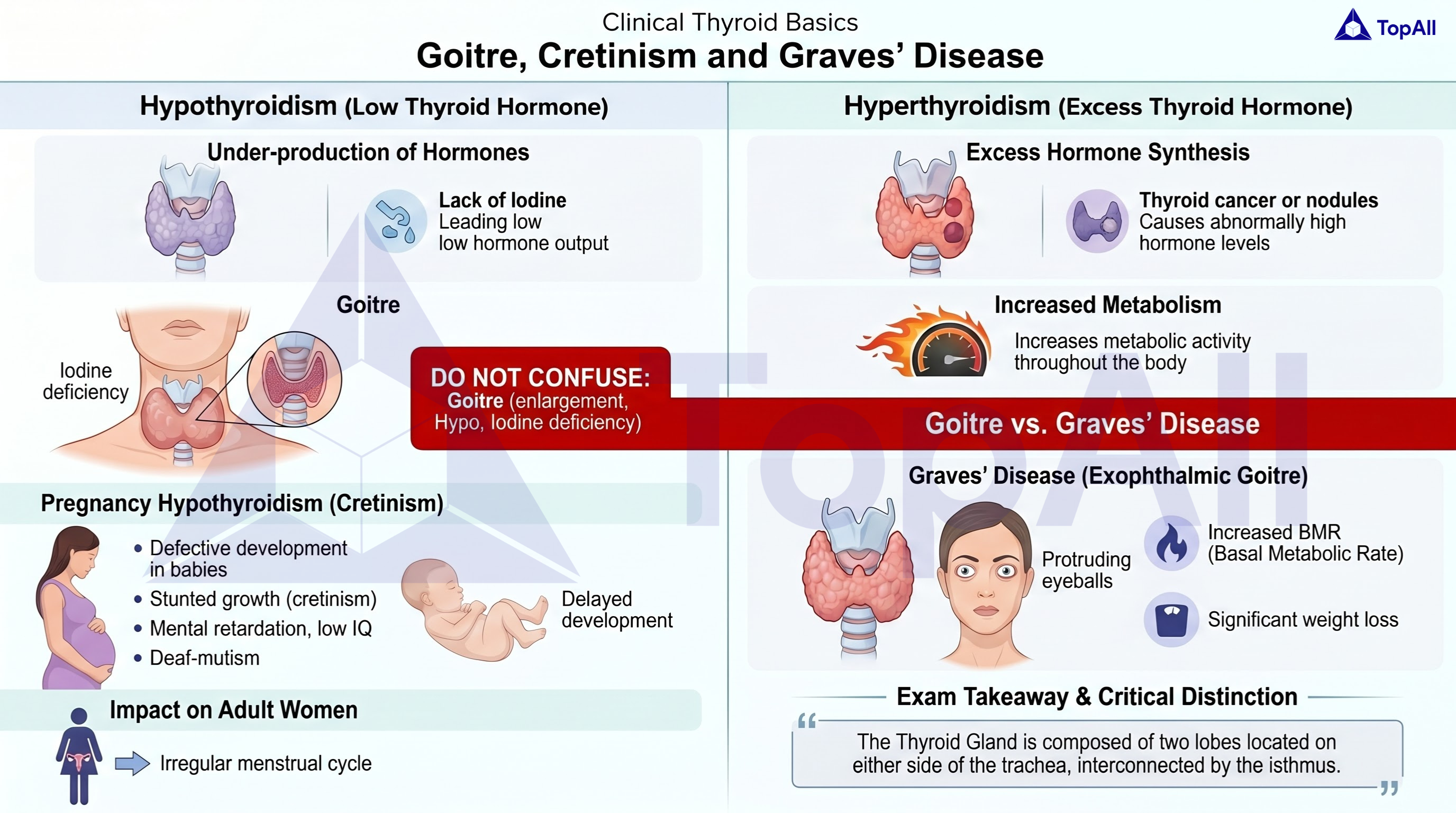
Understand thyroid disorders and hormone effects for NEET UG with TopAll.
NEET UG · Mind map
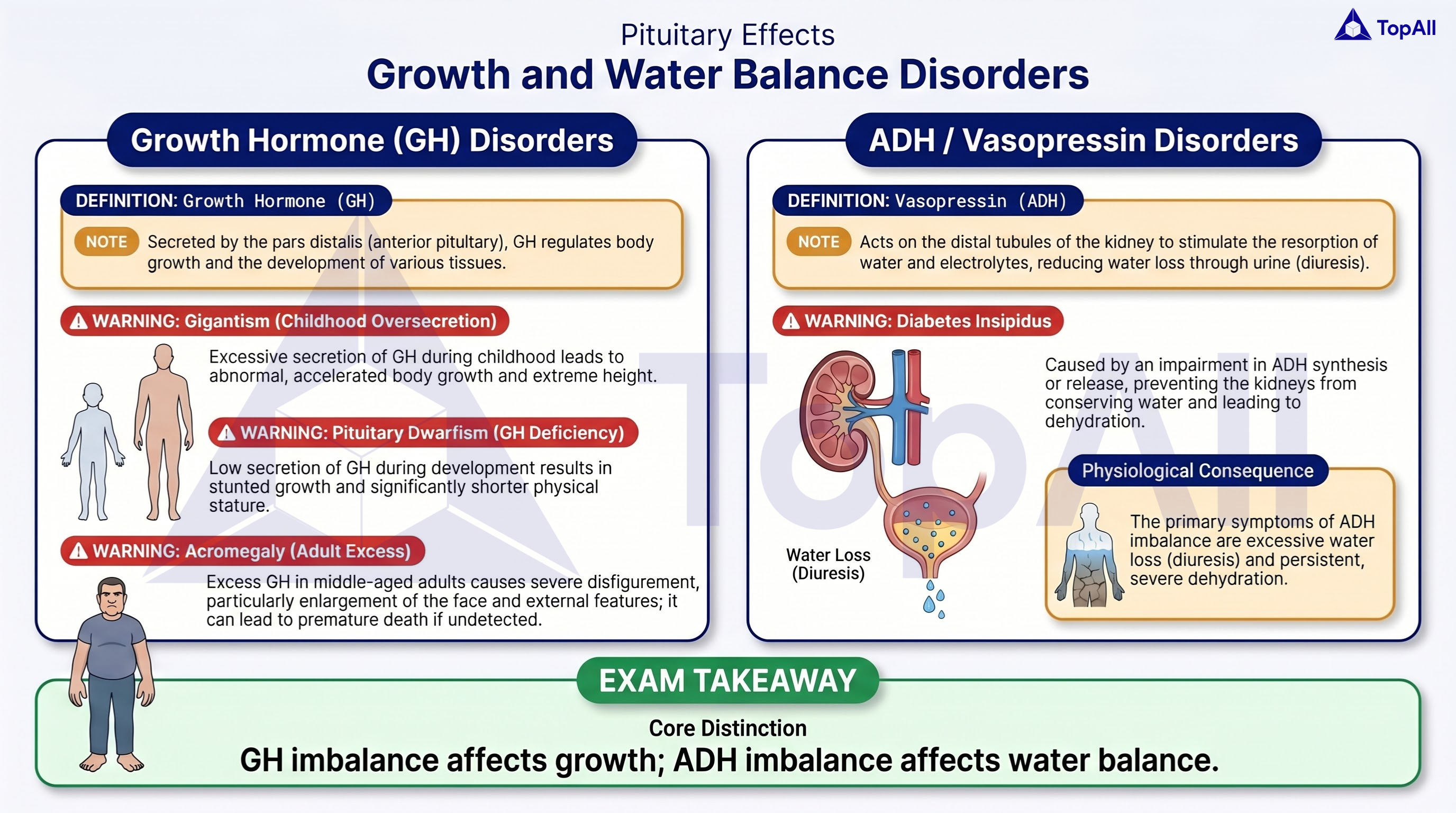
Study pituitary hormone disorders and effects for NEET UG with TopAll.
NEET UG · Mind map
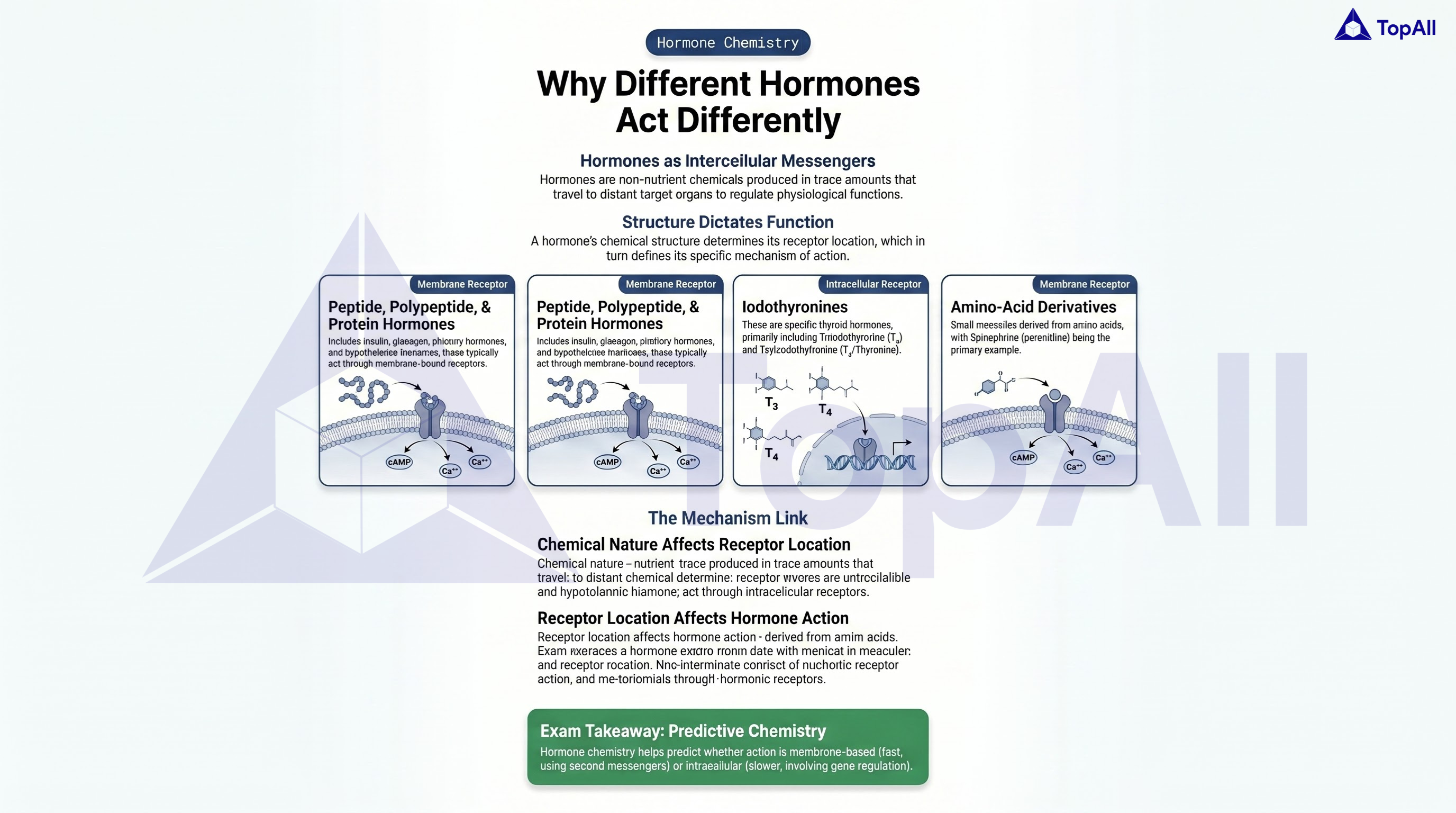
Learn chemical classes of hormones with examples for NEET UG with TopAll.
Trace hormone synthesis and release, compare receptor locations and predict feedback under explicit thyroid, glucose and water-balance assumptions.
For NEET UG Biology students: separate hormone synthesis, release and action, predict a negative-feedback response and locate the receptor without assuming that every hormone of one chemical class uses an identical pathway.
Hormones are intercellular messengers, and a target’s response depends on the appropriate receptor and signalling machinery. The synthesis site, storage or release site and target tissue need not be the same. An endocrine gland releases into internal fluid rather than through an exocrine duct. A useful MCQ method is to identify four links: where the hormone is made, where it is released, which cells respond and what feedback changes its further release.
ADH or vasopressin is synthesised in hypothalamic neurosecretory neurons, transported along axons, and stored and released from the posterior pituitary. Its renal actions promote water recovery in responsive distal and collecting segments. Therefore, “released by posterior pituitary” does not imply “synthesised there”. Oxytocin likewise has hypothalamic synthesis and posterior-pituitary storage and release, but it has different targets and actions.
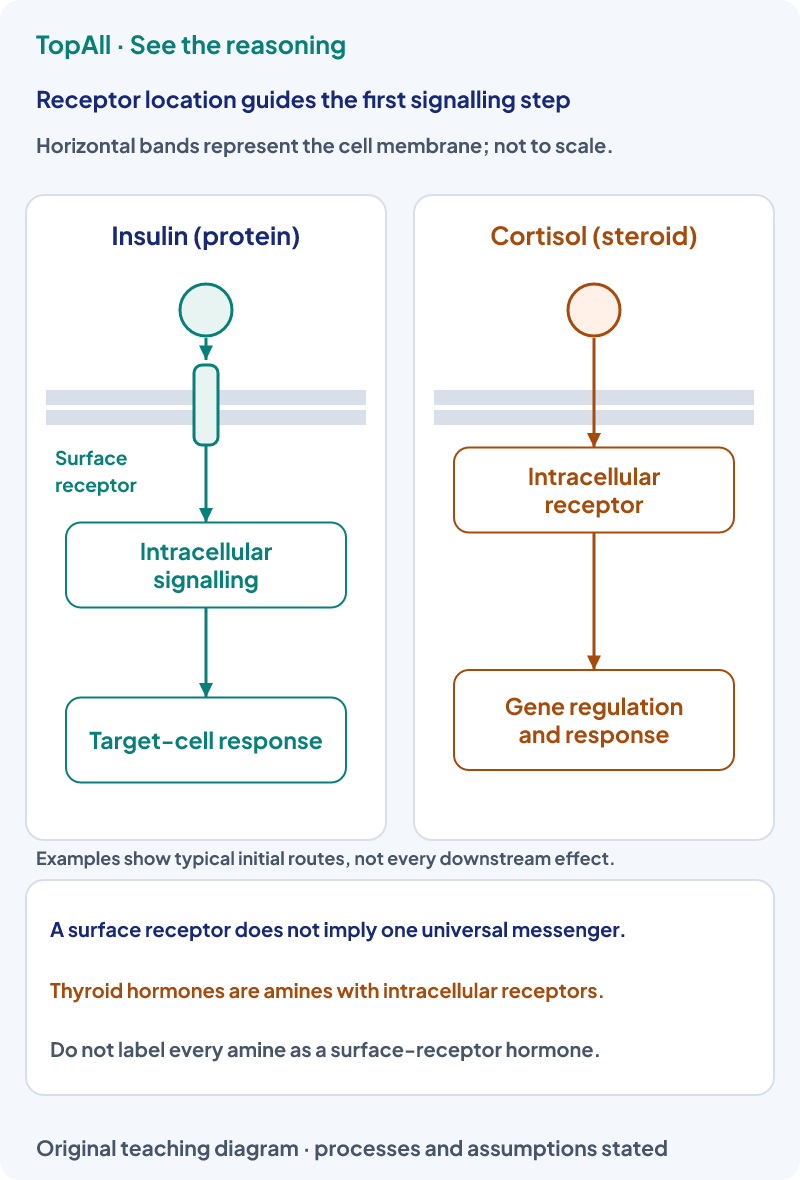
Peptide and protein hormones such as insulin act through cell-membrane receptors and intracellular signalling. Steroids such as cortisol use intracellular receptors and can alter gene expression. This describes typical initial routes, not a rule that membrane signalling can never affect transcription. Iodinated thyroid hormones are amino-acid-derived yet act through intracellular receptors. Some surface pathways use second messengers such as cAMP, but a membrane receptor does not imply that every hormone uses that exact messenger.
After an illustrative rise in blood glucose, pancreatic β cells increase insulin secretion. Insulin supports glucose uptake especially in muscle and adipose tissue and promotes storage, including hepatic glycogen formation, tending to lower blood glucose. In a fasting low-glucose setting, α-cell glucagon promotes hepatic glycogen breakdown and gluconeogenesis, tending to raise blood glucose. Glucagon’s liver action is not a claim that skeletal muscle releases its glycogen as free glucose into blood. Reversing α and β cells reverses the stimulus-response map.
Thyroid follicular cells produce iodinated thyroid hormones; parathyroid glands produce parathyroid hormone. These are different structures with different controls. Adrenal cortex produces steroids such as cortisol and aldosterone, while adrenal medulla releases catecholamines such as adrenaline. A nearby location or shared gland name is not evidence of an identical chemical class, receptor location or function.
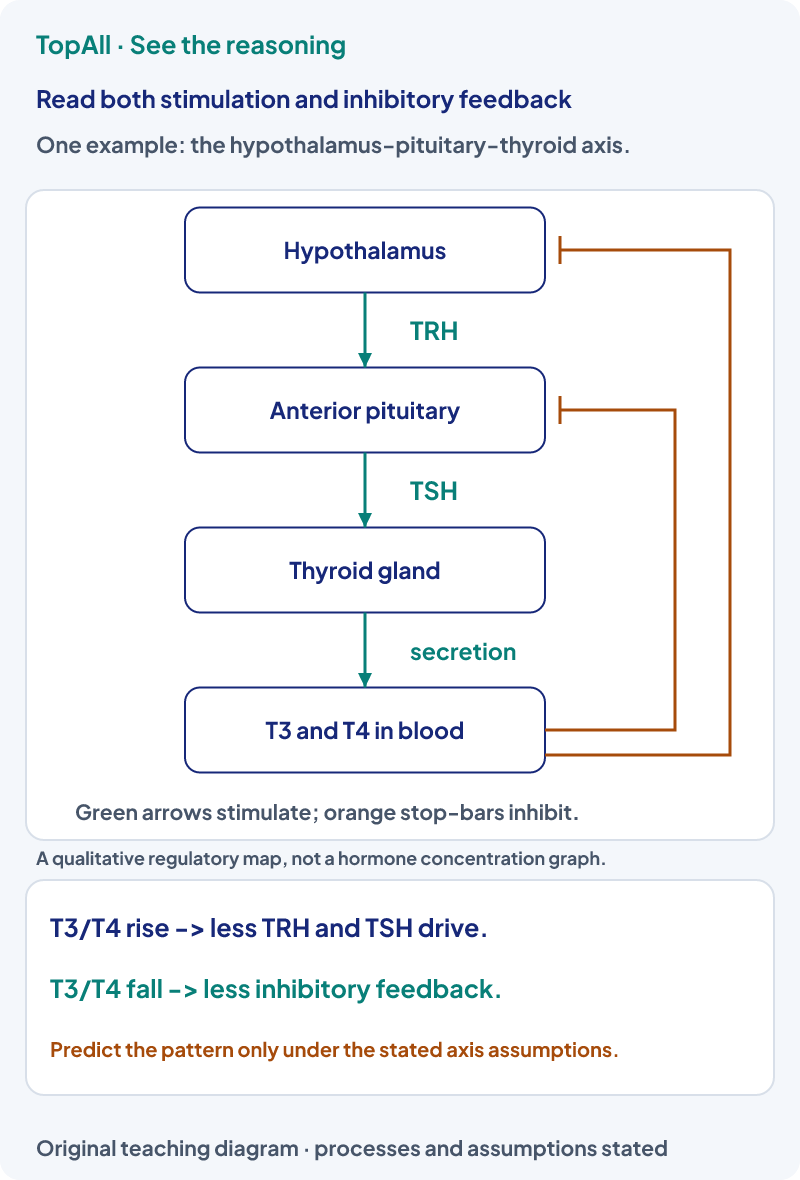
Assume the thyroid’s output falls because of a problem local to that gland, while hypothalamic and anterior-pituitary feedback responses remain functional. Reduced thyroid hormone weakens inhibitory feedback, so TRH and TSH drive tend to rise; TSH does not necessarily restore thyroid output if the gland cannot respond. In contrast, a problem in pituitary TSH secretion need not give the same high-TSH pattern. The conclusion follows the stated location and intact-loop assumptions rather than treating all low-thyroid-output situations as identical.
Negative feedback opposes a change in a regulated variable through the relevant pathway. In the thyroid example, rising thyroid hormones reduce upstream drive. In water regulation, increased ADH-dependent water recovery tends to correct raised osmolarity. In calcium regulation, parathyroid hormone tends to raise blood when its concentration falls. These loops use different stimuli and targets; the existence of one hypothalamic-pituitary axis does not mean that every endocrine gland must be controlled by TSH.
Name the precise source cells and release site, then locate the receptor and the regulated variable. For feedback, identify where a hypothetical defect occurs and which responses remain intact. Keep pancreatic α and β cells distinct, and do not treat every membrane receptor as a cAMP pathway or every amino-acid-derived hormone as membrane-bound.
A statement says, “Every amino-acid-derived hormone binds only to a cell-surface receptor.” Give a textbook counterexample.
Thyroid hormones T₃ and T₄ are iodinated derivatives of tyrosine but act through intracellular receptors. This is enough to disprove “every”. It does not mean that every amine uses an intracellular receptor; catecholamines typically use surface receptors. Decide using the specific hormone rather than the broad chemical-class name alone.
Blood Ca²⁺ falls in a simplified feedback question. Which gland releases the hormone that tends to raise it: thyroid follicular tissue or parathyroid tissue?
Parathyroid tissue releases parathyroid hormone, which tends to raise blood Ca²⁺ through coordinated actions on bone, kidney and intestinal absorption indirectly through activated vitamin D. Thyroid follicular tissue produces T₃/T₄ and is not the source of PTH. A gland’s physical proximity to another does not merge their hormone identities.
For ADH, insulin and TSH, write the synthesis or source cells, release site, target and effect. For one feedback problem, state which link is altered. Use Excretory Products and their Elimination to trace water recovery, or Body Fluids and Circulation to distinguish transport in blood from a cell’s specific response.
Practice opens the broad Chemical Coordination and Integration chapter pool, not a guaranteed thyroid-axis-only set.
Technical review: Codex (automated), 24 October 2026. Definitions and conventions checked against the linked primary textbooks. Numerical examples, self-checks and diagrams are original; calculations and diagram coordinates are checked separately. Human subject review is not claimed. These focused lessons support the existing NEET Biology chapter catalogue and do not claim complete current exam or syllabus coverage.
After a hormone error, check source, release, receptor and feedback separately. State which tissues can still respond before returning to chapter practice.

