NEET UG · Video

Curable vs Incurable STIs Guide
Compare curable and incurable STIs for NEET UG with TopAll.
3 min video

NEET UG · Biology
Revise the concepts. Try a question. Understand your next step.
60 easy questions available · Try answers free. Sign in to save progress or take a quiz.
NEET UG · Biology
Understand the concept, practise questions and check your learning.
Understand
Distinguish IVF, ICSI, GIFT and transfer vocabulary while separating contraceptive mechanisms from other health outcomes. Reproductive health: decode the stage, location and supported outcome
Read the guidePractise
Try 60 easy chapter MCQs. Untimed; check answers and available explanations as you go.
Practise chapter MCQsCheck your learning
Prepare a timed chapter quiz. Choose the available question count and pace before starting.
Prepare a chapter quizThis is chapter practice, not a full-length NEET mock paper.
These are playable question counts after quality and duplicate checks.
The practice player uses single-correct-answer MCQs. Chapter quizzes are not full-length NEET mock papers. Check the practice guide and official syllabus sources.
Revise before you practise
NEET UG · Video
Compare curable and incurable STIs for NEET UG with TopAll.
3 min video
NEET UG · Video
Revise STI and ART concepts in one master card for NEET UG with TopAll.
5 min video
NEET UG · Video
Revise contraceptive methods through a master tree for NEET UG with TopAll.
4 min video
NEET UG · PDF notes
Read PDF · 9 pages →Revise STI and ART concepts in one master card for NEET UG with TopAll.
9 pages
NEET UG · PDF notes
Read PDF · 9 pages →Revise contraceptive methods through a master tree for NEET UG with TopAll.
9 pages
NEET UG · PDF notes
Read PDF · 9 pages →Memorise key numbers and years in reproductive health for NEET UG with TopAll.
9 pages
NEET UG · Mind map
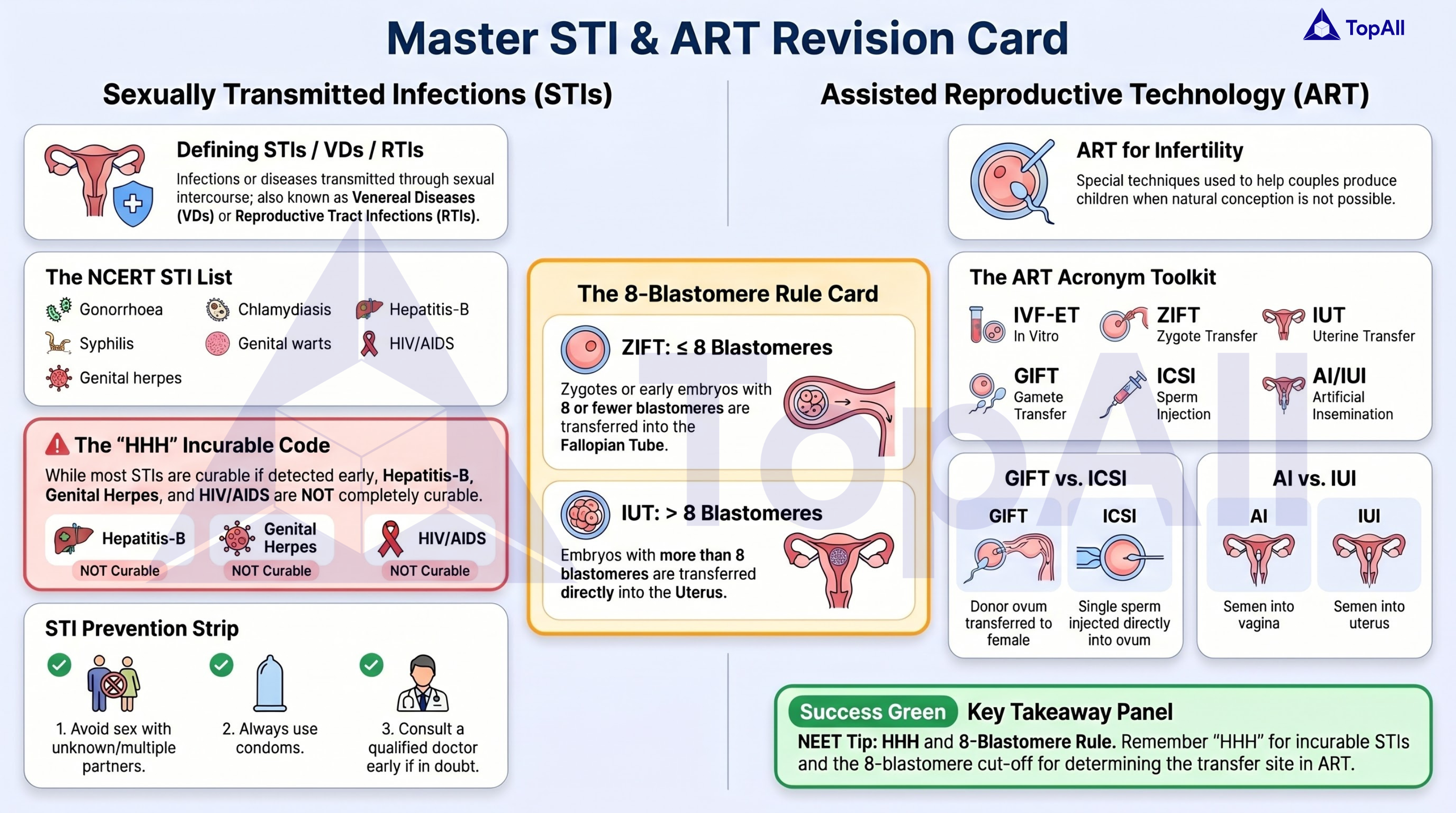
Revise STI and ART concepts in one master card for NEET UG with TopAll.
NEET UG · Mind map
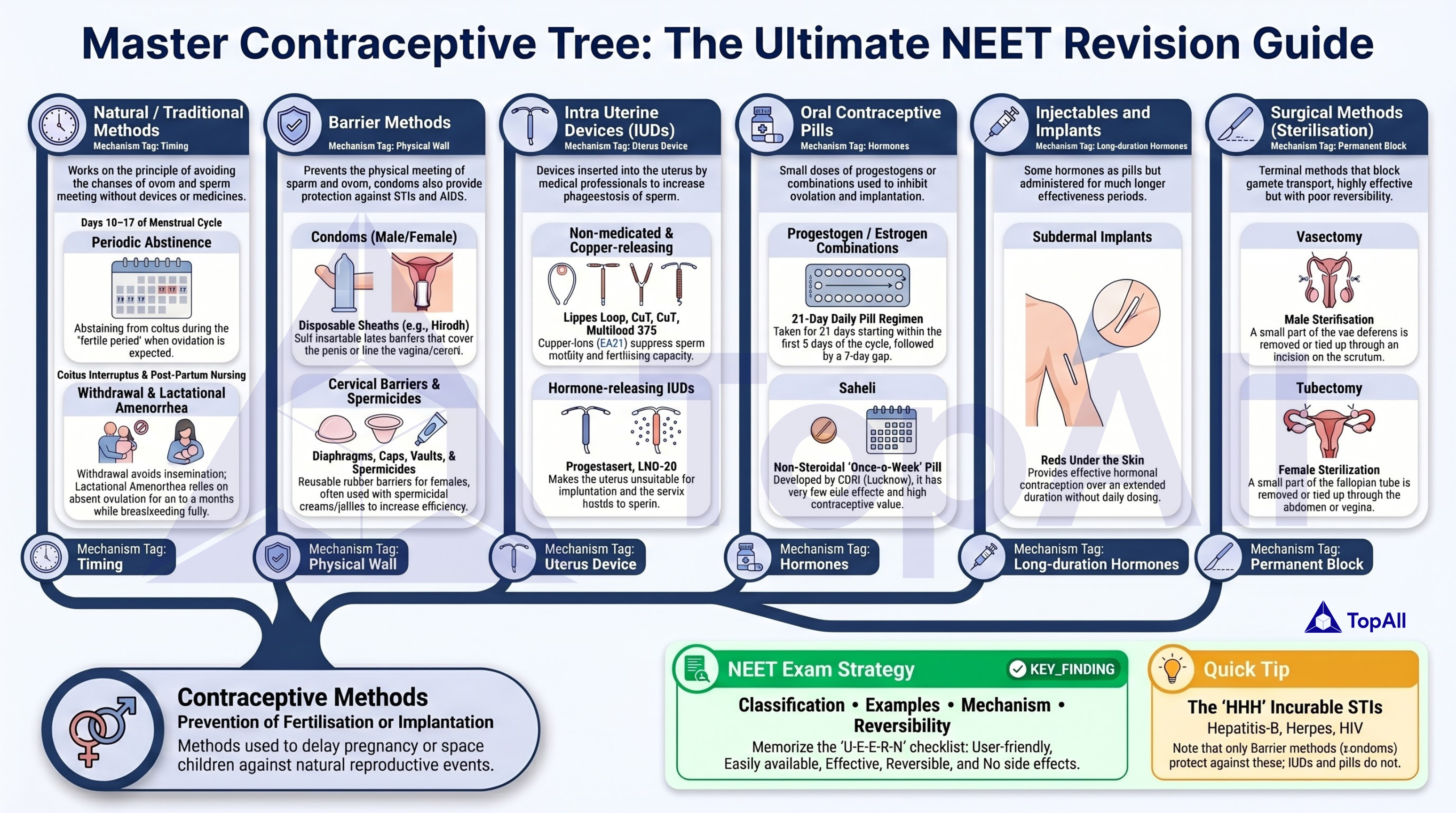
Revise contraceptive methods through a master tree for NEET UG with TopAll.
NEET UG · Mind map
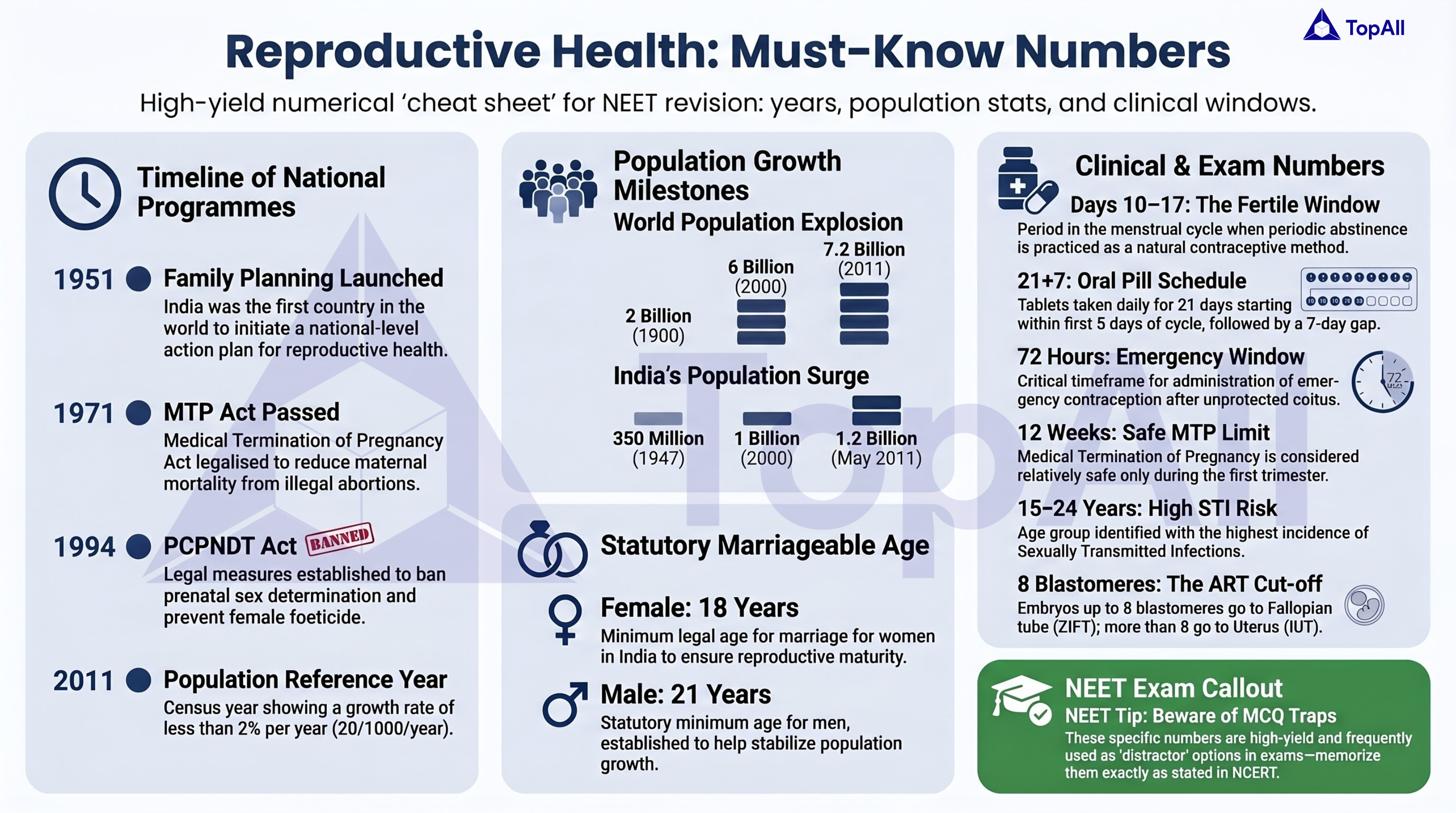
Memorise key numbers and years in reproductive health for NEET UG with TopAll.
Distinguish IVF, ICSI, GIFT and transfer vocabulary while separating contraceptive mechanisms from other health outcomes.
For NEET UG Biology students: decode assisted-reproduction terms by stage and location, and distinguish a contraceptive mechanism from the outcome it can support.
IVF names fertilisation outside the body, while later embryo transfer and implantation are separate stages. ICSI concerns sperm introduction into an oocyte in a laboratory fertilisation pathway. GIFT transfers gametes to a fallopian tube, with fertilisation intended in the body. Introducing semen into the reproductive tract is not itself in-vitro fertilisation.
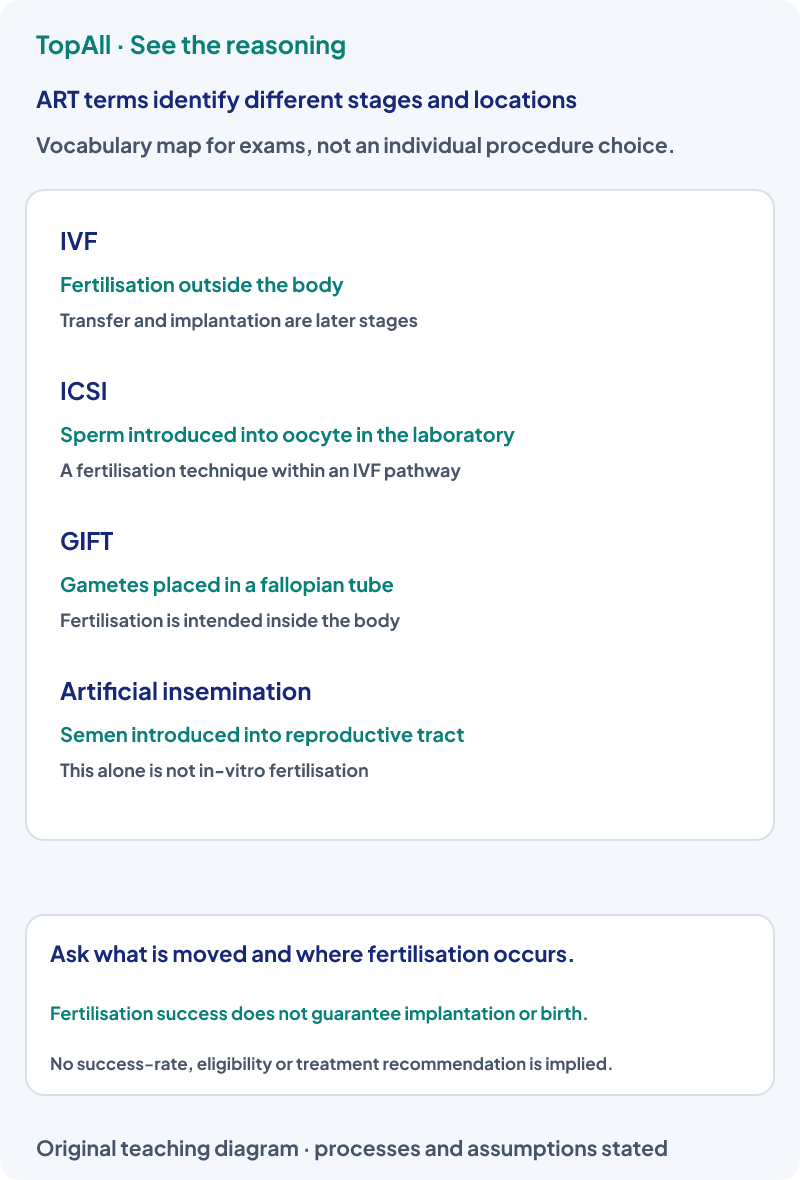
An original description transfers gametes into a fallopian tube and expects fertilisation inside the body. GIFT matches those stated features. Calling it IVF merely because a transfer occurred ignores where fusion is intended. If the question instead describes laboratory fusion followed by embryo transfer, the fertilisation-stage classification changes.
ZIFT is associated with transfer of a zygote or early embryo to a fallopian tube in the textbook vocabulary; IUT names an intrauterine destination. These destination terms are different from the fertilisation technique. Textbook stage examples are curriculum descriptions rather than universal contemporary clinical selection rules.
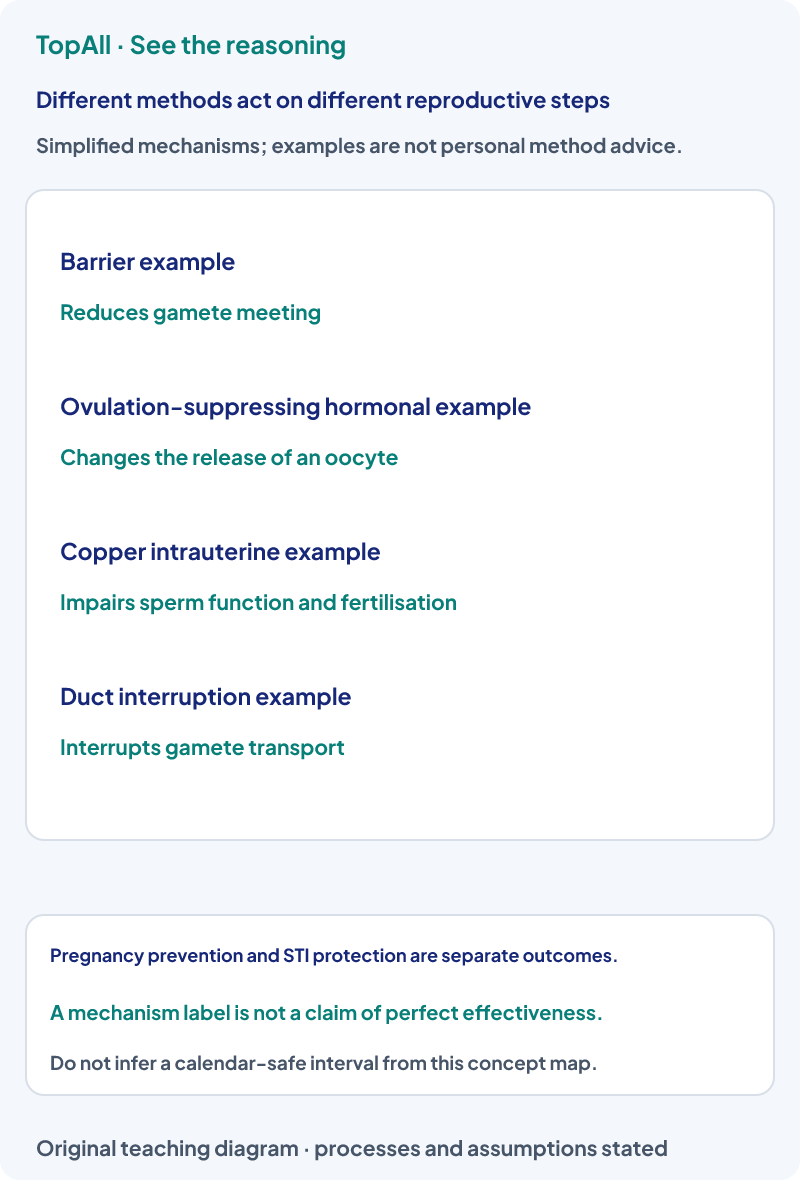
An original explanation says that interrupting gamete transport must also prevent every sexually transmitted infection. That outcome does not follow from the mechanism. Blocking a reproductive transport route and reducing pathogen transmission are different biological questions. WHO distinguishes contraceptive methods from the STI-protection role of condoms; no method should be labelled universally perfect from this comparison.
Gamete production, transport, fusion, cleavage, transfer and implantation refer to different stages. A supplied observation at one stage cannot automatically prove success at all subsequent stages. The same distinction helps explain why fertilisation outside the body does not mean development to birth occurs entirely outside the body.
An original laboratory report in a question states that fertilisation has occurred and cleavage has begun. This supports those described stages. It does not prove uterine implantation or a live birth, which are later outcomes. A correct answer should name the supported event without inventing a guarantee about the remainder of the journey.
The curriculum can compare how selected methods affect reproductive steps without choosing a method for a person. Individual choice involves health, preferences and professional assessment. This guide therefore avoids personal effectiveness estimates, medication schedules, calendar-safe days and assumptions based on an individual’s cycle.
Underline the material moved and circle the site of fertilisation. Then identify which outcome is actually described. Do not use a transfer destination to redefine IVF, or infer STI protection from pregnancy prevention. Historical legal statements and population totals are outside this mechanism-focused guide.
A description places a sperm into an oocyte in the laboratory. Does the stated action describe implantation into uterine endometrium?
No. It describes the ICSI fertilisation-stage technique. Implantation is a later embryo–endometrium event. An action involving an oocyte in the laboratory does not itself place a blastocyst in uterine tissue.
A question says a selected method suppresses ovulation. Does that statement alone establish protection against all STI transmission?
No. The statement describes a reproductive mechanism rather than a pathogen-transmission outcome. It supplies no basis for a universal STI-protection conclusion. Keep the two outcomes separate even when the same topic heading discusses both.
Classify a new description by material, location and supported outcome. Revisit normal stages in Human Reproduction, or practise the cell-versus-product distinction in Human Health and Diseases.
The action opens the broad reproductive-health pool; the guide is curriculum education rather than individual clinical advice.
Technical review: Codex (automated), 24 October 2026. Core mechanisms were compared with the linked primary textbooks and university or government references. All diagrams, problem inputs and explanations are original. Numerical balances and diagram directions are checked separately. Independent human subject review is not claimed. These focused guides support the existing chapter catalogue; they do not claim complete current exam or syllabus coverage.
For an abbreviation error, identify the moved material and site. For an outcome error, state what the described mechanism actually establishes and what remains unproven.