NEET UG · Video

Viroids NEET Biology Study Guide
Learn viroids, structure and plant disease basics for NEET UG with TopAll.
4 min video

NEET UG · Biology
Revise the concepts. Try a question. Understand your next step.
68 easy questions available · Try answers free. Sign in to save progress or take a quiz.
NEET UG · Biology
Understand the concept, practise questions and check your learning.
Understand
Separate cellular organisation from nutrition, keep the NCERT framework explicit and distinguish viruses, viroids and prions. Biological classification: use the full set of characters, not one shortcut
Read the guidePractise
Try 68 easy chapter MCQs. Untimed; check answers and available explanations as you go.
Practise chapter MCQsCheck your learning
Prepare a timed chapter quiz. Choose the available question count and pace before starting.
Prepare a chapter quizThis is chapter practice, not a full-length NEET mock paper.
These are playable question counts after quality and duplicate checks.
The practice player uses single-correct-answer MCQs. Chapter quizzes are not full-length NEET mock papers. Check the practice guide and official syllabus sources.
Revise before you practise
NEET UG · Video
Learn viroids, structure and plant disease basics for NEET UG with TopAll.
4 min video
NEET UG · Video
Study reproduction in fungi with clear examples for NEET UG with TopAll.
4 min video
NEET UG · Video
Understand prions and infectious protein concepts for NEET UG with TopAll.
6 min video
NEET UG · PDF notes
Read PDF · 9 pages →Learn Kingdom Monera concepts for NEET UG with TopAll.
9 pages
NEET UG · PDF notes
Read PDF · 8 pages →Learn viroids, structure and plant disease basics for NEET UG with TopAll.
8 pages
NEET UG · PDF notes
Read PDF · 10 pages →Study reproduction in fungi with clear examples for NEET UG with TopAll.
10 pages
NEET UG · Mind map
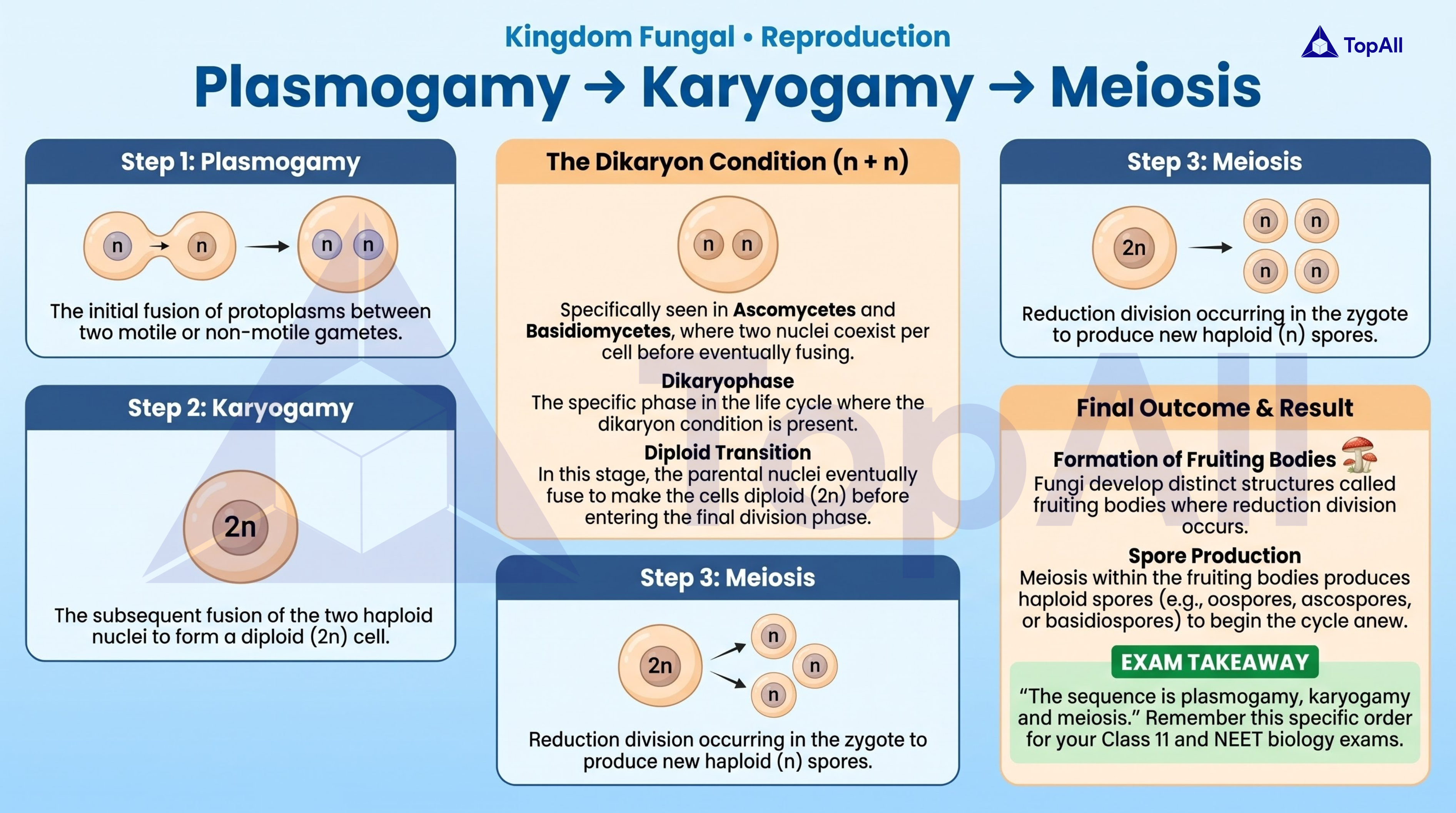
Study reproduction in fungi with clear examples for NEET UG with TopAll.
NEET UG · Mind map
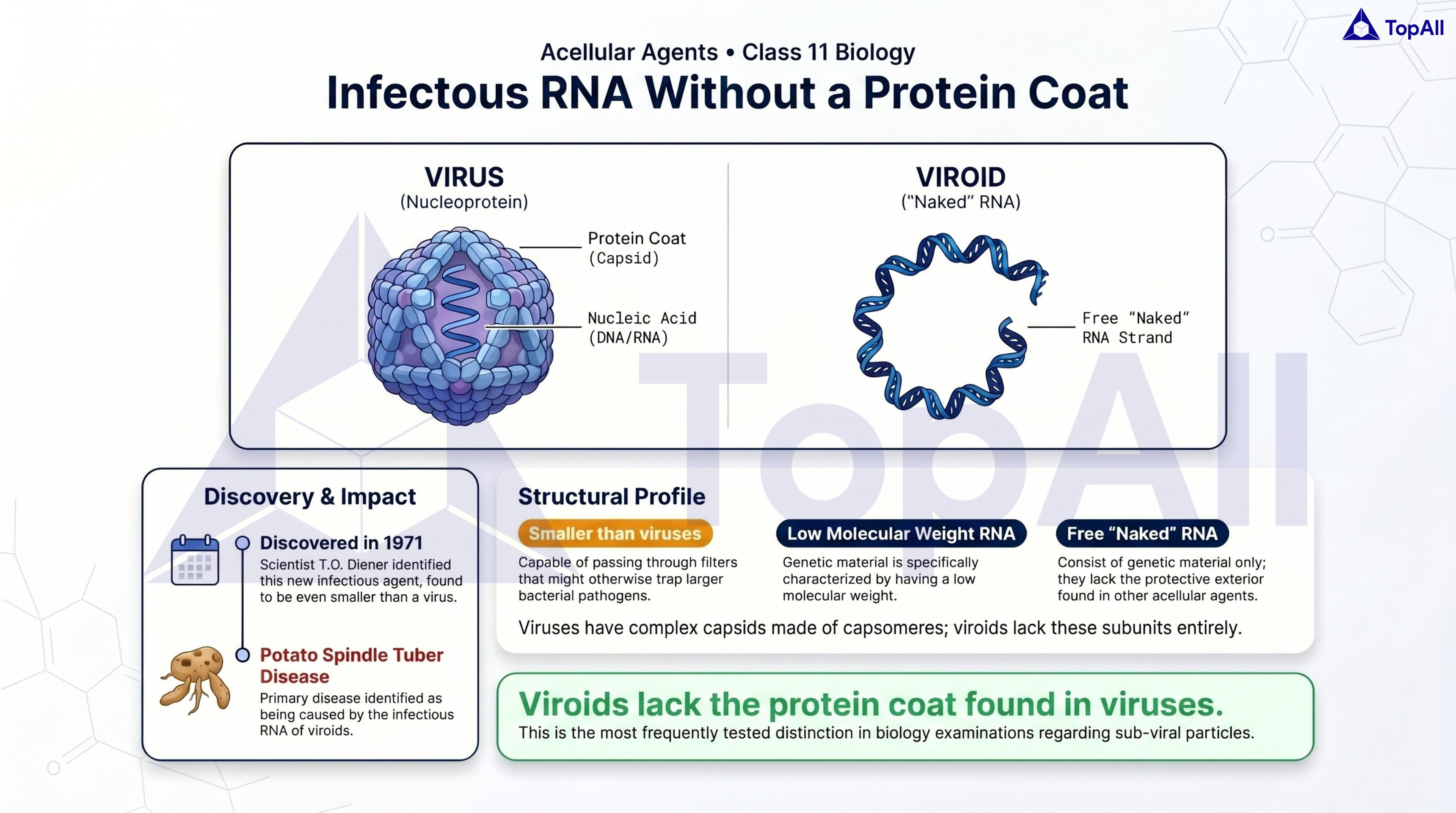
Learn viroids, structure and plant disease basics for NEET UG with TopAll.
NEET UG · Mind map
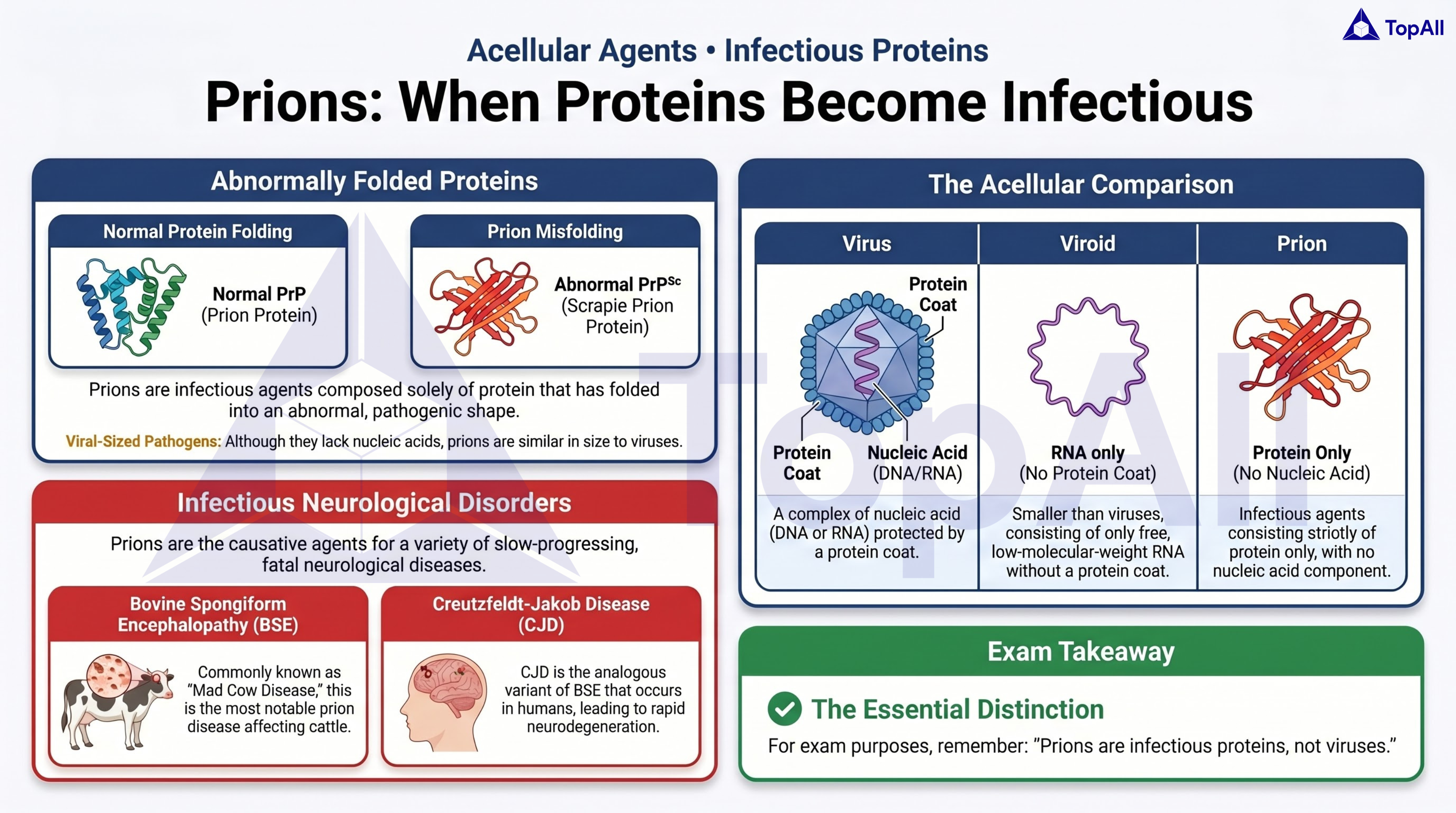
Understand prions and infectious protein concepts for NEET UG with TopAll.
Separate cellular organisation from nutrition, keep the NCERT framework explicit and distinguish viruses, viroids and prions.
For NEET UG Biology students: combine cellular organisation, body form and nutrition instead of sorting by a single familiar word. Use the NCERT five-kingdom framework explicitly, then distinguish acellular agents from cells.
In the NCERT five-kingdom scheme, Monera contains prokaryotes, while Protista, Fungi, Plantae and Animalia are eukaryotic groups. Nutrition and body organisation add information; neither photosynthesis nor being unicellular selects a kingdom on its own. The modern three-domain system answers a different grouping question. Keep the requested framework attached to your answer instead of silently mixing the two systems.
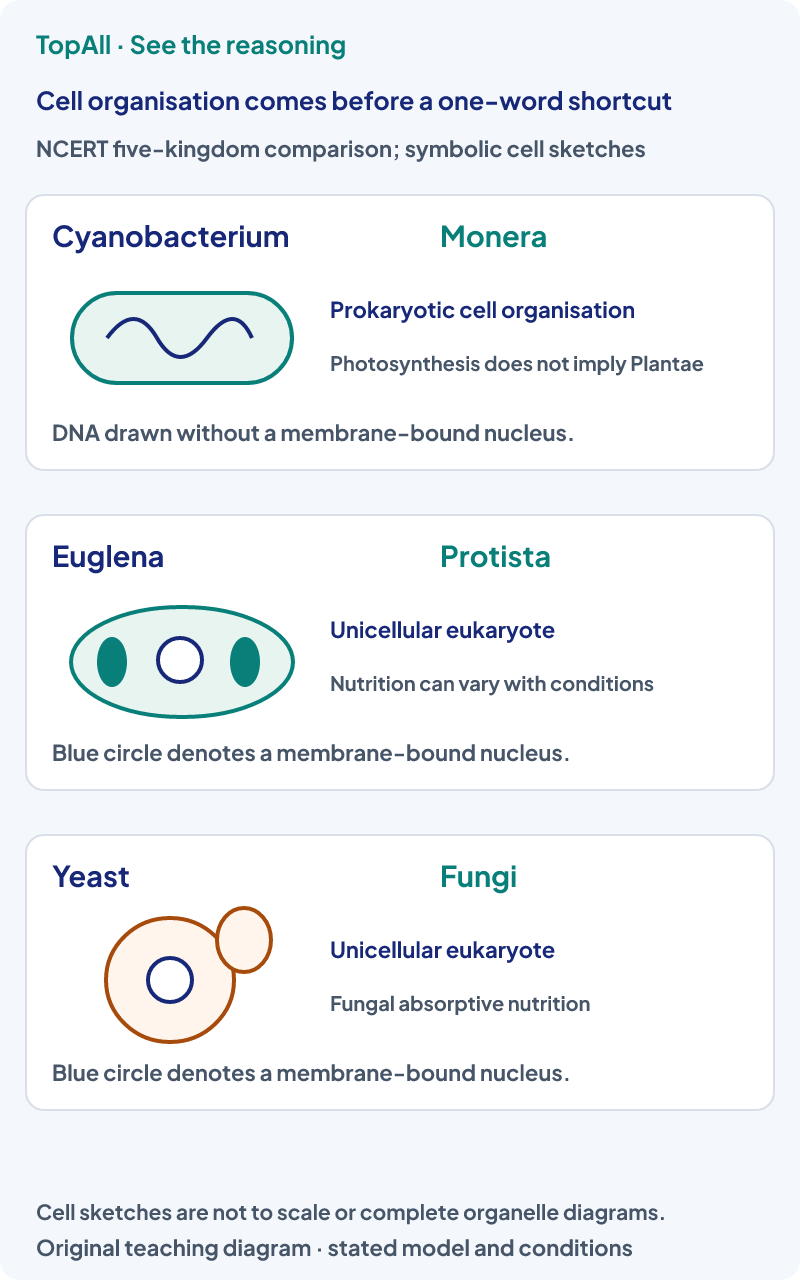
An MCQ describes a cyanobacterium with prokaryotic organisation and photosynthetic nutrition. Within the stated five-kingdom choices, select Monera. Calling it Plantae because it makes food using light would ignore the more fundamental cellular distinction. The older phrase blue-green algae does not turn cyanobacteria into the eukaryotic algae discussed in Plant Kingdom. Do not classify an entire organism from the absence of a nucleus in one specialised cell alone; the description here explicitly establishes prokaryotic organisation.
Most familiar fungi are multicellular, but yeasts are unicellular. A cell wall can occur in several kingdoms, and wall chemistry matters. Mycoplasma lacks a cell wall but remains a prokaryote in the NCERT scheme. A statement that relies on just one of these observations may therefore exclude the correct answer. Look for a consistent combination of characters.
The question names Euglena and describes photosynthesis in light and heterotrophic nutrition under unsuitable light conditions. In the NCERT framework it remains Protista; it does not alternate between Plantae and Animalia whenever conditions change. Compare yeast: its unicellular form does not outweigh its fungal organisation and absorptive nutrition. Read each full description before using a one-feature mnemonic.
A lichen combines a fungal partner with a photosynthetic partner. At NCERT level, the partners are described as mycobiont and phycobiont, with different nutritional roles. The association does not erase their distinct cellular identities or create an additional kingdom alongside the five listed. Likewise, a fungal association with plant roots is not proof that the fungus is a plant.
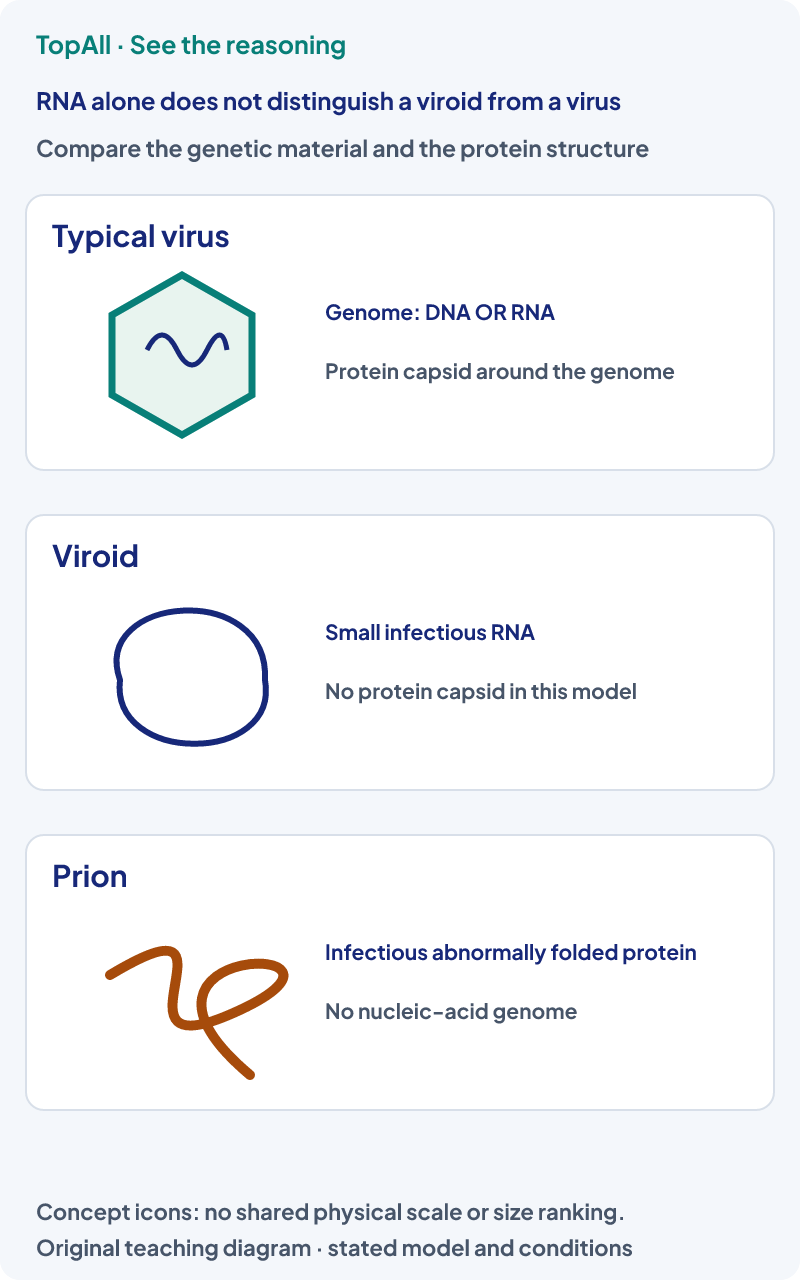
Two hypothetical descriptions are given. Agent A has RNA enclosed in a protein capsid; agent B is a small infectious RNA lacking that coat. In this comparison A fits an RNA virus and B fits a viroid. “Both contain RNA” is true but does not make the categories identical. A description of infectious abnormally folded protein instead points to the prion model. Size alone is not the deciding criterion, and not every isolated RNA or protein molecule is an infectious agent.
Viruses rely on host cells for replication and are not assigned one of the five cellular kingdoms in this chapter. A protein coat does not supply cytoplasm, ribosomes or independent cellular metabolism. Describe the genome and capsid separately before choosing an acellular-agent category.
Do not place all photosynthetic organisms in Plantae, all unicellular eukaryotes in Protista, every wall-less cell in Animalia or every RNA-containing agent among viroids. State the framework, list the supplied decisive characters and reject any option that contradicts one of them.
The question explicitly identifies an organism as Mycoplasma and asks its kingdom in the NCERT five-kingdom scheme. A distractor says Animalia because a cell wall is absent. Explain the error.
The correct group is Monera in that framework. Absence of a wall is not equivalent to animal cellular organisation. The organism is prokaryotic, while Animalia is eukaryotic. Use the full supplied identity and cellular organisation rather than a one-character shortcut.
A hypothetical acellular agent has an RNA genome surrounded by a protein capsid. A student calls it a viroid because its genome is RNA. Which observation contradicts that choice, and which description best fits instead?
The protein capsid contradicts the viroid model used in this comparison, which lacks that coat. The supplied description fits an RNA virus. A viral genome need not be DNA, and the presence of RNA alone is not enough to choose viroid.
Compare the three cellular examples and the three acellular models without looking at the labels. Use NEET Living World to separate a rank from a named taxon, or NEET Plant Kingdom to distinguish plant generations and reproductive structures.
Chapter practice opens the broad Biological Classification pool.
Technical review: Codex (automated). Primary textbook definitions and methods checked on 24 October 2026. Worked examples, diagrams, counterexamples and self-checks are original. Human subject review is not claimed. This focused lesson supports the existing chapter catalogue; it does not claim complete current exam coverage.
After a mistake, identify the character you ignored: cellular organisation, nutrition, wall, body organisation or capsid. Re-evaluate the supplied description within its stated framework rather than memorising the answer letter.

