NEET UG · Video

Meiosis I Stages NEET Guide
Study Metaphase I, Anaphase I, Telophase I and interkinesis for NEET UG with TopAll.
7 min video

NEET UG · Biology
Revise the concepts. Try a question. Understand your next step.
46 easy questions available · Try answers free. Sign in to save progress or take a quiz.
NEET UG · Biology
Understand the concept, practise questions and check your learning.
Understand
Track chromosome number and DNA amount through S phase, mitosis and meiosis with original diagrams and self-checks before chapter MCQs. Count chromosomes and DNA without mixing them up
Read the guidePractise
Try 46 easy chapter MCQs. Untimed; check answers and available explanations as you go.
Practise chapter MCQsCheck your learning
Prepare a timed chapter quiz. Choose the available question count and pace before starting.
Prepare a chapter quizThis is chapter practice, not a full-length NEET mock paper.
These are playable question counts after quality and duplicate checks.
The practice player uses single-correct-answer MCQs. Chapter quizzes are not full-length NEET mock papers. Check the practice guide and official syllabus sources.
Revise before you practise
NEET UG · Video
Study Metaphase I, Anaphase I, Telophase I and interkinesis for NEET UG with TopAll.
7 min video
NEET UG · Video
Understand G0 quiescent stage and division capacity for NEET UG with TopAll.
4 min video
NEET UG · Video
Learn why meiosis is important in reproduction for NEET UG with TopAll.
4 min video
NEET UG · PDF notes
Read PDF · 10 pages →Study Metaphase I, Anaphase I, Telophase I and interkinesis for NEET UG with TopAll.
10 pages
NEET UG · PDF notes
Read PDF · 8 pages →Understand G0 quiescent stage and division capacity for NEET UG with TopAll.
8 pages
NEET UG · PDF notes
Read PDF · 9 pages →Learn why meiosis is important in reproduction for NEET UG with TopAll.
9 pages
NEET UG · Mind map
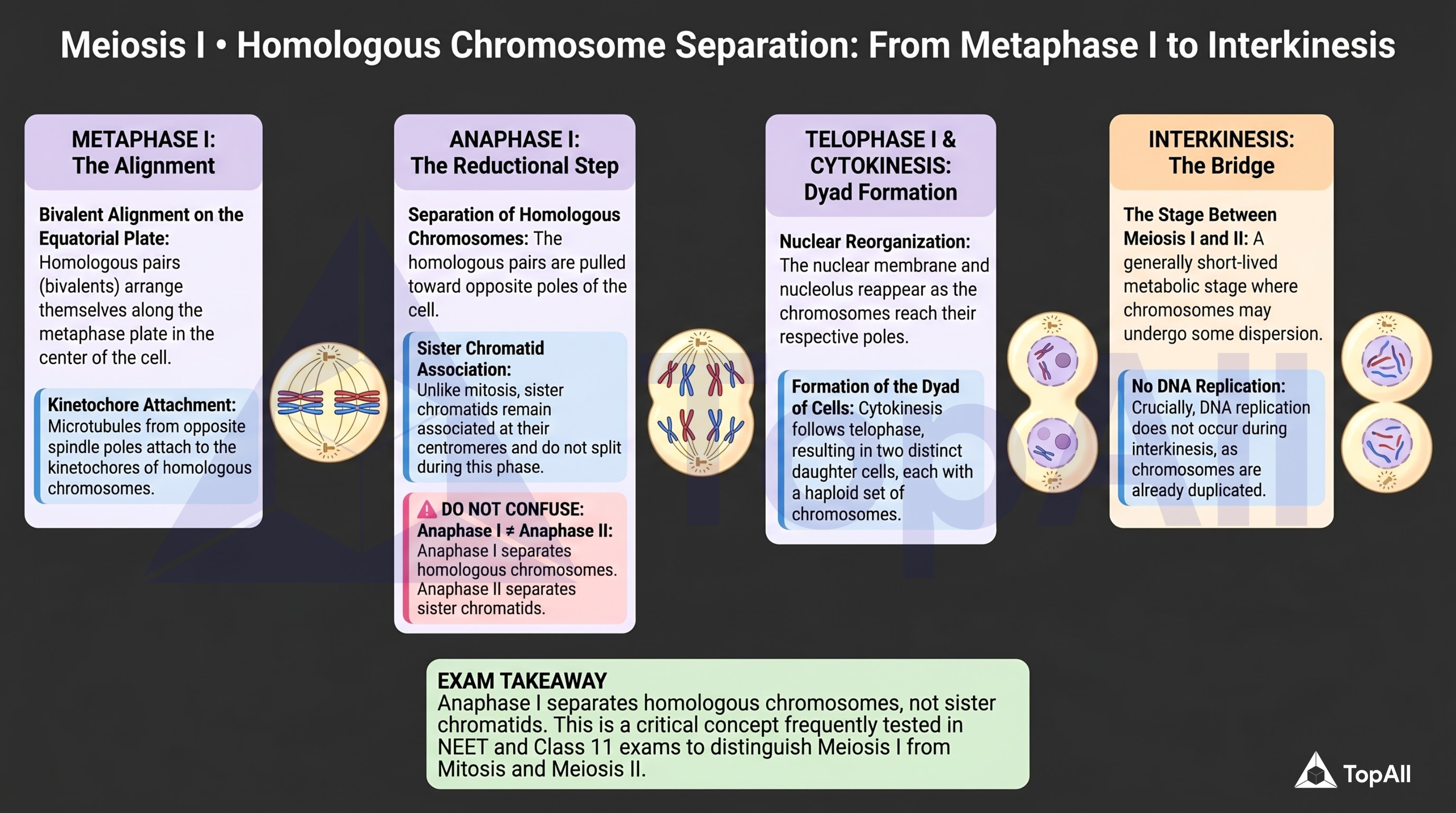
Study Metaphase I, Anaphase I, Telophase I and interkinesis for NEET UG with TopAll.
NEET UG · Mind map
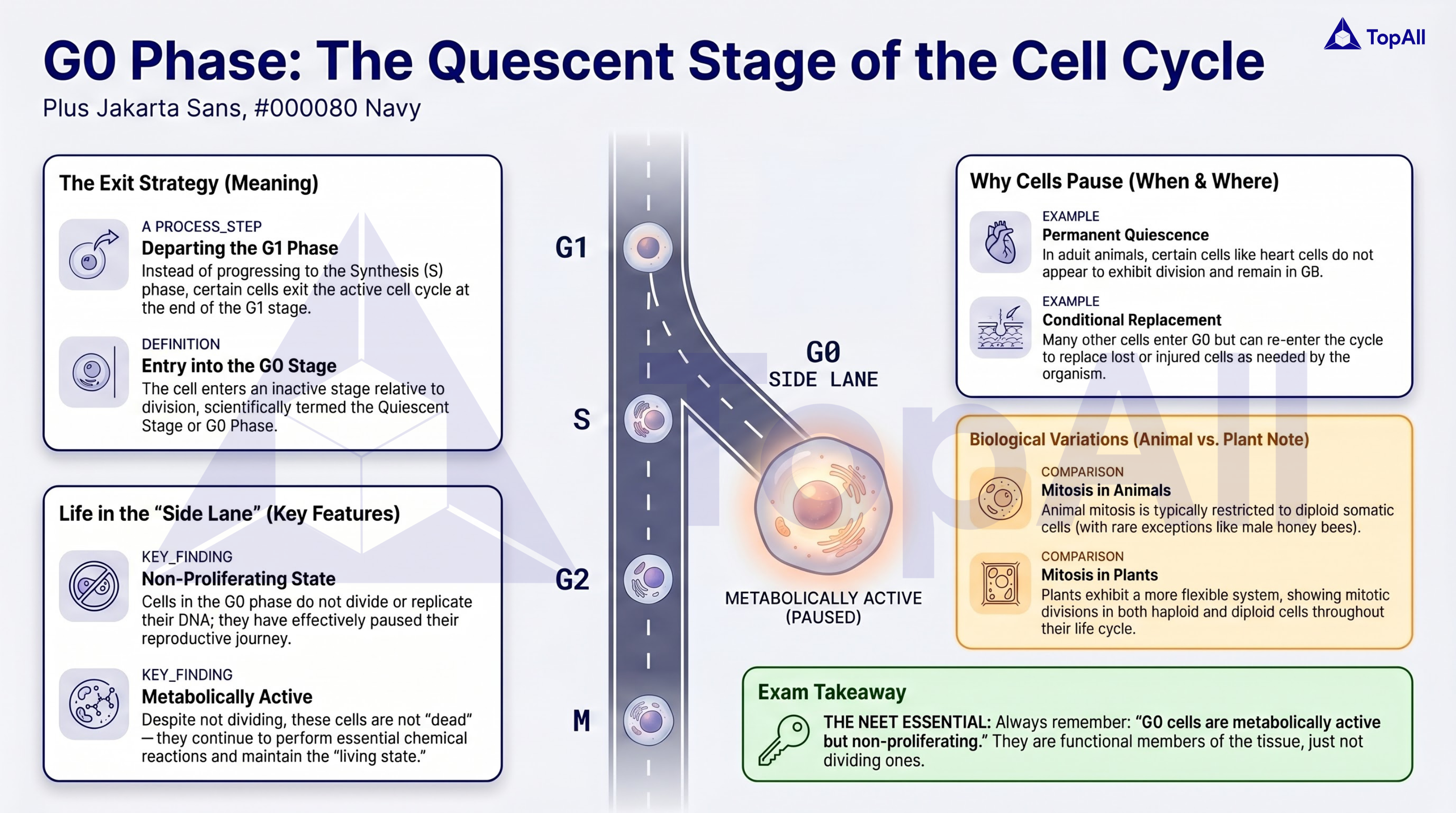
Understand G0 quiescent stage and division capacity for NEET UG with TopAll.
NEET UG · Mind map
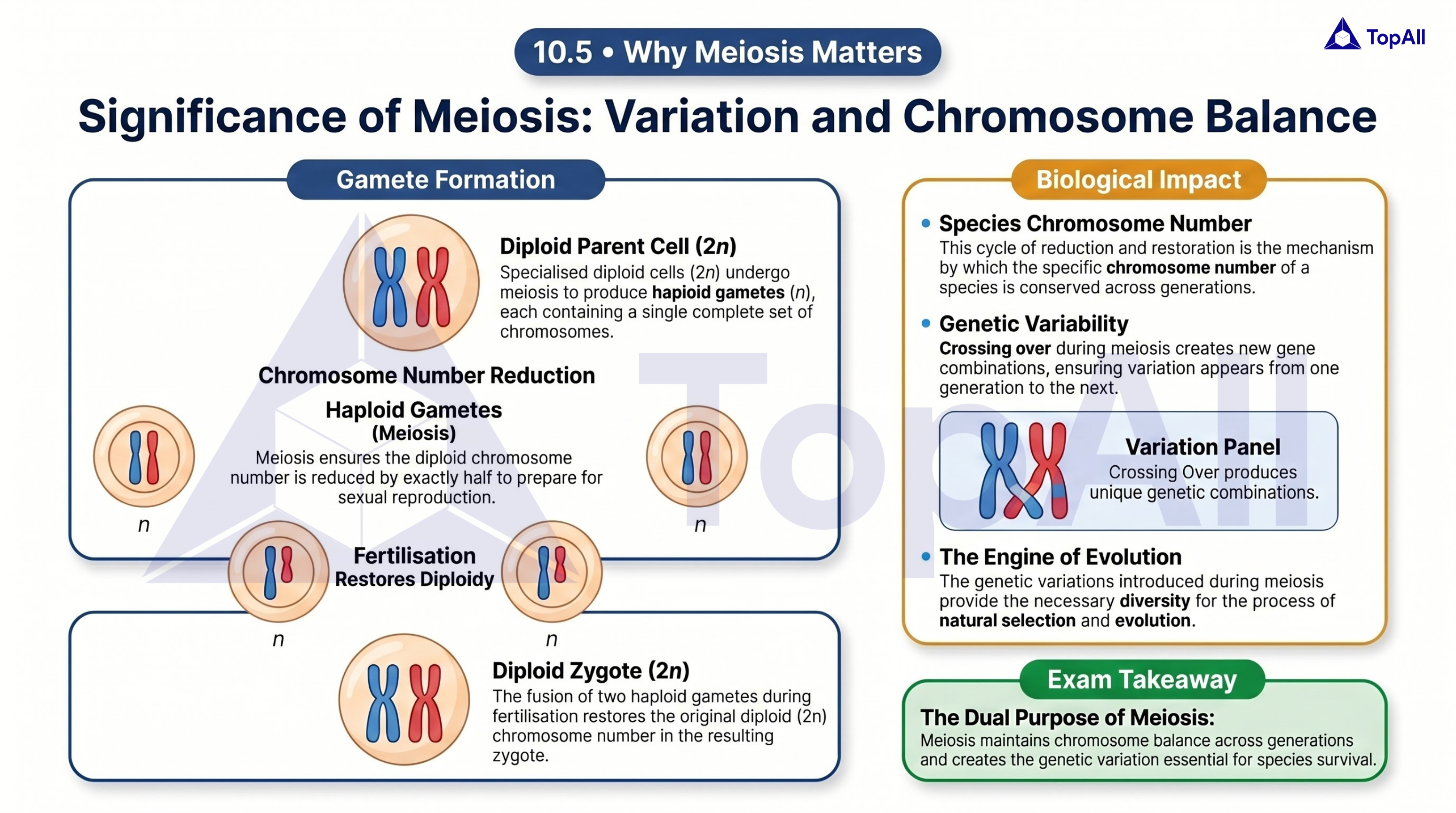
Learn why meiosis is important in reproduction for NEET UG with TopAll.
Track chromosome number and DNA amount through S phase, mitosis and meiosis with original diagrams and self-checks before chapter MCQs.
Keep chromosome number, ploidy and DNA amount separate. Use a simple 2n = 4 model to predict counts at defined stages. Counts here concern nuclear chromosomes and DNA, not mitochondrial DNA.
During S phase each chromosome is copied into joined sister chromatids. Chromosome number remains the same until sisters separate; nuclear DNA amount doubles. C denotes DNA amount relative to one unreplicated haploid genome. A diploid G1 cell has 2C DNA, rising to 4C after S phase. Ploidy describes sets of homologous chromosomes, not the number of DNA copies.
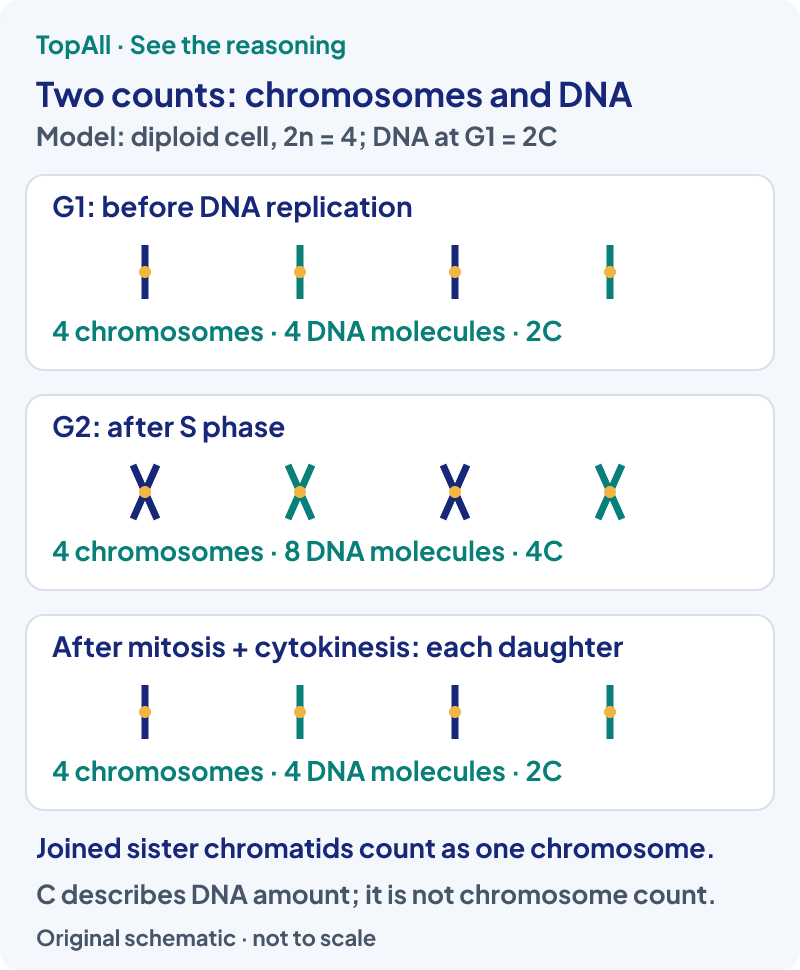
At G1: four chromosomes and 2C DNA. At G2: still four chromosomes, now eight sister chromatids carrying eight DNA molecules and 4C DNA. After normal mitosis and cytokinesis, each daughter has four chromosomes and 2C DNA.
Write “per daughter” beside the last result. Adding both daughter cells answers a different question. The diagram uses condensed counting symbols; chromosomes are not normally X-shaped in G1 or G2.
Meiosis has one preceding S phase followed by two divisions. Homologous chromosomes separate in meiosis I; sister chromatids remain joined. Sister chromatids separate in meiosis II without an intervening DNA replication. The model below omits crossing over to make counting visible; it does not imply that meiotic products are generally genetically identical.
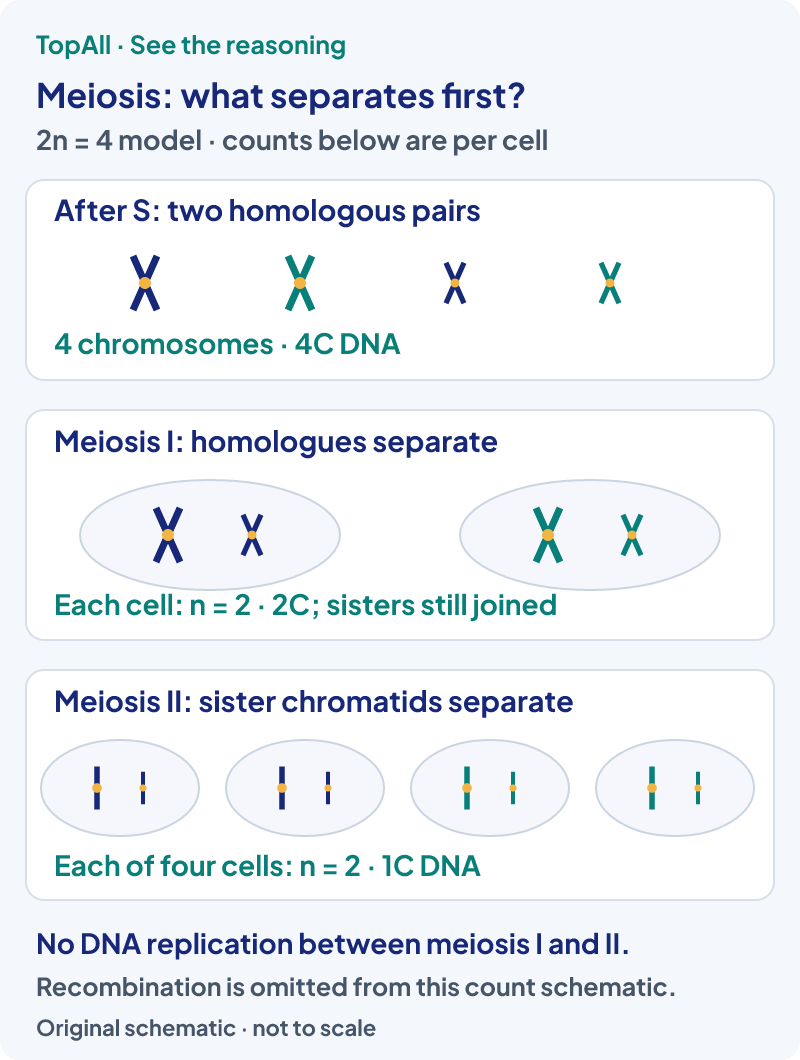
For a hypothetical diploid species with 2n = 12, a G2 cell has 12 chromosomes and 4C DNA. After meiosis I and cytokinesis, each cell has six duplicated chromosomes and 2C DNA. After meiosis II and cytokinesis, each of four cells has six chromosomes and 1C DNA.
For your next visit, reconstruct these three rows for 2n = 8 without looking, and state what separated at each division.
Do not double chromosome number merely because an X has two arms. During mitotic anaphase, separated sisters become daughter chromosomes: in the still-undivided 2n = 4 model, the whole cell temporarily contains eight chromosomes, with four moving to each pole. Always specify whole cell, pole or daughter nucleus. Interphase is metabolically active; calling it an inactive “rest” phase hides growth and DNA synthesis.
A diploid cell has 2n = 10 and 2C DNA in G1. After S phase, before mitosis, which pair is correct?
A. 20 chromosomes, 4C
B. 10 chromosomes, 4C
C. 10 chromosomes, 2C
B. Ten chromosomes remain, each with two joined sister chromatids. DNA amount has doubled to 4C. A counts sisters as separate chromosomes before separation; C misses replication.
For 2n = 10, what does each cell contain after meiosis I and cytokinesis?
A. Five duplicated chromosomes, 2C DNA
B. Five single-chromatid chromosomes, 1C
C. Ten duplicated chromosomes, 4C
A. Homologues have separated, reducing the sets to n = 5, but sisters are still joined. B describes the endpoint after meiosis II. C describes the premeiotic G2 starting state.
Reconstruct the worked example from memory before looking at the diagrams. If a self-check exposed a mix-up, explain why your original answer failed, then try chapter practice.
Technical review: Codex (automated). Sources checked on 23 October 2026. Diagrams, numerical models, worked examples and self-checks are original teaching material. Human subject review is not claimed.

