
NEET UG · Biology
NEET UG · Biology
Strategies for enhancement in food production
Revise the concepts. Try a question. Understand your next step.
42 easy questions available · Try answers free. Sign in to save progress or take a quiz.
NEET UG · Biology
Continue studying Strategies For Enhancement In Food Production
Understand the concept, practise questions and check your learning.
Understand
Follow breeding evidence, distinguish clonal multiplication from recombination and calculate nutrient output with the correct baseline. Food production: distinguish selection, multiplication and nutrient yield
Read the guidePractise
Try 42 easy chapter MCQs. Untimed; check answers and available explanations as you go.
Practise chapter MCQsCheck your learning
Prepare a timed chapter quiz. Choose the available question count and pace before starting.
Prepare a chapter quizThis is chapter practice, not a full-length NEET mock paper.
No revision resources are published for this chapter yet. Use your textbook alongside the guide and practice.
Choose your practice
All Biology chapters →These are playable question counts after quality and duplicate checks.
How practice and quizzes work
The practice player uses single-correct-answer MCQs. Chapter quizzes are not full-length NEET mock papers. Check the practice guide and official syllabus sources.
Revise before you practise
Study resources 0
No revision resources are published for this chapter yet. Use your textbook alongside the available practice questions.
Food production: distinguish selection, multiplication and nutrient yield
Follow breeding evidence, distinguish clonal multiplication from recombination and calculate nutrient output with the correct baseline.
What you will understand
For NEET UG Biology students: separate variation, selection and multiplication, and compare nutrient concentration with nutrient yield using a consistent mass basis.
Quick answer: selecting a trait and multiplying a plant do different jobs
A breeding objective defines the desired outcome. Variation provides candidates; crossing can create new combinations; selection identifies candidates against evidence; later evaluation checks performance and stability. Clonal propagation multiplies suitable material without the same gamete-recombination step. None of these labels alone guarantees a better crop in every environment.
Keep the evidence stages visible after the cross
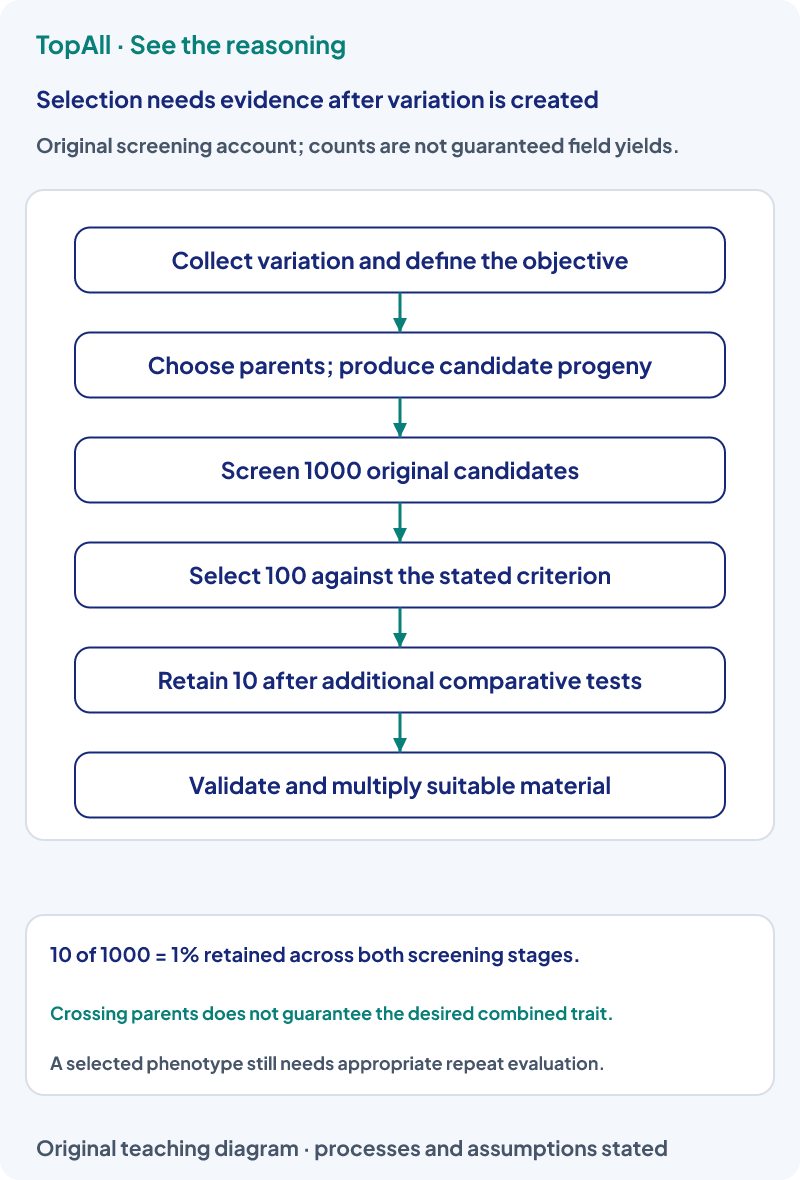
Multiply the retention fractions with the correct denominator
The first stage retains 100/1000 = 10%. The next retains 10/100 = 10% of that selected group. Across both stages, retention is10/1000 = 1%. Adding the two percentages gives 20% and uses the wrong logic. The example describes candidate counts and does not predict the number of genes, seeds or cultivars released.
Genotype, environment and the measured trait all matter
A promising phenotype can reflect both inherited properties and growing conditions. Evaluation in appropriate repeated or comparative conditions helps distinguish a robust candidate from one favourable observation. An original yield comparison from different environments cannot establish genetic superiority without accounting for those conditions. The breeding question must specify what evidence was collected.
Multiply grain yield by its protein mass fraction
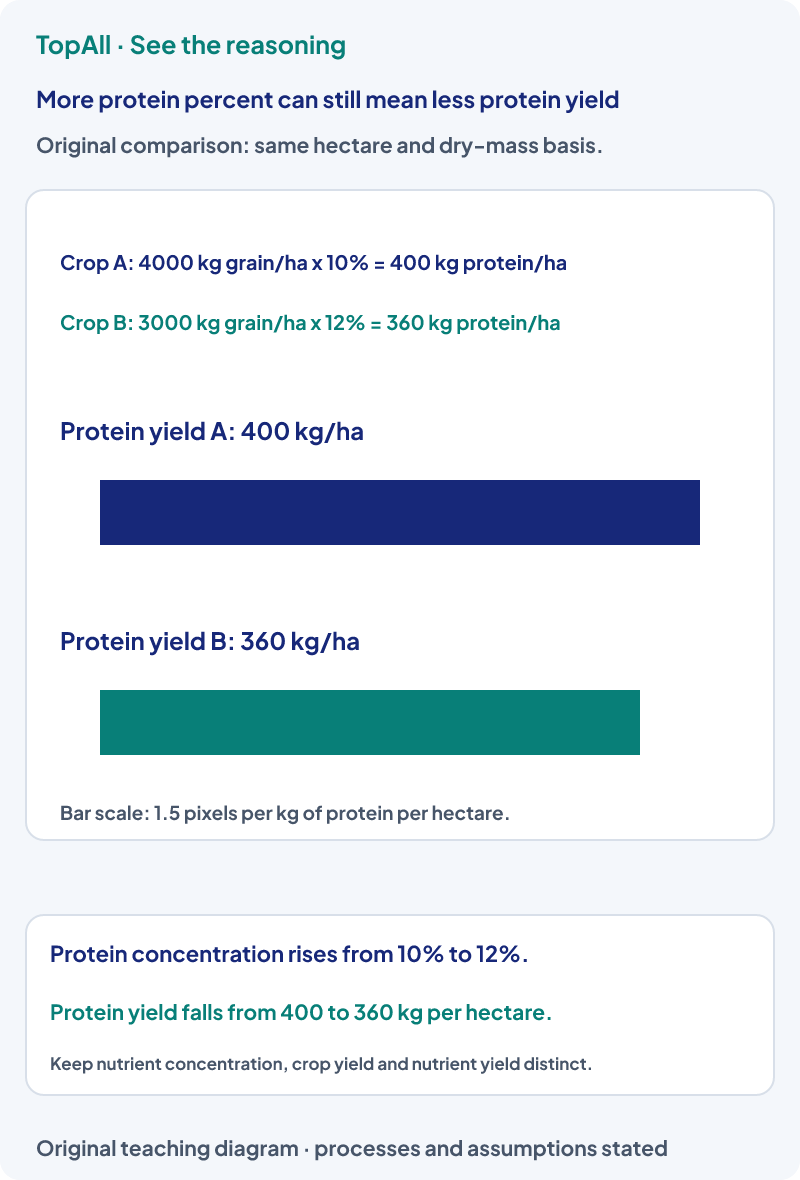
Higher concentration does not guarantee higher nutrient output
For crop A, 4000 × 0.10 = 400 kg protein/ha. For crop B, 3000 × 0.12 = 360. The concentration rises by 2 percentage points, a 20% relative increase, while protein output falls 40 kg/ha, or 10% relative to A. These are different quantities; the supplied data do not justify a claim about dietary benefit or universal crop quality.
Inbreeding and crossing change the genetic comparison
Inbreeding tends to increase homozygosity and can expose recessive effects; inbreeding depression concerns reduced mean performance in a relevant comparison, not a rule that every inbred individual is weak. Crossing can increase heterozygosity in the appropriate context, but heterosis must be evaluated rather than assumed for every cross and trait.
Distinguish an absolute yield difference from a percentage
Original comparable yield results are 1200 and 1500 kg/ha. The increase is 300 kg/ha and the relative increase from 1200 is 25%. Dividing by the later 1500 gives 20%, which answers a different baseline comparison. The arithmetic alone does not prove the cause of the difference or establish the result across all environments.
Micropropagation is not automatically a new hybrid
Plant tissue culture can multiply material through appropriate regeneration pathways. Sexual hybridisation combines parental gametes; clonal propagation generally preserves the chosen genotype rather than deliberately recombining gametes. Culture-associated variation and contamination are possible, so “every cultured plant is genetically identical and pathogen-free” is an unjustified guarantee. Health status and genetic fidelity need their own evidence.
Common mistakes: assign the objective to the technique
A named technique describes an action, while higher yield, improved nutrient concentration or resistance is an objective needing measurement. Mutation creates variation rather than directing every change toward a desired trait; selection and evaluation remain necessary. This guide retains the existing food-production chapter label without claiming complete current syllabus coverage.
Try it: compare percentages and percentage points
A nutrient mass fraction changes from 8% to 10% on the same basis. What is the increase in percentage points and the relative percentage increase?
Reveal the answer
The increase is 2 percentage points. Relative to 8%, it is 2/8 × 100 = 25%. Neither result alone gives nutrient yield per hectare because total harvested mass is not supplied. A concentration comparison and an output comparison have different denominators.
Try it: identify what multiplication does not prove
A selected plant is multiplied through tissue culture. Does multiplication alone prove that it has gained a new beneficial allele and broad environmental superiority?
Reveal the answer
No. Multiplication increases the material available; it does not by itself establish a new useful allele or universal performance. Genetic identity, health status and the desired measured trait need appropriate evidence. Do not replace validation with a technique name.
Come back tomorrow: name the objective and its unit
Calculate a two-stage retention and compare protein concentration with protein yield. Connect microbial production roles in Microbes in Human Welfare, or revisit genetic combinations in Inheritance and Variation.
The practice action opens the broad existing food-production pool, not a plant-breeding-only set.
Sources and review
Technical review: Codex (automated), 24 October 2026. Core mechanisms were compared with the linked primary textbooks and university or government references. All diagrams, problem inputs and explanations are original. Numerical balances and diagram directions are checked separately. Independent human subject review is not claimed. These focused guides support the existing chapter catalogue; they do not claim complete current exam or syllabus coverage.
Choose your next chapter task
Write the measured trait, unit, baseline and evidence stage. Then use chapter questions to check whether a technique name has been mistaken for a proven outcome.
Sources and reading
- OpenStax Biology 2e: Asexual Reproduction — Clonal propagation, micropropagation and distinction from sexual recombination. The guide does not promise every cultured plant is genetically identical or pathogen-free.
- FAO: Inbreeding and Brood Stock Management—Using Inbreeding — Homozygosity, inbreeding depression, selection and crossbreeding as distinct concepts. Original questions do not reproduce animal-management protocols.
- IAEA: Mutation Breeding for Crop Improvement (2018 factsheet) — Induced variation followed by selection and agronomic evaluation. Historical statistics and irradiation procedures are not reproduced.