NEET UG · Video

Drugs and Alcohol Abuse Guide
Study drugs and alcohol abuse with exam-focused clarity for NEET UG with TopAll.
5 min video

NEET UG · Biology
Revise the concepts. Try a question. Understand your next step.
66 hard questions available · Try answers free. Sign in to save progress or take a quiz.
NEET UG · Biology
Understand the concept, practise questions and check your learning.
Understand
Classify active and passive immunity, follow antibody-secreting cell roles and interpret adaptive memory without mixing biological levels. Immunity: distinguish the response, cell and transferred product
Read the guidePractise
Try 66 hard chapter MCQs. Untimed; check answers and available explanations as you go.
Practise chapter MCQsCheck your learning
Prepare a timed chapter quiz. Choose the available question count and pace before starting.
Prepare a chapter quizThis is chapter practice, not a full-length NEET mock paper.
These are playable question counts after quality and duplicate checks.
The practice player uses single-correct-answer MCQs. Chapter quizzes are not full-length NEET mock papers. Check the practice guide and official syllabus sources.
Revise before you practise
NEET UG · Video
Study drugs and alcohol abuse with exam-focused clarity for NEET UG with TopAll.
5 min video
NEET UG · Video
Study the effects of drug alcohol abuse on health for NEET UG with TopAll.
5 min video
NEET UG · Video
Understand addiction and dependence in human health for NEET UG with TopAll.
4 min video
NEET UG · PDF notes
Read PDF · 8 pages →Learn allergies, allergens and immune responses for NEET UG with TopAll.
8 pages
NEET UG · PDF notes
Read PDF · 10 pages →Study the effects of drug alcohol abuse on health for NEET UG with TopAll.
10 pages
NEET UG · PDF notes
Read PDF · 8 pages →Understand addiction and dependence in human health for NEET UG with TopAll.
8 pages
NEET UG · Mind map
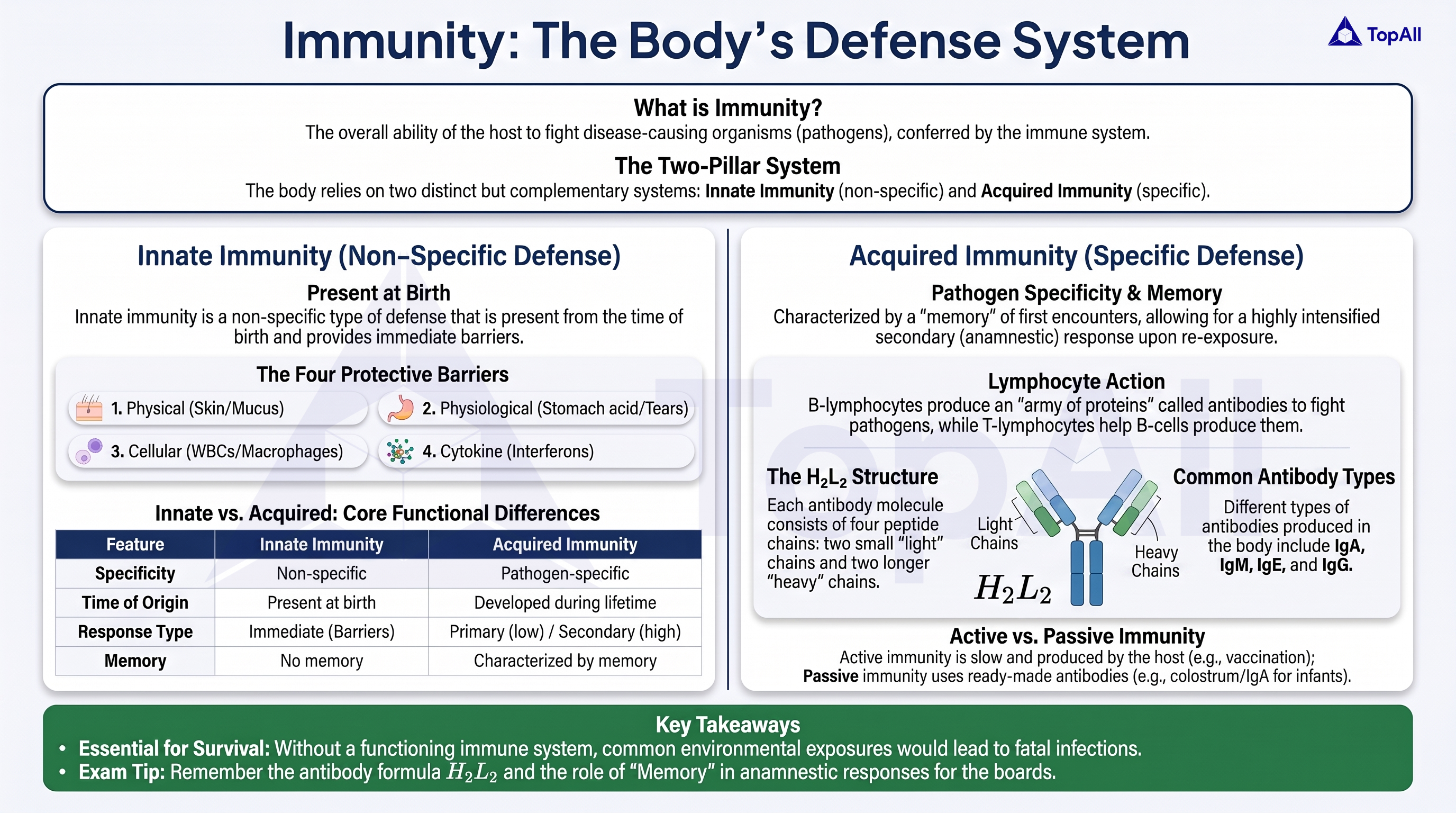
Master immunity, body defence and immune responses for NEET UG with TopAll.
NEET UG · Mind map
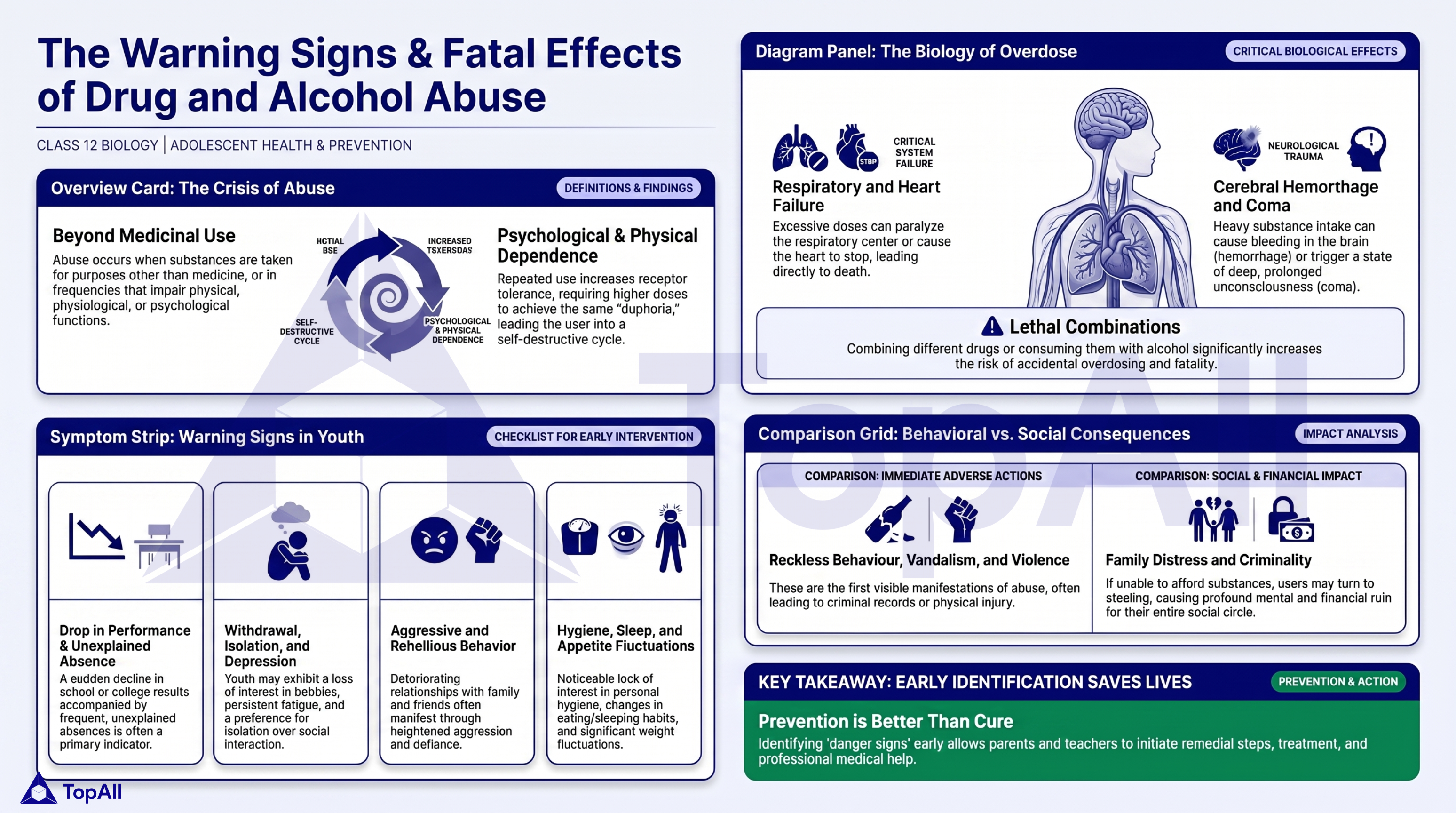
Study the effects of drug alcohol abuse on health for NEET UG with TopAll.
NEET UG · Mind map
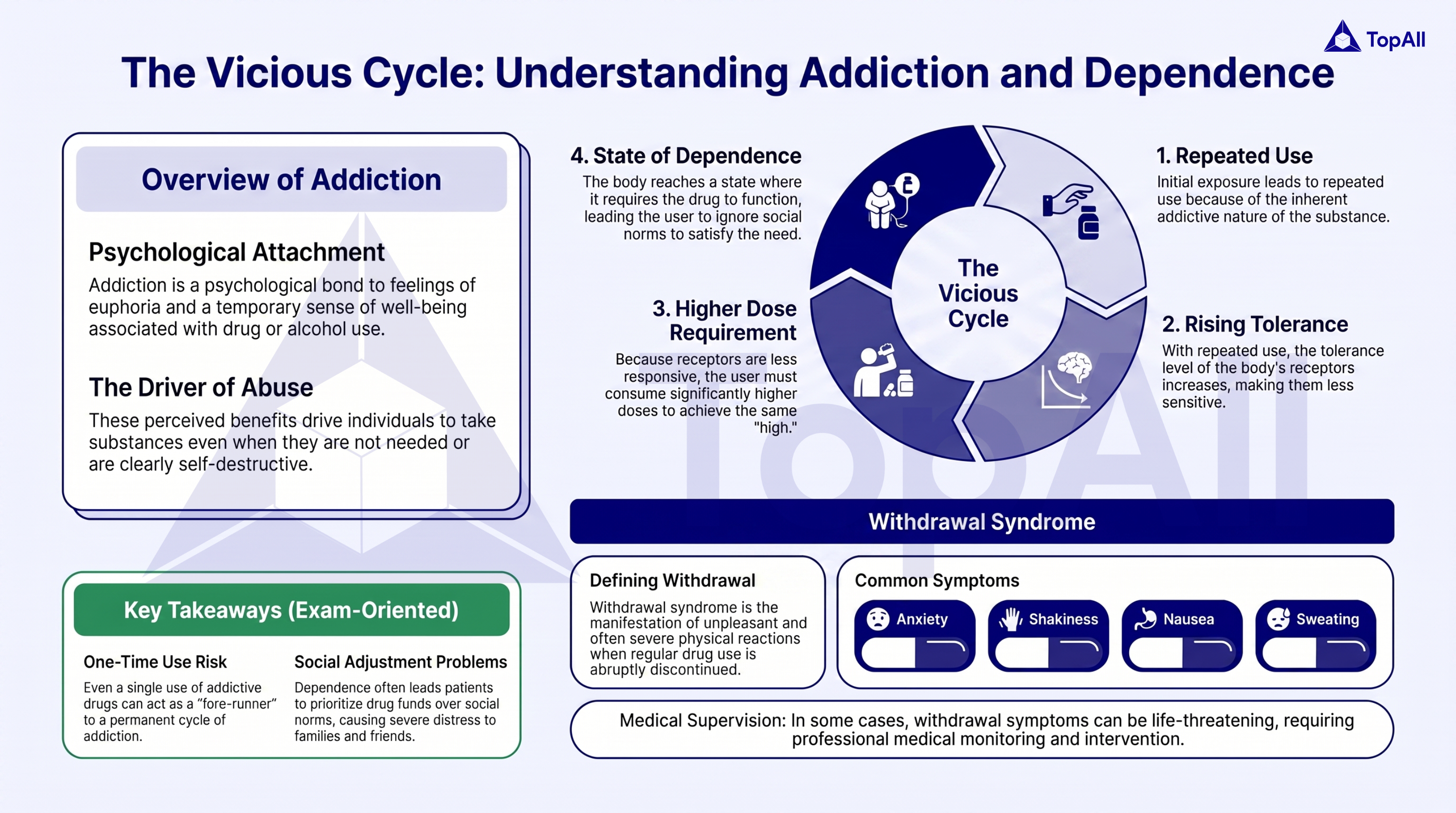
Understand addiction and dependence in human health for NEET UG with TopAll.
Classify active and passive immunity, follow antibody-secreting cell roles and interpret adaptive memory without mixing biological levels.
For NEET UG Biology students: separate innate defence from adaptive memory, identify who makes an antibody and classify active versus passive acquisition.
Innate defences include barriers and cells that respond without the same antigen-specific memory account used for adaptive immunity. Adaptive responses involve antigen-specific lymphocytes and can generate memory. Active acquisition means the recipient mounts the response; passive acquisition means ready-made antibodies are transferred. Natural/artificial and active/passive describe different axes.
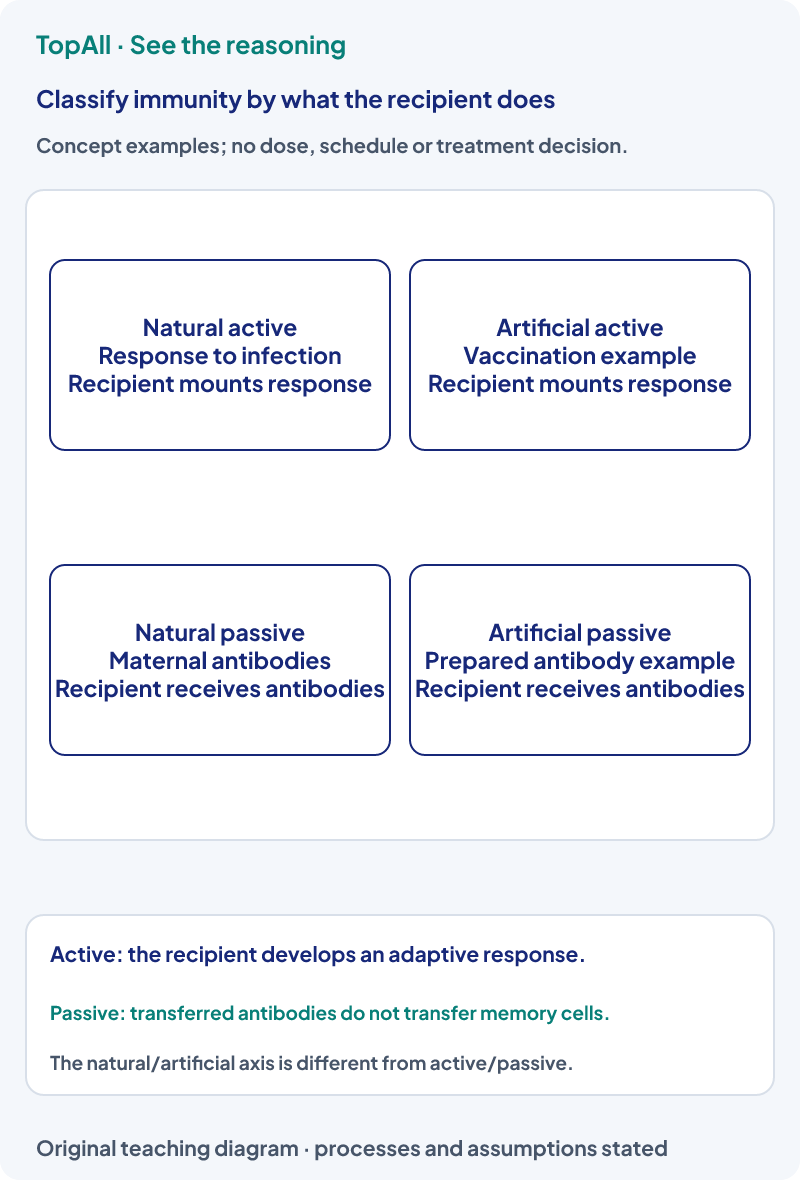
An original question says a recipient receives purified preformed antibodies but does not describe antigen-driven activation of the recipient’s lymphocytes. The acquisition described is passive. Calling it active merely because an injection was involved confuses the delivery route with the immune mechanism. Artificial/natural needs the source of transfer, a separate piece of information.
B-cell lineages can differentiate into antibody-secreting plasma cells. T-cell functions include helping appropriate responses and acting on target cells. Natural killer cells are lymphocytes with innate roles; therefore “all lymphocytes are adaptive antibody makers” is too broad. A phagocyte and a plasma cell also perform different tasks.
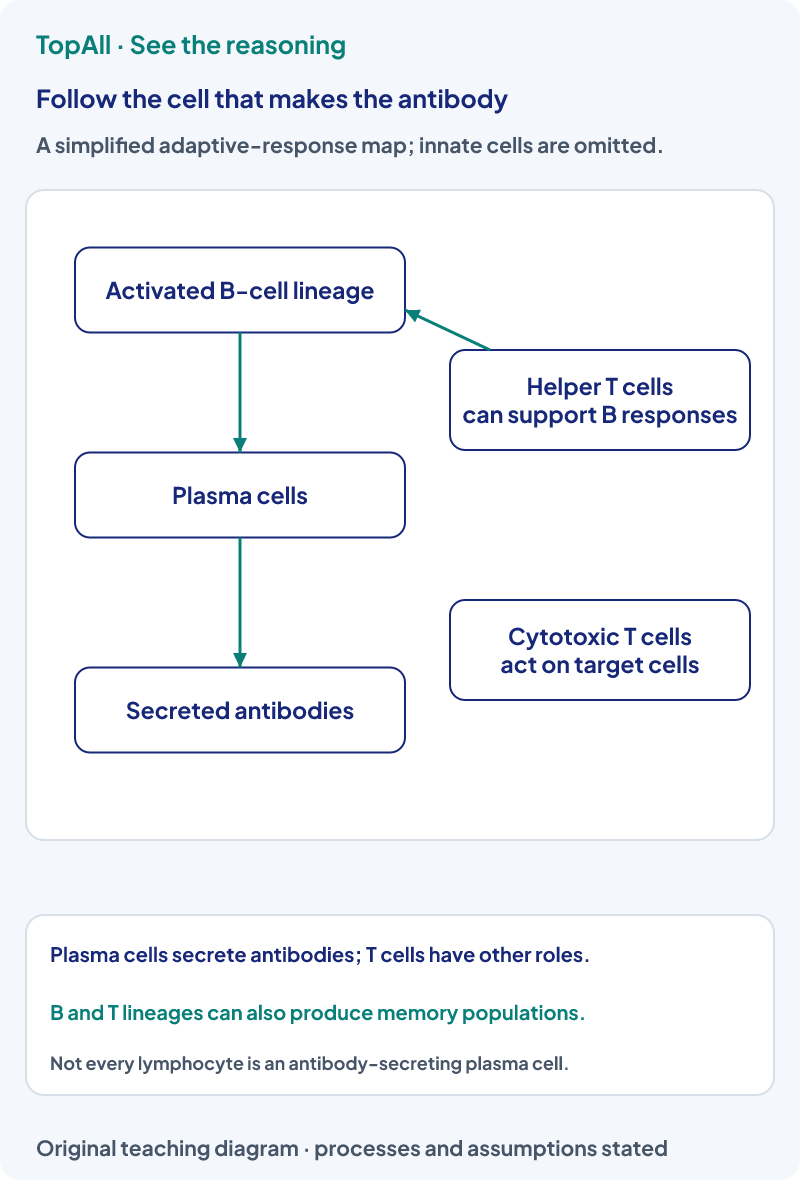
A proposed explanation says cytotoxic T cells protect by secreting the large antibody quantities in blood. The immediate antibody-secreting role belongs to plasma cells of the B lineage. Cytotoxic T cells have a target-cell role; helper T cells can support B-cell responses. An immune outcome should be traced to the cell and action actually described.
A memory response concerns recognition after a prior relevant adaptive encounter. It should not be inferred from an unrelated earlier infection or from transferred antibodies alone. A faster later response in a supplied model is consistent with memory, but a graph without antigen and exposure information cannot identify the full cause.
Two original response records show a shorter lag after the second encounter with the same antigen under otherwise comparable stated conditions. Adaptive memory is a supported explanation in that model. If the second exposure were to an unrelated antigen, the same conclusion would need more evidence. A curve’s height is not a direct count of all memory cells.
Bone marrow and thymus are primary lymphoid organs in the standard curriculum account, while structures such as lymph nodes and spleen support responses as secondary lymphoid organs. A question about maturation is different from a question about encountering antigen and expanding a response. Do not infer that every lymphoid organ makes every mature cell type.
An antigen is a recognised target or stimulus in the stated context; an antibody is a binding protein; a plasma cell secretes antibodies. Allergy, autoimmunity and immunodeficiency also describe different kinds of immune problems rather than three names for one mechanism. Match the supplied observation before selecting a category.
A newborn receives maternal antibodies. Does the transfer itself establish that the newborn made those antibodies or generated the donor’s memory cells?
No. This is passive acquisition in the stated example. The recipient can benefit from transferred antibodies without having produced them through that transfer. The observation does not erase the newborn’s own immune system or imply that every maternal molecule is transferred identically.
A question asks which differentiated cells secrete antibodies, and an option names the thymus. Does naming a lymphoid organ answer the cell question?
No. The required differentiated cell type is a plasma cell of the B lineage. The thymus is an organ, not an antibody-secreting cell type. First identify the level requested: molecule, cell, tissue or organ.
Classify a new example on both axes, then trace antibody production to its cell lineage. Compare microbial roles in Microbes in Human Welfare, or separate biological stages in Reproductive Health.
The action opens the broad health-and-disease pool, not an immunity-only set. These are curriculum explanations, not individual clinical advice.
Technical review: Codex (automated), 24 October 2026. Core mechanisms were compared with the linked primary textbooks and university or government references. All diagrams, problem inputs and explanations are original. Numerical balances and diagram directions are checked separately. Independent human subject review is not claimed. These focused guides support the existing chapter catalogue; they do not claim complete current exam or syllabus coverage.
After an error, write the antigen, responding cell and product. For acquisition, state whether the recipient makes the response or receives ready-made antibodies.

