
NEET UG · Biology
NEET UG · Biology
Mineral nutrition
Revise the concepts. Try a question. Understand your next step.
38 hard questions available · Try answers free. Sign in to save progress or take a quiz.
NEET UG · Biology
Continue studying Mineral Nutrition
Understand the concept, practise questions and check your learning.
Understand
Separate nitrogen transformations, interpret nutrient mobility and evaluate original controlled-omission data before chapter practice. Mineral nutrition: follow nitrogen forms and use leaf-age clues
Read the guidePractise
Try 38 hard chapter MCQs. Untimed; check answers and available explanations as you go.
Practise chapter MCQsCheck your learning
Prepare a timed chapter quiz. Choose the available question count and pace before starting.
Prepare a chapter quizThis is chapter practice, not a full-length NEET mock paper.
No revision resources are published for this chapter yet. Use your textbook alongside the guide and practice.
Choose your practice
All Biology chapters →These are playable question counts after quality and duplicate checks.
How practice and quizzes work
The practice player uses single-correct-answer MCQs. Chapter quizzes are not full-length NEET mock papers. Check the practice guide and official syllabus sources.
Revise before you practise
Study resources 0
No revision resources are published for this chapter yet. Use your textbook alongside the available practice questions.
Mineral nutrition: follow nitrogen forms and use leaf-age clues
Separate nitrogen transformations, interpret nutrient mobility and evaluate original controlled-omission data before chapter practice.
What you will understand
For NEET UG Biology students: identify nitrogen transformations by their endpoints, interpret leaf-age clues and design a controlled nutrient comparison instead of choosing from colour alone.
Quick answer: nutrient identity, chemical form and role differ
An element can be required in a small amount and still be essential. Macro- and micronutrient labels concern required quantity, not importance. Uptake of nitrate is different from fixation of atmospheric nitrogen, and nitrogen incorporation into an amino acid is another step. A deficiency symptom describes a response; it does not alone establish which nutrient is unavailable.
Name a nitrogen process from what changes
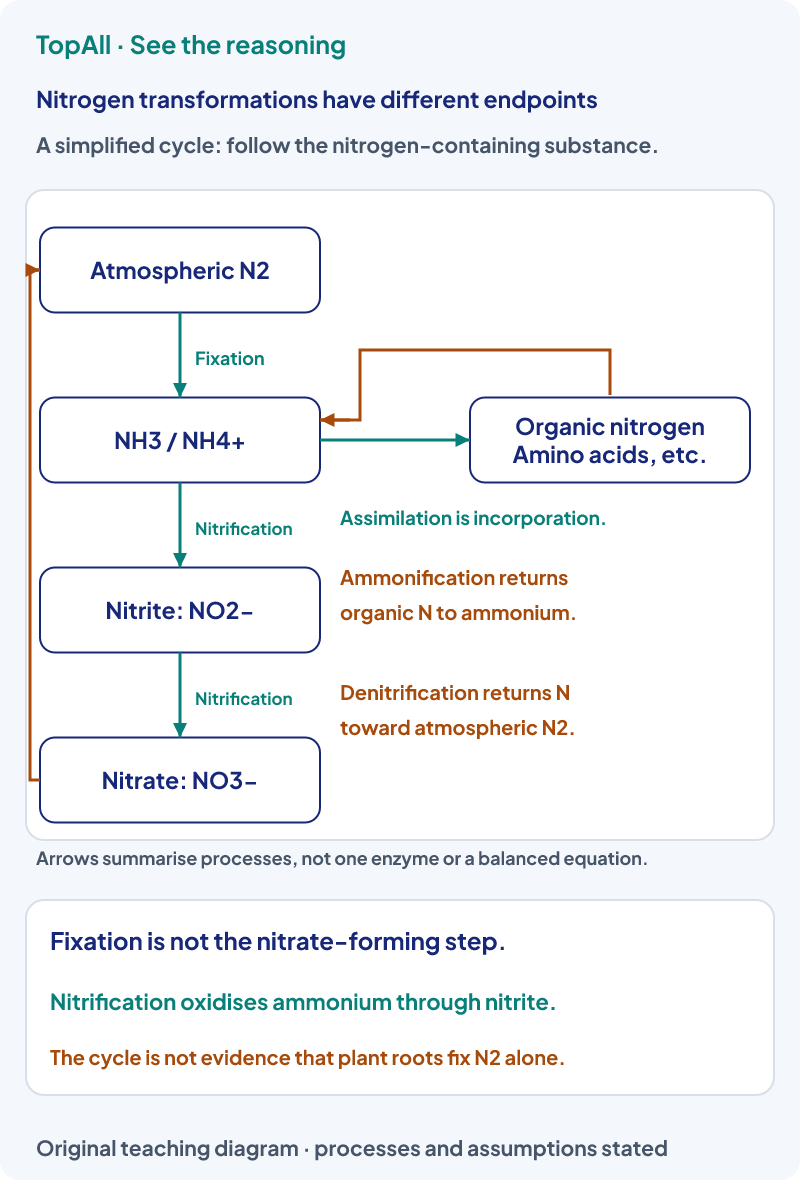
Distinguish an oxidation step from nitrogen fixation
A culture is supplied ammonium, and a measured product is nitrite. That endpoint change matches the first nitrification step; it is not evidence for conversion of atmospheric N₂. If the subsequent product is nitrate, that belongs to the later oxidation step. Always write the supplied nitrogen form and measured product before matching a process name.
Microbial partners do not turn a plant into a nitrogen-fixing bacterium
Nitrogenase activity belongs to nitrogen-fixing prokaryotes. In a legume association, microbes provide the fixation machinery while the plant supplies a supportive context and carbon resources. Absorbing nitrate or ammonium through roots is a different process. A root nodule therefore does not justify saying that ordinary plant cells independently reduce atmospheric nitrogen.
Use leaf age as evidence of remobilisation
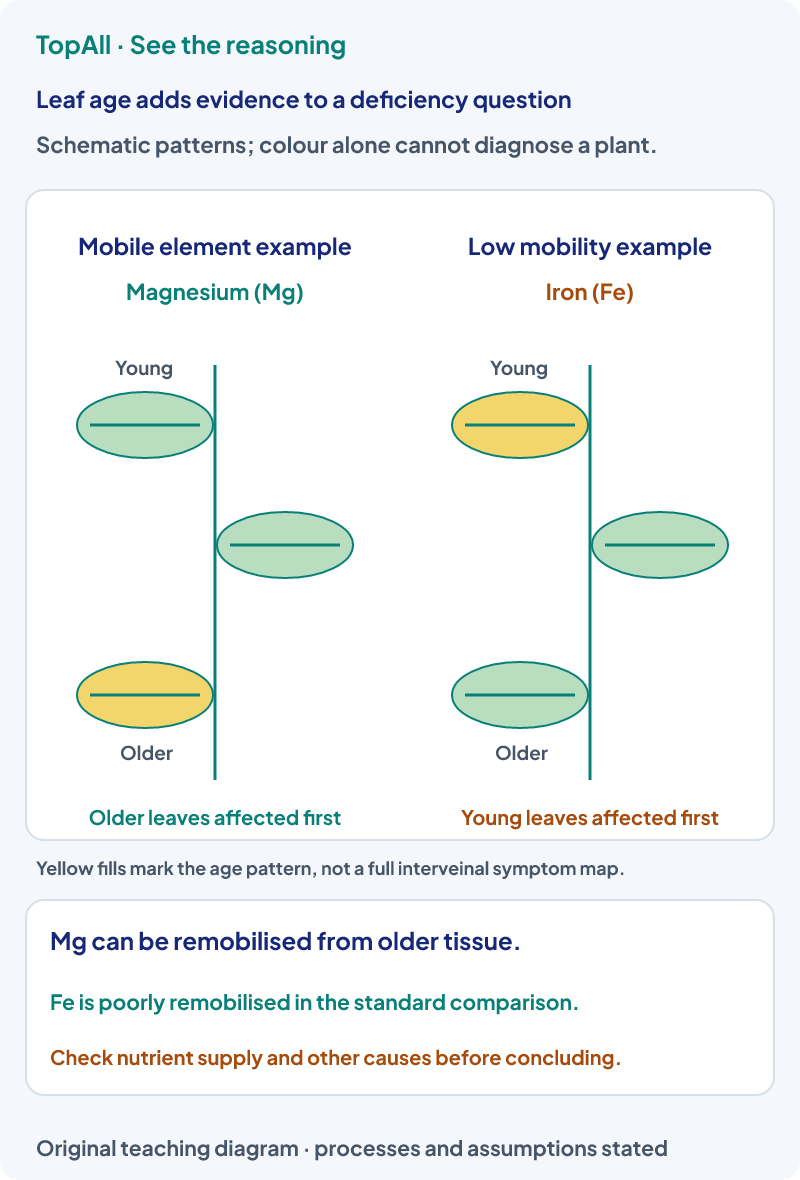
Choose between Mg and Fe using the supplied age clue
An original MCQ restricts the alternatives to magnesium or iron deficiency and explicitly states that older leaves show interveinal yellowing first while young leaves remain green. Magnesium is the better fit to the supplied pattern. If only “yellow leaves” were given, that conclusion would be too strong. The distinguishing clue is age and redistribution, not the mere presence of yellow.
A controlled omission is stronger than an uncontrolled comparison
To study whether a nutrient is required, compare otherwise matched plants in a complete nutrient medium and a medium omitting that element. Control light, water, pH, temperature, aeration and other nutrient supplies. Add-back rescue strengthens the interpretation. Detecting an element in tissue or observing one poor-growing plant alone does not establish essentiality.
Read an original nutrient-omission experiment carefully
Assume matched replicates average 8.0 g dry mass in complete medium, 4.8 g when element X is omitted, and 7.6 g after X is restored. Omission is associated with a 3.2 g loss, or 40% relative to the complete treatment; rescue reaches 95% of that reference. This supports an X-dependent effect in the supplied experiment. Without variability, replication details and life-cycle evidence, it does not by itself prove every essentiality criterion.
Check the chemical account in nitrogen fixation
A standard nitrogenase summary uses 16 ATP per reduced and yields two ammonia molecules, with reductant and proton requirements and hydrogen evolution. Treat this as the stated idealised reaction account, not the total energetic cost of a functioning nodule. Uptake, maintenance and assimilation are additional processes. In biological solutions, ammonia and ammonium proportions also depend on pH.
Common mistakes: treat small amounts as optional or diagnose by colour
Write element, uptake form, biochemical role and symptom as separate labels. For a process name, compare nitrogen endpoints. For a symptom question, use leaf age and the alternatives actually supplied. For an experiment, ask which variable changed and whether restoration reverses the effect.
Try it: scale a supplied fixation account
Within the stated standard account of 16 ATP per N₂, how many ATP are required for reduction of three N₂ molecules, and how many ammonia molecules result?
Reveal the answer
Three N₂ require 48 ATP in that idealised account and produce six ammonia molecules. The six nitrogen atoms are conserved. The answer excludes additional nodule costs and is not a measured whole-plant ATP budget. Do not multiply by two again merely because each N₂ contains two nitrogen atoms; the given ATP basis is already per N₂.
Try it: assess an essentiality claim
A trace of element Z is detected in a healthy leaf. Does that observation alone prove that Z is essential, or that a micronutrient is less important than a macronutrient?
Reveal the answer
Neither follows. Presence alone is not proof that normal completion of the life cycle depends on a specific indispensable function. Required amount and importance are separate: a small requirement can still be essential. Use controlled evidence and the relevant essentiality criteria rather than the size of the measured trace.
Come back tomorrow: name five nitrogen arrows
From memory, connect N₂, ammonium, nitrite, nitrate and organic nitrogen, then label each process. Explain why leaf age improves a symptom question. Relate nutrient movement to Transport in Plants, or compare the energy accounts in Respiration in Plants.
Practice opens the broad legacy mineral-nutrition pool; the guide does not claim a standalone current-NCERT chapter or a nutrient-specific practice set.
Sources and review
Technical review: Codex (automated), 24 October 2026. Core mechanisms were compared with the linked primary textbooks and university or government references. All diagrams, problem inputs and explanations are original. Numerical balances and diagram directions are checked separately. Independent human subject review is not claimed. These focused guides support the existing chapter catalogue; they do not claim complete current exam or syllabus coverage.
Choose your next chapter task
Choose a process-name question after redrawing its endpoints, or a symptom question after explaining remobilisation. Recheck the assumptions before starting another chapter task.
Sources and reading
- OpenStax Biology 2e: Nutritional Requirements of Plants — Essentiality criteria, amount-based macro/micro distinction and controlled hydroponics. No universal element-count claim is drawn from its expanded list.
- OpenStax Biology 2e: Nutritional Adaptations of Plants — Microbial nitrogen fixation, root associations and nitrogenase stoichiometric account.
- OpenStax Biology 2e: Biogeochemical Cycles — Nitrogen fixation, ammonification, nitrification and denitrification endpoints.
- Singapore NParks: Identifying Nutrient Deficiency in Plants — Older versus younger leaf patterns, mobility of magnesium and low mobility of iron; symptoms require context.
- University of Minnesota Extension: Magnesium for Crop Production — Magnesium in chlorophyll, remobilisation and older-leaf deficiency symptoms.