NEET UG · Video

Small Molecular Weight Compounds
Study small molecular weight organic compounds for NEET UG with TopAll.
6 min video

NEET UG · Biology
Revise the concepts. Try a question. Understand your next step.
89 hard questions available · Try answers free. Sign in to save progress or take a quiz.
NEET UG · Biology
Understand the concept, practise questions and check your learning.
Understand
Connect biomolecule units to their linkages, distinguish activation energy from overall energy change, and check your reasoning before Biomolecules MCQs. Match biomolecule bonds and read enzyme energy diagrams
Read the guidePractise
Try 89 hard chapter MCQs. Untimed; check answers and available explanations as you go.
Practise chapter MCQsCheck your learning
Prepare a timed chapter quiz. Choose the available question count and pace before starting.
Prepare a chapter quizThis is chapter practice, not a full-length NEET mock paper.
These are playable question counts after quality and duplicate checks.
The practice player uses single-correct-answer MCQs. Chapter quizzes are not full-length NEET mock papers. Check the practice guide and official syllabus sources.
Revise before you practise
NEET UG · Video
Study small molecular weight organic compounds for NEET UG with TopAll.
6 min video
NEET UG · Video
Learn nitrogen bases, nucleosides and nucleotides for NEET UG with TopAll.
4 min video
NEET UG · Video
Understand metabolic pathways and reaction flow for NEET UG with TopAll.
4 min video
NEET UG · Short video
Understand amino acids with a simple, exam-focused explanation of their basic structure, classification and role as the building blocks of proteins.
2 min video
NEET UG · PDF notes
Read PDF · 10 pages →Study small molecular weight organic compounds for NEET UG with TopAll.
10 pages
NEET UG · PDF notes
Read PDF · 9 pages →Learn nitrogen bases, nucleosides and nucleotides for NEET UG with TopAll.
9 pages
NEET UG · PDF notes
Read PDF →Understand metabolic pathways and reaction flow for NEET UG with TopAll.
NEET UG · Mind map
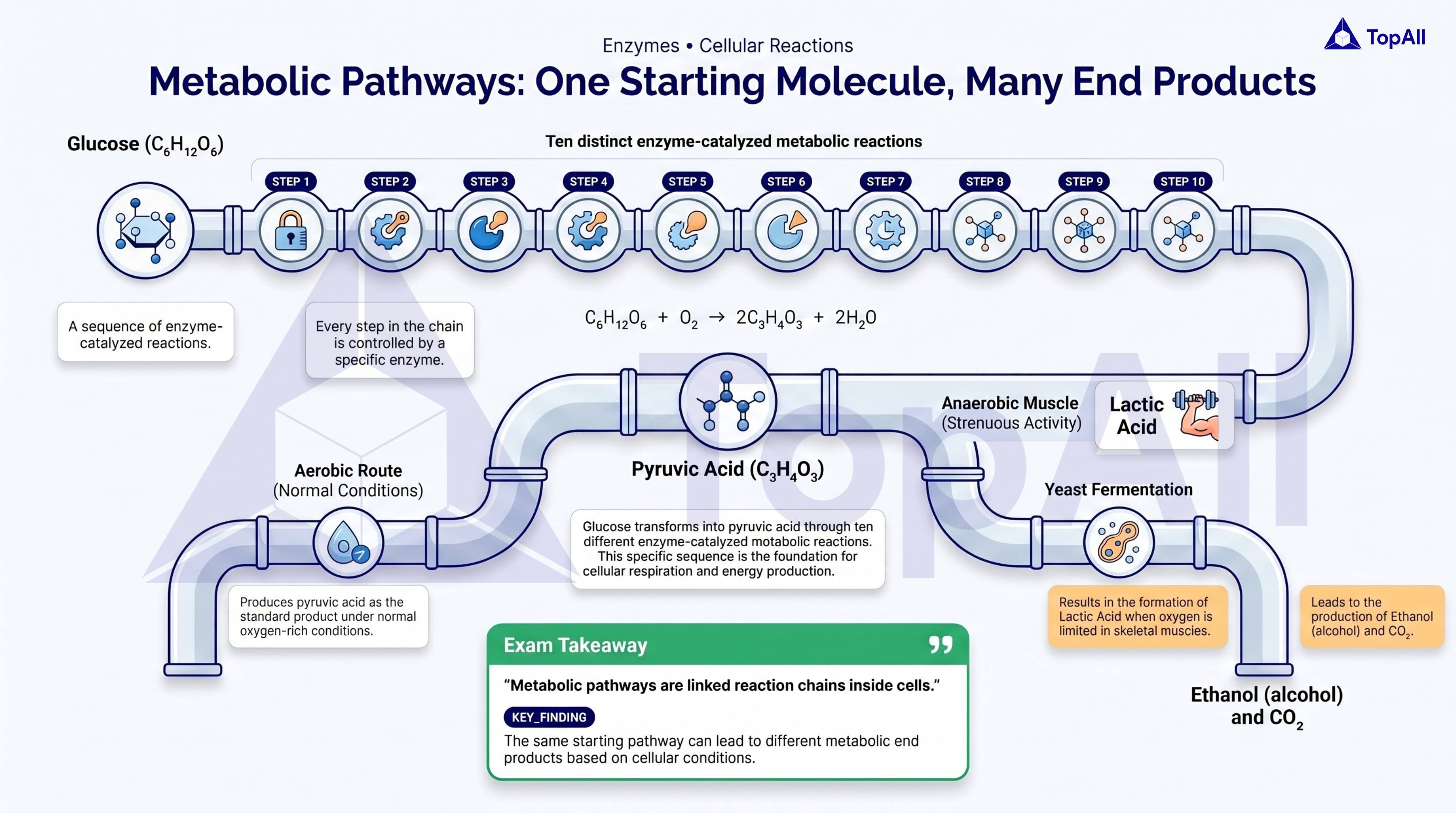
Understand metabolic pathways and reaction flow for NEET UG with TopAll.
NEET UG · Mind map
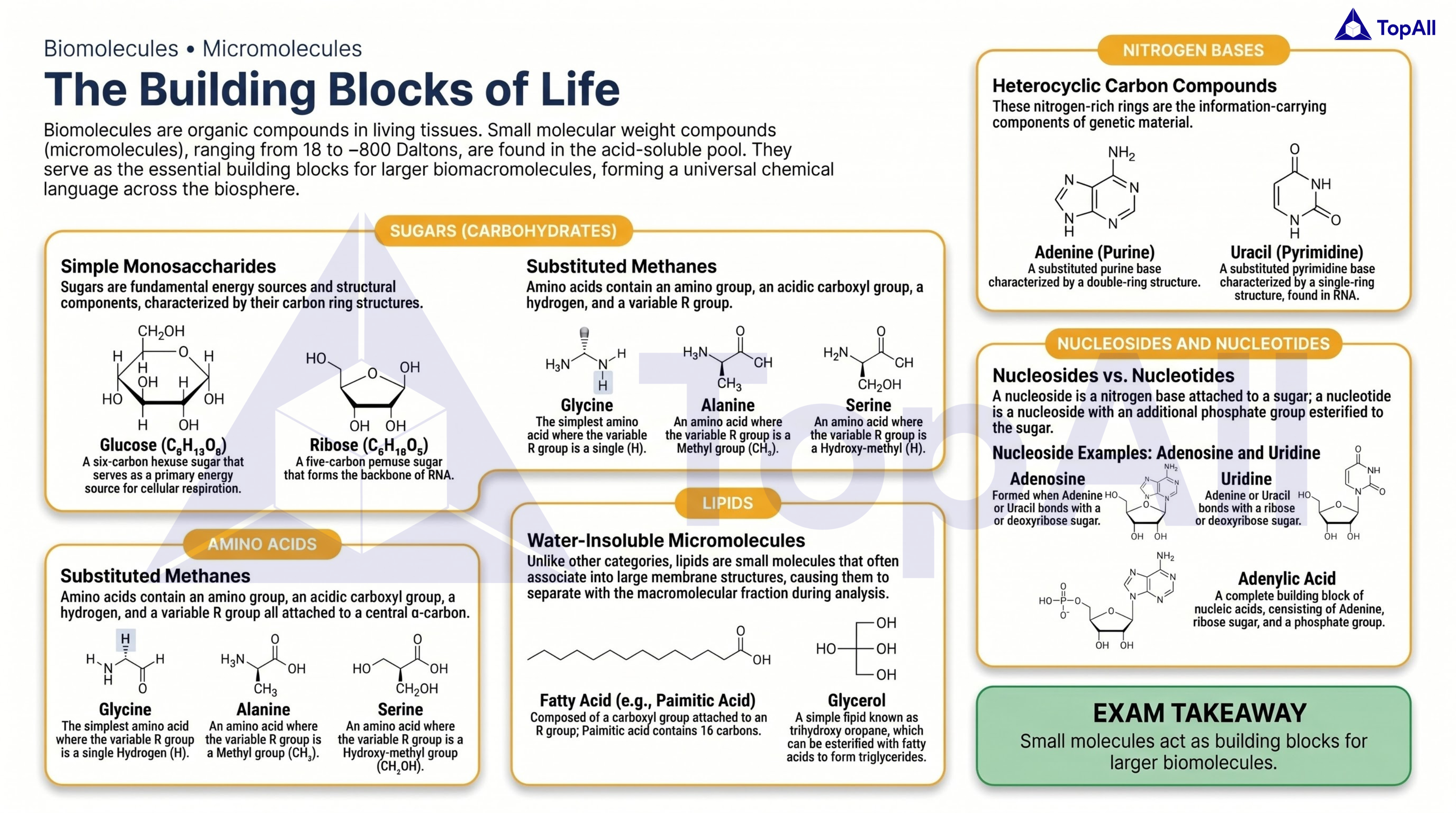
Study small molecular weight organic compounds for NEET UG with TopAll.
NEET UG · Mind map
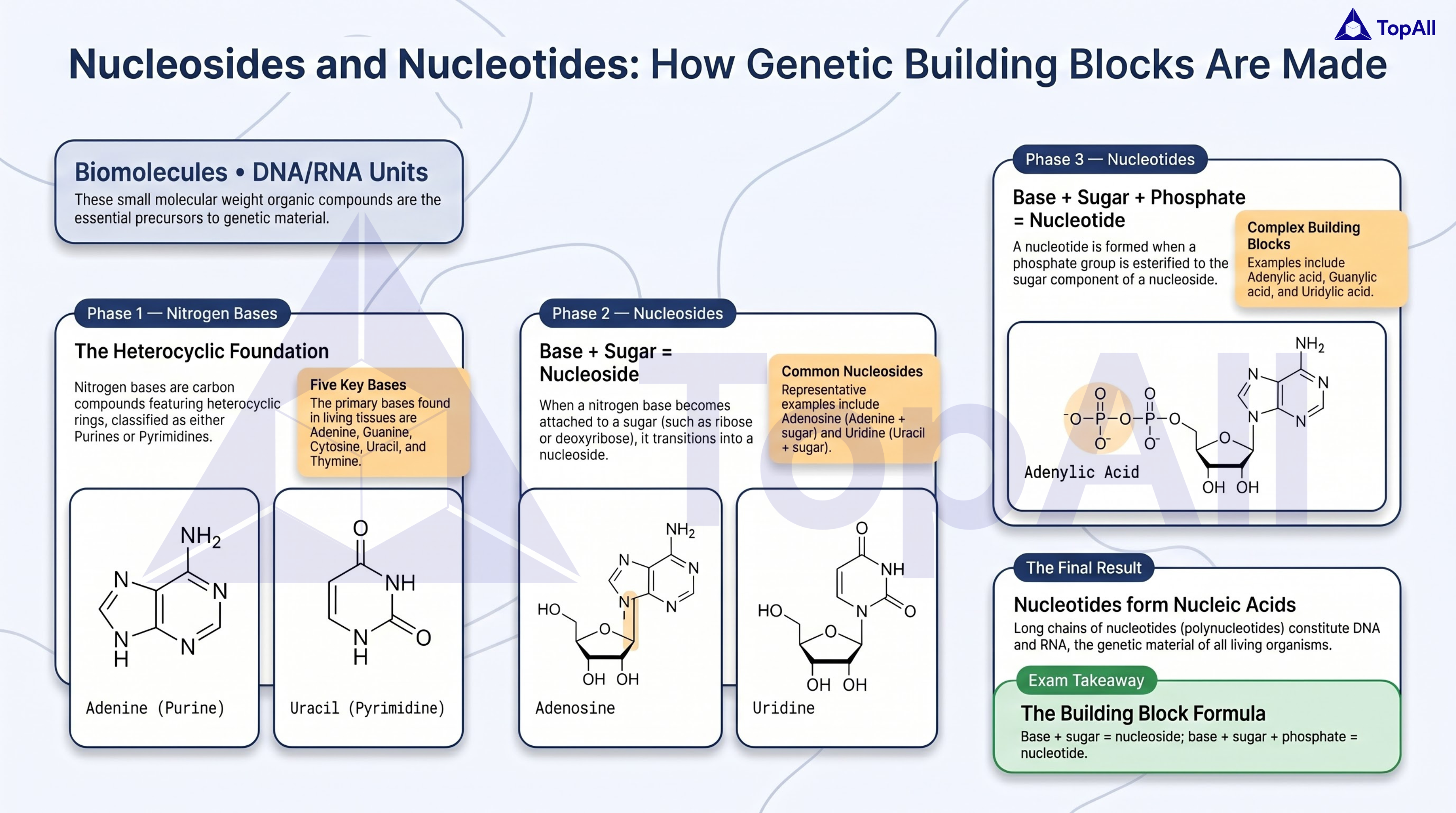
Learn nitrogen bases, nucleosides and nucleotides for NEET UG with TopAll.
Connect biomolecule units to their linkages, distinguish activation energy from overall energy change, and check your reasoning before Biomolecules MCQs.
Answer two different Biomolecules question types: which units are joined by a named bond, and what changes when an enzyme catalyses a reaction. Keep structural identification separate from energy reasoning.
Peptide linkages join amino-acid residues in polypeptides. Glycosidic linkages join sugar residues in polysaccharides. Phosphodiester linkages connect nucleotide residues along a nucleic-acid strand. Hydrogen bonds between complementary DNA bases describe a different connection. For enzyme questions, compare the activation barrier with the overall substrate-to-product energy change.
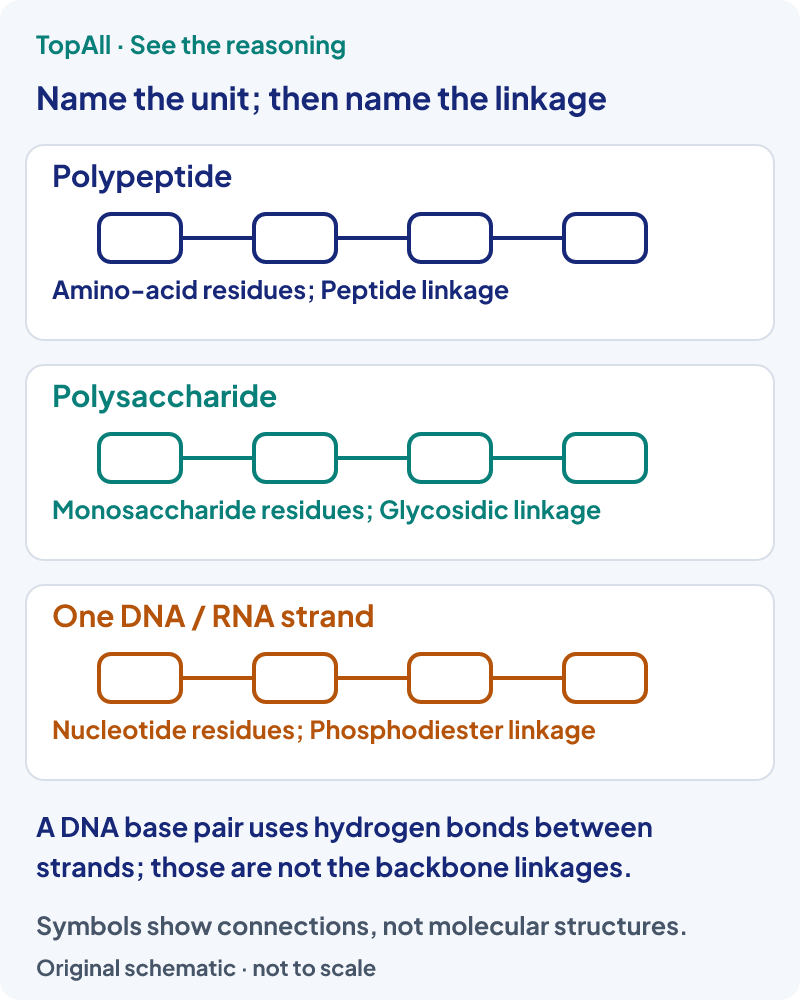
A linear, unbranched peptide contains five amino-acid residues and has no cyclic closure. There are four peptide linkages: draw five dots in a row and count the four gaps. Complete hydrolysis of those four peptide linkages consumes four water molecules in this simplified bookkeeping model.
The answer changes if the question changes the structure; do not reuse the “number of residues minus one” shortcut for a closed ring.
Polymers contain covalently linked repeating units. Membrane lipids can occur in the acid-insoluble fraction because membrane fragments are insoluble; this does not make each lipid molecule a polymer. For nucleic acids, distinguish base + sugar (nucleoside) from base + sugar + phosphate (nucleotide). A nucleotide is a building block; it is not the same thing as a whole DNA strand.
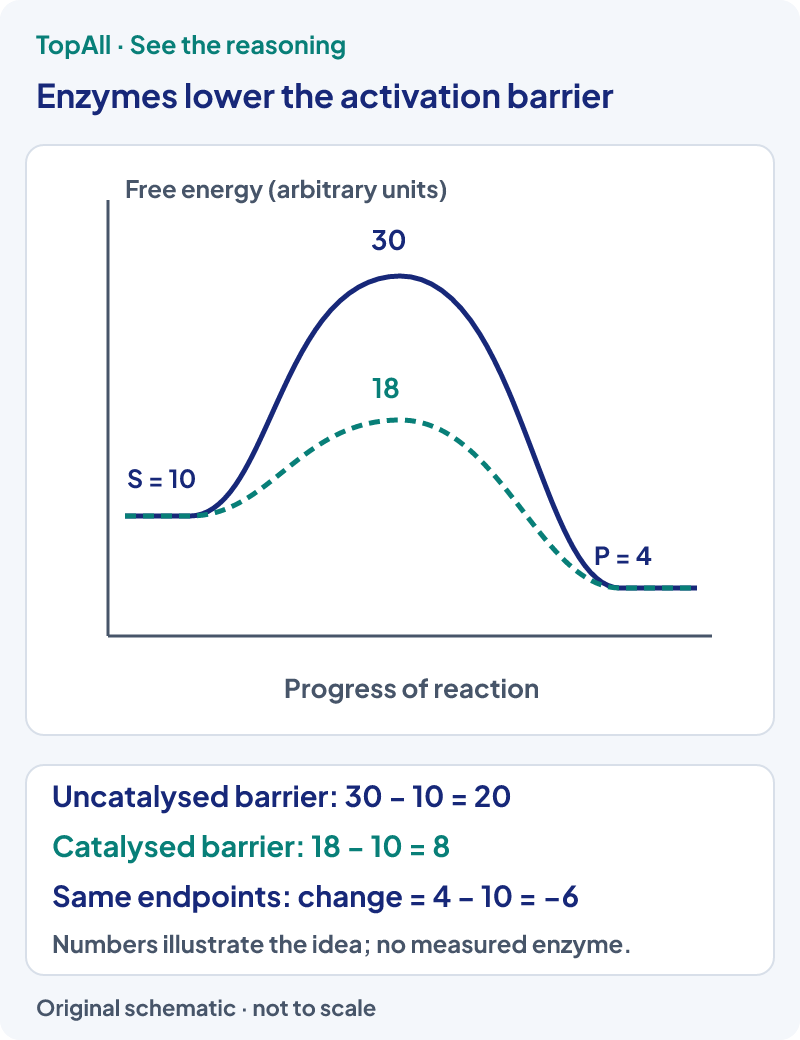
Use the arbitrary units in the diagram. Substrate S is at 10; product P is at 4. The uncatalysed peak is 30, so its forward barrier is 30 − 10 = 20. The catalysed peak is 18, giving 18 − 10 = 8. The overall free-energy change is 4 − 10 = −6 in both routes. The enzyme lowers the barrier; it does not move these endpoints.
For your next visit, redraw both routes with identical endpoints and explain why peak height alone is not activation energy.
A faster catalysed reaction does not mean a more negative overall free-energy change or a shifted equilibrium. Enzymes do not supply a reaction’s net energy. Most enzymes are proteins, but catalytic RNA is an exception. Avoid the statement “every enzyme denatures at the same temperature”: stability depends on the enzyme and its conditions.
Which linkage connects successive nucleotide residues along one DNA strand?
A. Hydrogen bond between complementary bases
B. Peptide linkage
C. Phosphodiester linkage
C. The question asks about the covalent backbone of one strand. A concerns base pairing between strands; B joins amino-acid residues in a polypeptide.
A schematic reaction starts at 12 units and ends at 5. Its peak falls from 32 to 20 with an enzyme. Which is correct?
A. The new forward barrier is 8; overall change remains −7.
B. The new forward barrier is 20; overall change is −12.
C. The enzyme changes the product energy to 20.
A. Subtract the substrate level: 20 − 12 = 8. The endpoint difference is still 5 − 12 = −7. B uses peak height as the barrier; C confuses the transition-state region with the product. These are illustrative units, not measured data.
Reconstruct the worked example from memory before looking at the diagrams. If a self-check exposed a mix-up, explain why your original answer failed, then try chapter practice.
Technical review: Codex (automated). Sources checked on 23 October 2026. Diagrams, numerical models, worked examples and self-checks are original teaching material. Human subject review is not claimed.


