
NEET UG · Biology
NEET UG · Biology
Digestion and absorption
Revise the concepts. Try a question. Understand your next step.
67 hard questions available · Try answers free. Sign in to save progress or take a quiz.
NEET UG · Biology
Continue studying Digestion And Absorption
Understand the concept, practise questions and check your learning.
Understand
Trace pancreatic protease activation, distinguish bile from lipase and follow soluble nutrients and long-chain lipids into their transport routes. Digestion: separate enzyme activation from nutrient absorption
Read the guidePractise
Try 67 hard chapter MCQs. Untimed; check answers and available explanations as you go.
Practise chapter MCQsCheck your learning
Prepare a timed chapter quiz. Choose the available question count and pace before starting.
Prepare a chapter quizThis is chapter practice, not a full-length NEET mock paper.
No revision resources are published for this chapter yet. Use your textbook alongside the guide and practice.
Choose your practice
All Biology chapters →These are playable question counts after quality and duplicate checks.
How practice and quizzes work
The practice player uses single-correct-answer MCQs. Chapter quizzes are not full-length NEET mock papers. Check the practice guide and official syllabus sources.
Revise before you practise
Study resources 0
No revision resources are published for this chapter yet. Use your textbook alongside the available practice questions.
Digestion: separate enzyme activation from nutrient absorption
Trace pancreatic protease activation, distinguish bile from lipase and follow soluble nutrients and long-chain lipids into their transport routes.
What you will understand
For NEET UG Biology students: separate enzyme production, activation and action, distinguish emulsification from hydrolysis and follow absorbed nutrients into blood or lymph through the correct enterocyte steps.
Quick answer: source, substrate, activation and destination are separate labels
An enzyme can be made in one organ and act in another. Some proteases are secreted as inactive precursors and activated at the action site. Mechanical processing and emulsification alter physical presentation, while enzymatic digestion hydrolyses chemical bonds. Absorption then moves products across the intestinal epithelium into transport pathways. A correct answer should identify which step is being asked, rather than choosing an organ name because it appears somewhere in digestion.
Follow pancreatic production and intestinal activation
Explain why bile helps digestion without calling it a lipase
A prompt says that bile improves fat digestion and asks whether it must therefore contain a triglyceride-hydrolysing enzyme. Bile salts help disperse large lipid droplets and support micellar delivery of lipid products, improving access and subsequent absorption. Pancreatic lipase catalyses triglyceride hydrolysis. The helper role does not make bile itself a digestive enzyme. Bile is produced by liver and can be stored and concentrated in the gallbladder; pancreatic secretion is a different source.
Keep the protease activation pathways separate
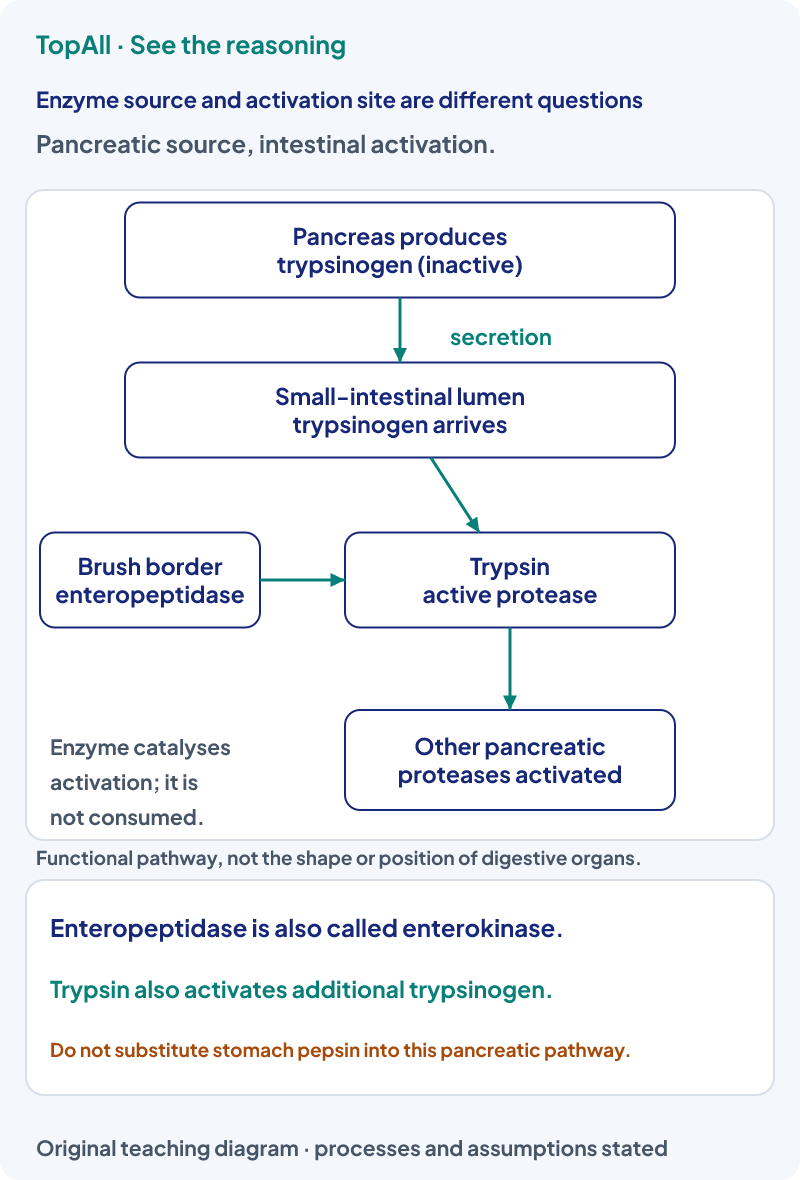
Gastric chief cells release pepsinogen, while acid from parietal cells helps initiate its activation to pepsin; pepsin can further activate pepsinogen. Pancreatic trypsinogen instead enters the intestinal environment and is activated by brush-border enteropeptidase, then by trypsin. These precursors protect the secretory context and allow activation at an appropriate site. The common ending “-ogen” does not mean that every precursor is activated by the same enzyme or pH.
Follow soluble nutrients and long-chain lipid products by different routes
Correct a lipid-absorption shortcut step by step
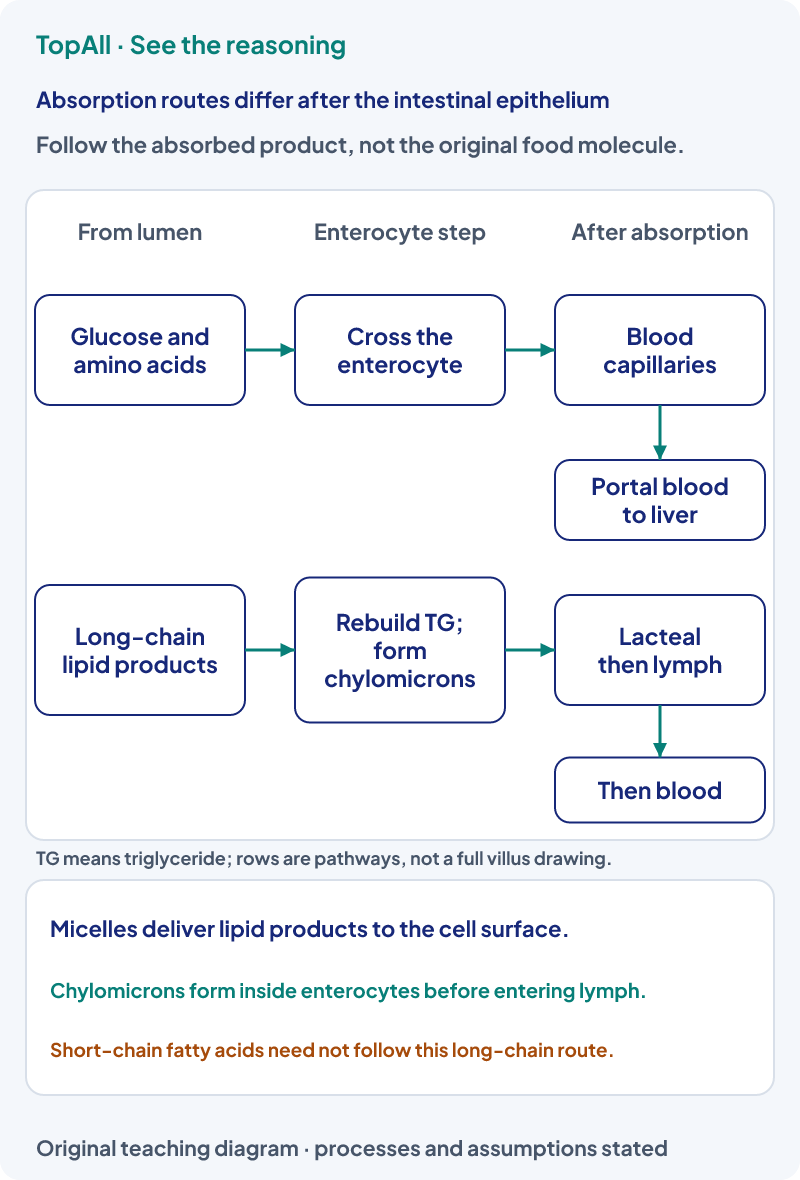
A proposed sequence is “dietary fat→micelle→lacteal unchanged”. It omits both digestion and enterocyte processing. For the main long-chain route, products such as long-chain fatty acids and monoacylglycerides reach the apical surface with micellar help, leave that delivery arrangement and enter cells. Triglycerides are reassembled and packaged with other components into chylomicrons. Chylomicrons leave enterocytes and enter lacteals, then lymph and eventually blood. Micelle and chylomicron name different structures in different compartments.
The intestinal surface provides area and specialised transport
Villi are projections of the intestinal mucosa, while microvilli are projections on the apical surfaces of individual absorptive cells. They describe different levels of organisation. Microvilli enlarge the surface for digestion-associated enzymes and uptake; they are not motile cilia sweeping food along. Different nutrients use different transport mechanisms and downstream routes. A surface-area statement alone does not specify which enzyme or transporter handles a particular molecule.
Predict the effect of blocking one activation step
Assume trypsinogen secretion reaches the small intestine normally but enteropeptidase activation is prevented, with no pre-existing trypsin in the stated model. The initial trypsin supply is impaired, reducing activation of additional trypsinogen and other pancreatic protease precursors. Protein digestion through that cascade is therefore affected. This does not mean that intestinal amylase activity or every digestive process must disappear; gastric and other digestive steps are separate. The conclusion follows the specified activation link and model assumptions.
Use a substrate-product check to catch a wrong sugar
Lactase hydrolyses lactose to glucose and galactose, not two glucose molecules:
Maltase acts on maltose and produces glucose units; sucrase acts on sucrose and yields glucose plus fructose. Enzyme names, substrate identity and products should agree. Absorption of the products is a later step and does not change the identity of the hydrolysis products.
Common mistakes: equate secretion with activation or use one route for all lipids
Write source→inactive precursor→activator→action site for a protease. For a lipid, identify lumen, enterocyte and lymph or blood at each step. Distinguish bile-mediated physical handling from lipase-mediated hydrolysis. Check the exact substrate and products before choosing an absorption destination.
Try it: count products from a supplied lactose amount
In a complete hydrolysis model, three lactose molecules are split with sufficient water and active lactase. How many glucose and galactose molecules result?
Reveal the answer
Each lactose yields one glucose and one galactose, so three yield three glucose and three galactose molecules. Three water molecules are used in the bond-cleavage reactions. The model concerns complete hydrolysis of supplied molecules; it does not predict an absorption rate, enzyme turnover rate or a clinical response.
Try it: distinguish a villus, a microvillus and a cilium
Which is an intestinal tissue-level projection, which is an absorptive cell’s apical surface projection, and which is typically a motile structure?
Reveal the answer
A villus is a projection of intestinal mucosa containing epithelium and underlying components including blood vessels and a lacteal. A microvillus is an apical projection of one cell that increases surface area. A cilium is a different cellular structure, often motile in the relevant epithelial examples. Calling microvilli “tiny cilia” loses a structural and functional distinction.
Come back tomorrow: trace one nutrient across compartments
Choose one sugar, protein precursor and long-chain lipid product. Name the source, processing site and transport destination in each case. Use Structural Organisation in Animals to interpret the absorptive lining, or Neural Control and Coordination to distinguish neural control from enzyme chemistry.
Practice opens the broad Digestion and Absorption chapter pool, not a guaranteed pancreatic-enzyme-only set.
Sources and review
Technical review: Codex (automated), 24 October 2026. Definitions and conventions checked against the linked primary textbooks. Numerical examples, self-checks and diagrams are original; calculations and diagram coordinates are checked separately. Human subject review is not claimed. These focused lessons support the existing NEET Biology chapter catalogue and do not claim complete current exam or syllabus coverage.
Choose your next chapter task
After a digestion error, identify source, activation, action and absorption separately. Keep the product and its compartment explicit before returning to chapter practice.
Sources and reading
- OpenStax Anatomy and Physiology 2e: Chemical Digestion and Absorption—A Closer Look — Enzyme source/substrate/product, enteropeptidase activation, micelles, enterocyte lipid reassembly, portal blood and lacteals.
- OpenStax Anatomy and Physiology 2e: Epithelial Tissue — Simple versus stratified arrangements, apical cell shape, basement membrane, pseudostratification, microvilli and cilia.