NEET UG · Video

Beats in Sound Waves NEET Guide
Learn beats in sound waves with examples, formulas & MCQs.
3 min video

NEET UG · Physics
Revise the concepts. Try a question. Understand your next step.
159 medium questions available · Try answers free. Sign in to save progress or take a quiz.
NEET UG · Physics
Understand the concept, practise questions and check your learning.
Understand
Find wave direction, wavelength and frequency, distinguish wave speed from particle speed and check phase before NEET Waves MCQs. Travelling waves: separate wave speed from particle motion
Read the guidePractise
Try 159 medium chapter MCQs. Untimed; check answers and available explanations as you go.
Practise chapter MCQsCheck your learning
Prepare a timed chapter quiz. Choose the available question count and pace before starting.
Prepare a chapter quizThis is chapter practice, not a full-length NEET mock paper.
These are playable question counts after quality and duplicate checks.
The practice player uses single-correct-answer MCQs. Chapter quizzes are not full-length NEET mock papers. Check the practice guide and official syllabus sources.
Revise before you practise
NEET UG · Video
Learn beats in sound waves with examples, formulas & MCQs.
3 min video
NEET UG · Video
Master standing waves & normal modes with easy theory & MCQs.
4 min video
NEET UG · Video
Study air columns & resonance with concepts, tricks & MCQs.
5 min video
NEET UG · PDF notes
Read PDF · 9 pages →Learn beats in sound waves with examples, formulas & MCQs.
9 pages
NEET UG · PDF notes
Read PDF · 9 pages →Master standing waves & normal modes with easy theory & MCQs.
9 pages
NEET UG · PDF notes
Read PDF · 9 pages →Study air columns & resonance with concepts, tricks & MCQs.
9 pages
NEET UG · Mind map

Learn beats in sound waves with examples, formulas & MCQs.
NEET UG · Mind map
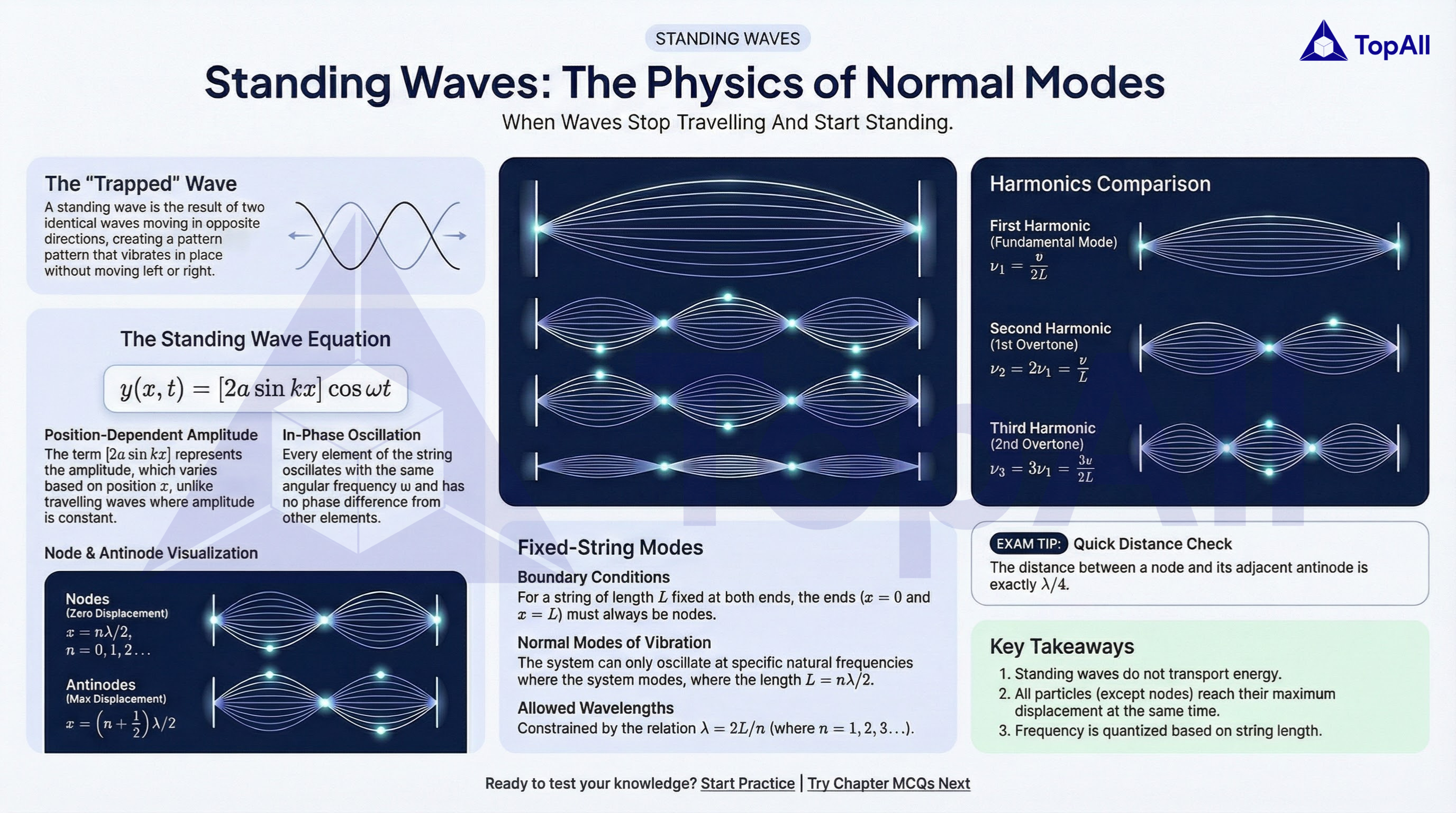
Master standing waves & normal modes with easy theory & MCQs.
NEET UG · Mind map
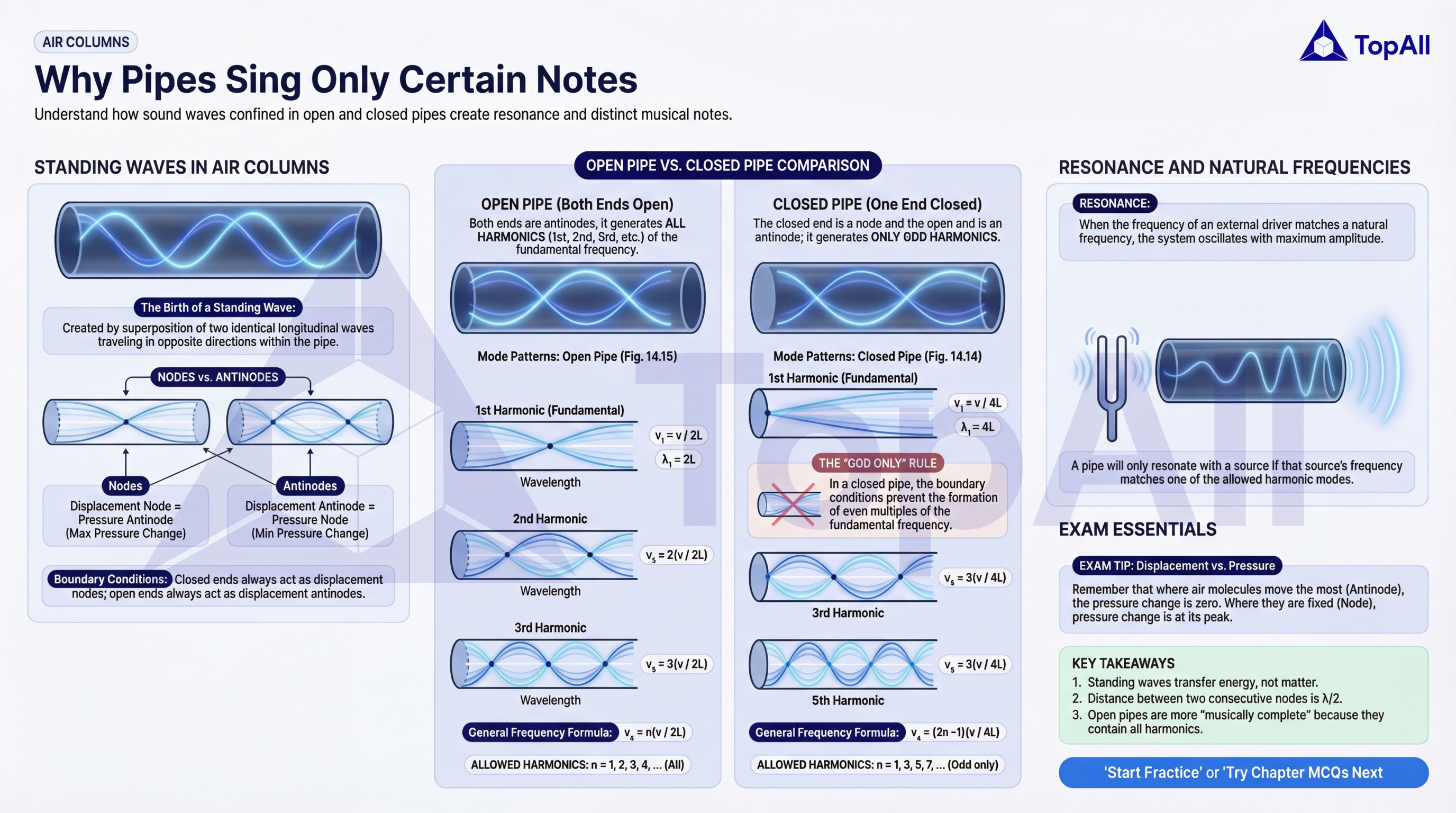
Study air columns & resonance with concepts, tricks & MCQs.
Find wave direction, wavelength and frequency, distinguish wave speed from particle speed and check phase before NEET Waves MCQs.
Read the units and coefficients in a sinusoidal travelling-wave equation. Distinguish movement of the wave pattern from motion of a material point, then compare points at the same instant.
For with positive and , constant phase requires to increase as increases: the pattern travels toward with speed . With , it travels toward . Here and . A material point on the ideal transverse string oscillates in ; it does not follow the crest along the string.
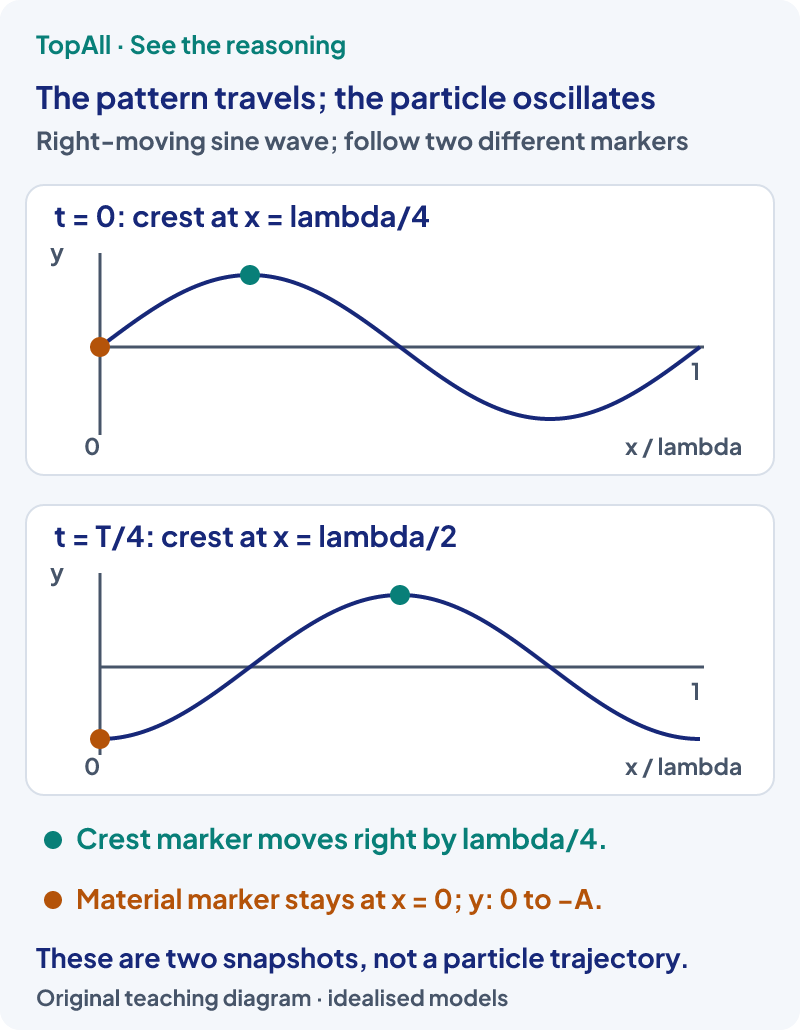
Let , where are in metres and is in seconds. The amplitude is ; and . Hence , and . The pattern travels at toward . The maximum transverse particle speed is , about . These are different quantities and directions.
For this one wave, the signed change from event 1 to event 2 is . At the same time set . At the same position set . “In phase” means the phase difference is an integer multiple of . Equal displacement at one instant is insufficient: the two points may be on different parts of the sine cycle.
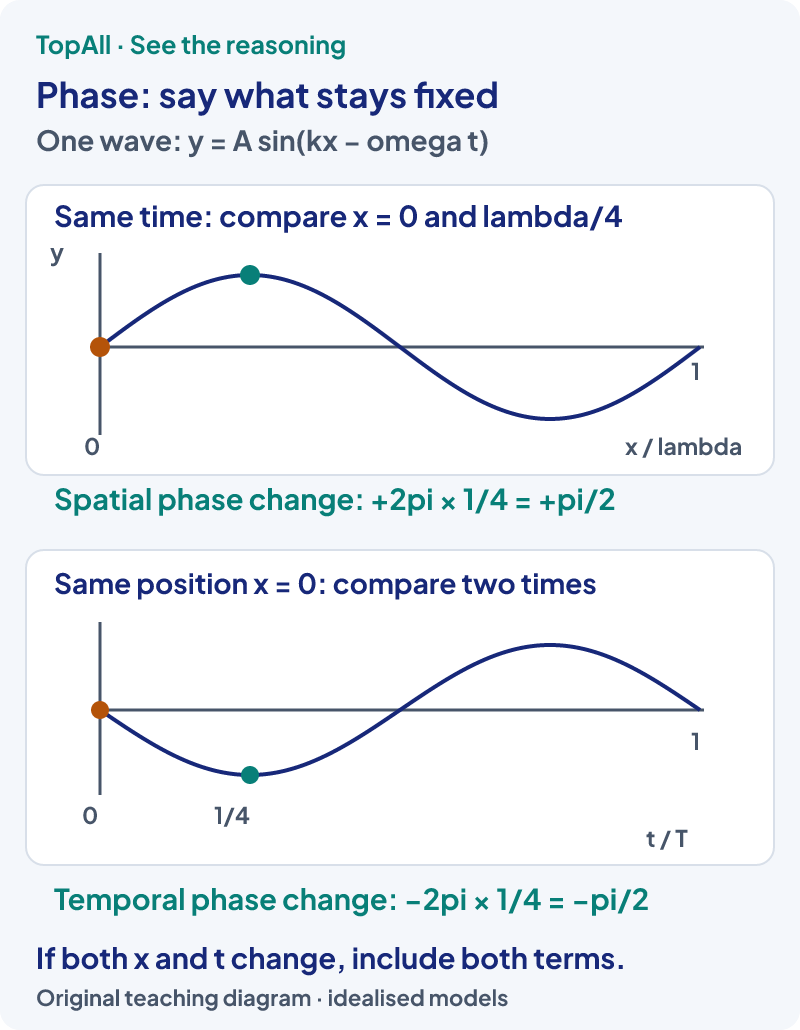
For the numerical wave above, a separation at the same time gives . At one fixed position, a delay gives . Now compare two events with both changes together: . They lie on the same phase of the right-moving pattern. This does not mean that one material particle moved along the string.
The coefficient is not , and is not frequency in hertz. Include the factors of . The speed describes propagation; is the maximum speed of a material point in this sinusoidal model. In a transverse string wave the latter direction is perpendicular to propagation. A snapshot against position is different from a displacement–time graph at one position.
For the worked wave, which is the pattern speed? A. ; B. ; C. .
A. Use . B is the maximum transverse particle speed, and 20 is the numerical value of frequency in hertz, not a speed.
Two points of the worked wave are separated by in the direction at the same time. What is the signed phase change? A. ; B. ; C. .
B. Set and use . The negative quarter-cycle change belongs to a later time at a fixed position in this convention.
Draw a snapshot and a displacement–time trace for one material point. Label the horizontal axis on each. Recover , , pattern speed and maximum particle speed from the worked equation, naming the units before checking your answer.
Explain the mistake behind any self-check you missed, then use chapter practice to test the corrected idea.
Technical review: Codex (automated). Sources checked on 23 October 2026. The diagrams, worked numerical models and self-checks are original teaching material. Human subject review is not claimed.

