NEET UG · Video

Capacitors and Capacitance for NEET
Learn capacitors and capacitance with simple concepts, formulas and MCQ practice on TopAll.
8 min video

NEET UG · Physics
Revise the concepts. Try a question. Understand your next step.
173 medium questions available · Try answers free. Sign in to save progress or take a quiz.
NEET UG · Physics
Understand the concept, practise questions and check your learning.
Understand
Choose work signs and decide what stays fixed before solving a capacitor change, with original diagrams, worked examples and self-checks. Potential work and capacitor constraints: a NEET decision guide
Read the guidePractise
Try 173 medium chapter MCQs. Untimed; check answers and available explanations as you go.
Practise chapter MCQsCheck your learning
Prepare a timed chapter quiz. Choose the available question count and pace before starting.
Prepare a chapter quizThis is chapter practice, not a full-length NEET mock paper.
These are playable question counts after quality and duplicate checks.
The practice player uses single-correct-answer MCQs. Chapter quizzes are not full-length NEET mock papers. Check the practice guide and official syllabus sources.
Revise before you practise
NEET UG · Video
Learn capacitors and capacitance with simple concepts, formulas and MCQ practice on TopAll.
8 min video
NEET UG · Video
Learn energy stored in a capacitor with simple formulas and exam-focused MCQs on TopAll.
4 min video
NEET UG · Video
Learn how dielectric affects capacitance with simple explanations and MCQs on TopAll.
5 min video
NEET UG · PDF notes
Read PDF · 8 pages →Learn equipotential surfaces with clear concepts, diagrams and MCQ practice on TopAll.
8 pages
NEET UG · PDF notes
Read PDF · 8 pages →Learn energy stored in a capacitor with simple formulas and exam-focused MCQs on TopAll.
8 pages
NEET UG · PDF notes
Read PDF · 8 pages →Master combination of capacitors with easy concepts, formulas and MCQ practice on TopAll.
8 pages
NEET UG · Mind map
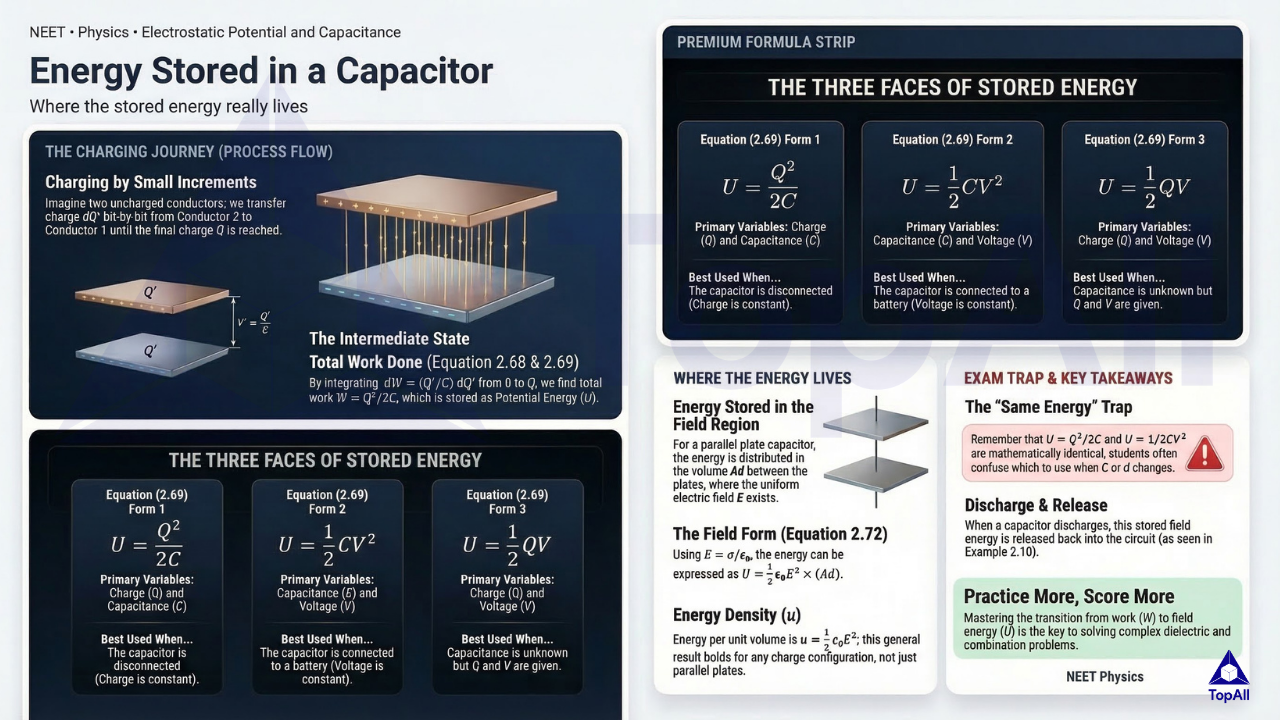
Learn energy stored in a capacitor with simple formulas and exam-focused MCQs on TopAll.
NEET UG · Mind map
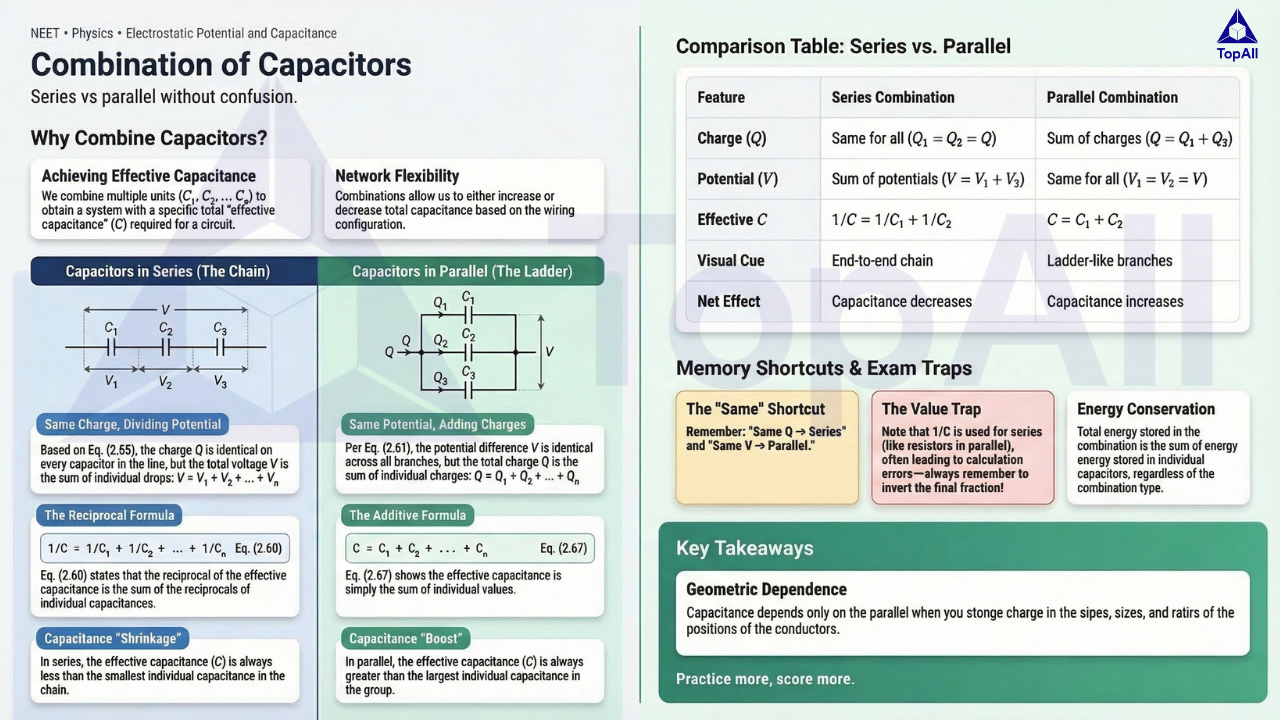
Master combination of capacitors with easy concepts, formulas and MCQ practice on TopAll.
NEET UG · Mind map
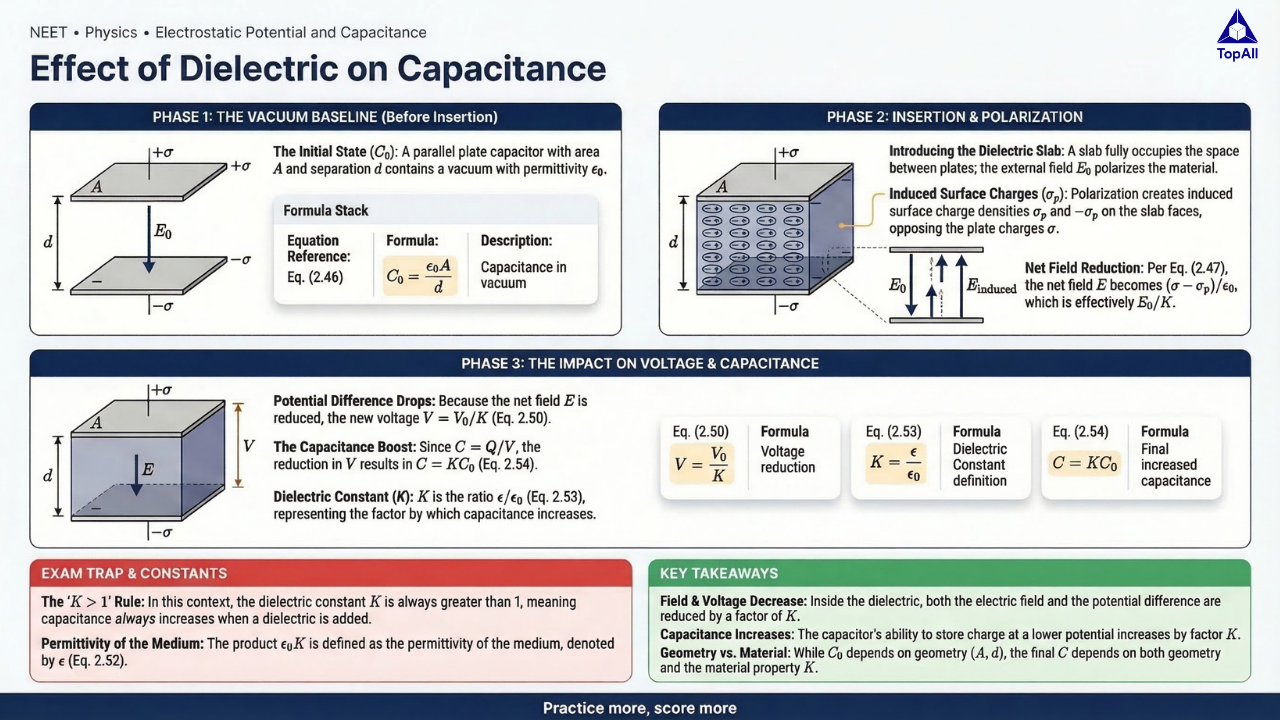
Learn how dielectric affects capacitance with simple explanations and MCQs on TopAll.
Choose work signs and decide what stays fixed before solving a capacitor change, with original diagrams, worked examples and self-checks.
For NEET UG students: decide the signs of potential-energy change and field work, then choose the quantity that stays fixed when a capacitor changes.
For a test charge moved from A to B, , and . For a linear capacitor, use and . Here is the magnitude of the free charge on either plate and is the voltage magnitude between the plates. A connected ideal battery fixes ; an isolated disconnected capacitor with no leakage fixes . Those are different experiments.
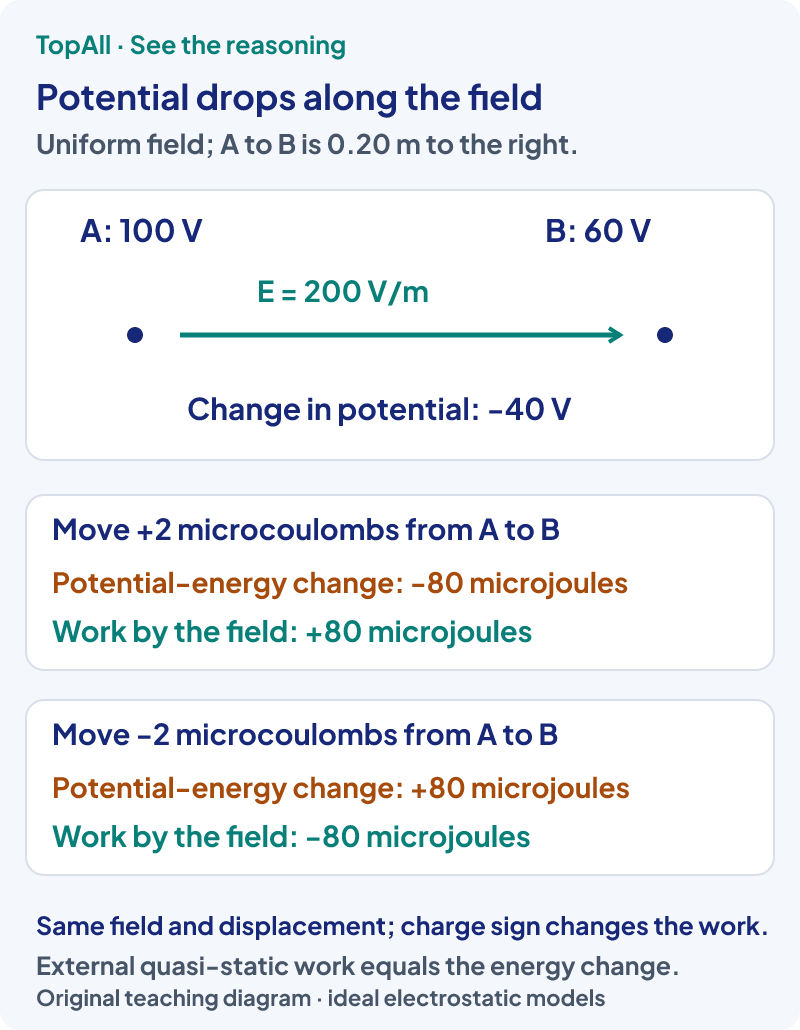
In a uniform rightward field, A is at and B, to its right, is at . Thus . Move from A to B: , so . The field points right but the force on this negative charge points left. Quasi-static external work is if no other force does work and kinetic energy does not change.
For ideal parallel plates with area , gap and a linear homogeneous dielectric completely filling that gap, . Neglect fringing. is relative permittivity. Capacitance depends on geometry and material in this model, not on whichever and happen to be present. Inserting at unchanged geometry doubles ; it does not by itself tell you whether or doubles.
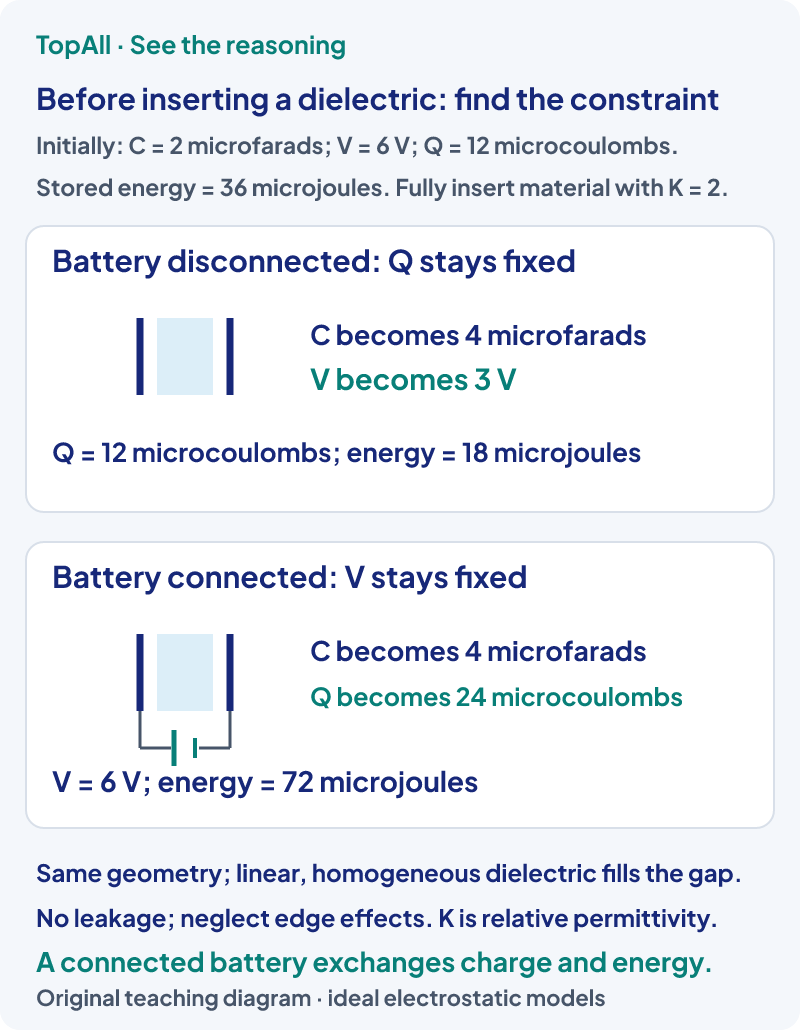
Initially and , so and . Disconnect the battery, isolate the plates with no leakage, and fully fill the gap with dielectric at unchanged geometry. Then , , and . Fixed makes energy inversely proportional to capacitance. The decreased capacitor energy can be transferred mechanically during insertion; do not claim it disappears.
Start with a separate identical capacitor across the ideal battery. Keep the battery attached while fully inserting at unchanged geometry. again becomes , but stays fixed, so and . This is twice the initial stored energy. The battery supplies extra charge: , with electrical work . Only is the capacitor-energy increase; the rest is accounted for by mechanical transfer and any dissipation in the actual insertion process. Capacitor energy alone is not conserved.
Wrong: “Dielectric always decreases capacitor energy.” Correct: it decreases energy for the isolated fixed-charge experiment but increases it at fixed voltage. Wrong: “Connected means charge stays fixed.” Correct: charge can flow through the battery leads. Wrong: use without signs for an arbitrary direction. Correct: the field component is ; a magnitude formula needs the appropriate direction and uniform-field assumption. Wrong: external work always equals . Correct: if kinetic energy changes and only electric and external work act, .
Move from A at to B at . Find and work by the field. What would quasi-static external work be if there is no other work?
, hence and . With no kinetic-energy change and no other work, : the external agent removes energy. Reversing the charge sign would reverse all three work/energy signs, not the source potential difference.
A vacuum parallel-plate capacitor is initially at . Disconnect and isolate it with no leakage, then double the plate gap while retaining the plate area. Neglect fringing. Find its new capacitance, charge, voltage and stored energy.
Initially and . Since , the new . Charge remains , so and . Separating attracted plates requires positive external work in the quasi-static ideal model. The fixed-voltage result would be a different experiment.
Rebuild three rows from memory: connected battery → fixed voltage; disconnected and isolated with no leakage → fixed charge; full homogeneous dielectric at unchanged geometry → capacitance multiplied by . Then derive the remaining quantities with and one energy expression. Use the diagram only after you have predicted whether voltage, charge and energy rise or fall.
Re-solve the gap-doubling self-check while keeping the ideal battery connected. Predict the changes first. The result is , and . Explain why these differ from the disconnected answers. Continue with broad chapter practice below; these links are not a dedicated dielectric set or a promise of every JEE question format.
Technical review: Codex (automated). Primary textbook sources checked on 23 October 2026. Numerical examples, self-checks and diagrams are original. Human subject review is not claimed.
Explain the mistake you corrected, then try a fresh chapter question.

