NEET UG · Physics
Alternating Current
Determine an induced current direction, convert sinusoidal peaks to RMS values and solve a series LCR example without mixing phases.

NEET UG · Physics
Revise the concepts. Try a question. Understand your next step.
12 medium questions available · Try answers free. Sign in to save progress or take a quiz.
NEET UG · Physics
Understand the concept, practise questions and check your learning.
Understand
Separate predictions from observations, check model assumptions and keep complete energy accounts. Physical reasoning: test the model and define the system
Read the guidePractise
Try 12 medium chapter MCQs. Untimed; check answers and available explanations as you go.
Practise chapter MCQsCheck your learning
Prepare a timed chapter quiz. Choose the available question count and pace before starting.
Prepare a chapter quizThis is chapter practice, not a full-length NEET mock paper.
No revision resources are published for this chapter yet. Use your textbook alongside the guide and practice.
These are playable question counts after quality and duplicate checks.
The practice player uses single-correct-answer MCQs. Chapter quizzes are not full-length NEET mock papers. Check the practice guide and official syllabus sources.
Revise before you practise
No revision resources are published for this chapter yet. Use your textbook alongside the available practice questions.
Separate predictions from observations, check model assumptions and keep complete energy accounts.
For NEET UG Physics students using this existing chapter catalogue: separate observation from prediction, test a model within stated assumptions, recognise the limits of dimensional checks and choose a system for energy accounting.
This is a focused guide to physical reasoning; an existing chapter route does not establish current exam inclusion.
A physical model represents selected features of a system and leaves others out. State what it assumes, calculate a prediction and compare it with observations and their stated measurement limits. Agreement in tested cases supports usefulness in that range; it is not proof for every possible case. A mismatch may call for checking measurement, assumptions or the model. Conservation statements also require a system boundary and the relevant forms of energy or transfers.
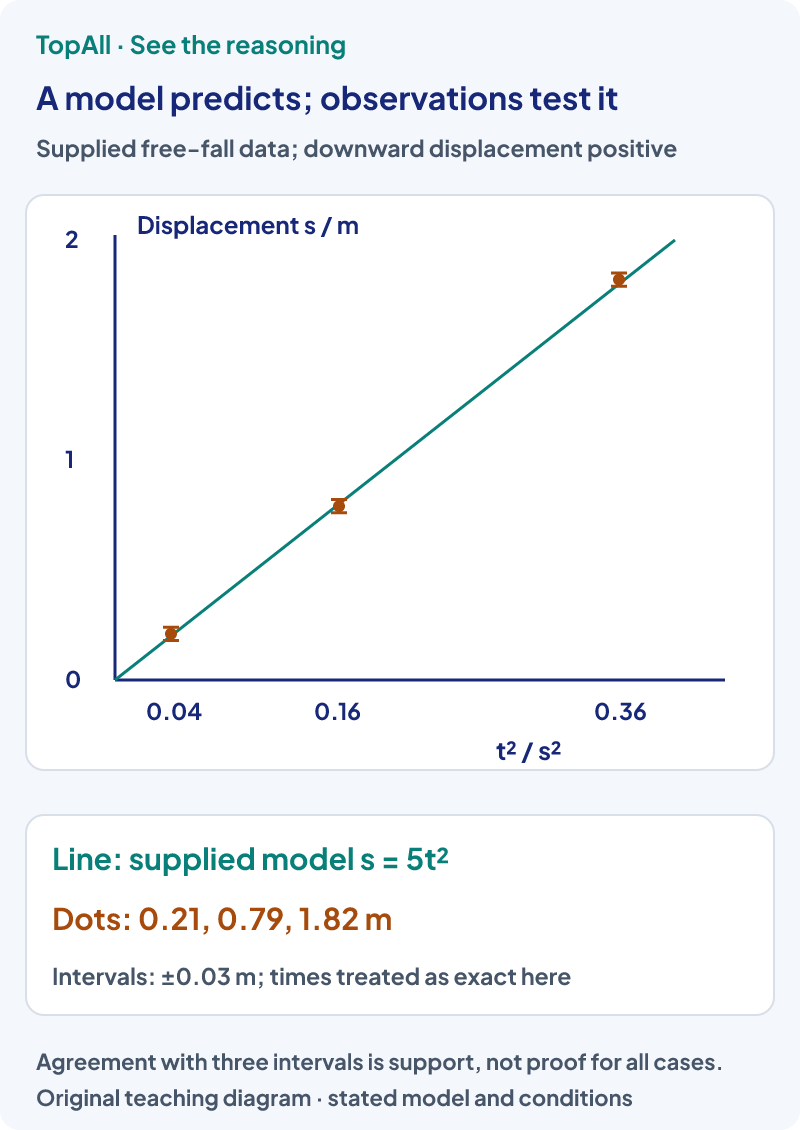
Assume from-rest vertical motion with negligible air resistance and supplied constant . The prediction gives0.20,0.80 and 1.80 m at 0.20,0.40 and 0.60 s. Invented observations 0.21,0.79 and 1.82 m each have a supplied position comparison interval ±0.03 m; time uncertainty is ignored here. The model values lie inside all three intervals. At0.80 s the model predicts 3.20 m, but no observation at that time has been supplied. Keep the prediction distinct from a measurement, and do not turn three consistent comparisons into proof of exact g or a universal law.
Changing several uncontrolled conditions at once can make a discrepancy hard to interpret. A heavier and lighter object falling differently in air does not alone isolate mass dependence of the ideal negligible-drag model; shape, area and drag can also differ. Repeated observations, controlled comparisons, calibration and stated uncertainty help interpret a test. These are reasoning requirements, not instructions to perform a particular experiment or a guarantee that every uncertainty is random.
Both and have length dimensions because g has dimension LT−2 and t² has T². A unit check therefore cannot select the factor one half. For the supplied from-rest constant-g model and t=0.40 s, the two candidates predict1.60 m and 0.80 m. The invented observation 0.79±0.03 m is consistent with 0.80 m and inconsistent with 1.60 m under this stated interval comparison. The physical derivation and test add information that dimensions alone do not provide.
A definition fixes how a quantity or term is used, while a model represents selected physical features and an empirical claim is assessed against observations. Choosing metres rather than centimetres does not change which physical prediction agrees with a consistently converted observation. More elaborate mathematics does not by itself make a model better: its predictions, useful domain and evidence matter. Classical approximations can remain useful in a regime even when a broader theory is needed elsewhere.
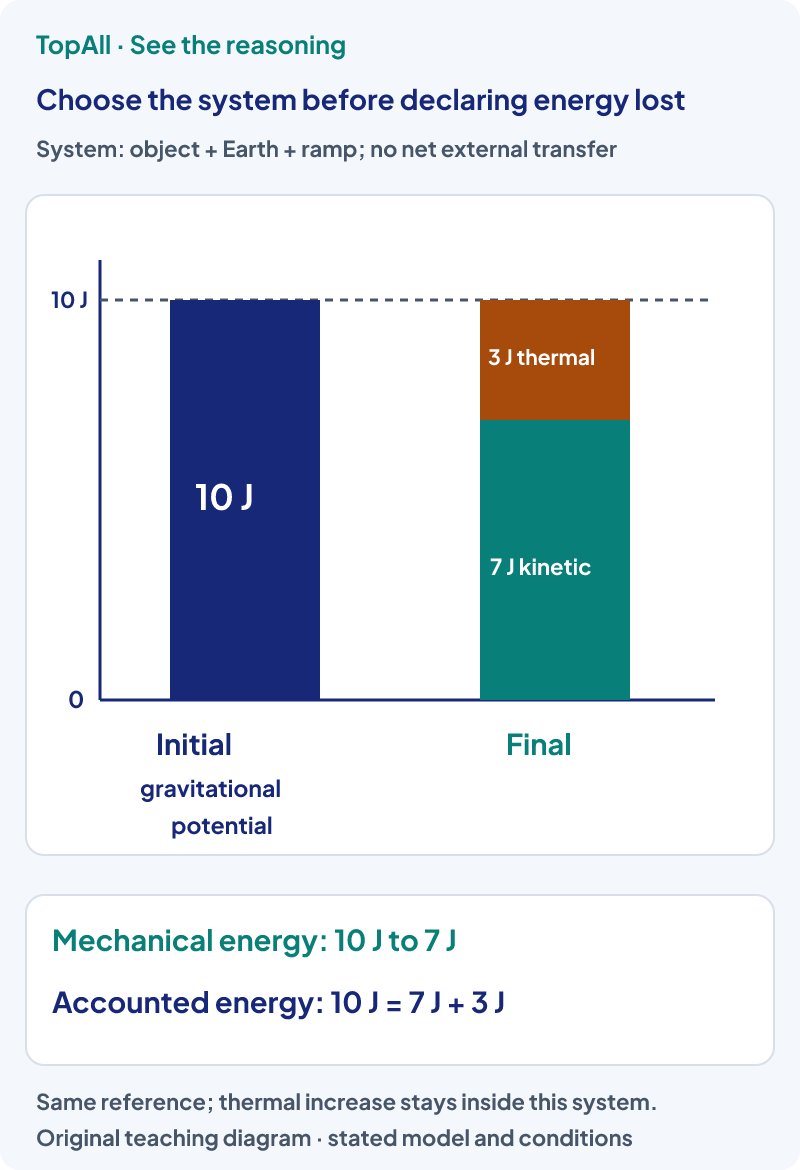
For the supplied isolated object+Earth+ramp accounting, take the bottom position as the zero gravitational-potential reference and ignore unchanged contributions. Initial available energy is 10 J gravitational potential. Final kinetic energy is 7 J and internal thermal energy has increased by 3 J. The balance10=7+3 J closes, although mechanical energy decreased by 3 J. Friction did not destroy energy. The thermal increase belongs to the whole stated system; it need not all be assigned to the moving object. If the boundary excluded the ramp or allowed outside transfers, those terms would need to be included instead.
A model that reproduces a few supplied points may still fail outside their range or under changed conditions. Compare a new prediction with an independent observation, and state what the model leaves out. A scientific theory is supported through testing and reasoning within a domain; it does not become a law simply by being repeated for a long time. A diagram or simulation is another representation whose assumptions must be checked, rather than independent proof of its own equations.
A prediction is not an observation because its number looks plausible. A comparison interval is not automatically a statistical confidence interval. Correct dimensions cannot establish every coefficient or the validity of assumptions. A mechanical-energy decrease is not by itself total-energy destruction. Name the system and omitted interactions before diagnosing the result, and separate a model’s domain from the complete physical world.
A heavier object falls faster than a lighter object in air, but their shapes and surface areas also differ. Does that single comparison by itself refute the ideal model in which all objects have the same acceleration when air resistance is negligible?
No. The comparison has not isolated the negligible-drag conditions or changed only mass. Different drag, shape and area can matter in air. The observation should be described accurately and compared with a model whose assumptions match the tested situation.
A report gives initial mechanical energy 10 J and final mechanical energy 7 J, but says nothing about system boundary, heating or outside transfer. Is that alone proof that energy conservation failed? What extra information would make the illustrated balance meaningful?
It is not enough information. Define the system and check other energy forms and transfers. In the illustrated object+Earth+ramp model with no net external transfer, a3 J internal thermal increase closes the balance. Without those conditions or measurements, do not invent a heating value or declare a conservation-law failure.
Identify one model assumption and one quantity that could test it. Then reconstruct an energy balance with a clear boundary. Revisit NEET Units and Measurements for dimensions and measurement limits, or NEET Work, Energy and Power for system and transfer accounting.
Chapter practice opens the existing Physical World pool.
Technical review: Codex (automated). Primary textbook sources checked on 23 October 2026. Diagrams, worked examples and self-checks are original and use stated models and supplied inputs. Human subject review is not claimed. The existing chapter catalogue and these focused guides do not establish complete current exam or syllabus coverage.
Before opening the next set, name the initial state, final state, system and model assumptions. After a mistake, correct the assumption or comparison before repeating the calculation.