NEET UG · Video

Capillary Rise NEET Explained
Master capillary rise with derivation, numericals & MCQs on TopAll.
4 min video

NEET UG · Physics
Revise the concepts. Try a question. Understand your next step.
218 medium questions available · Try answers free. Sign in to save progress or take a quiz.
NEET UG · Physics
Understand the concept, practise questions and check your learning.
Understand
Distinguish gauge and absolute pressure, apply continuity, and check Bernoulli’s assumptions before NEET fluid-mechanics chapter practice. Pressure at rest and in flow: choose the reference and the model
Read the guidePractise
Try 218 medium chapter MCQs. Untimed; check answers and available explanations as you go.
Practise chapter MCQsCheck your learning
Prepare a timed chapter quiz. Choose the available question count and pace before starting.
Prepare a chapter quizThis is chapter practice, not a full-length NEET mock paper.
These are playable question counts after quality and duplicate checks.
The practice player uses single-correct-answer MCQs. Chapter quizzes are not full-length NEET mock papers. Check the practice guide and official syllabus sources.
Revise before you practise
NEET UG · Video
Master capillary rise with derivation, numericals & MCQs on TopAll.
4 min video
NEET UG · Video
Learn drops & bubbles concepts with formulas & MCQs on TopAll.
5 min video
NEET UG · Video
Understand angle of contact with concepts, examples & MCQs on TopAll.
3 min video
NEET UG · PDF notes
Read PDF · 9 pages →Master capillary rise with derivation, numericals & MCQs on TopAll.
9 pages
NEET UG · PDF notes
Read PDF · 9 pages →Learn drops & bubbles concepts with formulas & MCQs on TopAll.
9 pages
NEET UG · PDF notes
Read PDF · 9 pages →Understand angle of contact with concepts, examples & MCQs on TopAll.
9 pages
NEET UG · Mind map
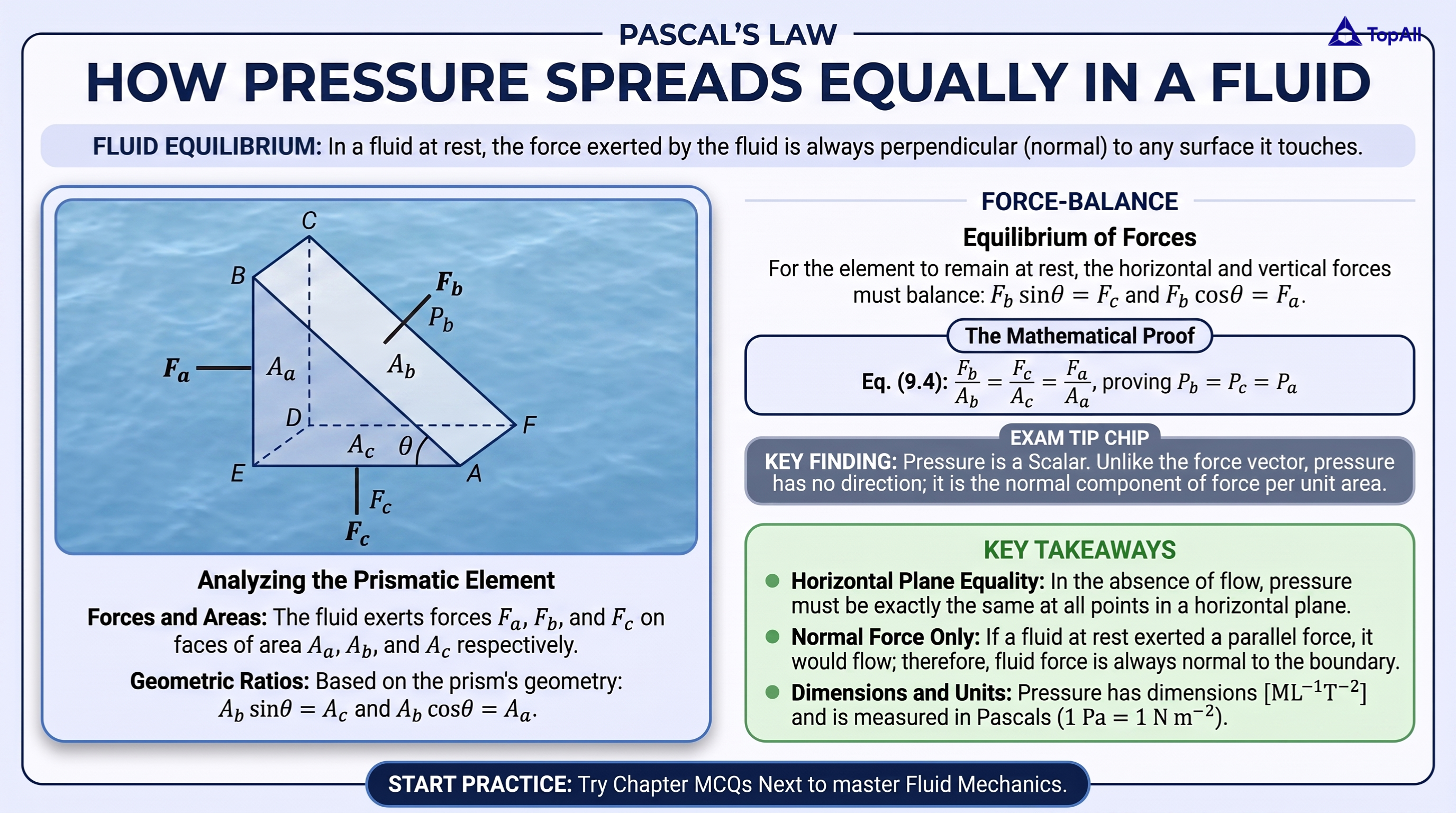
Master Pascal's Law in fluid mechanics for NEET UG with TopAll.
NEET UG · Mind map
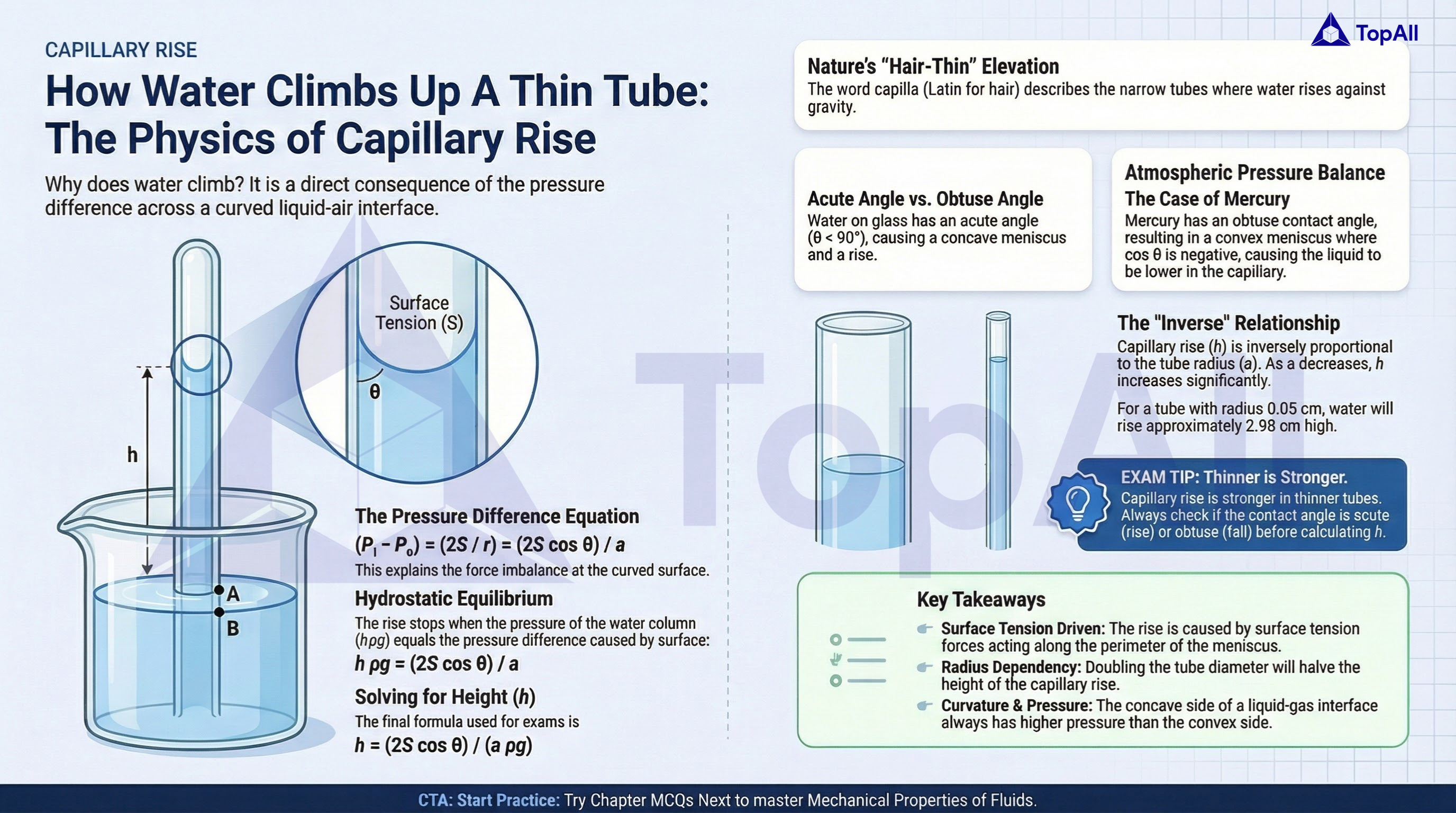
Master capillary rise with derivation, numericals & MCQs on TopAll.
NEET UG · Mind map
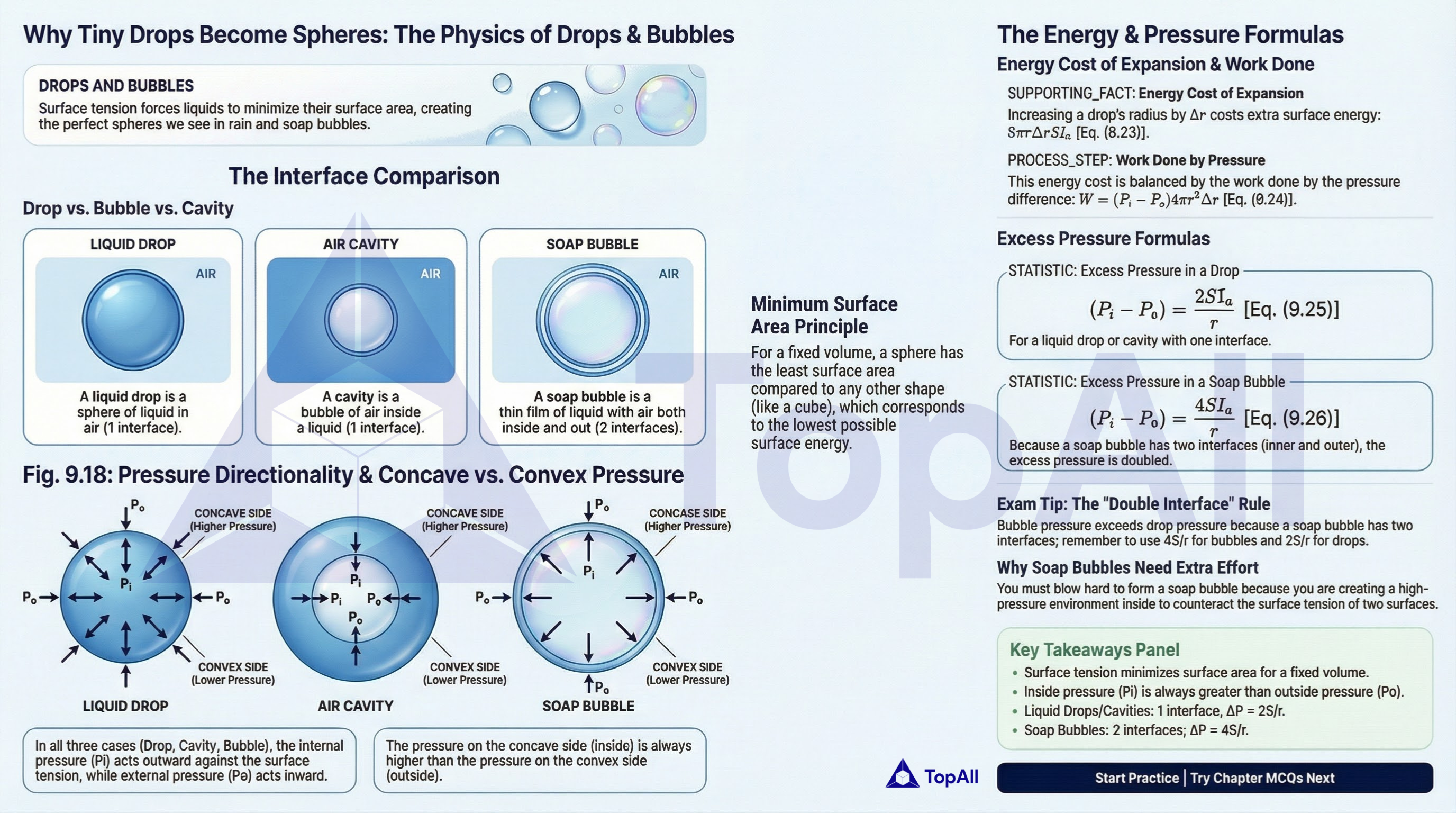
Learn drops & bubbles concepts with formulas & MCQs on TopAll.
Distinguish gauge and absolute pressure, apply continuity, and check Bernoulli’s assumptions before NEET fluid-mechanics chapter practice.
For NEET UG students: choose a pressure reference for water at rest, use continuity before calculating flow pressure, and identify when the ideal Bernoulli model applies. The worked examples keep depth, area, speed and pressure from becoming interchangeable shortcuts.
For a constant-density liquid at rest in uniform gravity, , with measured downward from the free surface. Gauge pressure is ; it equals when the surface is at that same atmospheric pressure.
For steady incompressible flow in a filled tube with no leaks, continuity gives using mean section speeds. Under a one-dimensional ideal-flow model with uniform section speeds, negligible viscosity, no pump or energy loss and points on the same streamline, use . Use one consistent pressure reference.
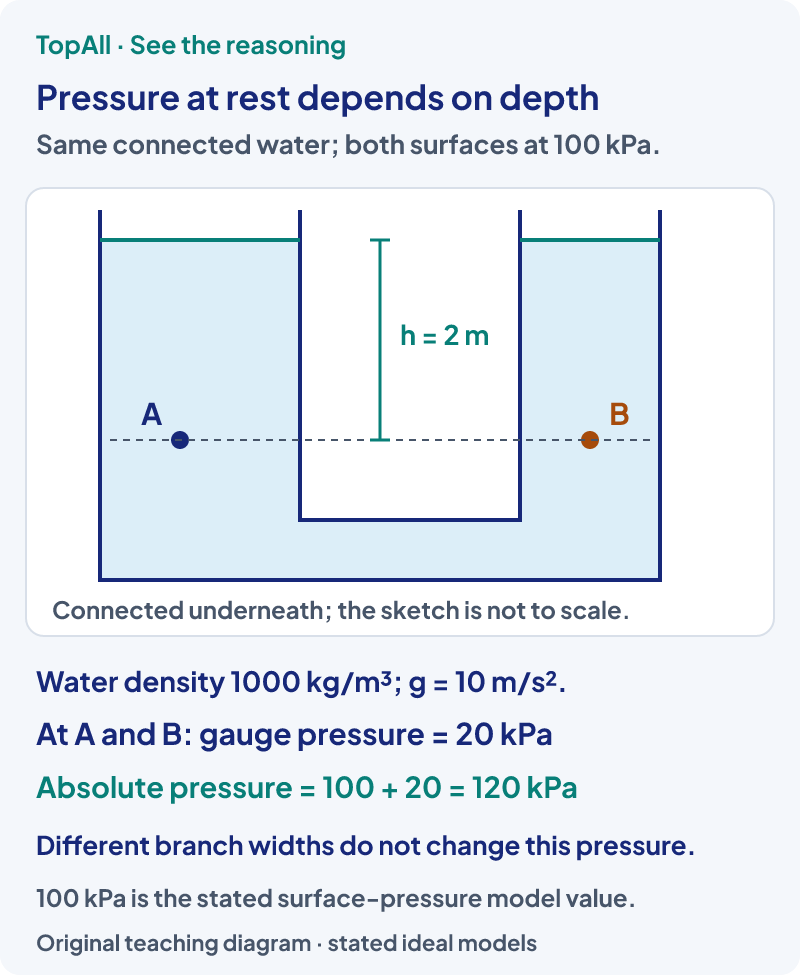
Two branches contain the same connected stationary water. In this model both surfaces are exposed to . Take , and depth .
is the gauge pressure at each point. Absolute pressure is . Different branch widths do not change this equality at the same depth in the same connected liquid. The stated 100 kPa is the model’s atmospheric value, not a definition of one standard atmosphere.
Pressure is a scalar; the pressure force on a surface element acts normally to that surface. For uniform pressure on a flat area, its normal force magnitude is , so equal pressure does not mean equal force on different areas. Hydrostatic buoyancy is the net result of pressure forces; for a displaced volume in a constant-density liquid, its upward magnitude is .
In an ideal confined liquid at rest, an imposed pressure change is transmitted throughout the liquid. Account for height differences when comparing pressures. In flow, do not use “faster means lower pressure” without the streamline, height and energy assumptions.
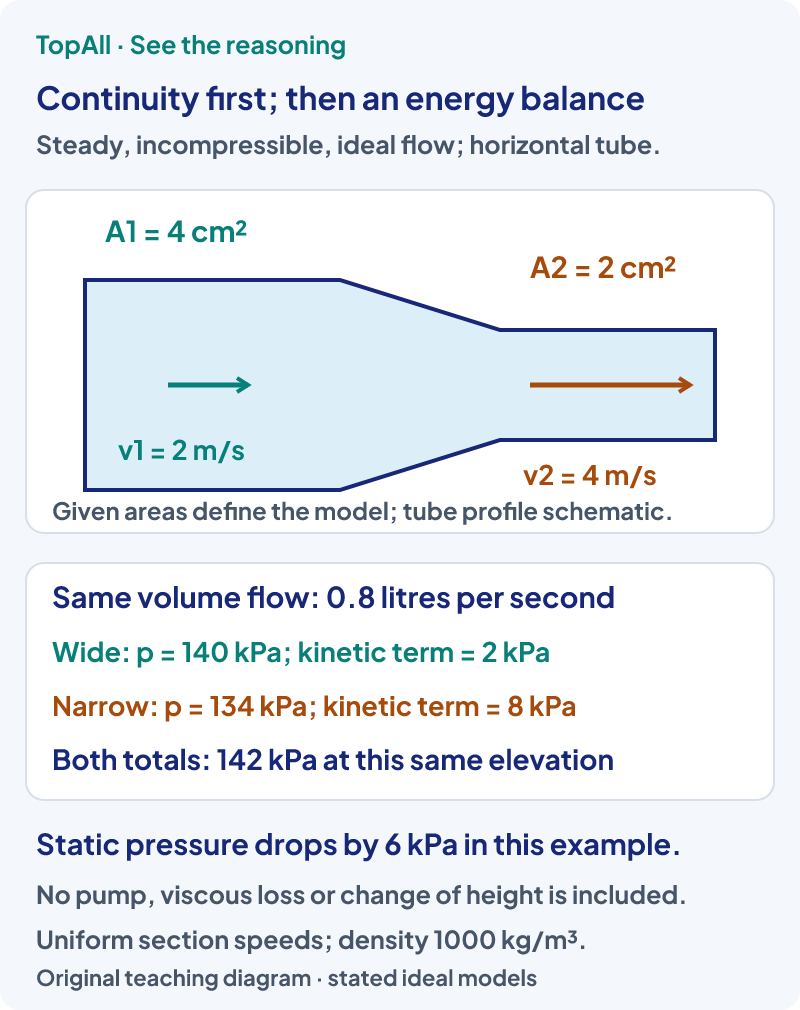
Use the stated horizontal ideal-flow model with uniform section speeds. Let , and . Continuity gives . The common volume flow is .
With and equal heights, . If absolute, . Static-plus-kinetic pressure terms are and . A pressure in Pa is an energy per unit volume, not an energy in joules.
Viscosity describes resistance to shear flow and has unit Pa s; it can produce mechanical-energy losses that the simple Bernoulli equation above omits. Surface tension is force per unit length, with unit N/m; curved interfaces can create pressure jumps. A flat free-surface hydrostatic example does not supply a universal rule for droplets, bubbles or capillary tubes. Choose the model from the conditions stated in the question.
Do not report gauge pressure as absolute pressure or add atmospheric pressure twice. Equal depths in the stated connected static liquid give equal pressure, regardless of branch width. In a tube, area and diameter are different: a doubled circular diameter gives four times the area. The ideal-flow pressure difference includes the gravitational term if heights differ, and a real pump or viscous loss changes the balance.
In the water-at-rest example, surface pressure is 100 kPa and the depth contribution is 20 kPa. What is the absolute pressure? A. 20 kPa; B. 100 kPa; C. 120 kPa.
C. Absolute pressure includes the surface pressure. Twenty kilopascals is the gauge pressure relative to the stated 100 kPa atmosphere in this model.
In the horizontal ideal-flow example, the area changes from 4 cm² to 2 cm². The initial speed is 2 m/s and static pressure 140 kPa. Which result follows? A. 4 m/s and 134 kPa; B. 1 m/s and 146 kPa; C. 4 m/s and 140 kPa.
A. Continuity doubles the speed. With the stated uniform-speed, equal-height, no-loss model, the kinetic pressure term rises by 6 kPa, so the static pressure falls by 6 kPa. Faster flow does not mean a larger volume flow rate here.
Cover the diagrams and distinguish gauge from absolute pressure, then explain why the narrower flow section carries the same volume per second. Before each question, write “at rest” or “flowing” and state the pressure reference and assumptions.
Explain the distinction you missed, then apply it to a fresh chapter question.
Technical review: Codex (automated). Primary textbook sources checked on 23 October 2026. Diagrams, numerical examples and self-checks are original teaching material. Human subject review is not claimed.