NEET UG · Video

Controlled Thermonuclear Fusion NEET
Learn controlled thermonuclear fusion concepts for NEET exams easily.
5 min video

NEET UG · Physics
Revise the concepts. Try a question. Understand your next step.
146 medium questions available · Try answers free. Sign in to save progress or take a quiz.
NEET UG · Physics
Understand the concept, practise questions and check your learning.
Understand
Check binding-mass conventions, half-life fractions and total nuclear energy balances. Nuclei: count particles and keep the energy basis clear
Read the guidePractise
Try 146 medium chapter MCQs. Untimed; check answers and available explanations as you go.
Practise chapter MCQsCheck your learning
Prepare a timed chapter quiz. Choose the available question count and pace before starting.
Prepare a chapter quizThis is chapter practice, not a full-length NEET mock paper.
These are playable question counts after quality and duplicate checks.
The practice player uses single-correct-answer MCQs. Chapter quizzes are not full-length NEET mock papers. Check the practice guide and official syllabus sources.
Revise before you practise
NEET UG · Video
Learn controlled thermonuclear fusion concepts for NEET exams easily.
5 min video
NEET UG · Video
Explore nuclear fusion & energy in stars with simple NEET concepts.
5 min video
NEET UG · Video
Learn nuclear fission with clear, exam-focused explanations for NEET.
4 min video
NEET UG · PDF notes
Read PDF · 8 pages →Learn controlled thermonuclear fusion concepts for NEET exams easily.
8 pages
NEET UG · PDF notes
Read PDF · 9 pages →Explore nuclear fusion & energy in stars with simple NEET concepts.
9 pages
NEET UG · PDF notes
Read PDF · 9 pages →Learn nuclear fission with clear, exam-focused explanations for NEET.
9 pages
NEET UG · Mind map
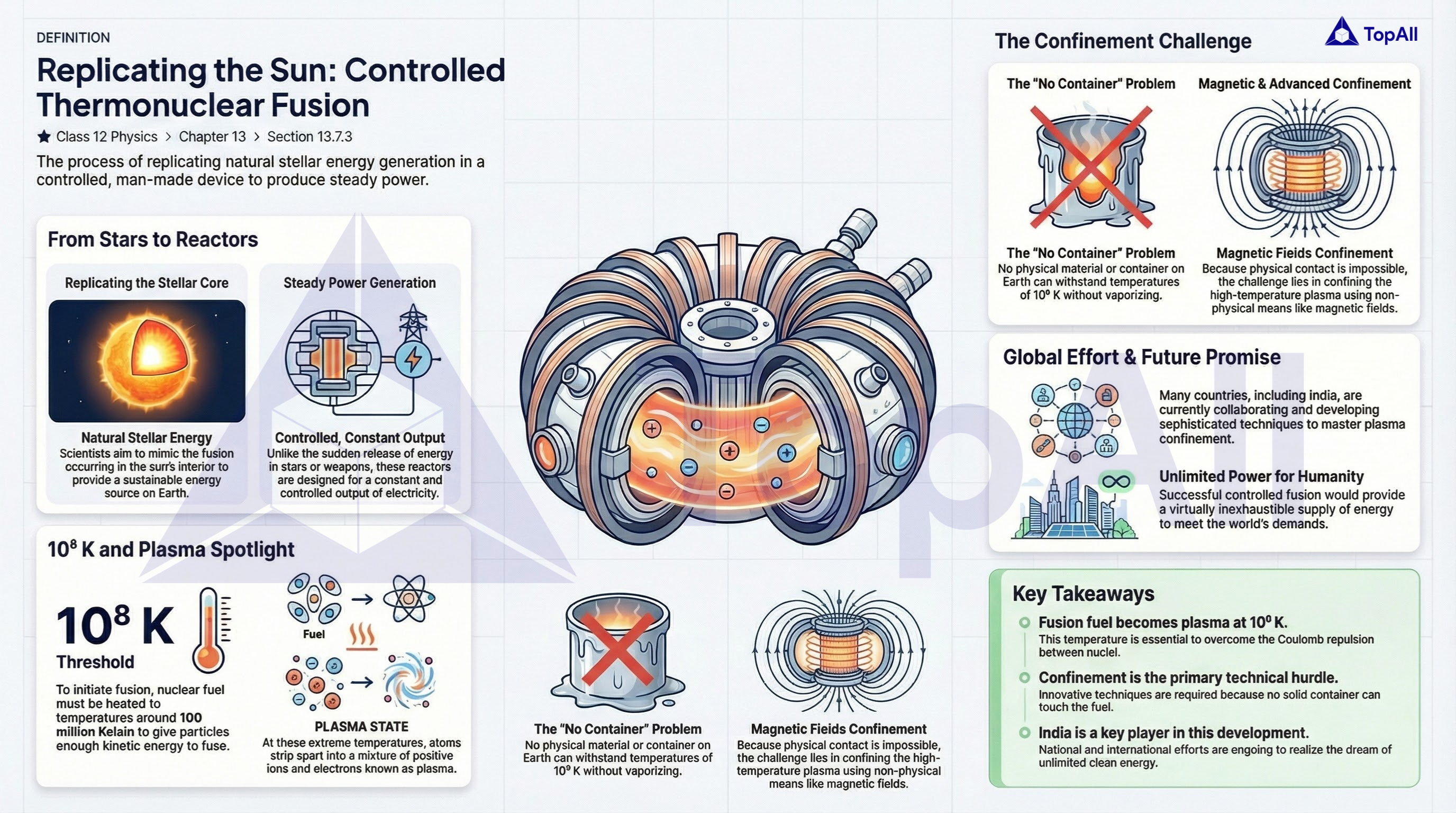
Learn controlled thermonuclear fusion concepts for NEET exams easily.
NEET UG · Mind map
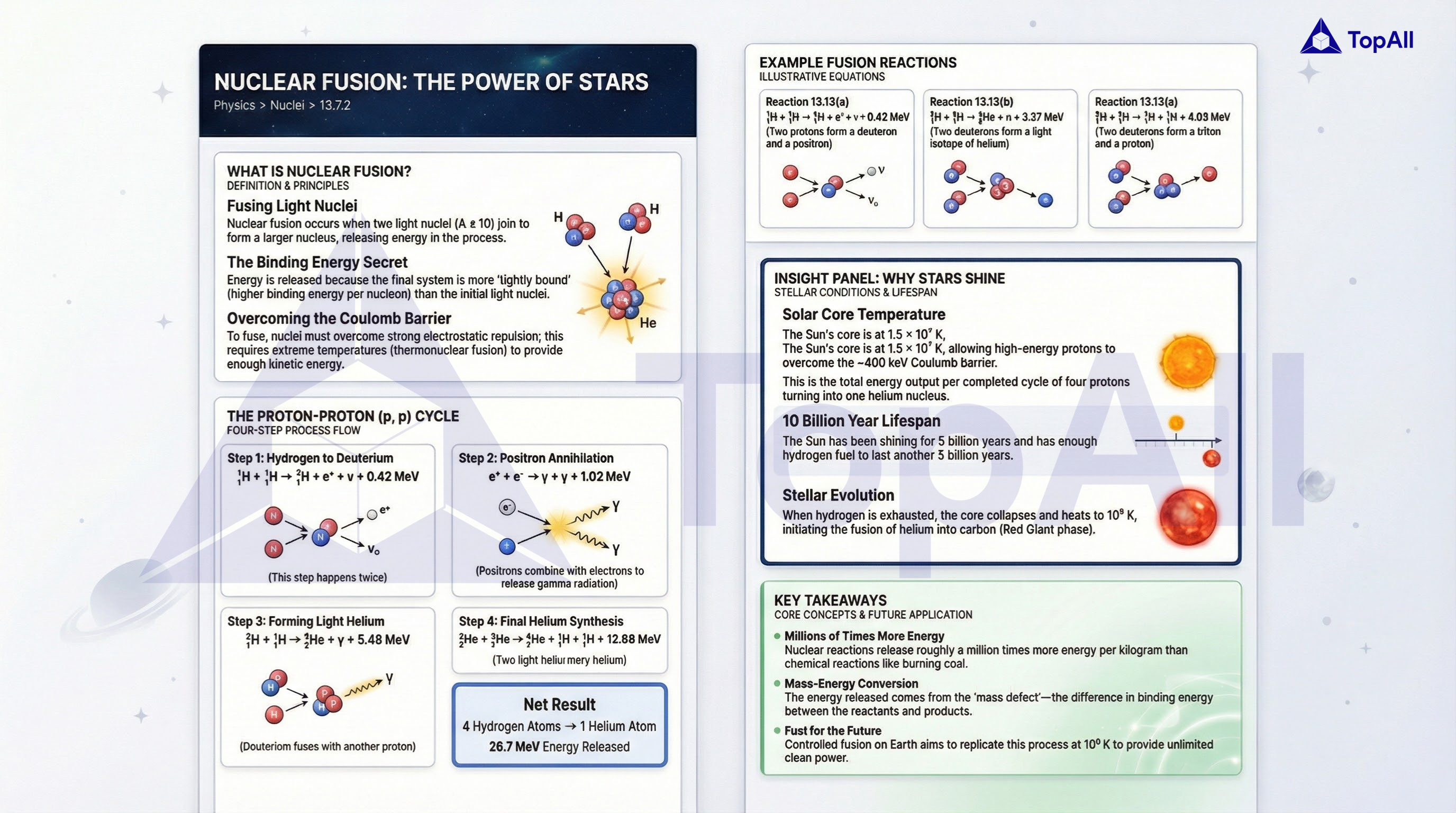
Explore nuclear fusion & energy in stars with simple NEET concepts.
NEET UG · Mind map
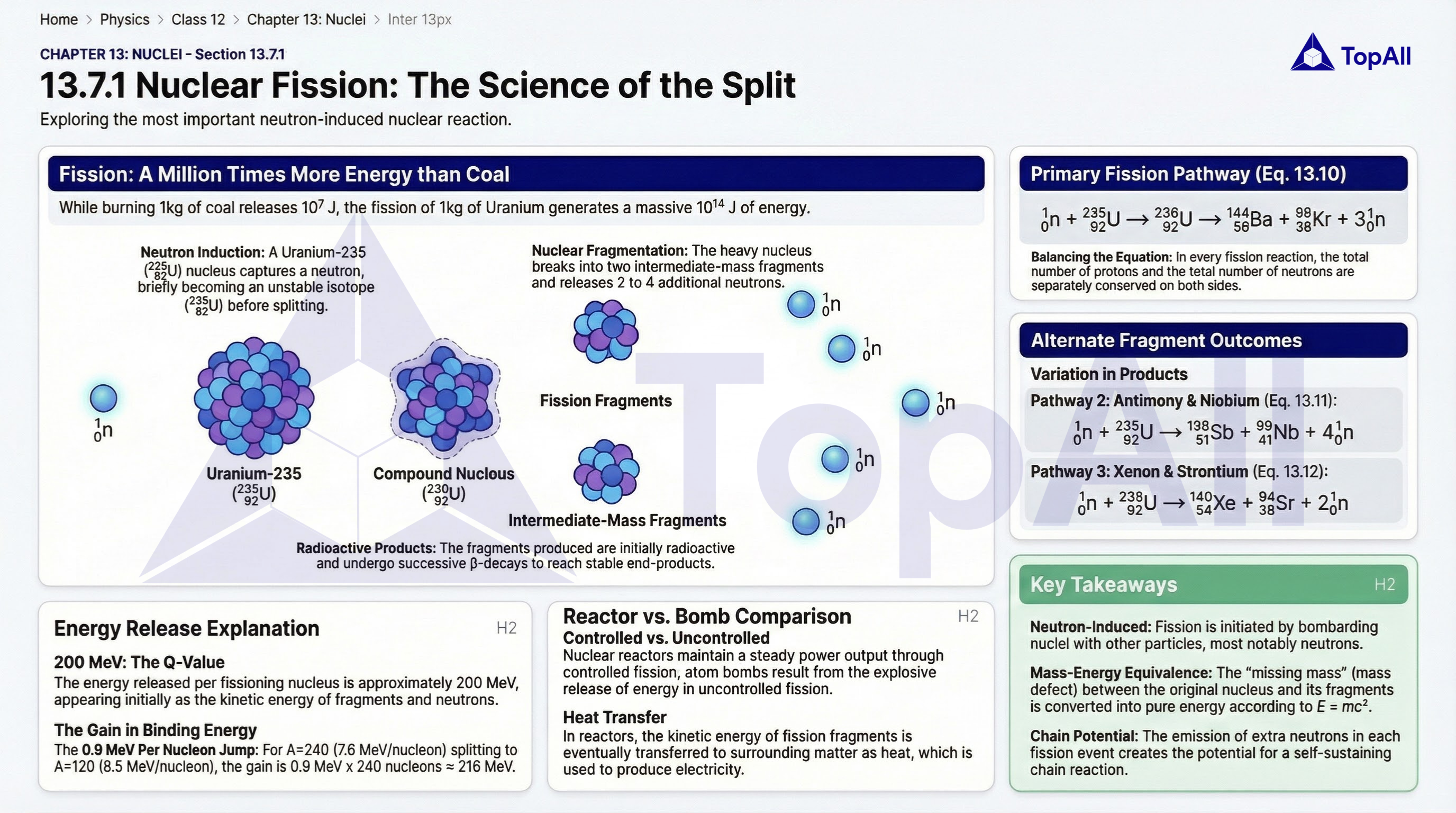
Learn nuclear fission with clear, exam-focused explanations for NEET.
Check binding-mass conventions, half-life fractions and total nuclear energy balances.
For NEET UG Physics students: count protons and neutrons, use a consistent mass convention for binding energy, separate remaining nuclei from decayed nuclei and calculate nuclear energy changes from total binding.
Mass number A counts protons plus neutrons; atomic number Z counts protons. A bound nucleus has lower rest mass than its separated constituent nucleons, and its positive binding energy is the energy required to separate them. Use either nuclear masses with bare protons or a consistent atomic-mass formula with hydrogen atoms. Radioactive half-life concerns a remaining-parent population, while activity also includes the decay constant. Total binding and binding per nucleon answer different questions.
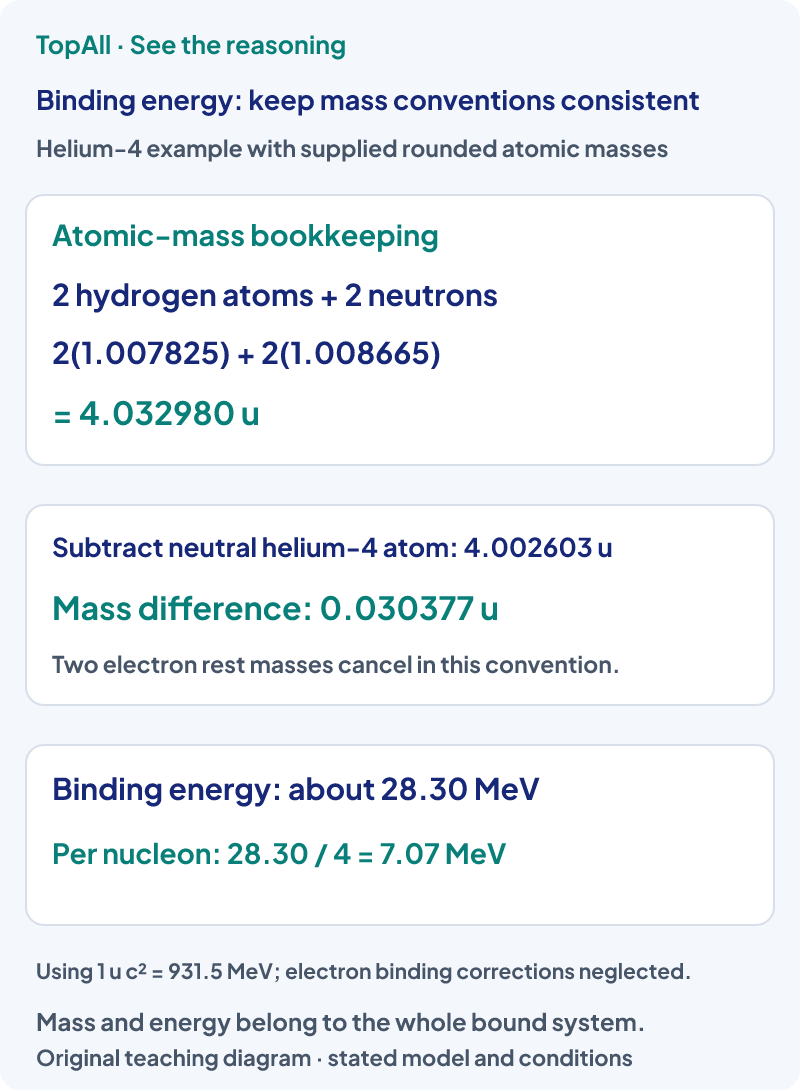
Use supplied rounded masses mH=1.007825 u for a neutral hydrogen atom, mn=1.008665 u and mHe=4.002603 u for a neutral helium-4 atom. With Z=2 and A=4,
For a nuclide with A=56 and Z=26, proton count is 26 and neutron count is 30. Isotopes share Z but differ in neutron count; isobars share A, and isotones share neutron count. In the approximate radius law , increasing A by a factor of eight doubles R rather than multiplying it by eight. This scaling makes volume approximately proportional to nucleon count and density roughly independent of A in the simple model. A mass number is a count, not an exact atomic mass in u.
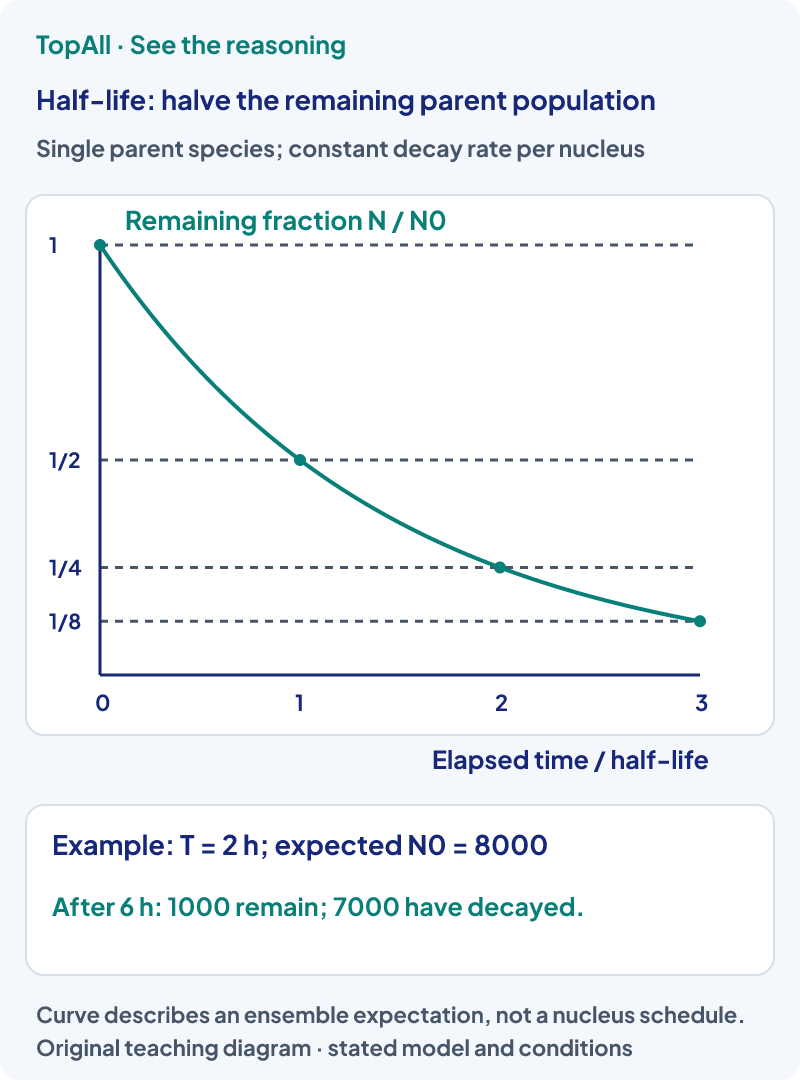
Suppose a single parent species has constant half-life T=2.00 h, initial expected population N0=8000 and no replenishment. After 6.00 h, three half-lives have elapsed, so . The expected remaining count is 1000, and the expected number of parent decays is 7000. The decayed fraction is 7/8, not 1/8. Since , the initial activity is about 0.770 Bq and after 6 h about 0.0963 Bq, using T=7200 s and . Both count and parent activity fall by the same fraction for this one species. A Bq is one decay per second; this does not specify a dose or the combined activity of radioactive daughters.
An alpha emission changes A to A−4 and Z to Z−2. A beta-minus emission leaves A unchanged and raises Z by one, with an electron and an electron antineutrino in the final state. An ordinary gamma transition changes nuclear excitation without changing A or Z. For a hypothetical parent with A=240,Z=90, one alpha followed by one beta-minus gives A=236,Z=89. That is nucleon/charge bookkeeping; energetic feasibility and actual branching require more information. The emitted beta electron is not evidence of a pre-existing electron stored inside the nucleus.
Consider a supplied hypothetical balanced fission-like comparison with one A=100 nucleus becoming two A=50 fragments, conserved proton/neutron totals and no additional particles. Parent binding per nucleon is 8.00 MeV and each fragment value is 8.50 MeV. Parent total binding is 800 MeV; final total is . Thus the rest-mass energy decrease is
The exponential model assigns a decay probability per unit time to each remaining nucleus. It does not specify which nucleus will decay next or say every nucleus survives exactly one half-life. A nucleus that remains after one half-life is still described by the same constant decay probability in this model. The remaining population falls smoothly in the large-sample approximation, while individual events are random.
Do not mix atomic and nuclear masses without correcting the electron convention. Positive binding energy does not mean the bound system is heavier. Multiply binding per nucleon by the relevant nucleon count before comparing totals. After three half-lives, one eighth remains and seven eighths has decayed. Activity depends on both decay constant and parent count. A balanced A/Z equation is necessary bookkeeping, not proof of an energetically allowed channel.
A single parent species has half-life 2 h. After 4 h, what fractions remain and have decayed in the ensemble model? Does the remaining fraction imply that every original nucleus had a fixed four-hour lifetime?
Two half-lives leave 1/4 of the expected initial parent population; 3/4 has decayed. This is a population/probability statement. It does not assign a fixed lifetime to each original nucleus.
For a hypothetical parent with A=210 and Z=84, perform A/Z bookkeeping for one alpha emission followed by one beta-minus emission. What are the final A, Z and neutron count? Does bookkeeping alone establish that the chain is physically allowed?
After alpha emission A=206,Z=82. Beta-minus leaves A=206 and raises Z to 83, so neutron count is 206−83=123. Electron and antineutrino must be included in the beta-minus process. This is a bookkeeping exercise; actual energy differences and available decay branches are needed to establish a physical chain.
Write a binding-energy balance with one consistent mass convention. Then distinguish remaining population, decayed population and activity without looking at the graph. Revisit NEET Atoms to compare electronic and nuclear energy changes, or NEET Work, Energy and Power for initial/final energy bookkeeping.
Chapter practice opens the broad Nuclei pool.
Technical review: Codex (automated). Primary textbook sources checked on 23 October 2026. Diagrams, worked examples and self-checks are original. Numerical calculations use stated approximations and supplied rounded constants. Human subject review is not claimed. Chapter catalogues and these explanations do not establish complete coverage of every current examination format or syllabus.
Before the next practice set, write the initial state, final state and quantity requested. After a mistake, correct the model or sign first, then redo the calculation without viewing the solution.

