NEET UG · Video

Newton’s Law of Cooling
Learn Newton’s law of cooling with easy formulas, concepts and MCQ practice on TopAll.
4 min video

NEET UG · Physics
Revise the concepts. Try a question. Understand your next step.
163 medium questions available · Try answers free. Sign in to save progress or take a quiz.
NEET UG · Physics
Understand the concept, practise questions and check your learning.
Understand
Separate warming from melting, test the final phase and use an energy balance before NEET Thermal Properties of Matter practice. Heat, temperature and phase change: choose the energy steps
Read the guidePractise
Try 163 medium chapter MCQs. Untimed; check answers and available explanations as you go.
Practise chapter MCQsCheck your learning
Prepare a timed chapter quiz. Choose the available question count and pace before starting.
Prepare a chapter quizThis is chapter practice, not a full-length NEET mock paper.
These are playable question counts after quality and duplicate checks.
The practice player uses single-correct-answer MCQs. Chapter quizzes are not full-length NEET mock papers. Check the practice guide and official syllabus sources.
Revise before you practise
NEET UG · Video
Learn Newton’s law of cooling with easy formulas, concepts and MCQ practice on TopAll.
4 min video
NEET UG · Video
Master blackbody radiation with simple explanations and NEET-focused MCQs on TopAll.
5 min video
NEET UG · Video
Learn radiation in thermal physics with clear theory and MCQ practice on TopAll. .
5 min video
NEET UG · PDF notes
Read PDF · 7 pages →Learn Newton’s law of cooling with easy formulas, concepts and MCQ practice on TopAll.
7 pages
NEET UG · PDF notes
Read PDF · 6 pages →Master blackbody radiation with simple explanations and NEET-focused MCQs on TopAll.
6 pages
NEET UG · PDF notes
Read PDF · 7 pages →Learn radiation in thermal physics with clear theory and MCQ practice on TopAll. .
7 pages
NEET UG · Mind map
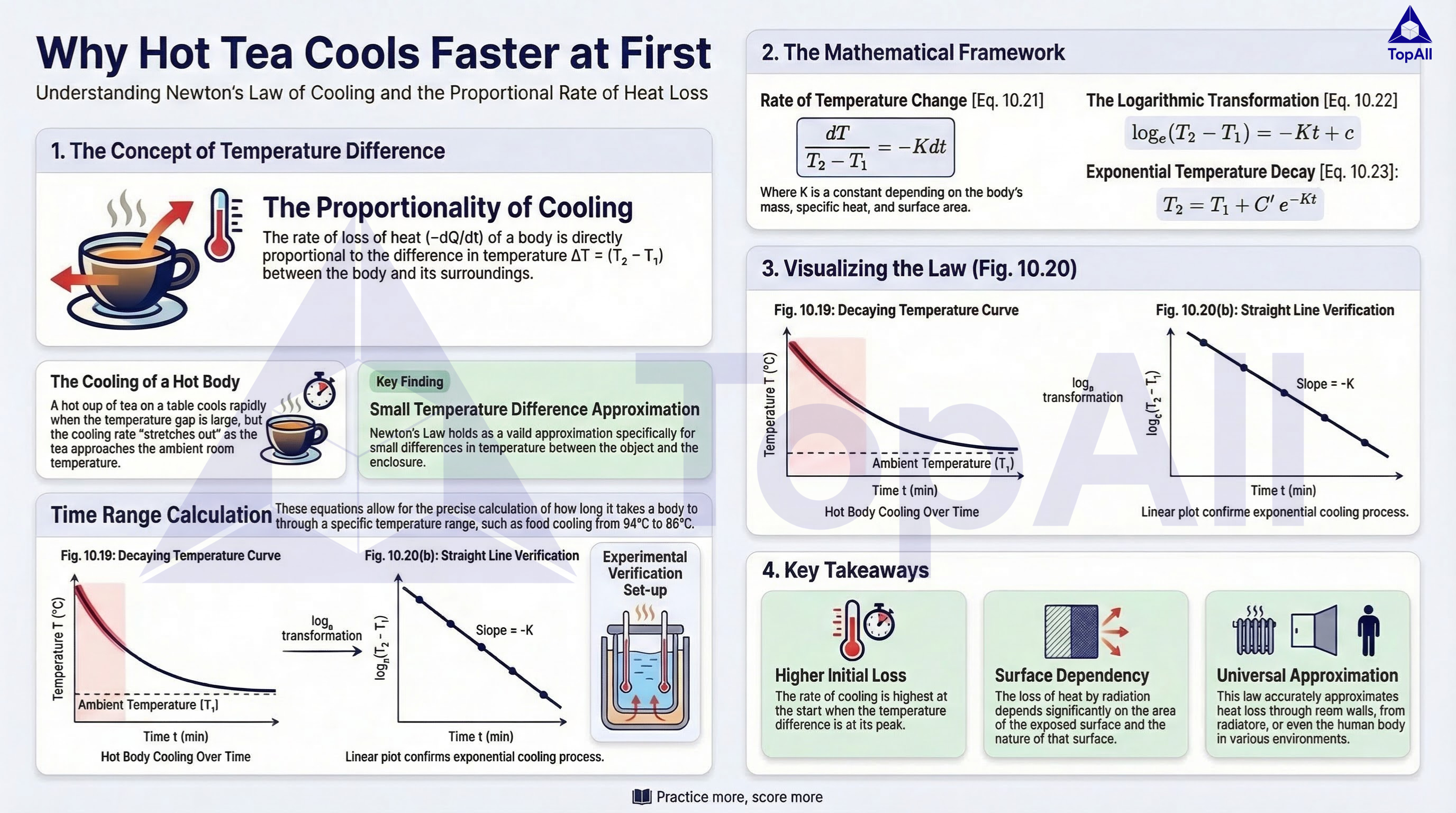
Learn Newton’s law of cooling with easy formulas, concepts and MCQ practice on TopAll.
NEET UG · Mind map
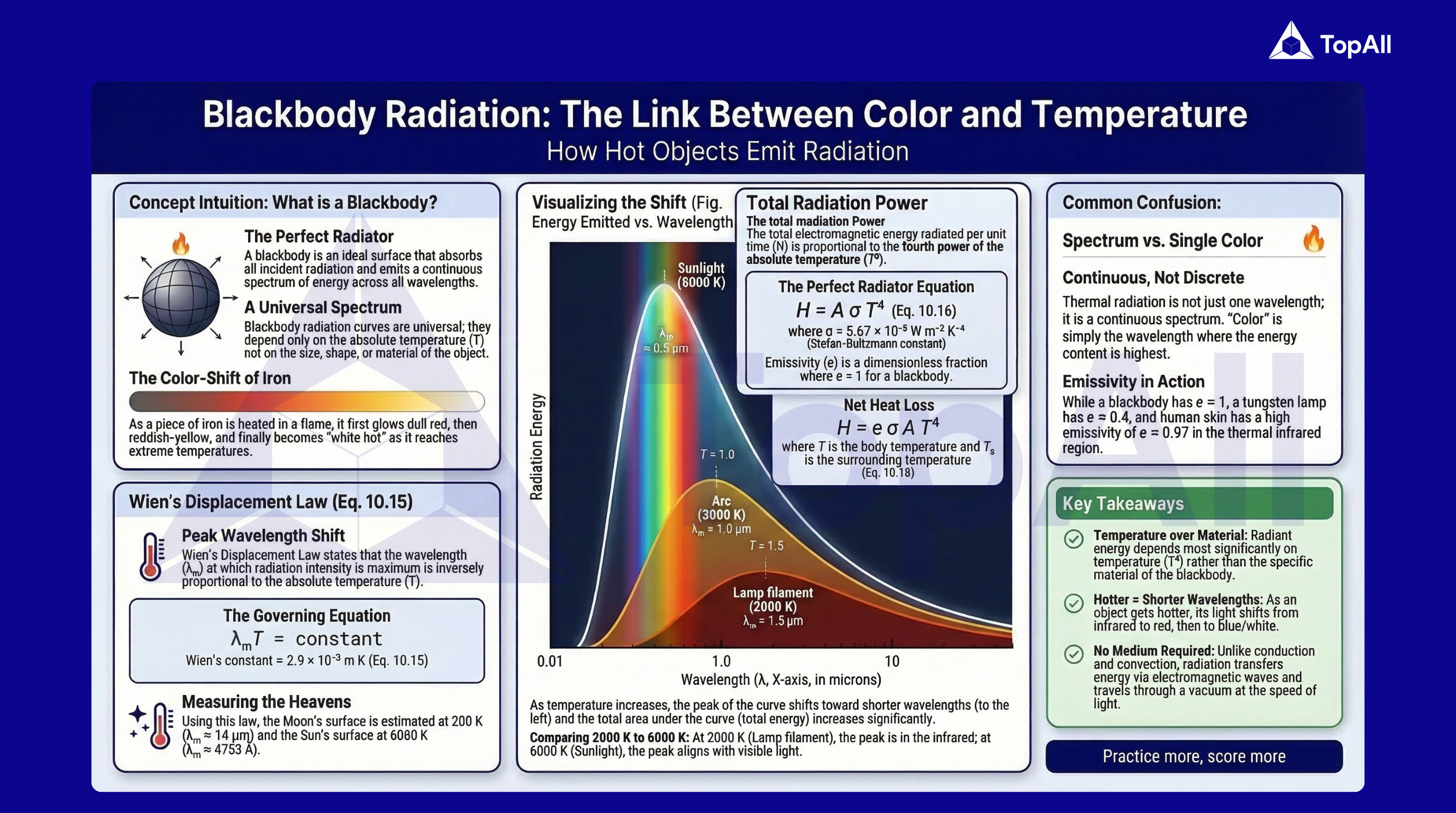
Master blackbody radiation with simple explanations and NEET-focused MCQs on TopAll.
NEET UG · Mind map
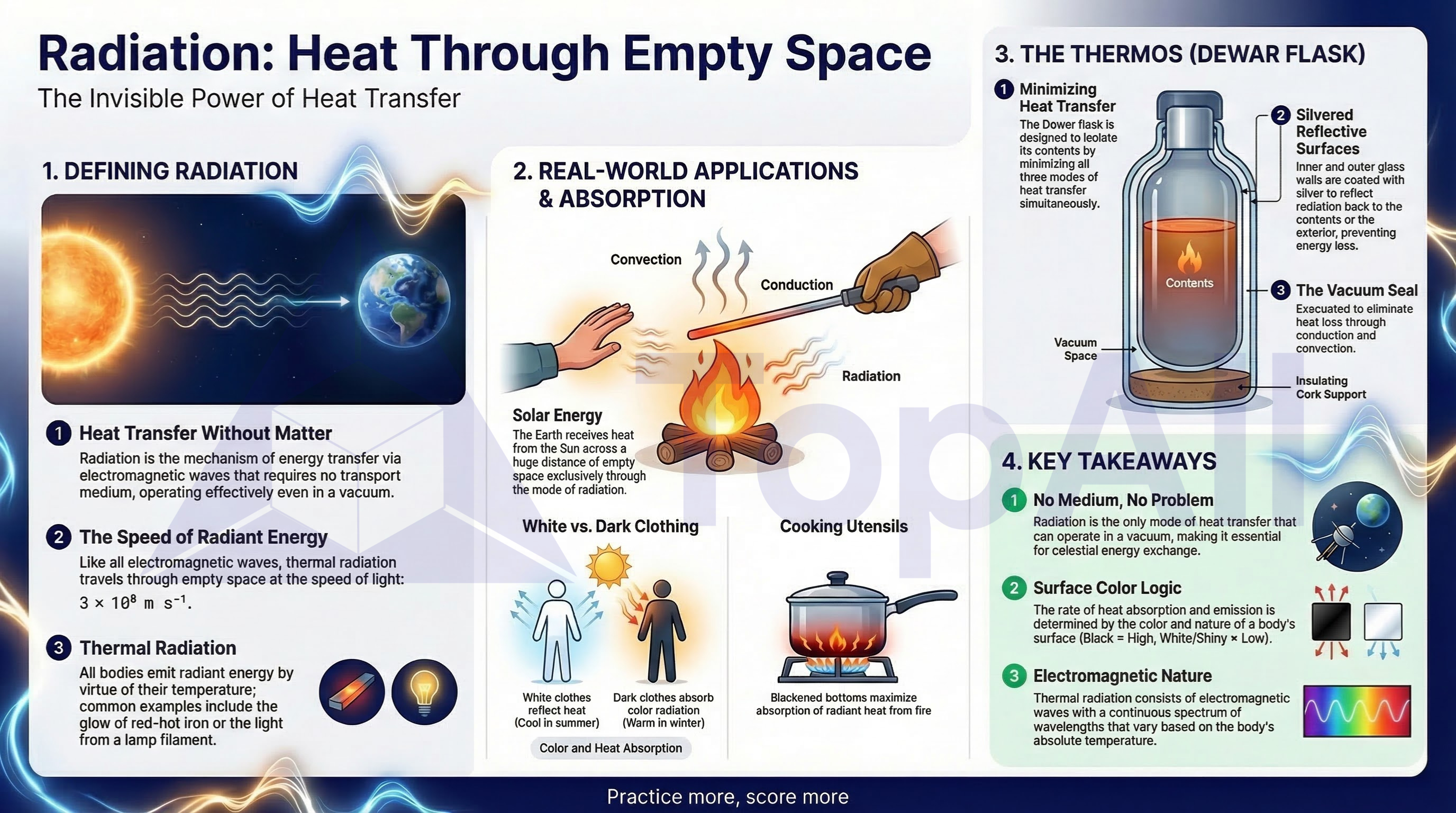
Learn radiation in thermal physics with clear theory and MCQ practice on TopAll. .
Separate warming from melting, test the final phase and use an energy balance before NEET Thermal Properties of Matter practice.
For NEET UG Physics students: separate heat from temperature, split warming and phase changes into energy stages, and test whether all the ice can melt before solving for a final temperature.
Heat is energy transferred because of a temperature difference; temperature is a state variable, not an amount of stored heat. Within one phase over a range where specific heat c is approximately constant, use . During a phase transition of a pure substance at its transition temperature and fixed pressure, use for the mass changing phase. Its temperature can stay constant while energy enters. A body has internal energy; it does not possess a state-function “heat content”.
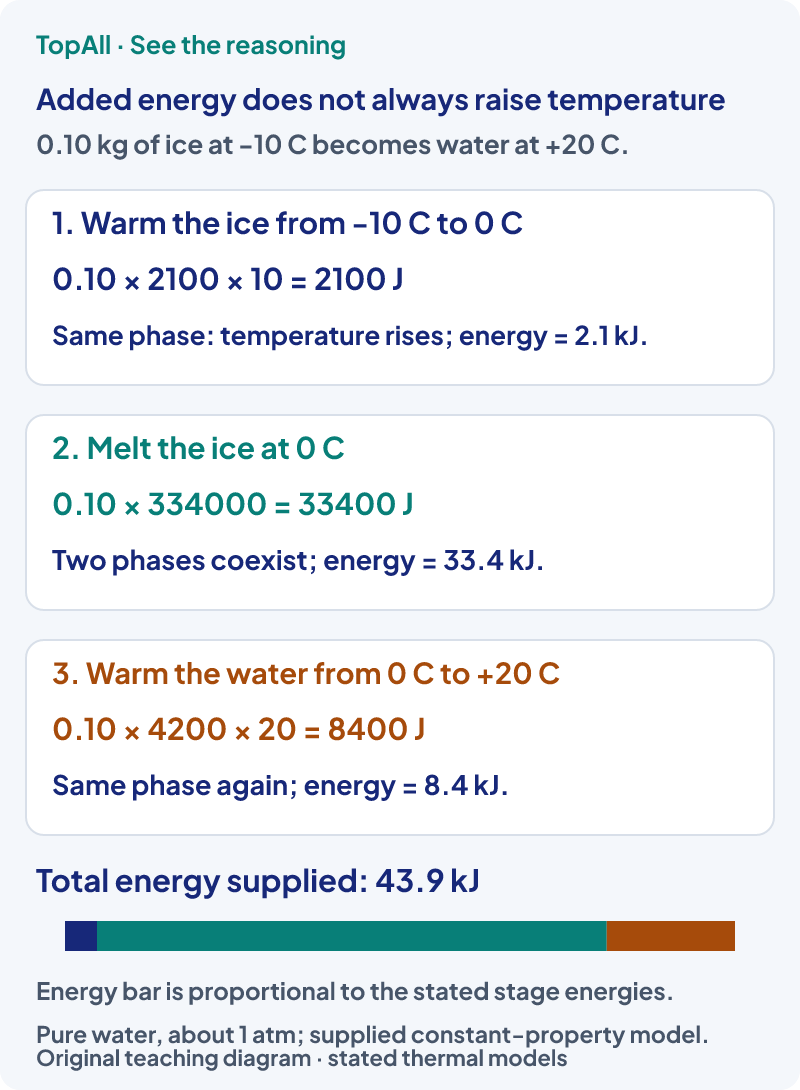
Take of pure ice at about one atmosphere. Use the supplied constant values , and . Neglect container heat capacity, evaporation and heat loss. Warm the ice to : . Melt all the ice at zero: . Warm the resulting water to 20: . Total supplied energy is . Using a single across the entire change would omit latent heat and use the wrong phase’s specific heat.
For an insulated mixing model with negligible container heat capacity, no evaporation and no other energy input, balance heat lost against heat gained. Before assuming the final mixture is all liquid above zero, compare the heat that warm water can release on cooling to zero with the heat required to melt all the ice at zero. If insufficient, the equilibrium mixture still contains ice at zero under the stated pure-water pressure model. Do not continue an all-liquid equation to an impossible negative temperature while liquid water and ice coexist in this example.
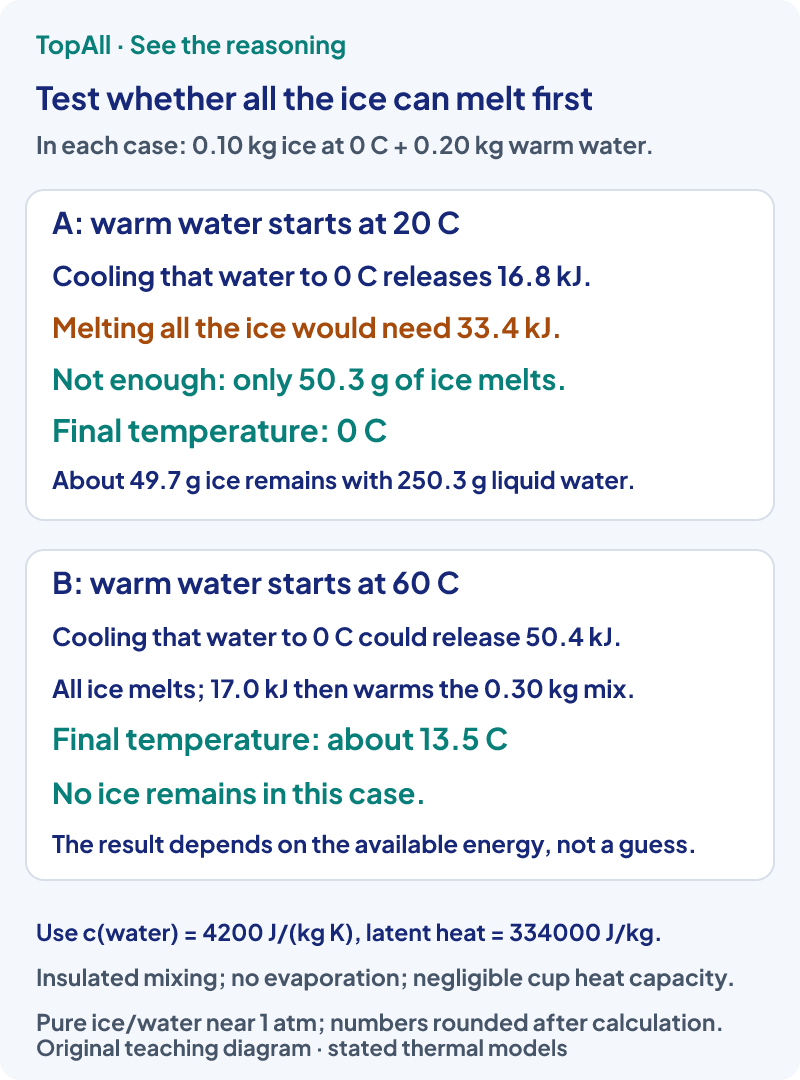
Mix ice at with water at in the stated insulated model. Warm water cooling to zero supplies only . Melting all the ice would require , so some ice remains. The melted mass is . Final temperature is zero, with about ice and liquid. The cold material’s phase, not an arithmetic average of the starting temperatures, fixes the final temperature here.
Repeat with the warm water initially at . Its potential heat release on cooling to zero is , greater than the melting requirement. The remaining warms the total liquid sample, giving . Check the original balance: . This checks both the assumed complete melting and the final liquid-water mass.
A temperature difference of 10 Celsius degrees is 10 K, so a temperature-change calculation does not add 273.15 to . Absolute-temperature ratios and radiation formulas require kelvin. For a freely expanding isotropic solid with small changes and a supplied constant linear coefficient, . With , and , extension is . Restraining expansion can introduce stress; the free-expansion formula alone does not solve that different setup.
Specific heat c has unit ; a sample’s heat capacity C is with unit . Latent heat L has unit . Thermal conductivity has unit and belongs to a heat-flow-rate model, not a phase-change energy. A supplied heater power P gives transferred energy only when the specified power actually reaches the sample over time t; account for losses or inefficiency if given.
Do not average temperatures without accounting for masses, heat capacities and phase changes. Do not add 273.15 to a temperature difference. A zero temperature change does not prove zero transferred heat during melting or boiling. Check whether all the ice melts before using the total liquid mass in a final-temperature equation. The approximate constants and pressure conditions in these examples define the model; melting/boiling temperatures and heat capacities are not universal constants independent of conditions.
Supply to pure ice already at near one atmosphere, with no losses. Use . Does the sample become warmer liquid water?
No. Melting all the ice needs , more than the supplied heat. The melted mass is , leaving about ice. The mixture remains at zero while both phases coexist under the stated conditions.
Mix liquid water at with water at . No phase change occurs. Neglect heat loss and cup heat capacity; use equal constant specific heats. Is the final temperature 50 Celsius?
No. gives . The simple average of 80 and 20 would apply to equal masses with equal heat capacities per kilogram, not these different masses. Check that the result is between the initial temperatures and closer to the larger cold-water sample’s temperature.
Explain why melting can absorb heat without a temperature rise. Then predict whether a new mixture has enough energy to melt all its ice before calculating a final temperature. Use the diagram only after making that prediction.
Explain the sign, phase or condition you missed, then try a fresh chapter question.
Technical review: Codex (automated). Primary textbook sources checked on 23 October 2026. Diagrams, worked examples and self-checks are original. Supplied property values define simplified teaching models; no measured dataset or human subject review is claimed.

