NEET UG · Video

Uniform Circular Motion NEET
Understand uniform circular motion with key concepts & questions.
4 min video

NEET UG · Physics
Revise the concepts. Try a question. Understand your next step.
169 medium questions available · Try answers free. Sign in to save progress or take a quiz.
NEET UG · Physics
Understand the concept, practise questions and check your learning.
Understand
Resolve projectile components, check the landing-height assumptions and explain velocity at the top before NEET chapter practice. Motion in a plane: components, flight time and landing height
Read the guidePractise
Try 169 medium chapter MCQs. Untimed; check answers and available explanations as you go.
Practise chapter MCQsCheck your learning
Prepare a timed chapter quiz. Choose the available question count and pace before starting.
Prepare a chapter quizThis is chapter practice, not a full-length NEET mock paper.
These are playable question counts after quality and duplicate checks.
The practice player uses single-correct-answer MCQs. Chapter quizzes are not full-length NEET mock papers. Check the practice guide and official syllabus sources.
Revise before you practise
NEET UG · Video
Understand uniform circular motion with key concepts & questions.
4 min video
NEET UG · Video
Learn projectile motion with formulas, tricks & MCQs.
4 min video
NEET UG · Video
Master motion with constant acceleration through solved problems. Join TopAll’s MCQ platform for NEET UG success
4 min video
NEET UG · PDF notes
Read PDF · 9 pages →Understand uniform circular motion with key concepts & questions.
9 pages
NEET UG · PDF notes
Read PDF · 11 pages →Learn projectile motion with formulas, tricks & MCQs.
11 pages
NEET UG · PDF notes
Read PDF · 9 pages →Master motion with constant acceleration through solved problems. Join TopAll’s MCQ platform for NEET UG success
9 pages
NEET UG · Mind map
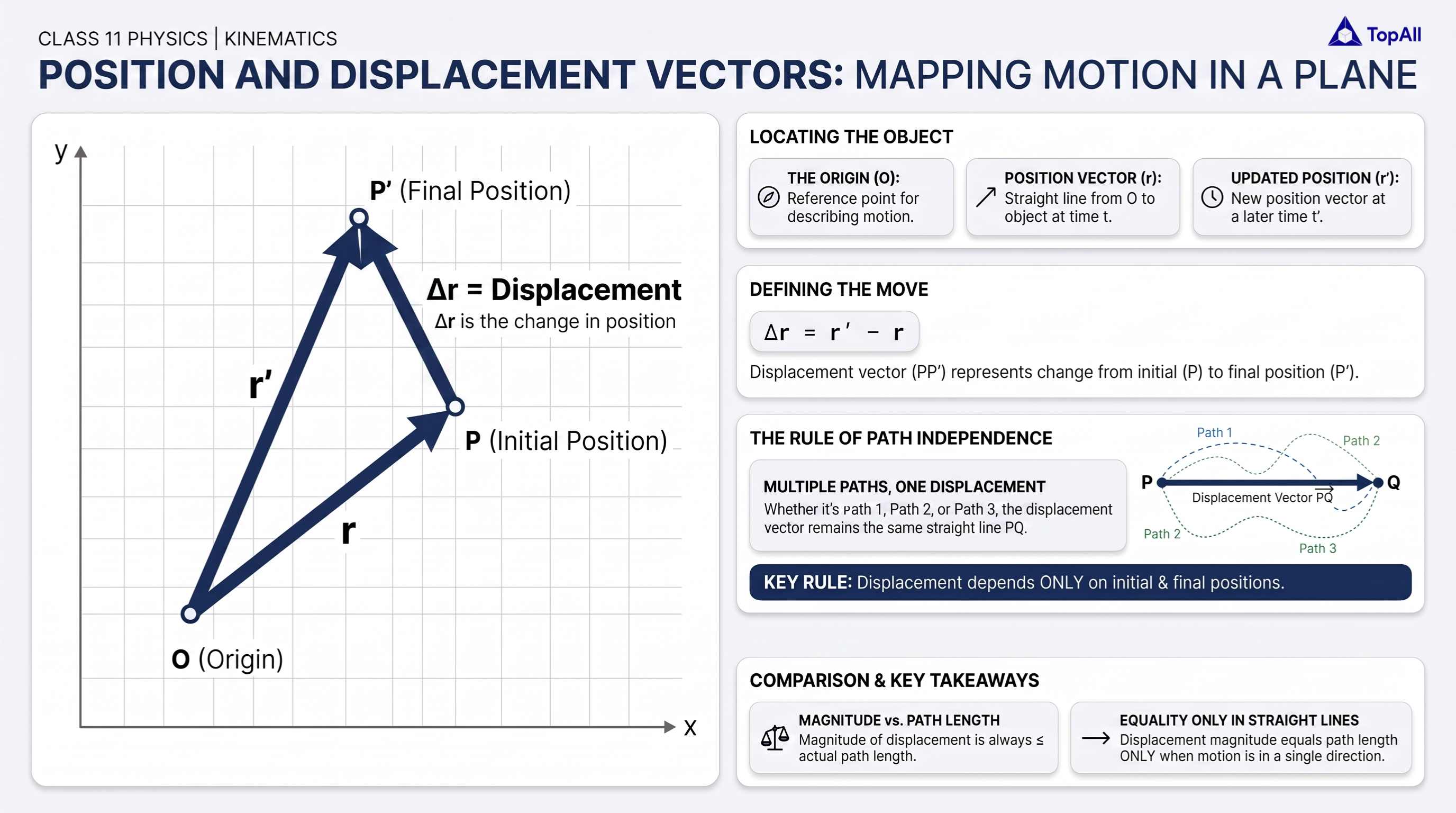
Master position and displacement vectors for NEET UG with TopAll.
NEET UG · Mind map
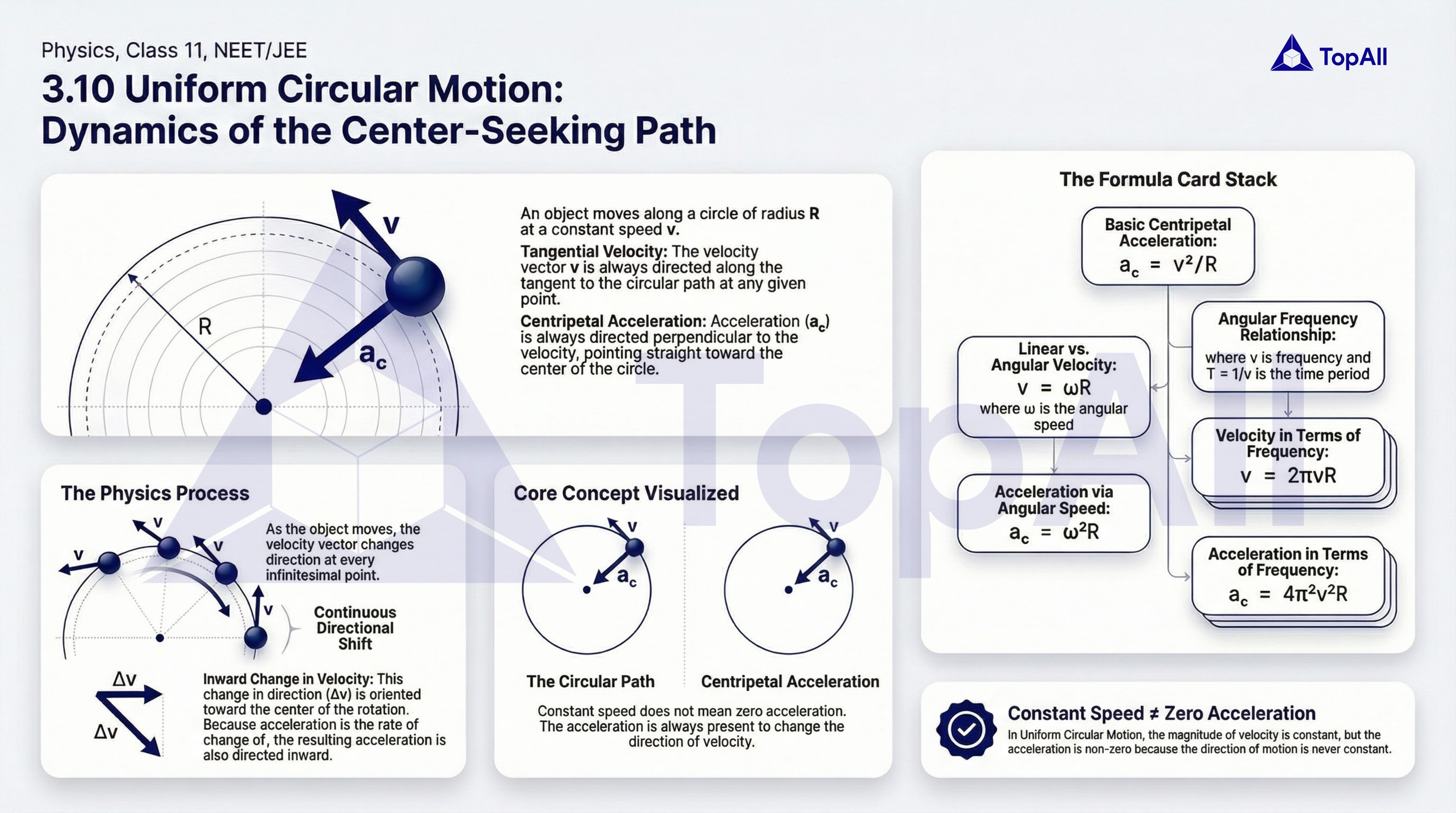
Understand uniform circular motion with key concepts & questions.
NEET UG · Mind map
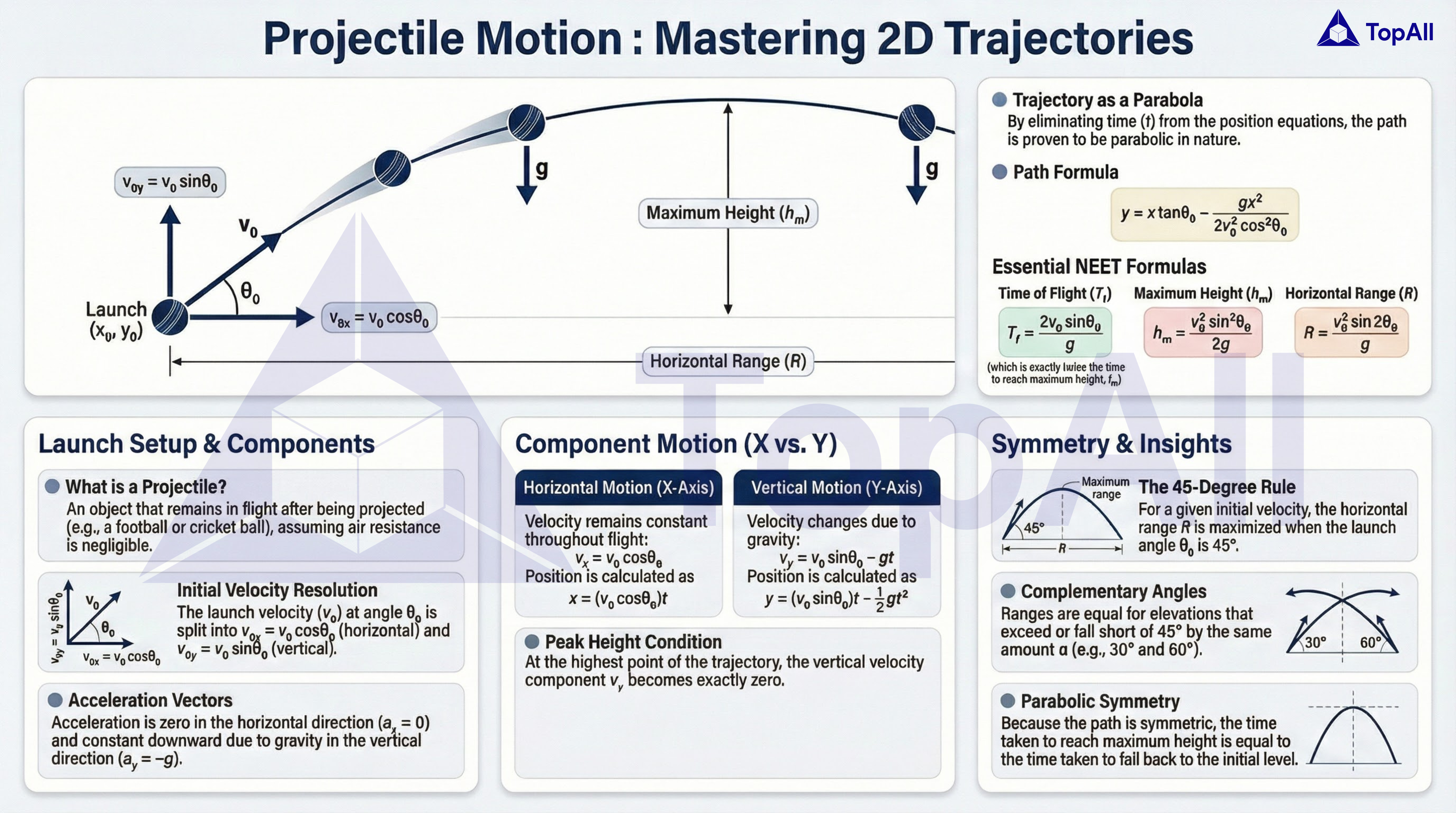
Learn projectile motion with formulas, tricks & MCQs.
Resolve projectile components, check the landing-height assumptions and explain velocity at the top before NEET chapter practice.
Resolve a projectile into components with one shared clock, explain its nonzero speed at the top and choose flight time from the actual landing height. Then connect the vector method to relative velocity and circular motion.
Choose an inertial ground frame, horizontal and upward . For a projectile with no air resistance and constant downward , and . Use and with the same time . Also and .
The vertical equation determines when the projectile reaches the specified landing height. The horizontal equation then determines where it lands. Horizontal and vertical velocities need not become zero together.
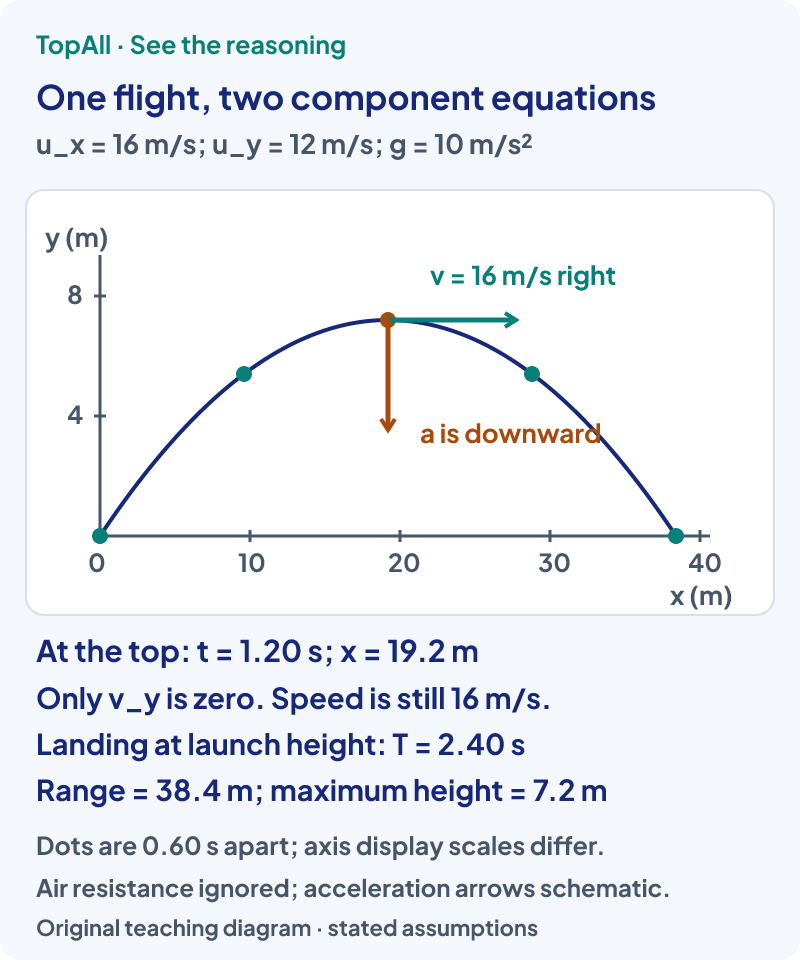
Launch from with , and . Initial speed is . At the top, , so . This gives , and speed .
Acceleration is still vertically. For return to launch height, has a launch root and a later landing root . Hence range is . Rejecting the launch root is a physical choice, not an algebraic deletion.
For launch speed at angle above horizontal, and . With upward launch, equal launch and landing heights, constant and no drag, flight time is and horizontal range is . The familiar 45-degree maximum range also assumes fixed speed and equal endpoint heights. If any condition changes, return to the component equations.
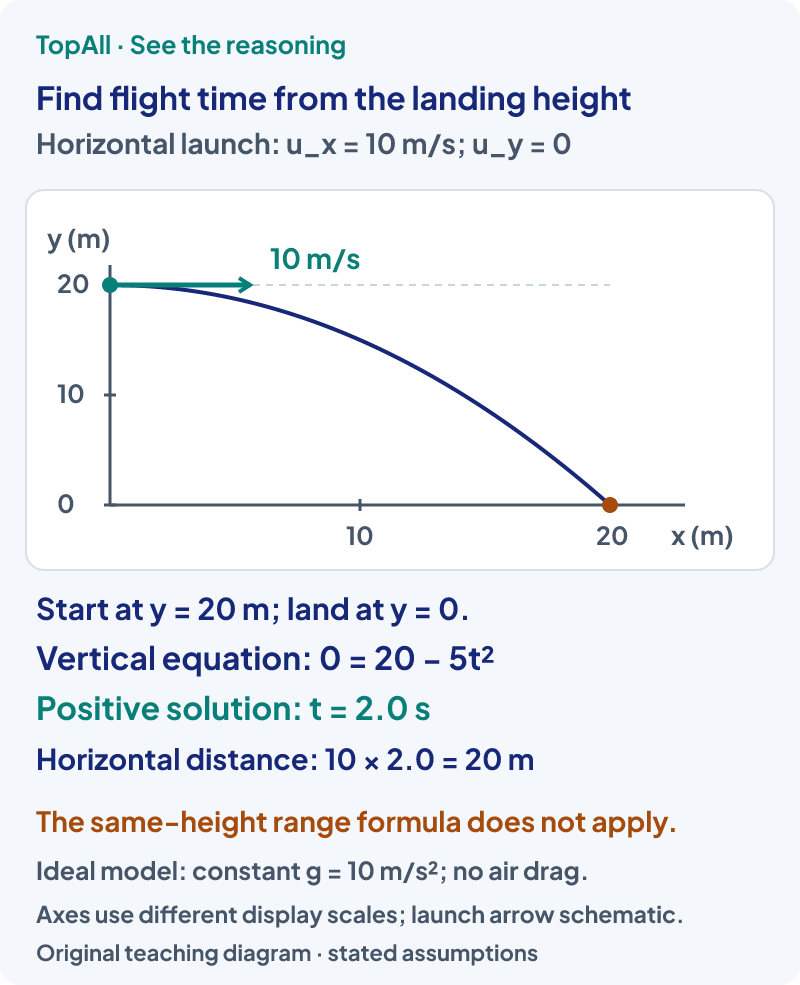
A projectile leaves a ledge horizontally at , from above level ground. Take , ground level and launch time zero. Since , gives the future landing time . Its horizontal travel is .
Putting a zero launch angle into the equal-height range formula would give zero, because that formula assumes a return to the launch height. It does not describe this lower landing surface. As a cross-check, the impact vertical velocity is , while the horizontal velocity stays .
Relative velocity needs frame labels: , with both right-hand vectors measured in the same ground frame. For example, in metres per second; the relative speed is 5 m/s. Subtract components before taking a magnitude.
In uniform circular motion, speed is constant but the velocity direction changes. Acceleration points inward with magnitude ; it is not zero. A 4 m/s speed on a 2 m radius gives 8 m/s² inward. These are different acceleration models from the constant-vector projectile example.
Do not set the whole velocity to zero at maximum height. Do not remove gravity at the top or treat horizontal velocity as horizontal acceleration. Distance along a curved trajectory is not its horizontal range. Equal heights on the ascending and descending parts give opposite vertical-velocity signs, not identical velocity vectors. A constant speed on a curved path does not mean zero acceleration.
At the top of the first trajectory, which combination is correct? A. Speed 0, acceleration 0. B. Speed 16 m/s, acceleration 10 m/s² downward. C. Speed 20 m/s, acceleration 0.
B. Only the vertical velocity component is zero. The horizontal component is still 16 m/s. Gravity acts throughout the ideal flight, including its highest point.
A horizontal launch at 10 m/s starts 20 m above ground, with . Which ground-landing result is correct? A. 0 s and 0 m; B. 2.0 s and 20 m; C. 4.0 s and 40 m.
B. The vertical fall fixes . Horizontal travel is . A zero flight time describes the launch instant at the ledge, not arrival at the lower ground.
Redraw the velocity and acceleration at the top, then explain why a horizontally launched object still takes time to reach lower ground. Before your next question, name the axes, common clock and landing height. Use the specific missing distinction to choose the next practice item.
Explain the distinction you missed in one sentence, then use it in a fresh chapter question.
Technical review: Codex (automated). Primary textbook sources checked on 23 October 2026. Diagrams, worked numerical examples and self-checks are original teaching material. Human subject review is not claimed.

