NEET UG · Video

Relative Velocity Physics NEET Guide
Master relative velocity in straight-line motion for NEET UG with TopAll.
5 min video

NEET UG · Physics
Revise the concepts. Try a question. Understand your next step.
32 hard questions available · Try answers free. Sign in to save progress or take a quiz.
NEET UG · Physics
Understand the concept, practise questions and check your learning.
Understand
Read position–time and velocity–time graphs, distinguish distance from displacement and try original self-checks before NEET chapter MCQs. Distance, displacement and graph signs: one clear example
Read the guidePractise
Try 32 hard chapter MCQs. Untimed; check answers and available explanations as you go.
Practise chapter MCQsCheck your learning
Prepare a timed chapter quiz. Choose the available question count and pace before starting.
Prepare a chapter quizThis is chapter practice, not a full-length NEET mock paper.
These are playable question counts after quality and duplicate checks.
The practice player uses single-correct-answer MCQs. Chapter quizzes are not full-length NEET mock papers. Check the practice guide and official syllabus sources.
Revise before you practise
NEET UG · Video
Master relative velocity in straight-line motion for NEET UG with TopAll.
5 min video
NEET UG · Video
Master kinematic equations for uniform acceleration with MCQs.
5 min video
NEET UG · Video
Learn acceleration concepts, types & solved MCQs for NEET prep.
4 min video
NEET UG · PDF notes
Read PDF · 8 pages →Understand relative velocity concepts & problem-solving with MCQs.
8 pages
NEET UG · PDF notes
Read PDF · 10 pages →Master kinematic equations for uniform acceleration with MCQs.
10 pages
NEET UG · PDF notes
Read PDF · 10 pages →Learn acceleration concepts, types & solved MCQs for NEET prep.
10 pages
NEET UG · Mind map
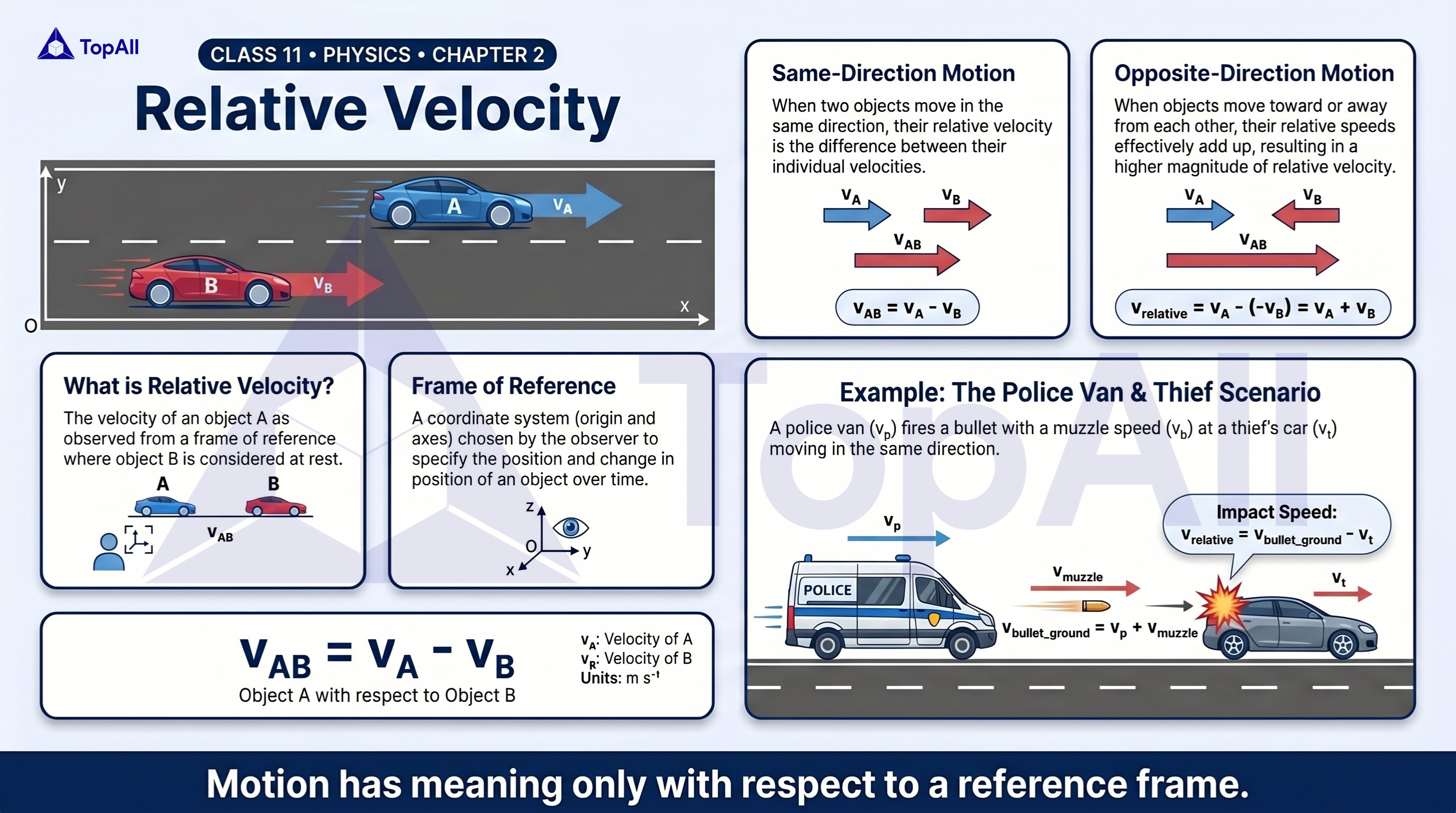
Understand relative velocity concepts & problem-solving with MCQs.
NEET UG · Mind map
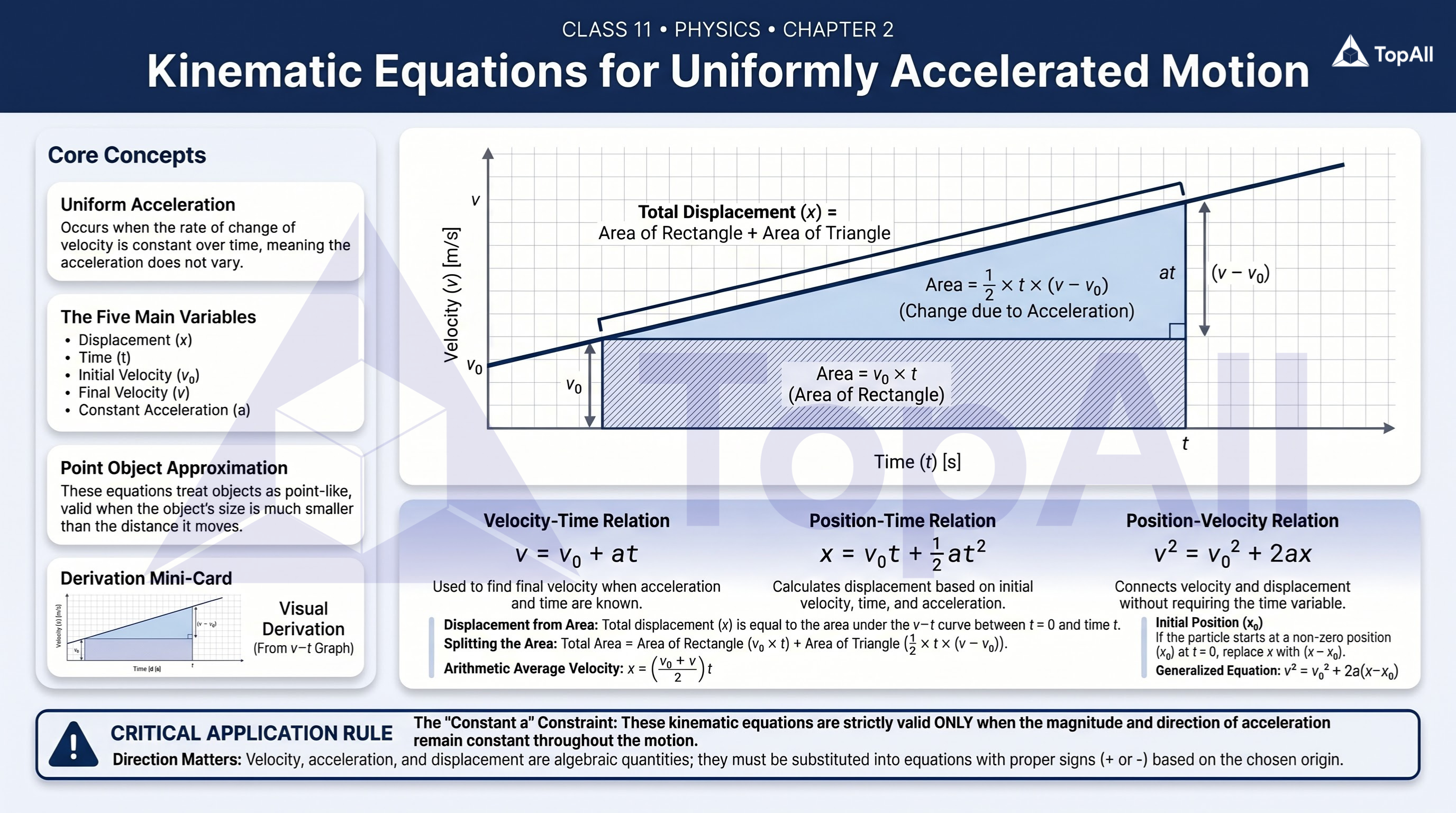
Master kinematic equations for uniform acceleration with MCQs.
NEET UG · Mind map
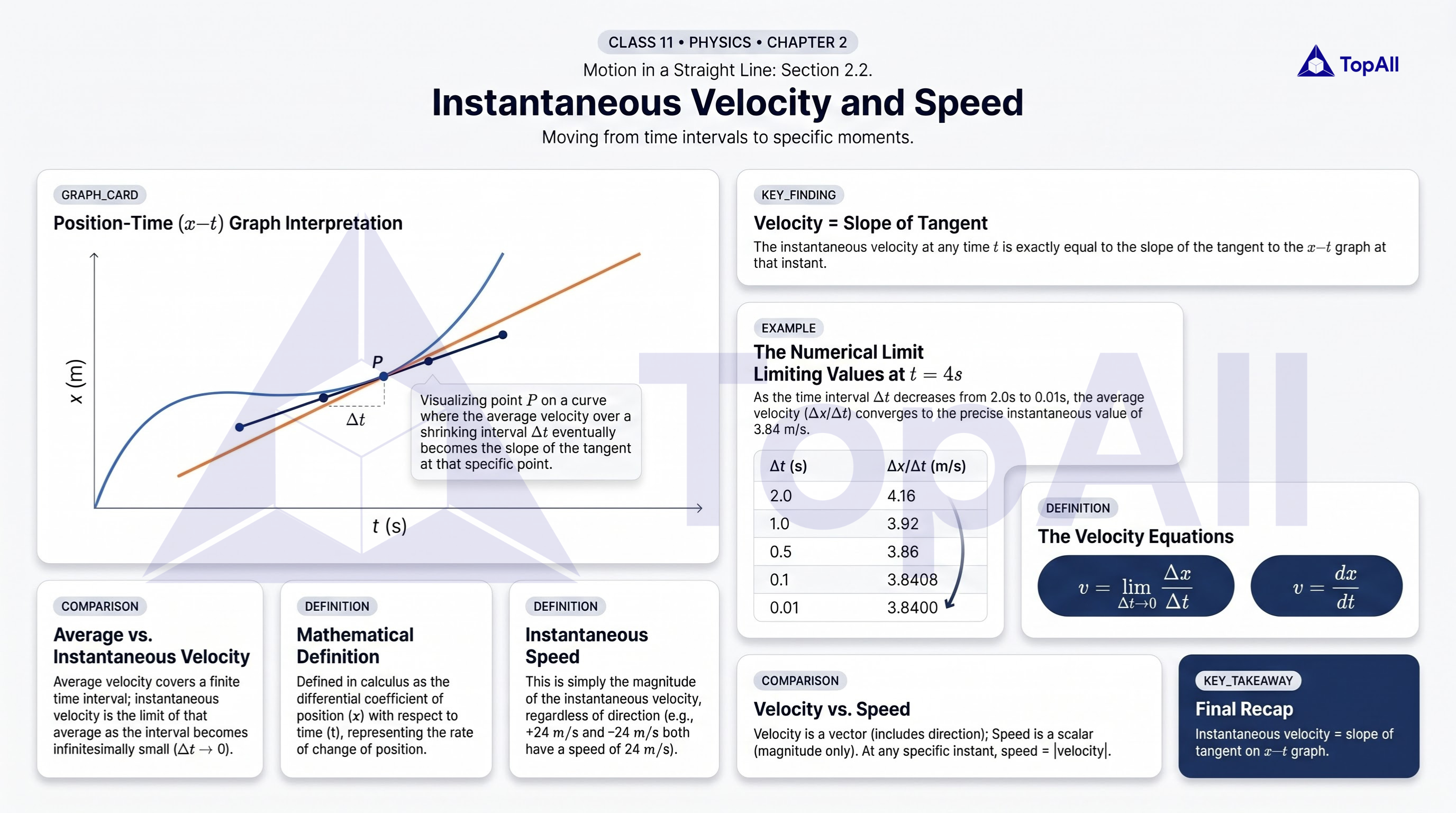
Learn acceleration concepts, types & solved MCQs for NEET prep.
Read position–time and velocity–time graphs, distinguish distance from displacement and try original self-checks before NEET chapter MCQs.
Read the axes first, distinguish a graph value from a graph slope, and calculate distance and displacement when a particle reverses direction. This focused lesson covers one-dimensional motion; it is not a complete chapter summary.
On a position–time graph, the ordinate is position and the tangent slope is instantaneous velocity. On a velocity–time graph, slope is acceleration and signed area is displacement. For total distance, add the magnitudes of areas after splitting at direction changes. Average velocity is ; average speed is total distance divided by elapsed time. Negative acceleration alone does not establish that speed is decreasing.
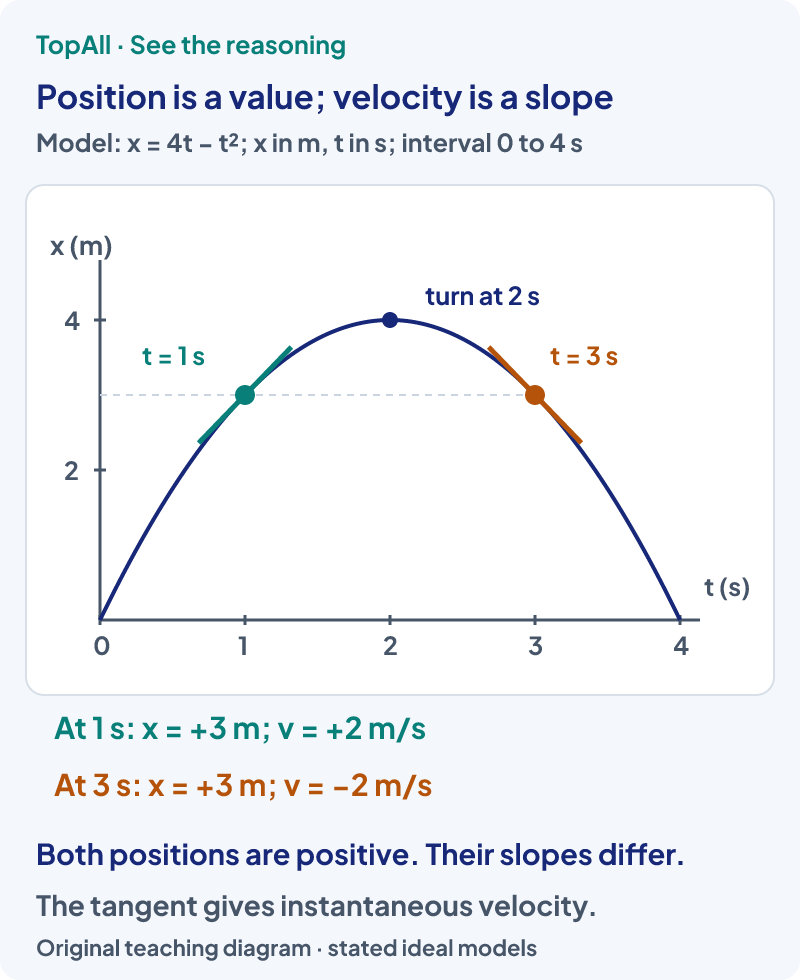
Use , with in metres and in seconds, only on . The velocity is and acceleration is . At , and . At , position is again , but . Positive position means the particle is on the positive side of the origin; it does not decide which way it is moving.
Set to find the turning time: gives . The particle reaches , then returns toward the origin. Before this time, velocity is positive and acceleration negative, so speed decreases. After it, both are negative, so speed increases. At the turning instant speed is zero; avoid using an interval sign rule as if the velocity were nonzero there.
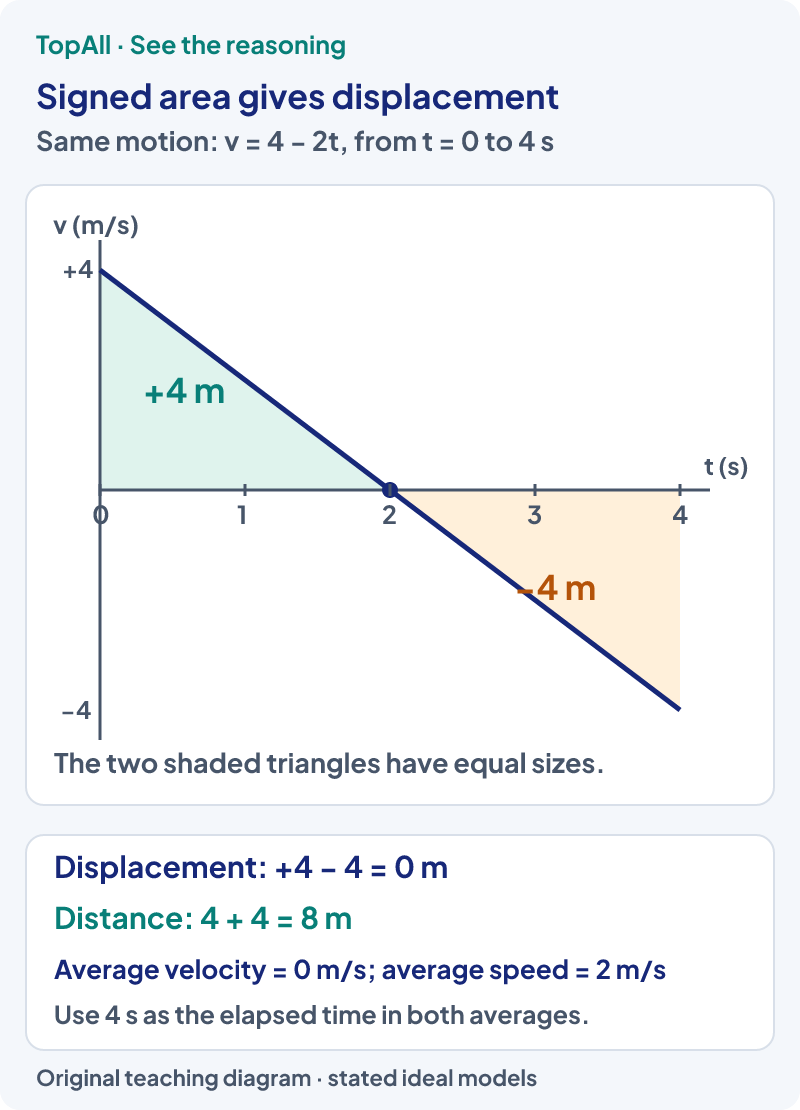
On , the positive triangular area is . On , the signed area is . Total displacement is ; total distance is . Divide each by the same four-second duration: average velocity is , while average speed is . Checking confirms displacement but does not calculate distance.
A negative velocity means motion along the chosen negative direction, not a negative speed. A graph below the time axis can give negative displacement even while the particle travels a positive distance. A stationary instant can occur during a journey whose average speed is nonzero. Convert units before multiplying graph-axis values to calculate an area.
For the worked motion at , which statement is correct? A. Positive position means positive velocity. B. Position is and velocity is . C. Negative velocity means negative speed.
B. Position is the graph height; velocity is its slope. The particle is still to the positive side of the origin but returning toward it. Its speed is , a nonnegative magnitude.
Over the full four-second trip, which pair is correct? A. average velocity 0 and average speed 0; B. average velocity 0 and average speed 2 m/s; C. both 4 m/s.
B. The particle returns to its initial position, so displacement and average velocity are zero. It still covers eight metres, giving average speed . Averaging only the endpoint speeds gives the wrong speed average here.
Cover the result boxes. Trace the journey from the origin to the turning point and back, then explain why the average velocity is zero while the average speed is not. Use the distinction you missed to choose your next practice question.
Explain your self-check mistake in one sentence, then try chapter questions using the corrected rule.
Technical review: Codex (automated). Sources checked on 23 October 2026. Diagrams, worked numerical models and self-checks are original teaching material. Human subject review is not claimed.

