NEET UG · Video

Elastic Behaviour Applications
Learn Elastic Behaviour Applications for NEET with TopAll.
5 min video

NEET UG · Physics
Revise the concepts. Try a question. Understand your next step.
11 hard questions available · Try answers free. Sign in to save progress or take a quiz.
NEET UG · Physics
Understand the concept, practise questions and check your learning.
Understand
Convert area, calculate stress and extension, and distinguish Young modulus from sample stiffness before NEET chapter MCQs. Stress, strain and stiffness: keep material and geometry separate
Read the guidePractise
Try 11 hard chapter MCQs. Untimed; check answers and available explanations as you go.
Practise chapter MCQsCheck your learning
Prepare a timed chapter quiz. Choose the available question count and pace before starting.
Prepare a chapter quizThis is chapter practice, not a full-length NEET mock paper.
These are playable question counts after quality and duplicate checks.
The practice player uses single-correct-answer MCQs. Chapter quizzes are not full-length NEET mock papers. Check the practice guide and official syllabus sources.
Revise before you practise
NEET UG · Video
Learn Elastic Behaviour Applications for NEET with TopAll.
5 min video
NEET UG · Video
Master Elastic Potential Energy for NEET with TopAll.
6 min video
NEET UG · Video
Learn Poisson’s Ratio for NEET with TopAll.
5 min video
NEET UG · Short video
Learn Stress and Strain for NEET with TopAll.
3 min video
NEET UG · PDF notes
Read PDF · 10 pages →Learn Elastic Behaviour Applications for NEET with TopAll.
10 pages
NEET UG · PDF notes
Read PDF · 10 pages →Master Elastic Potential Energy for NEET with TopAll.
10 pages
NEET UG · PDF notes
Read PDF · 9 pages →Learn Poisson’s Ratio for NEET with TopAll.
9 pages
NEET UG · Mind map
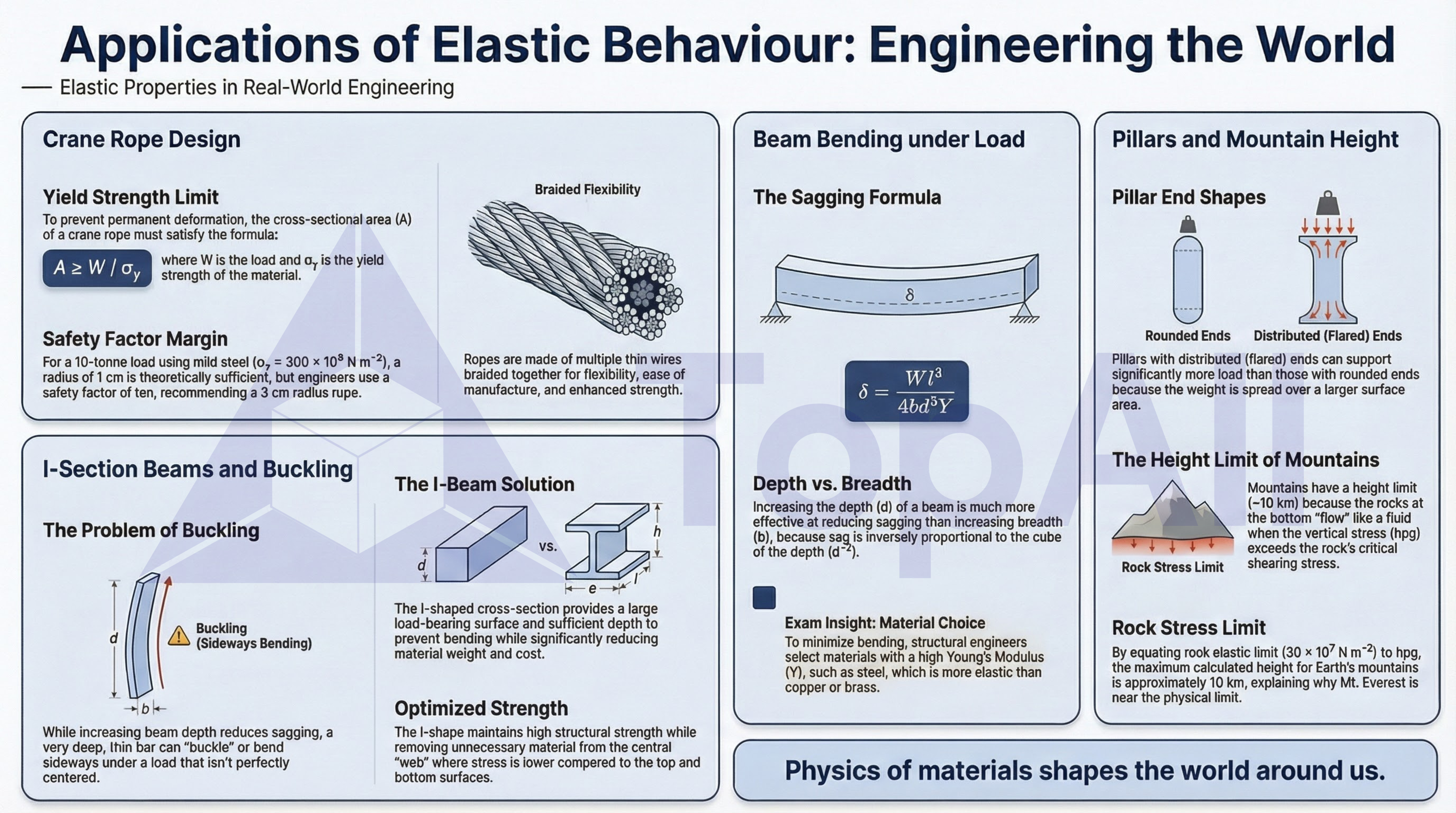
Learn Elastic Behaviour Applications for NEET with TopAll.
NEET UG · Mind map
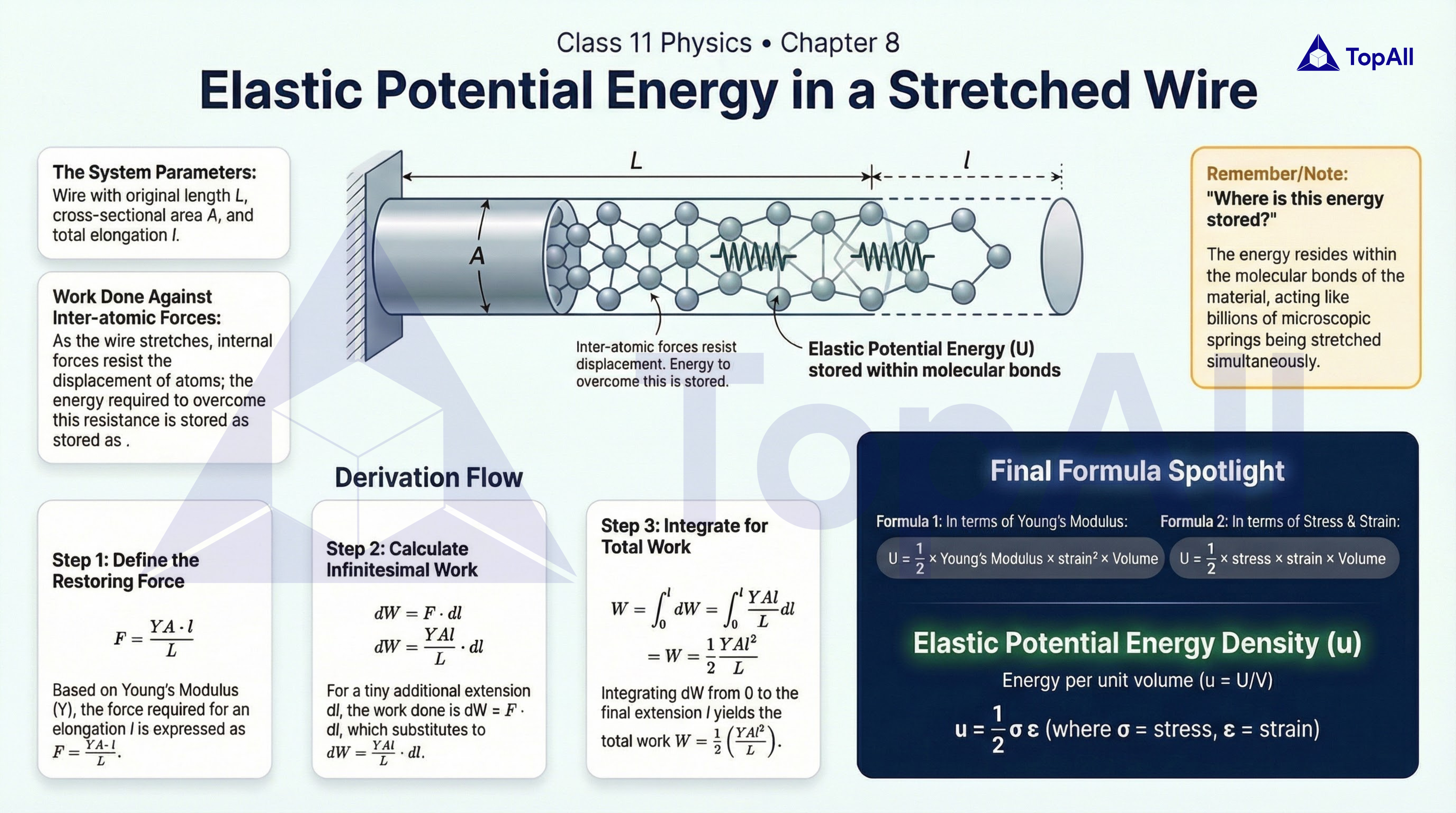
Master Elastic Potential Energy for NEET with TopAll.
NEET UG · Mind map
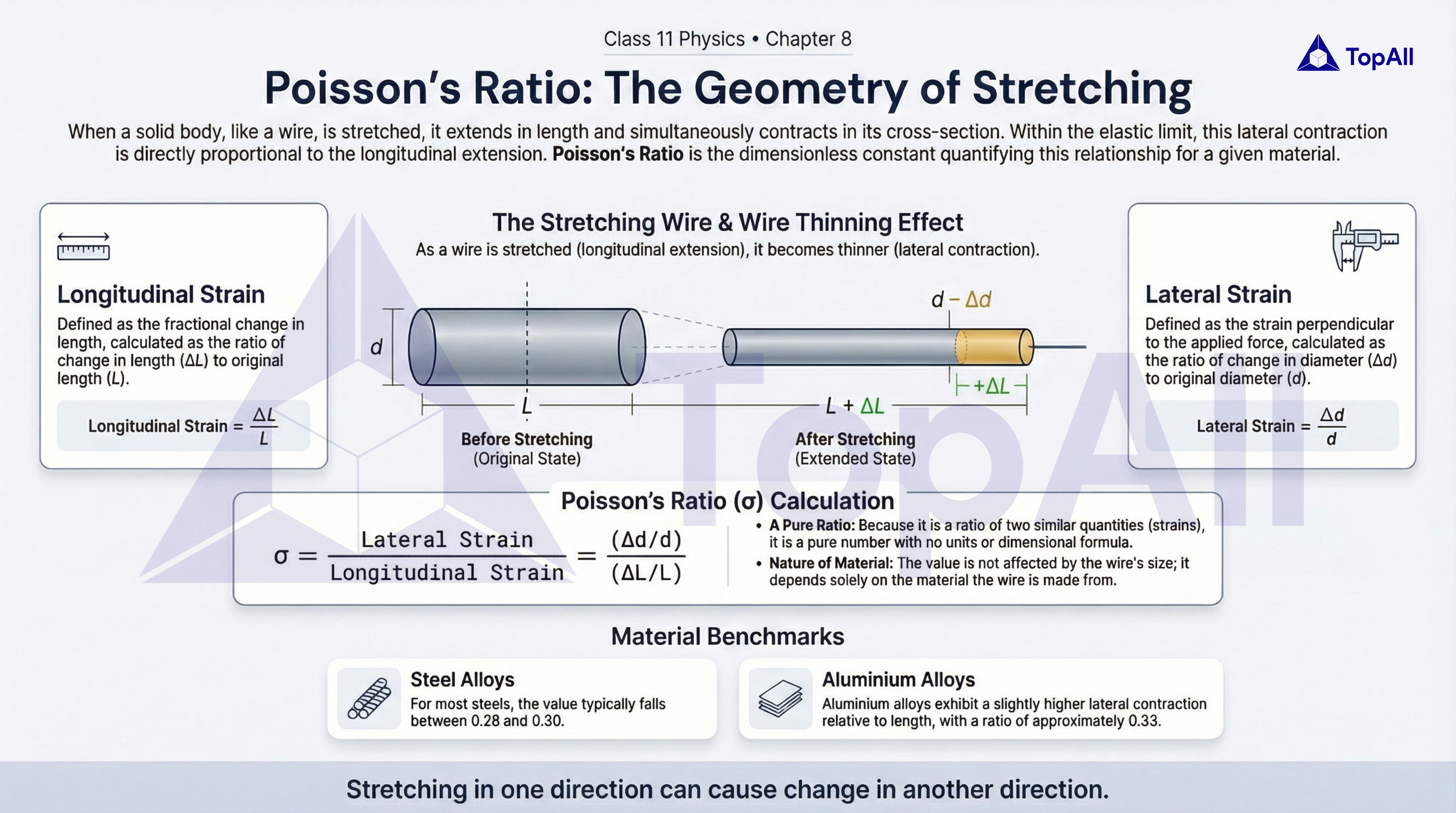
Learn Poisson’s Ratio for NEET with TopAll.
Convert area, calculate stress and extension, and distinguish Young modulus from sample stiffness before NEET chapter MCQs.
For NEET UG students: distinguish stress, strain and extension, convert a wire’s area correctly, and decide whether a change concerns the material modulus or the sample’s geometry. This focused lesson explains the reasoning before chapter practice.
For a uniform wire under a small axial load in its linear elastic range, engineering stress is , longitudinal strain is and Young modulus is . Here and are the original area and length. Thus .
Stress and have unit Pa; strain is dimensionless. The sample’s effective axial stiffness is , with unit N/m. Changing length or radius can change without changing the material’s .
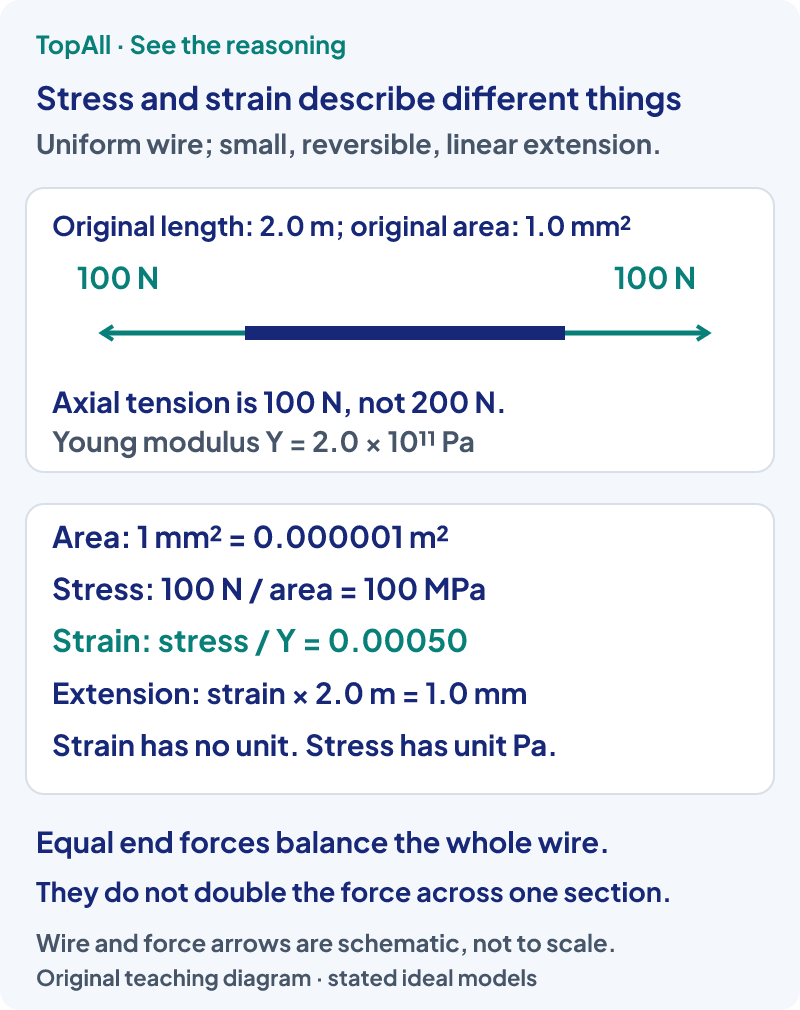
Take , , and . Treat the wire as uniform and neglect its weight. Two opposite 100 N end loads produce tension 100 N across a section, not 200 N.
Because , stress is . Strain is , or 0.050%. Extension is . A strain value is not itself a length.
Young modulus describes axial length change. Shear modulus relates tangential stress to shear strain. Bulk modulus is for small volume changes; the minus sign makes positive when a pressure increase compresses the volume.
The proportionality limit marks the end of a linear stress–strain relation. An elastic response can still be nonlinear beyond that limit; an elastic limit concerns recovery on unloading. Neither the modulus nor the linear slope alone specifies breaking strength. Do not extend the small-strain formula to arbitrary loads or materials.
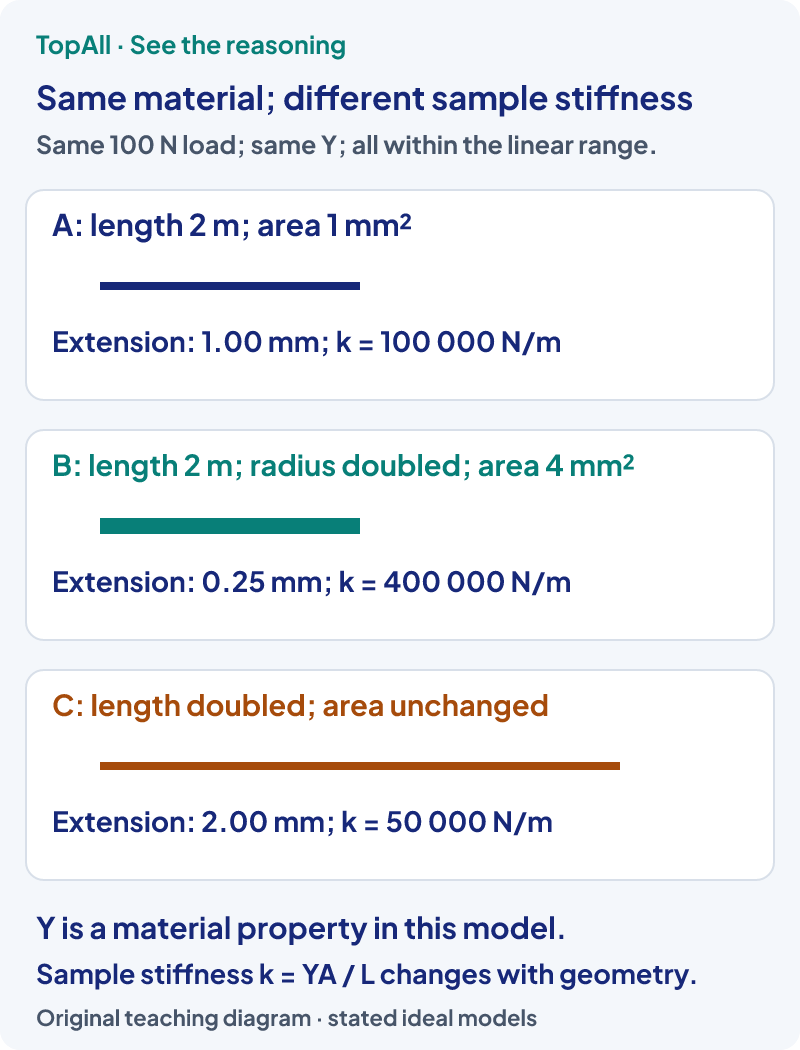
Keep the original length, material and 100 N load, but double the circular wire radius. Its area becomes four times as large. Since under these conditions, extension becomes . Young modulus stays the same; the sample stiffness becomes four times larger.
For the original wire, . Slow linear loading from zero stores . Using would incorrectly assume the load stayed at its final value throughout the extension.
Square the millimetre-to-metre conversion when converting an area. Use the force carried across one section, not the sum of opposite end-force magnitudes. Keep fractional strain distinct from percentage strain and extension. A doubled radius means four times the area. The material modulus, a sample’s stiffness, its elastic limit and its breaking strength describe different properties.
The original 1.0 mm² wire is pulled by two opposite 100 N end forces. What is the axial stress? A. 200 MPa; B. 100 MPa; C. zero.
B. The force transmitted across a cross-section is 100 N. Dividing by gives . Opposite end loads balance the wire as a whole; that does not make the internal stress zero or double the section force.
Cut an otherwise identical sample to half the original length. Keep area, material and the same 100 N load. What is its extension in the linear model? A. 2.0 mm; B. 1.0 mm; C. 0.50 mm.
C. Extension is proportional to original length at fixed force, area and modulus. The material’s Young modulus does not halve; the shorter sample is twice as stiff.
Explain stress, strain and extension in one sentence each, then recover the effect of changing length or radius without substituting numbers. On your next practice question, state which quantities stay fixed before choosing a proportionality.
Explain the distinction you missed, then apply it to a fresh chapter question.
Technical review: Codex (automated). Primary textbook sources checked on 23 October 2026. Diagrams, numerical examples and self-checks are original teaching material. Human subject review is not claimed.


