NEET UG · Video

Physical Relations NEET Notes
Deduce relations between quantities using dimensional analysis for NEET.
4 min video

NEET UG · Physics
Revise the concepts. Try a question. Understand your next step.
41 hard questions available · Try answers free. Sign in to save progress or take a quiz.
NEET UG · Physics
Understand the concept, practise questions and check your learning.
Understand
Check dimensional consistency, rounding and a worked area-uncertainty estimate before choosing your next NEET chapter MCQs. Units and measurements: check dimensions, digits and uncertainty
Read the guidePractise
Try 41 hard chapter MCQs. Untimed; check answers and available explanations as you go.
Practise chapter MCQsCheck your learning
Prepare a timed chapter quiz. Choose the available question count and pace before starting.
Prepare a chapter quizThis is chapter practice, not a full-length NEET mock paper.
These are playable question counts after quality and duplicate checks.
The practice player uses single-correct-answer MCQs. Chapter quizzes are not full-length NEET mock papers. Check the practice guide and official syllabus sources.
Revise before you practise
NEET UG · Video
Deduce relations between quantities using dimensional analysis for NEET.
4 min video
NEET UG · Video
Learn how to check dimensional consistency with solved NEET examples.
5 min video
NEET UG · Video
Master dimensional analysis, uses & tricks with NEET-level MCQs.
7 min video
NEET UG · PDF notes
Read PDF · 8 pages →Understand uncertainty in arithmetic calculations for NEET UG with TopAll.
8 pages
NEET UG · PDF notes
Read PDF · 8 pages →Master rounding off uncertain digits clearly for NEET UG with TopAll.
8 pages
NEET UG · PDF notes
Read PDF · 8 pages →Learn arithmetic rules with significant figures for NEET UG with TopAll.
8 pages
NEET UG · Mind map
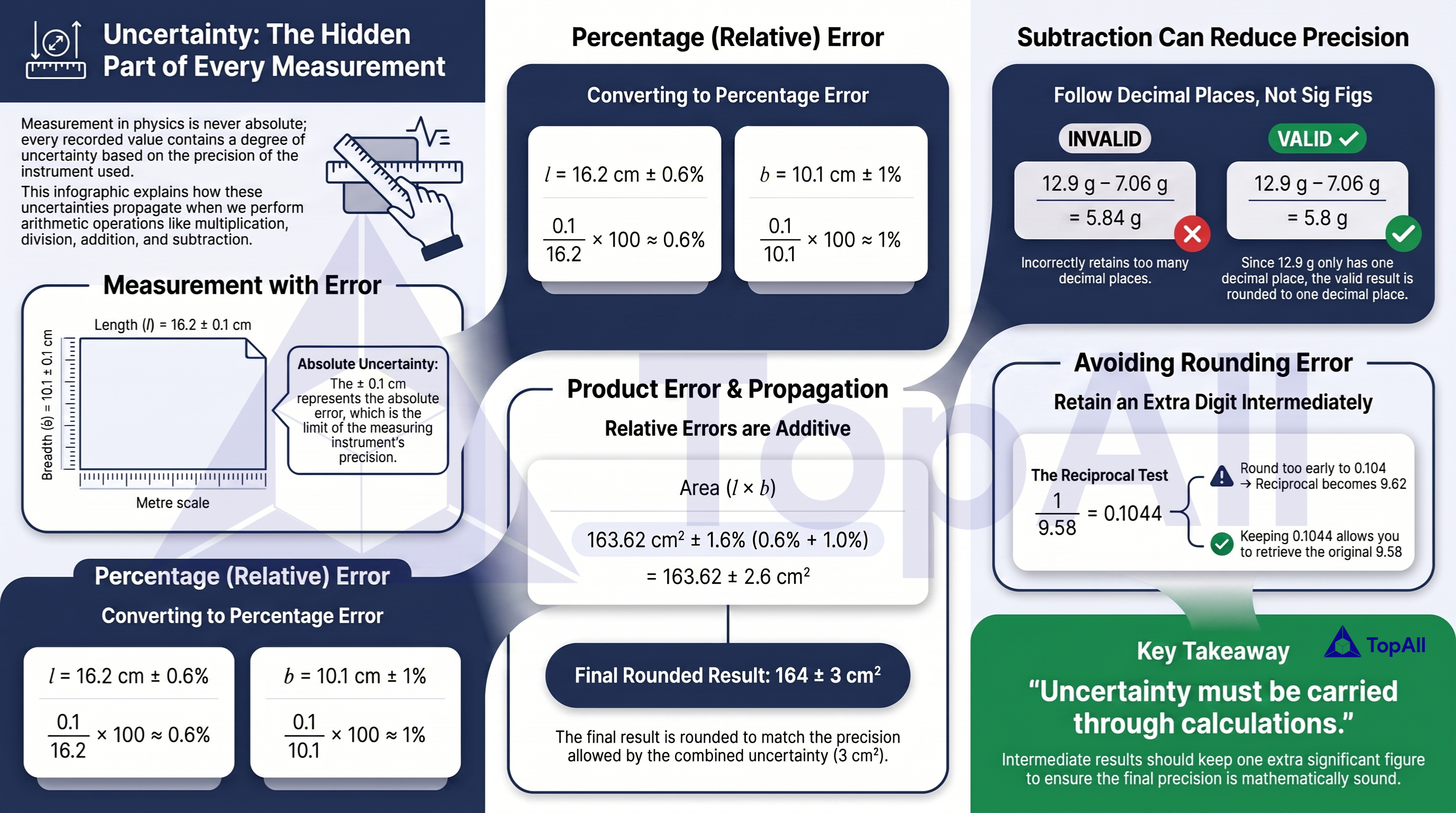
Understand uncertainty in arithmetic calculations for NEET UG with TopAll.
NEET UG · Mind map
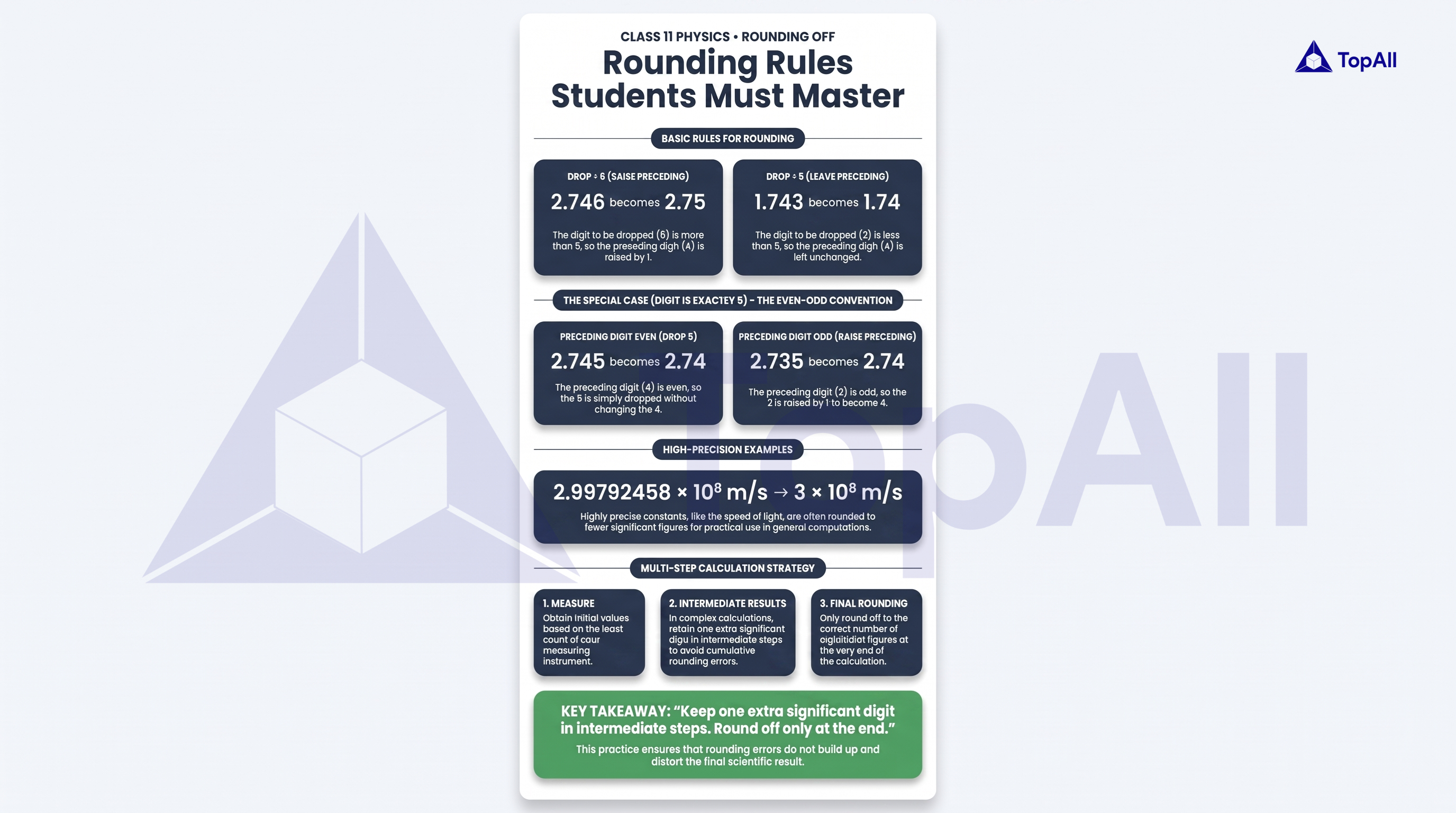
Master rounding off uncertain digits clearly for NEET UG with TopAll.
NEET UG · Mind map
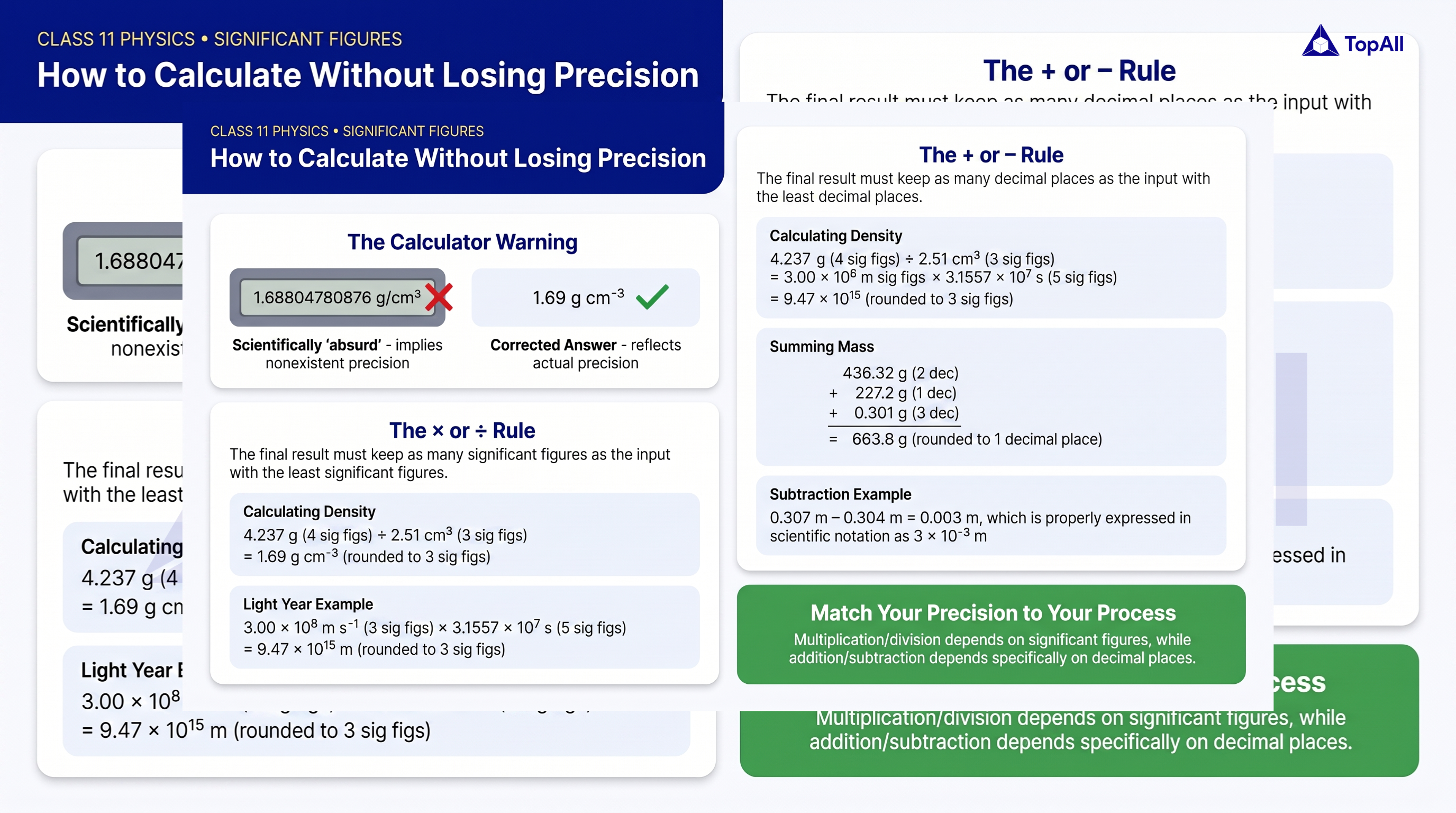
Learn arithmetic rules with significant figures for NEET UG with TopAll.
Check dimensional consistency, rounding and a worked area-uncertainty estimate before choosing your next NEET chapter MCQs.
Use dimensions to reject an impossible expression, keep the right digits and distinguish a first-order uncertainty estimate from a precise probability statement. This focused lesson prepares you to explain a calculation before choosing an MCQ option.
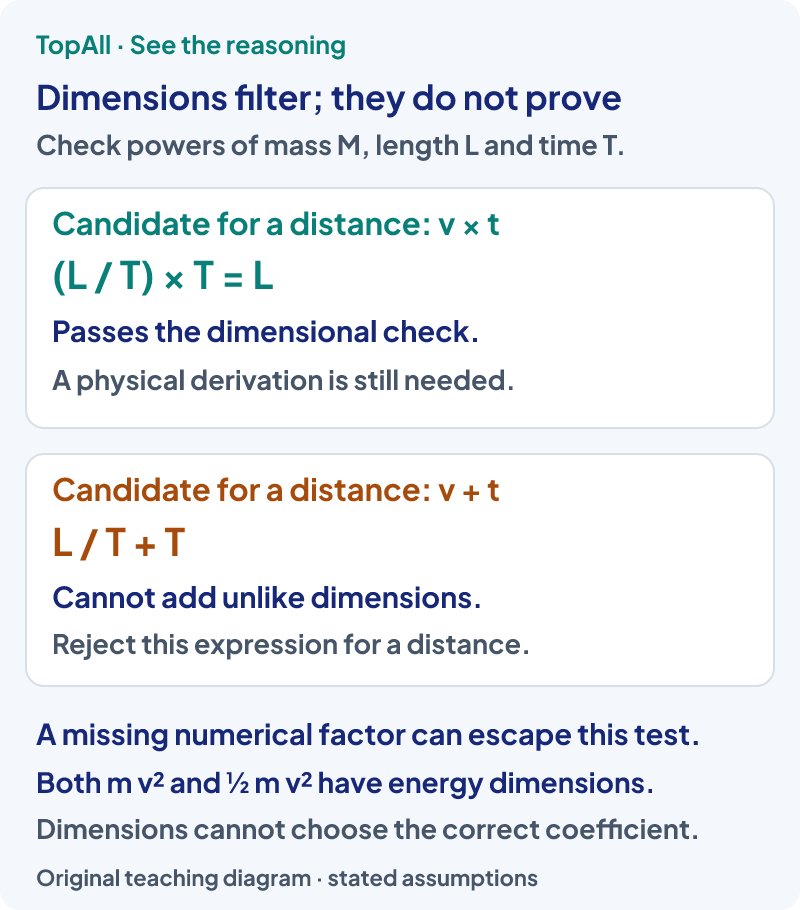
Dimensions ask whether terms describe compatible kinds of quantities. Significant figures govern how measured values are reported. An uncertainty model states how much variation or error is being allowed. These checks answer different questions; extra calculator digits do not make a measurement more accurate.
Keep units through the calculation, retain guard digits, and round the final result using the rule or uncertainty model stated in the question.
For measured lengths, before rounding. The least precise decimal place is tenths, so report .
For measured lengths and , multiplication gives an area reported as , using two significant figures. Addition follows decimal places; multiplication follows significant figures. These elementary rules apply when a more explicit uncertainty calculation is not supplied.
The measured value has three significant figures: 4, 5 and the final zero. Converting exactly to millimetres gives , still three significant figures. Leading zeros locate the decimal point; they are not measured digits. Write an ambiguous whole number in scientific notation to state its significant figures.
Exact counts and defined conversion factors do not limit significant figures. Carry extra digits through intermediate steps; round only when reporting the final quantity. An argument such as must be dimensionless, so .
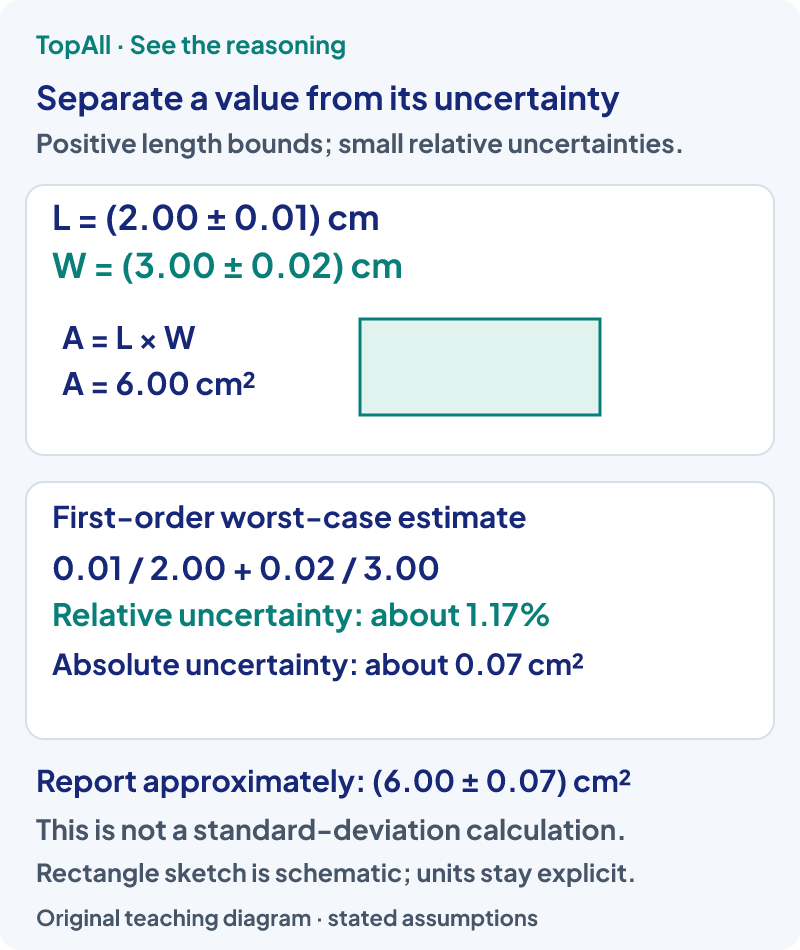
Let and , where the ± values are small allowed bounds. The central area is . A first-order worst-case estimate adds relative contributions: . Thus ; report approximately .
This drops a second-order product of the small input bounds. Direct endpoint multiplication gives and , showing the approximation. It is not an exact symmetric interval. If inputs instead represent uncorrelated standard uncertainties, the standard propagation rule combines squared relative contributions, then takes a square root. Do not switch models without a reason.
A dimensionally consistent equation can still have a wrong coefficient or physical assumption. Quantities with the same dimensions need not be identical: energy and torque share dimensions but describe different things. Converting units does not improve the original measurement. Do not add absolute bounds from unlike quantities in a product; first form their dimensionless relative contributions. The approximate bound above is not a confidence level or a measured systematic bias.
Using the elementary addition rule, how should be reported? A. 12.41 cm; B. 12.4 cm; C. 12 cm.
B. The sum before rounding is 12.41 cm, but the tenths place limits this addition. Counting the one significant figure in 0.3 and rounding the whole sum to one significant figure would use the wrong rule.
For the stated rectangle, the first-order relative area uncertainty is about . Which absolute estimate follows? A. ; B. ; C. .
B. Multiply the relative value by the central area: . The number 1.17 is the approximate percentage; it is not an absolute area uncertainty.
Cover the examples. Explain why an addition and a multiplication need different rounding rules, then recover the absolute area uncertainty from its relative value. When reviewing an error, write which operation or uncertainty model you should have used.
Explain the distinction you missed in one sentence, then use it in a fresh chapter question.
Technical review: Codex (automated). Primary textbook sources checked on 23 October 2026. Diagrams, worked numerical examples and self-checks are original teaching material. Human subject review is not claimed.

