NEET UG · Video

Simple Pendulum NEET Physics
Study simple pendulum concepts and formulas for NEET.
2 min video

NEET UG · Physics
Revise the concepts. Try a question. Understand your next step.
14 hard questions available · Try answers free. Sign in to save progress or take a quiz.
NEET UG · Physics
Understand the concept, practise questions and check your learning.
Understand
Distinguish speed from acceleration in SHM, use spring-energy fractions and try original self-checks before NEET chapter MCQs. SHM: connect position, motion and energy
Read the guidePractise
Try 14 hard chapter MCQs. Untimed; check answers and available explanations as you go.
Practise chapter MCQsCheck your learning
Prepare a timed chapter quiz. Choose the available question count and pace before starting.
Prepare a chapter quizThis is chapter practice, not a full-length NEET mock paper.
These are playable question counts after quality and duplicate checks.
The practice player uses single-correct-answer MCQs. Chapter quizzes are not full-length NEET mock papers. Check the practice guide and official syllabus sources.
Revise before you practise
NEET UG · Video
Study simple pendulum concepts and formulas for NEET.
2 min video
NEET UG · Video
Learn energy conservation in SHM with simple steps.
2 min video
NEET UG · Video
Explore velocity and acceleration in SHM with clarity.
2 min video
NEET UG · PDF notes
Read PDF · 10 pages →Study simple pendulum concepts and formulas for NEET.
10 pages
NEET UG · PDF notes
Read PDF · 9 pages →Learn energy conservation in SHM with simple steps.
9 pages
NEET UG · PDF notes
Read PDF · 9 pages →Explore velocity and acceleration in SHM with clarity.
9 pages
NEET UG · Mind map
Study simple pendulum concepts and formulas for NEET.
NEET UG · Mind map
Learn energy conservation in SHM with simple steps.
NEET UG · Mind map
Explore velocity and acceleration in SHM with clarity.
Distinguish speed from acceleration in SHM, use spring-energy fractions and try original self-checks before NEET chapter MCQs.
Predict what happens at the centre and the turning points, use the sign of velocity correctly, and calculate spring energy without confusing a fraction of energy with a fraction of speed. The model is ideal and undamped.
Measure from equilibrium. In the convention , let , with and . Then and . A displacement can occur on both halves of a cycle; velocity chooses the branch. At , speed is greatest and acceleration is zero. At , speed is zero and acceleration magnitude is greatest.
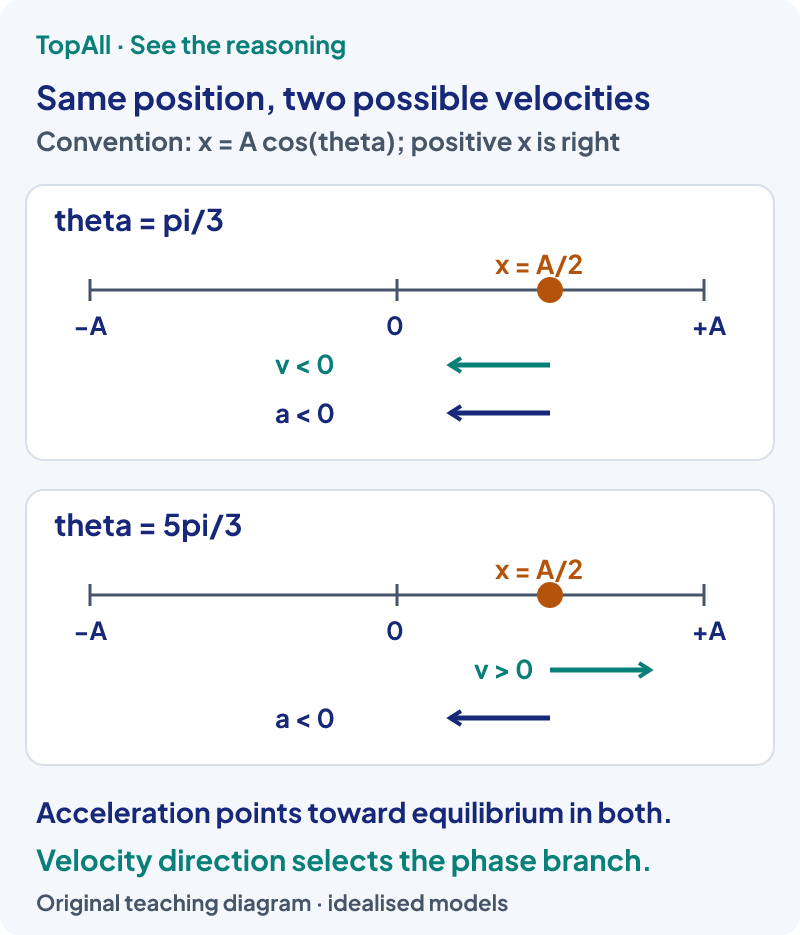
Take and . At , the particle is at and moving toward increasing . From , the candidates are and modulo . Since requires , choose . The resulting velocity is and acceleration is . If the direction were reversed at the same position, the phase would be and acceleration would still be negative.
For an ideal horizontal mass–spring oscillator, . Choose spring potential energy zero at equilibrium: , and . Thus and . Energy gives speed through ; it does not decide the sign of velocity.
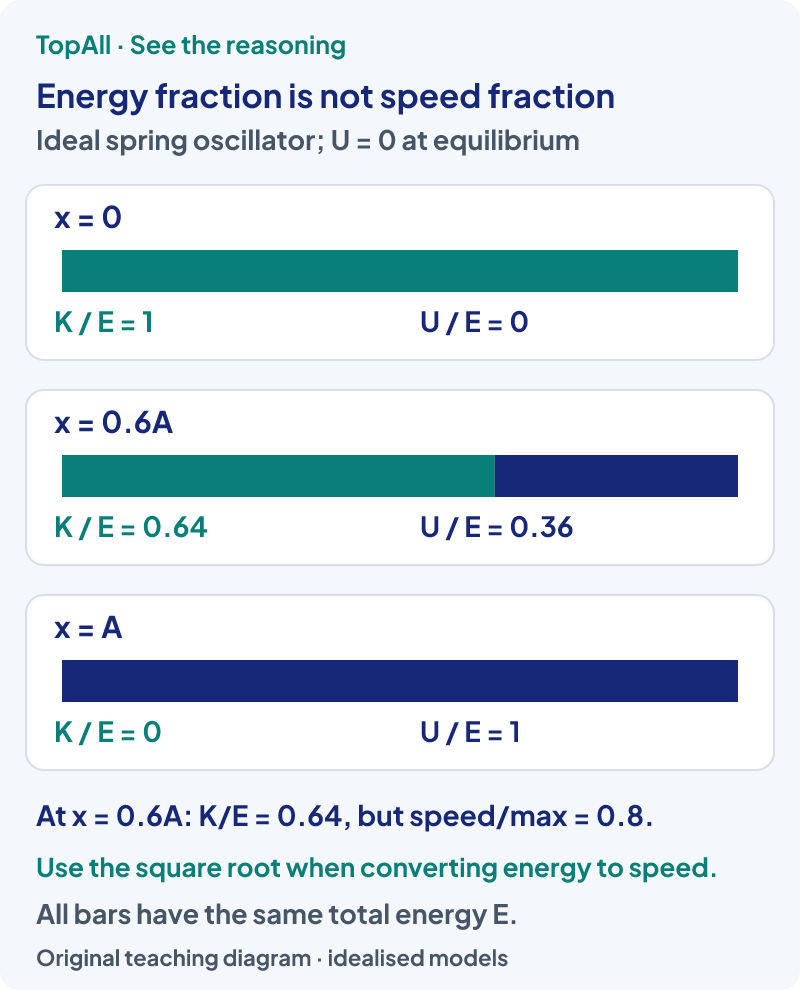
A block moves on a frictionless horizontal surface with and amplitude . At , and . Calculate and . Then . The energy fraction is , while the speed fraction is . Do not use 0.64 as the speed fraction.
Zero velocity at a turning point does not imply zero acceleration. Convert centimetres to metres before calculating joules. Potential energy is zero at the chosen equilibrium reference, not universally at every “starting point”. At fixed and , doubling amplitude doubles maximum speed and quadruples total energy; it leaves the ideal oscillator period unchanged.
At in ideal SHM, which statement holds? A. and ; B. and ; C. speed is maximum.
B. The particle reverses direction there. Zero instantaneous velocity does not remove the restoring force. Maximum speed occurs at equilibrium, where acceleration is zero.
For the same ideal spring and mass, amplitude doubles. How do total energy and maximum speed change? A. Both double; B. energy quadruples and maximum speed doubles; C. both quadruple.
B. Energy depends on ; maximum speed depends linearly on because is unchanged. Check the fixed-, fixed-, undamped assumptions before using this scaling.
Cover the labels and redraw the centre and both turning points. Add velocity, acceleration, and at each. Recalculate the energy and speed fractions. Use the distinction you missed to choose your next chapter-practice question.
Explain the mistake behind any self-check you missed, then use chapter practice to test the corrected idea.
Technical review: Codex (automated). Sources checked on 23 October 2026. The diagrams, worked numerical models and self-checks are original teaching material. Human subject review is not claimed.

