NEET UG · Video

De Broglie Explanation NEET
Understand De Broglie’s explanation of Bohr’s quantisation with MCQs on TopAll.
5 min video

NEET UG · Physics
Revise the concepts. Try a question. Understand your next step.
9 hard questions available · Try answers free. Sign in to save progress or take a quiz.
NEET UG · Physics
Understand the concept, practise questions and check your learning.
Understand
Read photon gaps, distinguish cascades and check hydrogenic or scattering assumptions. Atoms: read energy gaps and state the model
Read the guidePractise
Try 9 hard chapter MCQs. Untimed; check answers and available explanations as you go.
Practise chapter MCQsCheck your learning
Prepare a timed chapter quiz. Choose the available question count and pace before starting.
Prepare a chapter quizThis is chapter practice, not a full-length NEET mock paper.
These are playable question counts after quality and duplicate checks.
The practice player uses single-correct-answer MCQs. Chapter quizzes are not full-length NEET mock papers. Check the practice guide and official syllabus sources.
Revise before you practise
NEET UG · Video
Understand De Broglie’s explanation of Bohr’s quantisation with MCQs on TopAll.
5 min video
NEET UG · Video
Explore hydrogen line spectra, series & transitions with MCQs on TopAll.
5 min video
NEET UG · Video
Learn atomic energy levels, transitions & formulas with MCQs on TopAll.
6 min video
NEET UG · PDF notes
Read PDF · 10 pages →Understand De Broglie’s explanation of Bohr’s quantisation with MCQs on TopAll.
10 pages
NEET UG · PDF notes
Read PDF · 9 pages →Explore hydrogen line spectra, series & transitions with MCQs on TopAll.
9 pages
NEET UG · PDF notes
Read PDF · 9 pages →Learn atomic energy levels, transitions & formulas with MCQs on TopAll.
9 pages
NEET UG · Mind map
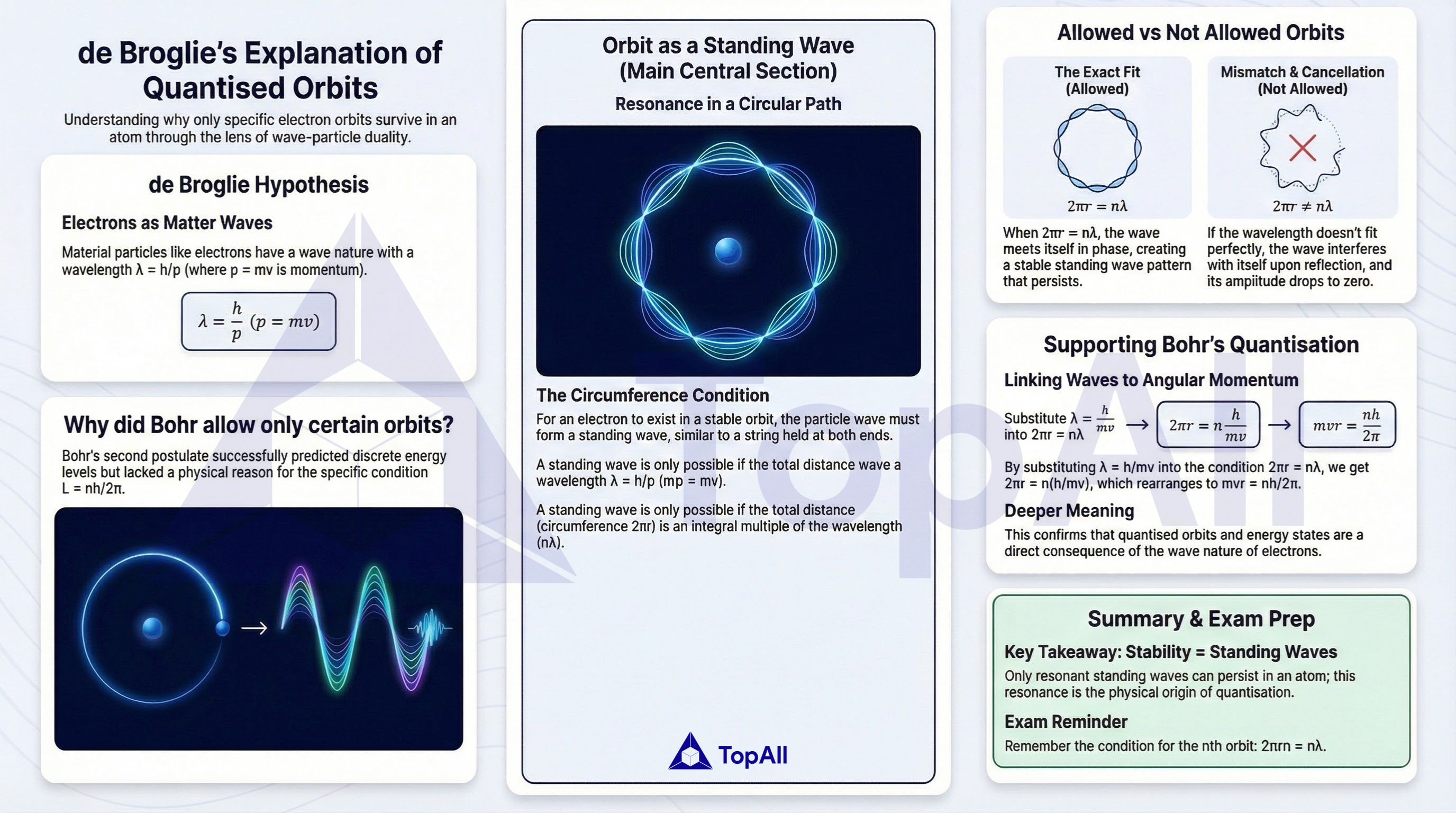
Understand De Broglie’s explanation of Bohr’s quantisation with MCQs on TopAll.
NEET UG · Mind map
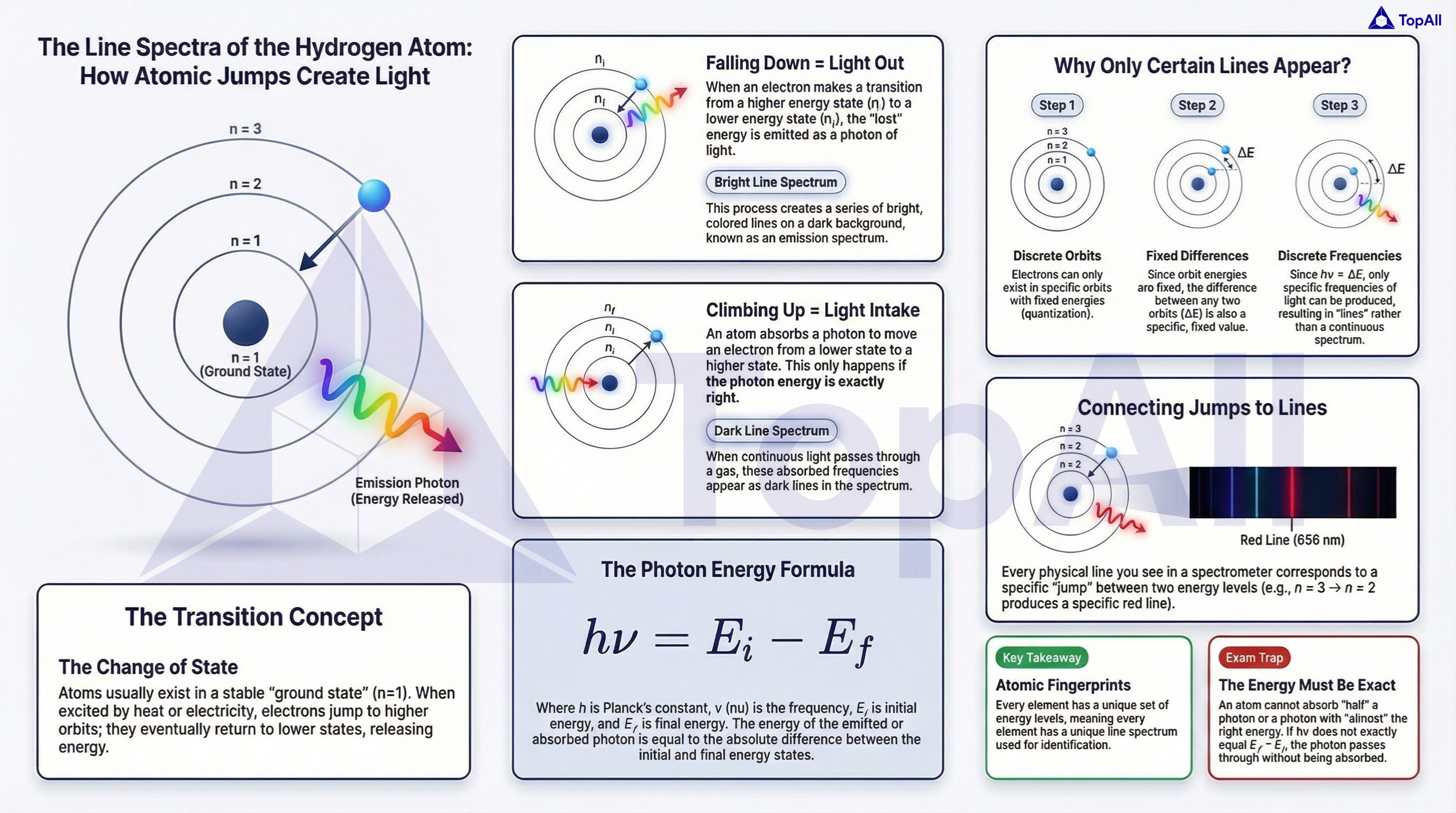
Explore hydrogen line spectra, series & transitions with MCQs on TopAll.
NEET UG · Mind map
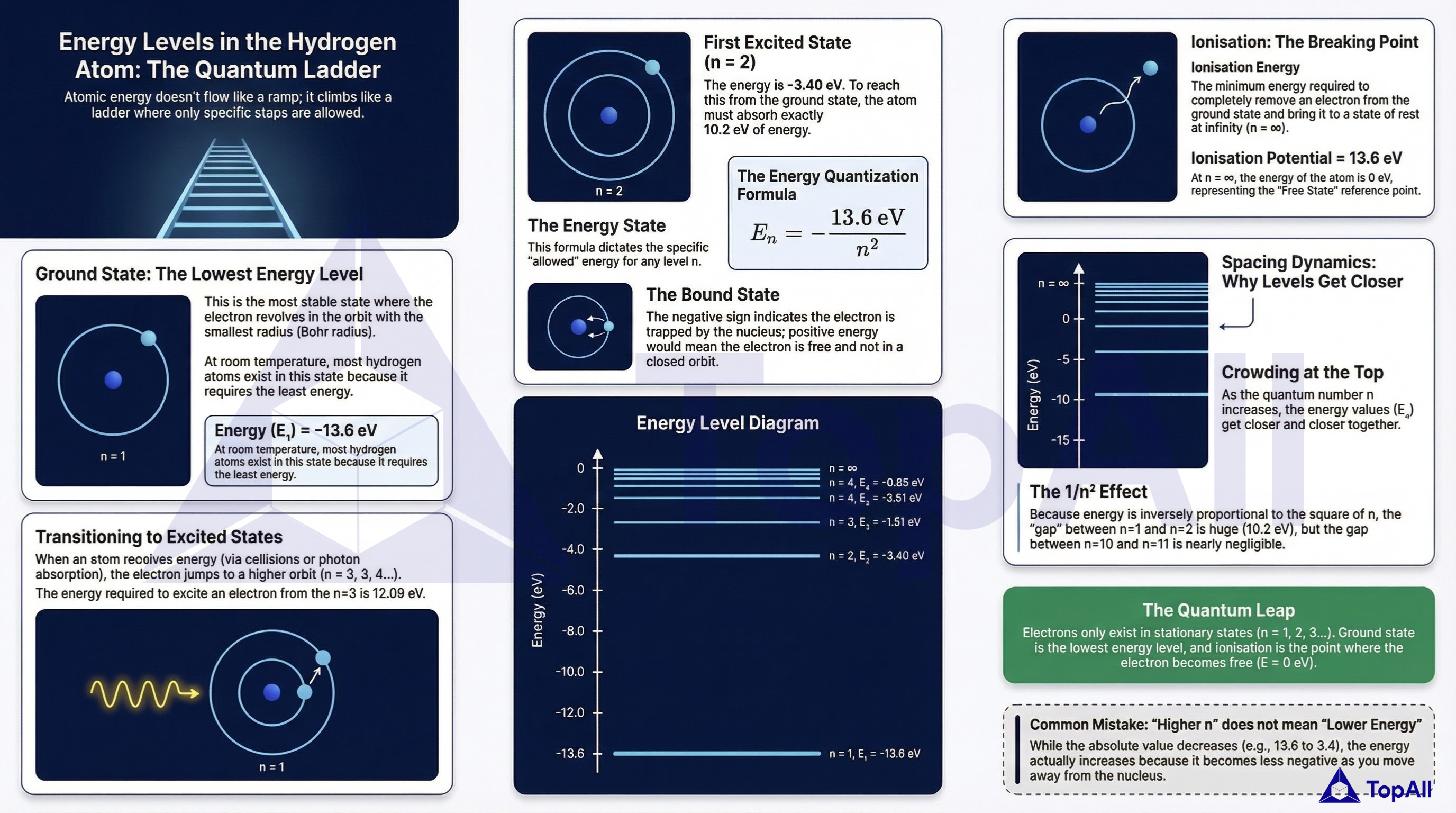
Learn atomic energy levels, transitions & formulas with MCQs on TopAll.
Read photon gaps, distinguish cascades and check hydrogenic or scattering assumptions.
For NEET UG Physics students: turn an energy-level difference into photon energy, distinguish a cascade from one transition, calculate a head-on Coulomb turning distance and state when a hydrogen-like formula applies.
An electron level energy is measured relative to a chosen reference. In the elementary hydrogen model, zero is a separated electron at rest infinitely far away; bound levels are negative. A downward transition lowers the electron energy and emits a positive-energy photon equal to the gap. A head-on scattering question instead compares incoming kinetic energy with electric potential energy at a turning point. These are different energy balances, and neither level energy nor a scattering separation is automatically a photon wavelength or a nuclear radius.
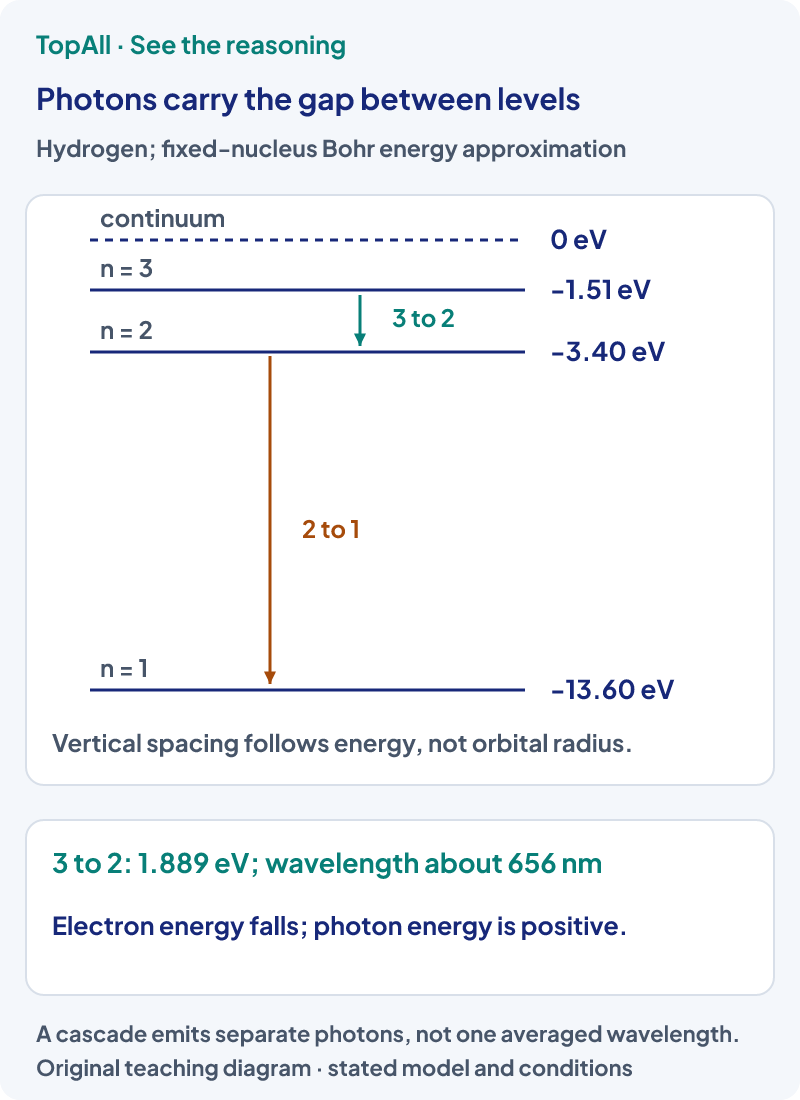
For hydrogen use in the supplied fixed-nucleus nonrelativistic approximation. Thus E3≈−1.511 eV and E2=−3.400 eV. The electron change is
To excite a hydrogen electron from n=2 to n=3 requires about 1.889 eV in this model. To ionise it from n=2 to the zero-energy continuum requires 3.40 eV. A photon supplies its entire energy in a simple absorption event; it is not an electron projectile that can give only part of an arbitrary kinetic energy to excitation. A collision problem may therefore have a different threshold/energy-sharing interpretation. Specify the initial level and whether the requested final state is bound or ionised.
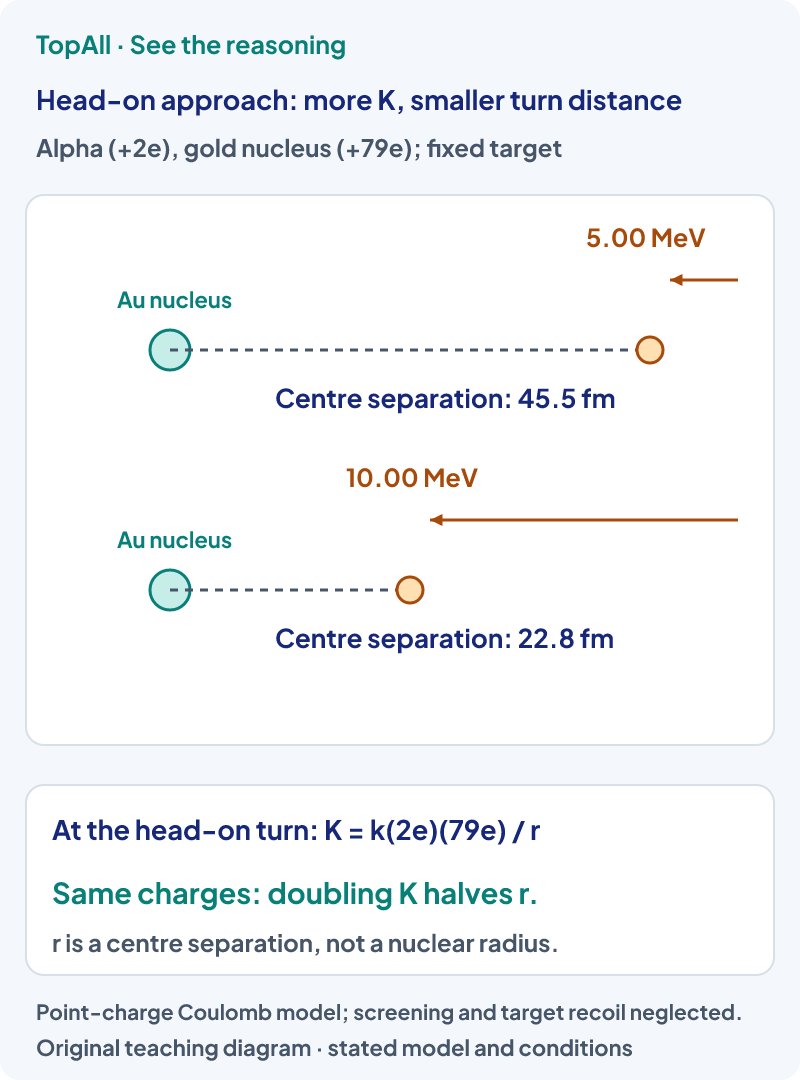
Take an alpha charge +2e and fixed gold-nucleus charge +79e. Assume an initially distant projectile, negligible screening and a pure Coulomb interaction. With supplied , energy conservation gives . At K=5.00 MeV this is , about 45.5 fm. At 10.00 MeV it is about 22.8 fm. These are centre-to-centre turning distances within the model. A nonzero impact parameter retains tangential motion at closest approach, so blindly setting all kinetic energy to potential energy there would be wrong. Finite target recoil and nuclear-force deviations require a different treatment.
For a one-electron ion of nuclear charge +Ze, the elementary fixed-nucleus model gives and , with supplied a0=0.0529 nm. A hydrogen atom and He+ fit this one-electron idealisation; neutral helium has two electrons and does not obey it directly. Bohr radii are model orbit radii, not general quantum trajectories or the nucleus size. Reduced mass, relativistic effects and detailed spectral structure are outside this elementary scaling.
Compare hydrogen at n=1 with He+ at n=2. Hydrogen has and radius a0. He+ has Z=2, so as well, but its radius is . The energy depends on Z2/n2, while radius depends on n2/Z. Equal model energy therefore does not force equal radius. The equality uses the stated fixed-nucleus approximation; it is not an exact high-precision identity between real hydrogen and helium-ion spectral lines.
Hydrogen transitions ending at n=1 belong to the Lyman series; those ending at n=2 belong to the Balmer series. The illustrated 3 to 2 line is the approximately 656 nm Balmer line. Classify by the final level, then calculate the energy gap if a wavelength is requested. The name of a series does not mean every member has the same wavelength, and energy levels are not equally spaced.
A negative bound-level energy does not mean a negative emitted photon energy. Do not use the magnitude of the initial energy when a question asks for a transition between two bound levels. Add photon energies across a cascade, not wavelengths. A head-on Coulomb turn distance is not a nuclear radius. Check that the system has one electron before applying hydrogenic scaling, and do not infer equal radius from equal energy.
A hydrogen electron starts at n=2, with model energy −3.40 eV. What minimum energy takes it to the zero-energy continuum? Would using 13.6 eV answer this initial-state question?
The minimum is 0−(−3.40)=3.40 eV in the stated model. The 13.6 eV ground-state ionisation value uses n=1 as the initial state. Read the starting level before recalling a familiar number.
Hydrogen can fall directly from n=3 to n=1, or through n=2. Ignoring recoil, do both routes release the same total photon energy? Must they produce the same number of photons or the same wavelength?
The total released energy is the same initial-to-final gap, about 12.089 eV in the stated model. The direct route emits one photon; the specified cascade emits two, about 1.889 eV and 10.20 eV. Their individual wavelengths differ from the direct photon wavelength. Equality of summed energy does not require equal photon count or a common wavelength.
Draw three hydrogen levels from memory, label one photon gap and explain why its energy is positive. Then compare two hydrogen-like radii. Revisit NEET Electric Potential and Capacitance for the Coulomb energy reference, or continue to NEET Nuclei to distinguish electronic energy from nuclear binding.
Chapter practice opens the broad Atoms pool.
Technical review: Codex (automated). Primary textbook sources checked on 23 October 2026. Diagrams, worked examples and self-checks are original. Numerical calculations use stated approximations and supplied rounded constants. Human subject review is not claimed. Chapter catalogues and these explanations do not establish complete coverage of every current examination format or syllabus.
Before the next practice set, write the initial state, final state and quantity requested. After a mistake, correct the model or sign first, then redo the calculation without viewing the solution.

