What you’ll understand
Separate electron-domain geometry from molecular shape in simple VSEPR examples.
Jump to a section
Quick answer
For simple VSEPR examples, count electron domains around the central atom. A multiple bond is one domain; each lone pair is another. Electron-domain geometry counts all domains, while molecular shape describes the positions of atoms. In the elementary valence-bond model, four domains correspond to sp³ hybridisation, but do not require a tetrahedral molecular shape.
Work through the reasoning
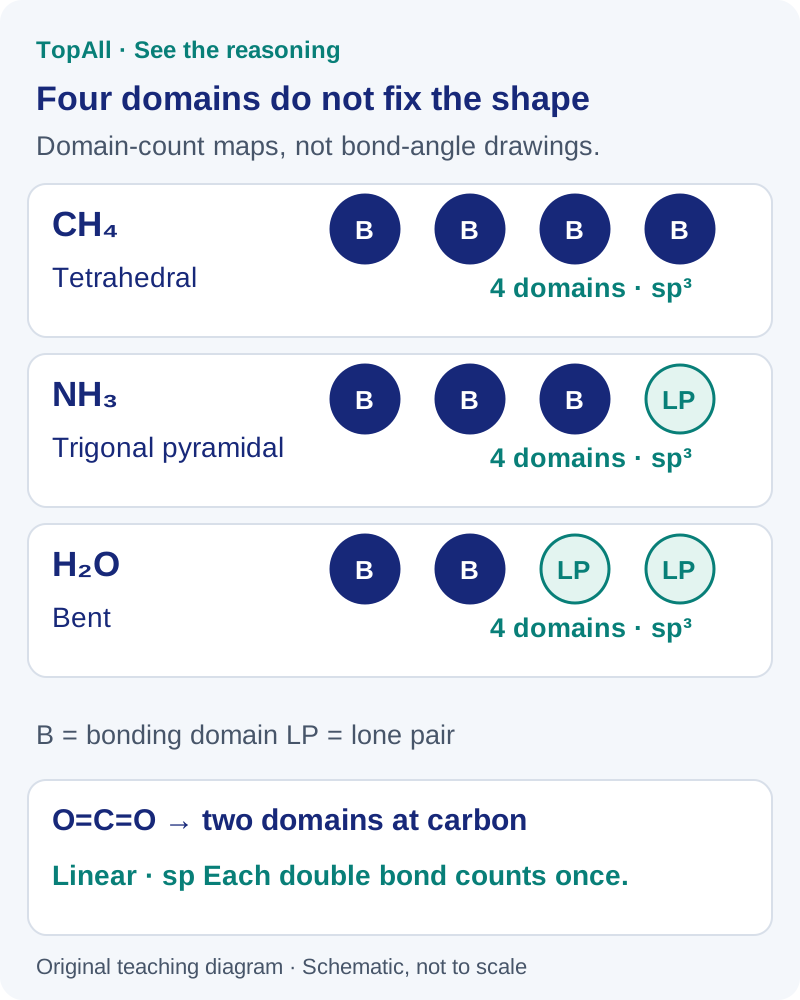
Example 1: three molecules, four domains each. has four bonding domains and no lone pair: tetrahedral molecular shape. has three bonding domains and one lone pair: trigonal pyramidal. has two bonding domains and two lone pairs: bent. All three are described using sp³ hybridisation in the elementary model, but their molecular shapes differ.
Example 2: count a double bond once. In , carbon has two double bonds and no lone pair: two domains, linear shape and sp hybridisation in this model. Counting the two electron pairs of each double bond as separate VSEPR domains would incorrectly give four.
See the reasoning
Count bonding domains and lone pairs separately
 Open full-size diagram ↗
Check it without looking: Draw the Lewis structure, count central-atom domains, and only then name the molecular shape. Keep lone pairs in the count even though they are absent from the shape name.
Common mistakes to catch
- Wrong: sp³ always means a tetrahedral molecule. Instead: inspect lone pairs before naming molecular shape.
- Wrong: use the total electron count of the whole molecule as the domain count. Instead: draw a sensible Lewis structure and inspect the central atom.
- Wrong: transfer these simple rules unchanged to every transition-metal complex. Instead: use the appropriate model for the species.
Try it yourself
1. Reveal the answer: compare the molecular shapes of NH₃ and H₂O.
Both have four electron domains in the elementary model. is trigonal pyramidal with one lone pair; is bent with two. Electron-domain geometry and molecular shape answer different questions.
2. Reveal the answer: how many domains surround carbon in CO₂?
Two: each double bond counts as one VSEPR domain. With no central lone pair, the molecular shape is linear; the elementary hybridisation description is sp.
NEET UG · Chemistry
Continue studying Chemical Bonding & Molecular Structure
Understand the concept, practise questions and check your learning.
Practise
Try 562 mixed-difficulty chapter MCQs. Untimed; check answers and available explanations as you go.
Practise chapter MCQsCheck your learning
Prepare a timed chapter quiz. Choose the available question count and pace before starting.
Prepare a chapter quizThis is chapter practice, not a full-length NEET mock paper.
Sources and method
The NCERT source supports the underlying concepts. All examples, self-checks and their explanations here are original editorial exercises, not past-paper questions, frequency estimates or promises of marks. Technical review: Codex (automated); human subject review is not claimed.
- NCERT Chemistry: Chemical Bonding and Molecular Structure
NCERT online textbook · Sections 4.3 and 4.6: VSEPR and hybridisation in simple molecules · Checked 2026-10-23
Frequently asked questions
Start with your question. Open an answer, then choose one study task to try.
Are these previous-year examination questions?
No. The worked examples and self-checks are original teaching exercises. Linked practice is chapter concept practice; it is not advertised as a complete verified PYQ collection.
Do I need to sign in?
You can read this guide, browse resources and check chapter practice answers free. Sign in to save practice progress or prepare a chapter quiz.