
What you will take away
- Name the product before choosing bases.
- Read the template in the opposite direction to the strand being synthesised.
- Check the double-stranded-DNA assumption before using base-percentage rules.
Start here if: Know A, T, G, C and U, complementary pairing, and the meaning of 5′ and 3′.
Jump to a section
Start with the product, not a memorised table
Replication produces DNA; transcription produces RNA from a DNA template. A copied genome and an RNA transcript are different products with different jobs. For a given transcription unit, one DNA strand is the template. That does not mean the same physical strand must be the template for every gene.
The new strand is synthesised 5′ to 3′ while its template is read 3′ to 5′. Write those ends before filling in bases. NCERT’s replication and transcription sections provide the biological context; the short sequences below are original teaching examples, not complete genes or past-paper questions.
A compact comparison you can explain
- Product
- Replication: DNA
- Transcription: RNA
- Bases in the new strand
- Replication: A, T, G, C
- Transcription: A, U, G, C
- Template use
- Replication: Both parental strands are copied.
- Transcription: One template strand for a given transcription unit.
- Shared direction rule
- Replication: New strand 5′ to 3′
- Transcription: New strand 5′ to 3′
First establish which strand you were given. A coding DNA strand matches the RNA sequence in the corresponding orientation apart from T/U; a template strand must be complemented.
Work through one template in two ways
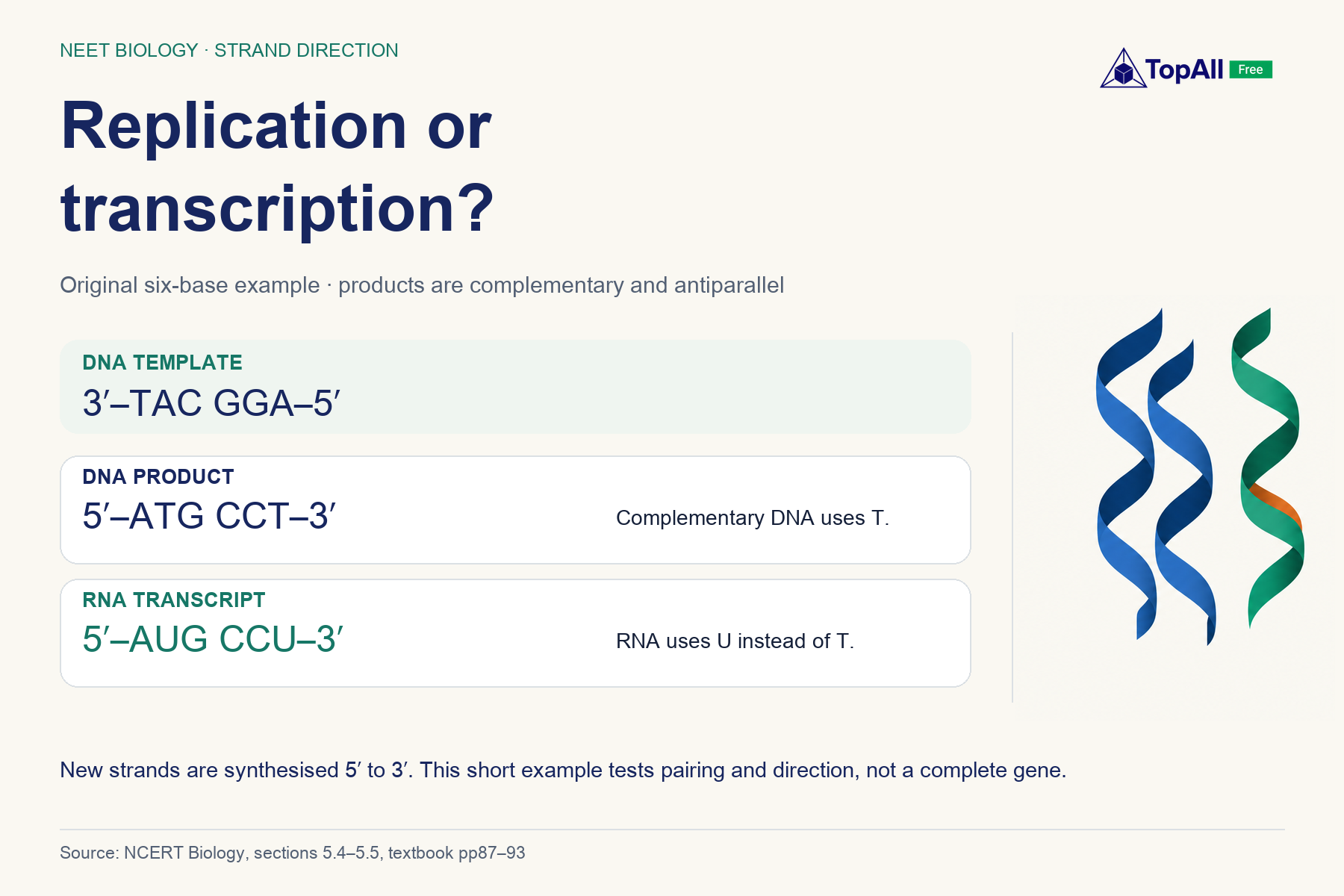
Original worked example. Read the template 3′–TAC GGA–5′ from left to right. For a new complementary DNA strand, T pairs with A, A with T, C with G and G with C. The product is 5′–ATG CCT–3′. For an RNA transcript from the same template segment, use U instead of T in the new strand: 5′–AUG CCU–3′.
Now check rather than reread: the product ends run opposite to the template, each base is complementary, and the RNA contains U. A six-base segment is too short to represent all the regulatory requirements of a real transcription unit; this exercise tests the pairing and direction rules only.
Work it through
Read the template, then write the product
3′–TAC GGA–5′5′–ATG CCT–3′5′–AUG CCU–3′Original six-base teaching sequence, not a complete gene or an official exam question. The displayed products run antiparallel to the template; RNA uses U in place of T. Source and scope.
TopAll · Original teaching example
Catch the coding-strand trap
Suppose the question instead gives the coding strand 5′–ATG CCT–3′ and asks for the corresponding RNA. In the same written direction, the answer is 5′–AUG CCU–3′. Complementing that coding strand would answer a different question.
Use a three-part margin note: given strand → requested product → direction. If any part is missing, pause before writing a sequence. For base percentages, also ask whether the sample is double-stranded DNA; a pairing relation from that model is not universal for every nucleic-acid sample.
Try it before opening the answer
An original template segment is 3′–CGA TTA–5′. Write its RNA transcript 5′ to 3′. Then name the single most useful check on your answer.
Show the reasoning
The transcript is 5′–GCU AAU–3′. Check complementarity and the antiparallel direction; make sure the RNA product uses U. If you wrote CGA UUA, you copied the template instead of complementing it.
Make the next ten questions useful
During chapter practice, classify each error as product, template/coding identity, direction or biological context. Write one corrected example for that category. Later, change the sequence and solve a fresh example without looking at the correction. Recognising the answer you just read is easier than producing the reasoning again.
Your next study session
Practise, then review your mistakes
Suggested task: choose 10 available chapter questions, allowing about 20 minutes plus error review. Adjust the pace if you are learning the concept for the first time.
- Choose ten available concept questions; this is a suggested task, not a separately filtered paper.
- For each mistake, record the first incorrect step and a brief correction.
- After a break, test the same idea with a fresh example before moving on.
Sources and method
Official sources establish concept or syllabus scope. Examples, calculations and planning routines are original editorial work, not PYQs, chapter-weightage estimates or performance guarantees.
- NCERT Biology: Molecular Basis of Inheritance
2026-27 reprint · Sections 5.4-5.5: replication and transcription; textbook pages 87-93 · Checked 2026-10-20
Frequently asked questions
Start with your question. Open an answer, then choose one study task to try.
Are both DNA strands templates during transcription?
For a given transcription unit, one strand is the template. Other genes can use the opposite strand; do not turn a statement about one unit into a rule about an entire chromosome.
Does RNA always match the coding strand?
For the corresponding transcribed segment, write both in the same 5′ to 3′ orientation: the RNA sequence matches the coding DNA sequence apart from U replacing T. RNA processing can change the final product in relevant contexts.
Do I complement a coding strand to get RNA?
Not when the coding sequence is already given in the corresponding 5′ to 3′ orientation. Replace T with U for that segment. Complement a DNA template strand to construct its transcript.
Are these NEET previous-year questions?
No. These are original teaching exercises. The linked chapter bank is concept practice and is not labelled a complete verified PYQ collection.