
What you will take away
- Compare the paper format before comparing scores. The time allowance and question-choice rules changed during this period.
- A historical chapter count cannot promise marks in your next paper. Use mistakes and prerequisites to choose today’s revision.
- Start with one familiar chapter, answer ten questions and identify the reason for each error.
Start here if: You have studied at least one Biology, Chemistry or Physics chapter.
Jump to a section
What changed across these seven years
A past paper is useful when you know which conditions produced its score. The table follows official examination documents, rather than assigning an unsupported difficulty label to every year. The 2019 entry records the start of the NTA era; later entries identify changes relevant to practice.
| Year | Evidence | Use it in practice |
|---|---|---|
| 2019 | NTA conducts NEET | Separate the examination authority from claims about chapter frequency. |
| 2020 | Three-hour scheduled examination | Match the time limit when you use this year’s paper. |
| 2021 | Choice introduced in Section B; three hours | An offered question and a scored selection are different counts. |
| 2022 | 200-minute test; Section A/B pattern | A 200-minute score is not directly comparable with a shorter sitting. |
| 2023 | 200 offered questions; 200 minutes | Record the rules beside your practice score. |
| 2024 | 200-minute examination | Do not carry that time allowance into a different year. |
| 2025 | 180 questions; 180 minutes; no Section B choice | Rehearse the relevant format and preserve review time. |
Sources: NTA NEET UG 2025 information bulletin, NTA NEET UG 2020 examination notice, NTA NEET UG 2021 information bulletin, NTA NEET UG 2022 paper instructions, NTA NEET UG 2023 application notice, NTA NEET UG 2024 application notice.
The data, explained
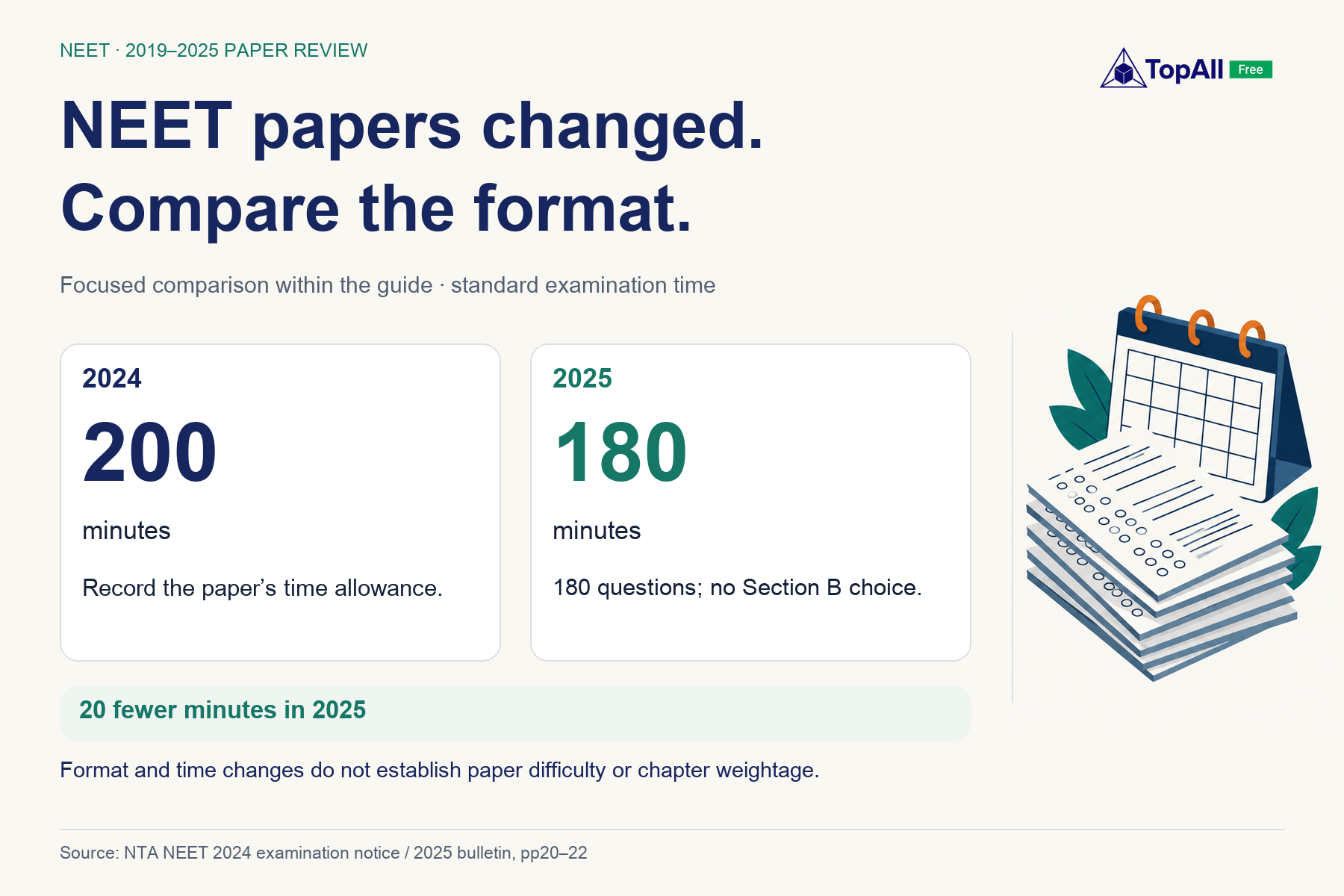
NEET time allowance: 2024 and 2025
Standard examination duration, in minutes. These two years are a focused comparison within the seven-year guide.
minutes · scale starts at zero
Use this in your next mock: 20 fewer minutes: rehearse your checking and review inside the paper’s own time allowance.
This compares time, not measured paper difficulty. Approved compensatory time follows the applicable examination rules.
View the exact data
| Year | Standard duration (minutes) |
|---|---|
| 2024 | 200 |
| 2025 | 180 |
Sources: NTA NEET UG 2024 application notice · NTA NEET UG 2025 information bulletin
TopAll · Official historical records
Read the data, then try it yourself
Read → interpret → try
- Spot the change
- The table records 200 minutes in 2024 and 180 in 2025: 20 fewer minutes. Section B choice also changed.
- What it means for practice
- Write the year and time limit beside a mock score. A faster or slower result can reflect a different task, not just a change in your ability.
- What it cannot tell you
- Those changes do not establish chapter weightage or the share of statement-based questions.
Evidence: 2024 notice and 2025 bulletin.
Try one statement-checking exercise
A double-stranded DNA sample contains 20% adenine. Which statement follows?
- Guanine is 20%.
- Thymine is 30%.
- Guanine and cytosine are 30% each.
- The same equal-pairing argument applies to every single-stranded sample.
Reveal the answer and study tip
C. Thymine is 20%; guanine and cytosine share the remaining 60% equally. Check the double-stranded condition before calculating. If you chose A or B, revise complementary pairing; if you chose D, review the scope of the assumption.
Concept source: NCERT Molecular Basis of Inheritance. This example teaches how to test a statement, not how often that question appeared.
Compare like with like
In 2021, each of Physics, Chemistry, Botany and Zoology had 35 Section A questions and 15 Section B questions, with ten selections allowed in each Section B. In 2025, the choice was removed. This is a change in paper structure; an unanswered question can still receive zero under the marking rules. It does not force you to guess every answer.
Sources: NTA NEET UG 2021 information bulletin, NTA NEET UG 2025 information bulletin.
When logging a mock, write its year, time allowed, questions scored, correct answers, wrong answers and unfinished questions. Compare your performance on a similar task before deciding that you have improved or become slower. The official time allowances describe the examination format, not measured paper difficulty.
Work through this example
Original teaching example. You answered 150 questions correctly and ten incorrectly, leaving 20 unanswered in a 180-question practice paper. Your score is 150 × 4 − 10 = 590 out of 720. Your accuracy among attempted questions is 150/160 = 93.75%. The remaining 20 questions need a separate review: did you lack the concept, run out of time, or decide the uncertainty was too high? A score alone cannot answer that question.
Choose a sensible starting chapter
If you are beginning Class 11, choose a concept you have already been taught and practise slowly. If you have covered the syllabus, use a recent error log to find one repeated gap. If you are repeating the exam, separate knowledge errors from reading, calculation and time-management errors before adding more study hours.
For a first session, revise DNA base pairing and transcription, then try the Biology practice link. Write one correction for each mistake. The NCERT chapter supports those concepts; it does not establish a percentage of NEET questions copied from the text.
Check your understanding
Two students both score 590. One leaves 20 questions blank; the other attempts every question with more wrong answers. Should their next revision task be identical?
Show the reasoning
No. Similar totals can conceal different problems. Review unfinished questions for the first student and mistaken reasoning/confidence for the second. Choose the next task from the errors, not only the total.
Your next study session
Practise, then review your mistakes
Suggested task: choose 10 available chapter questions, allowing about 15 minutes plus error review. Adjust the pace if you are learning the concept for the first time.
- Answer ten available questions without notes. This is a suggested task, not a separately filtered ten-question paper.
- For each error, record the concept, the step you missed and a short correction.
- Return to the same concept after a break and explain the correction before trying a new question.
Sources and method
Historical examination facts use the cited official documents and exact page locators. Study routines and teaching examples are original editorial suggestions. No question-share percentage or future score, rank or admission guarantee is inferred. Current NCERT reprints support concepts, not historical wording.
- NTA NEET UG 2025 information bulletin
2025 · PDF pages 20–22, examination scheme; chapter 2 for the NTA era · Checked 2026-10-19
- NTA NEET UG 2020 examination notice
2020 · Scheduled examination time, 2 pm to 5 pm · Checked 2026-10-19
- NTA NEET UG 2021 information bulletin
2021 · PDF pages 15–16, examination scheme · Checked 2026-10-19
- NTA NEET UG 2022 paper instructions
2022 · PDF pages 1–2, question pattern and duration · Checked 2026-10-19
- NTA NEET UG 2023 application notice
2023 · Examination pattern and duration · Checked 2026-10-19
- NTA NEET UG 2024 application notice
2024 · Examination pattern and duration · Checked 2026-10-19
- NCERT Biology, Molecular Basis of Inheritance
2026–27 reprint · Chapter 5, DNA base pairing and transcription; supports concepts, not a historical question-share estimate · Checked 2026-10-19
Frequently asked questions
Start with your question. Open an answer, then choose one study task to try.
Can I compare two old mock scores directly?
First compare the paper year, time allowance, question-choice rules and marking scheme. Then compare correct, wrong and unfinished questions. A total alone can hide a change in the task.
Does no Section B choice mean I must attempt every question?
No. The removal of optional selection changes the paper structure; it does not make an unanswered question an incorrect answer. Use the instructions for the particular paper you are practising.
Can these seven years tell me exactly which chapters will appear next?
No. This guide documents changes in examination format. It does not provide a classified question-by-question dataset from which a reliable chapter-frequency claim could be reproduced.
Which DNA task should follow this guide?
Explain which strand is given, then write a complementary product from a fresh short sequence. The companion replication-versus-transcription guide in this study path provides an original example and answer reveal.