
What you will take away
- Use the textbook to check a claim, then close it and retrieve the idea from memory.
- Treat words such as most, only and always as instructions to check scope, not automatic clues to the answer.
- Combine a short reading session with ten questions and a one-line explanation for each error.
Start here if: Know the basic structure of a cell and the meaning of a nucleotide.
Jump to a section
What the source supports
NCERT’s Molecular Basis of Inheritance chapter explains DNA structure, replication, transcription and gene expression. It distinguishes the roles of DNA and RNA, including exceptions. That gives you a concrete reading task: identify the claim, its scope and the biological context.
Sources: NCERT Biology, Molecular Basis of Inheritance.
This guide does not attach a numerical “direct from NCERT” share to the 2019–2025 papers. Such a figure would require a question list, a textbook edition and a consistent rule for distinguishing direct wording from a concept supported by the text. Use the chapter as a learning source rather than a prediction of the next paper.
Read, cover, retrieve, check
Read one short paragraph. Cover the page and write its central idea in your own words. Draw the structure or process if a diagram matters. Reopen the page and correct one missing link. This is more informative than highlighting every sentence, because it exposes what you cannot yet recall.
A beginner can start with nucleotide components and strand orientation. A student who knows those ideas can practise the difference between replication and transcription. A revision student can explain the lac operon and then check each regulatory step. These are different levels of the same chapter, not a single task for every reader.
Work through this example
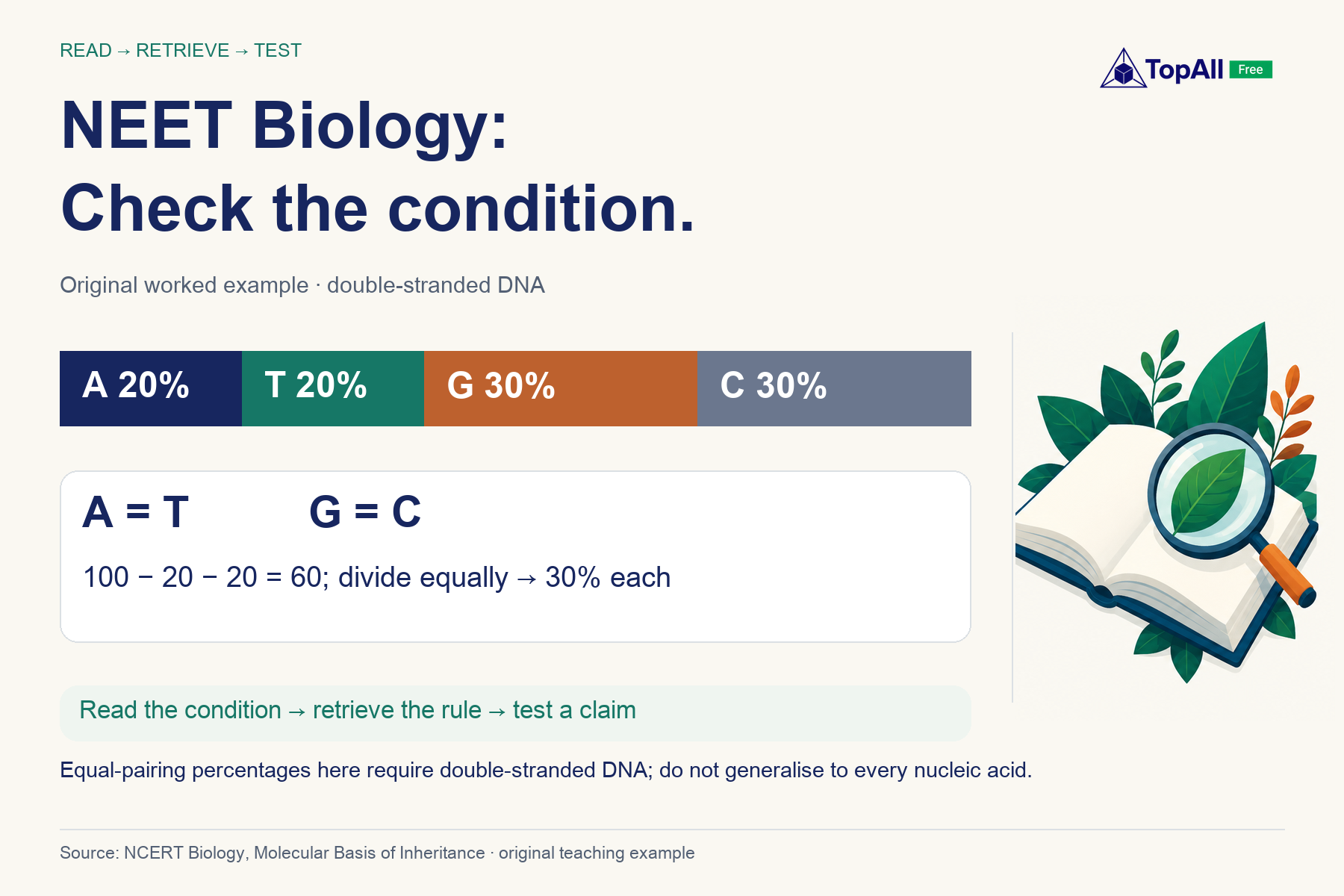
Original teaching example. A double-stranded DNA sample contains 20% adenine. Complementary base pairing gives 20% thymine. The remaining 60% consists of guanine and cytosine in equal amounts, so each is 30%. The statement “guanine is 20%” is false. The calculation assumes double-stranded DNA; you cannot apply the same equal-pairing argument to every single-stranded nucleic-acid sample.
Turn a line into a useful question
Write two statements: “DNA is the genetic material in most organisms” and “RNA has no structural role.” Check them independently. The first expresses a qualified claim; the second is false because RNA has roles beyond carrying a message. The word “most” is not the reason the first is true, and a forceful word is not proof the second is false. The underlying biology decides.
Sources: NCERT Biology, Molecular Basis of Inheritance.
For diagrams, cover the labels and redraw arrows before adding names. Note whether an arrow shows a template, a direction of synthesis or a flow of information. Then explain the diagram aloud using complete sentences.
Check your understanding
If a question changes “most organisms” to “all organisms”, what should you do?
Show the reasoning
Look for an exception supported by the concept. Do not answer from the word “all” alone. A qualified biological statement and its universal version can have different truth values.
Your next study session
Practise, then review your mistakes
Suggested task: choose 10 available chapter questions, allowing about 15 minutes plus error review. Adjust the pace if you are learning the concept for the first time.
- Answer ten available questions without notes. This is a suggested task, not a separately filtered ten-question paper.
- For each error, record the concept, the step you missed and a short correction.
- Return to the same concept after a break and explain the correction before trying a new question.
Sources and method
Historical examination facts use the cited official documents and exact page locators. Study routines and teaching examples are original editorial suggestions. No question-share percentage or future score, rank or admission guarantee is inferred. Current NCERT reprints support concepts, not historical wording.
- NCERT Biology, Molecular Basis of Inheritance
2026–27 reprint · Chapter 5, DNA base pairing and transcription; supports concepts, not a historical question-share estimate · Checked 2026-10-19
- NTA NEET UG 2025 information bulletin
2025 · PDF pages 20–22, examination scheme; chapter 2 for the NTA era · Checked 2026-10-19
Frequently asked questions
Start with your question. Open an answer, then choose one study task to try.
If DNA has 20% adenine, why is guanine 30%?
In the double-stranded DNA example, thymine is also 20%. Guanine and cytosine share the remaining 60% equally, giving 30% each. Check the double-stranded assumption before using that reasoning.
Should I mark every statement containing “all” as false?
No. Check the biological claim and its conditions. A word such as “all” changes the scope of a statement, but the underlying concept and any relevant exceptions decide its truth.
How can I check whether I understood a paragraph?
Cover it, explain the central idea in your own words, and redraw any important diagram without labels. Reopen the text and correct one missing link before moving on.
Which DNA task should follow this guide?
Explain which strand is given, then write a complementary product from a fresh short sequence. The companion replication-versus-transcription guide in this study path provides an original example and answer reveal.