What you’ll understand
Set up junction and loop equations without confusing current direction with traversal direction.
Jump to a section
Quick answer
Choose a direction for each unknown current and keep it consistent. At a junction, equate total current entering and leaving. Around a loop, add potential changes: a resistor gives when crossed along the assumed current and against it; an ideal cell gives from its negative to positive terminal. A negative solved current means the actual direction is opposite to your assumption.
Work through the reasoning
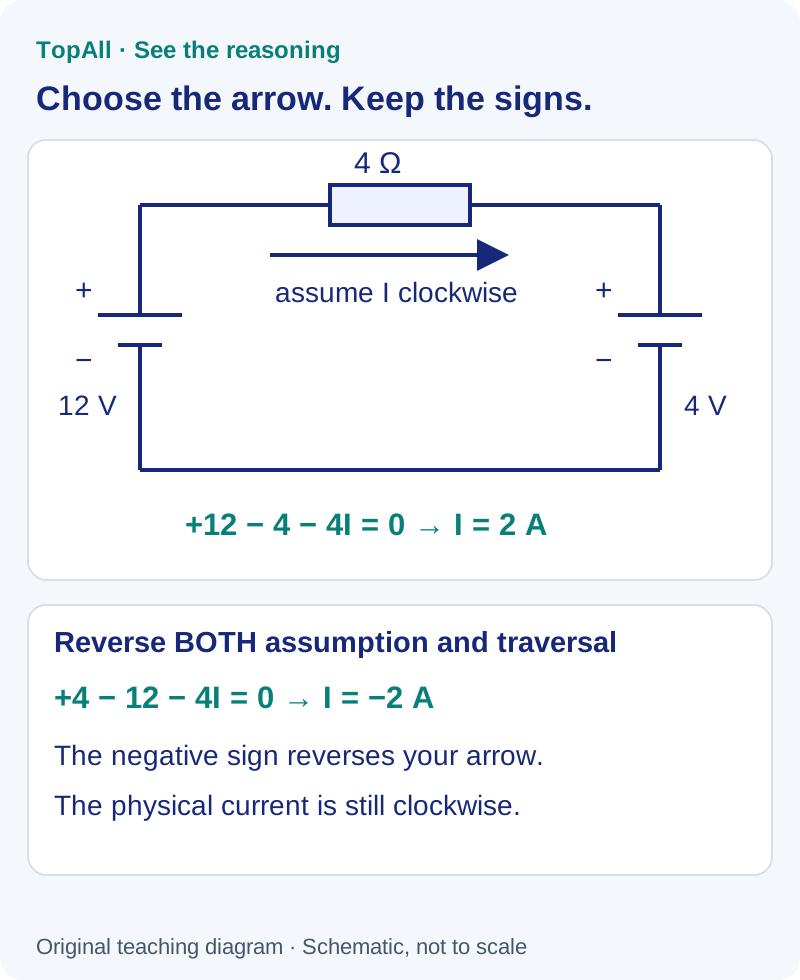
Example 1: two opposing cells. A loop has ideal cells of 12 V and 4 V opposing each other, and a total series resistance of 4 Ω. Traverse in the direction driven by the 12 V cell: . Thus . Choosing the reverse direction consistently gives , or . The physical current is unchanged.
Example 2: a junction. A 3 A current enters a junction. One branch carries 1.2 A out; assume the other branch carries out. Then , so . State the arrow with the answer. Junction conservation alone does not determine all currents in a resistive network; loop equations may also be needed.
See the reasoning
Two opposing cells: signs around a loop
 Open full-size diagram ↗
Check it without looking: Cover the equations and trace each crossing. If your sign changes, identify whether you crossed a cell terminal or followed a resistor’s current.
Common mistakes to catch
- Wrong: flip a current arrow halfway through without updating the equations. Instead: keep the arrow and interpret the sign after solving.
- Wrong: call every resistor term negative. Instead: compare traversal with the assumed current in that resistor.
- Wrong: add battery voltages as positive numbers regardless of polarity. Instead: mark the terminals before writing the loop equation.
Try it yourself
1. Reveal the answer: what is the current for an 8 V ideal cell and a 2 Ω resistor?
With traversal along the driven current, , giving . Reversing your assumed current produces −4 A relative to that arrow.
2. Reveal the answer: 5 A enters; 2 A and I leave. Find I.
, so leaving. If the I arrow were drawn entering, its value would be −3 A.
JEE · Physics
Continue studying Current Electricity
Understand the concept, practise questions and check your learning.
Practise
Try 457 mixed-difficulty chapter MCQs. Untimed; check answers and available explanations as you go.
Practise chapter MCQsCheck your learning
Prepare a timed chapter quiz. Choose the available question count and pace before starting.
Prepare a chapter quizPractice uses single-correct-answer MCQs. It does not cover every JEE Main or Advanced question format.
Sources and method
The NCERT source supports the underlying concepts. All examples, self-checks and their explanations here are original editorial exercises, not past-paper questions, frequency estimates or promises of marks. Technical review: Codex (automated); human subject review is not claimed.
- NCERT Physics: Current Electricity
NCERT online textbook · Section 3.12: Kirchhoff’s rules; ideal lumped DC circuit model · Checked 2026-10-23
Frequently asked questions
Start with your question. Open an answer, then choose one study task to try.
Are these previous-year examination questions?
No. The worked examples and self-checks are original teaching exercises. Linked practice is chapter concept practice; it is not advertised as a complete verified PYQ collection.
Do I need to sign in?
You can read this guide, browse resources and check chapter practice answers free. Sign in to save practice progress or prepare a chapter quiz.