What you’ll understand
Check the interval and integrability before using reflection, oddness or evenness.
Jump to a section
Quick answer
For an integrable function on , reflection gives . Add the two expressions when their sum simplifies. On , an integrable odd function has integral zero and an even function gives twice the integral on . Check the domain and singularities before using either shortcut.
Work through the reasoning
Example 1: a reflected pair. Let . Reflection gives , but their sum is not constant; reflection alone does not guarantee a short answer. Direct division gives , so . Choosing another method after checking is part of good reasoning.
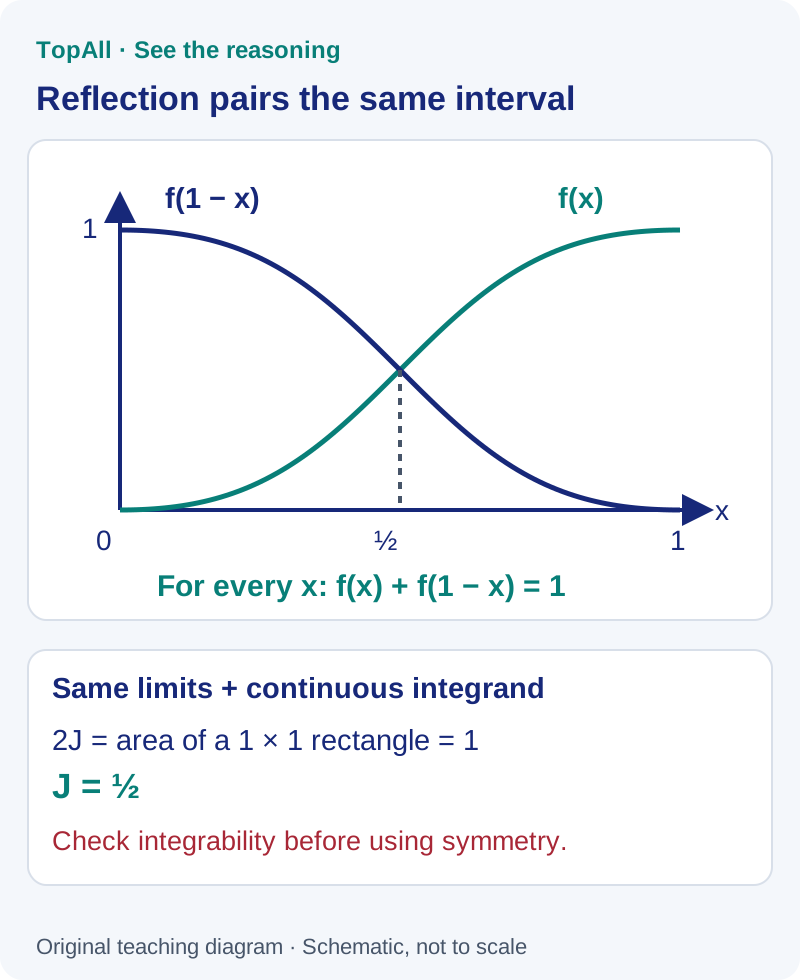
Example 2: a pair that does simplify. For , reflection replaces the numerator by . Adding gives , hence . The denominator is positive throughout the interval, so the integrand is continuous.
See the reasoning
A reflected pair with integral one half
 Open full-size diagram ↗
Check it without looking: Before reflecting a new integral, check its domain and test the algebraic sum. A pole such as 1/x at zero must be handled before invoking symmetry.
Common mistakes to catch
- Wrong: every odd-looking formula integrates to zero. Instead: verify both the symmetric limits and integrability.
- Wrong: as an ordinary improper integral. Instead: the separate one-sided integrals diverge. A Cauchy principal value is a different operation.
- Wrong: keep applying reflection when it does not simplify the pair. Instead: inspect algebra, substitution or an antiderivative.
Try it yourself
1. Reveal the answer: integrate x³ + x² from −1 to 1.
The odd part contributes zero; the even part contributes . The polynomial is continuous, so the symmetry rules apply.
2. Reveal the answer: is the ordinary improper integral of 1/x from −2 to 2 zero?
No. Splitting at zero gives divergent one-sided integrals. Symmetry does not make the ordinary improper integral converge. A symmetric principal-value limit is not the same definition.
JEE · Mathematics
Continue studying Definite Integration
Understand the concept, practise questions and check your learning.
Practise
Try 963 mixed-difficulty chapter MCQs. Untimed; check answers and available explanations as you go.
Practise chapter MCQsCheck your learning
Prepare a timed chapter quiz. Choose the available question count and pace before starting.
Prepare a chapter quizPractice uses single-correct-answer MCQs. It does not cover every JEE Main or Advanced question format.
No revision resources are published for this chapter yet. Use your textbook alongside the guide and practice.
Sources and method
The NCERT source supports the underlying concepts. All examples, self-checks and their explanations here are original editorial exercises, not past-paper questions, frequency estimates or promises of marks. Technical review: Codex (automated); human subject review is not claimed.
- NCERT Mathematics: Integrals
NCERT online textbook · Sections on definite integrals and their properties; integrability condition and original counterexample · Checked 2026-10-23
Frequently asked questions
Start with your question. Open an answer, then choose one study task to try.
Are these previous-year examination questions?
No. The worked examples and self-checks are original teaching exercises. Linked practice is chapter concept practice; it is not advertised as a complete verified PYQ collection.
Do I need to sign in?
You can read this guide, browse resources and check chapter practice answers free. Sign in to save practice progress or prepare a chapter quiz.