
What you will take away
- Balance the reaction before comparing reactants.
- Compare moles divided by stoichiometric coefficient, not raw grams.
- Calculate product from the limiting reagent and verify what remains.
Start here if: Convert grams to moles and interpret coefficients in a balanced chemical equation.
Jump to a section
The smaller pile is not automatically the limit
A reaction consumes reactants in the ratio written in its balanced equation. A substance supplied in a smaller mass may still be present in excess. Convert each amount to moles, then divide by the coefficient with which that substance is consumed. The smallest value tells you which supply runs out first under the assumed complete reaction.
That is the limiting-reagent idea in NCERT section 1.10.1. The questions here are original calculations. They assume one specified reaction proceeds to completion, with no side reaction or yield loss; they do not model the equilibrium yield of an industrial process.
Build a four-step routine
- Write and balance the equation.
- Convert every supplied reactant amount to moles.
- Compare each available amount divided by its reaction coefficient.
- Use the smallest value to find product and leftovers, then check conservation.
The comparison values have the units of amount of reaction extent when coefficients are dimensionless. Use the same balanced-equation convention throughout; doubling every coefficient halves the extent but leaves the physical answer unchanged.
Two moles versus three moles
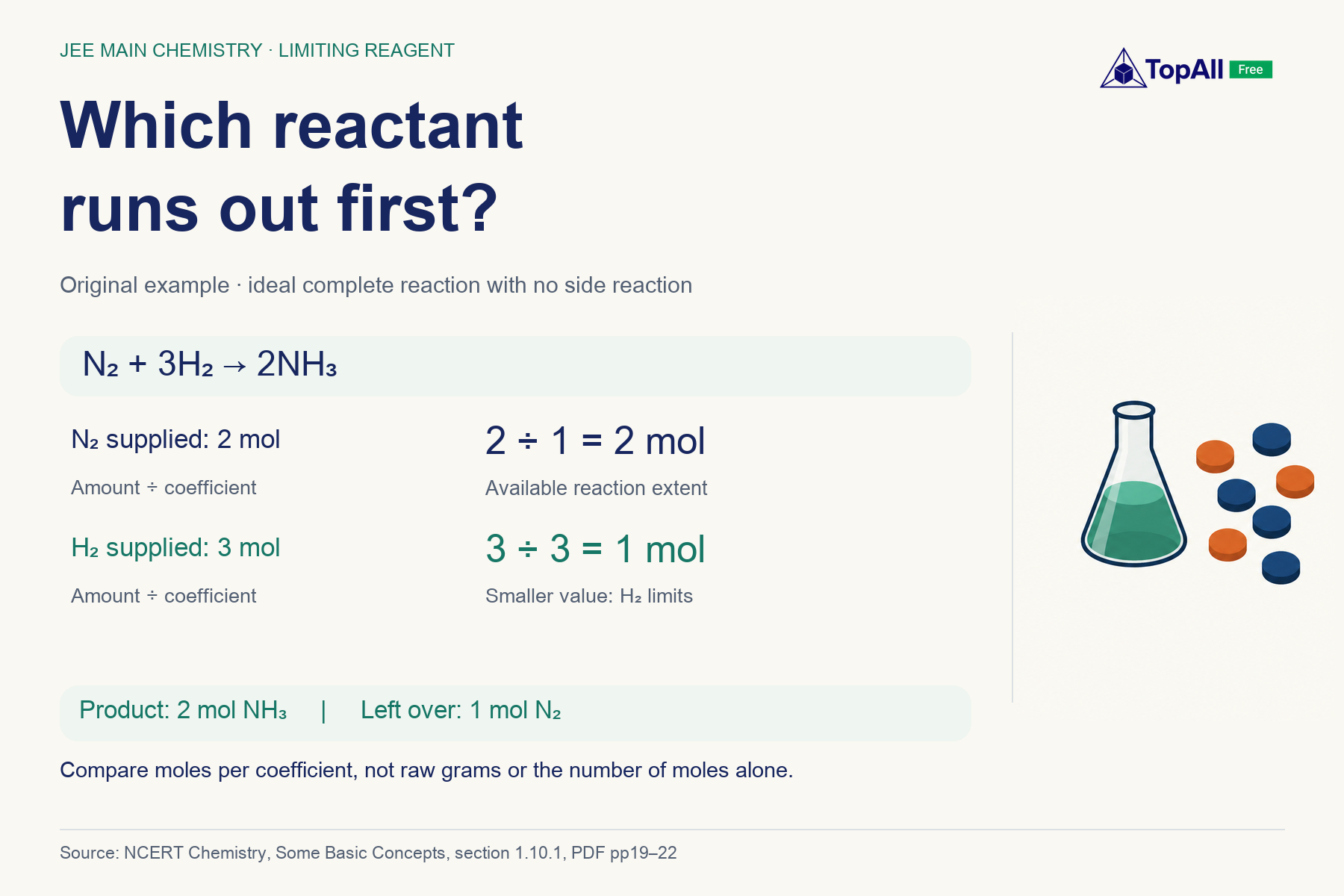
Original worked example. Supply 2 mol N₂ and 3 mol H₂ for the idealised complete reaction N₂ + 3H₂ → 2NH₃. N₂ gives 2/1 = 2 mol of available extent. H₂ gives 3/3 = 1 mol. Hydrogen limits the reaction even though it has the larger number of moles.
At extent 1 mol, the reaction consumes 1 mol N₂ and 3 mol H₂, producing 2 mol NH₃. It leaves 1 mol N₂ and no H₂. Check atoms: the initial 4 mol of nitrogen atoms become 2 mol in ammonia plus 2 mol in leftover nitrogen. The 6 mol of hydrogen atoms all enter ammonia.
Work it through
Available amount ÷ reaction coefficient
The smaller value sets the reaction extent: 1 mol. Therefore H₂ limits this idealised reaction. It forms 2 mol NH₃, using 1 mol N₂ and leaving 1 mol N₂.
Original example for N₂ + 3H₂ → 2NH₃, assuming the reaction proceeds to completion with no side reaction. Compare amounts in moles, not raw masses. Source and scope.
TopAll · Original teaching example
Use a mass example to expose the shortcut
For 2H₂ + O₂ → 2H₂O, supply 4 g H₂ and 16 g O₂, using the rounded molar masses 2 g/mol and 32 g/mol for this exercise. You have 2 mol H₂ and 0.5 mol O₂. Their usable extents are 1 mol and 0.5 mol, so oxygen limits the reaction.
The result is 1 mol water, or 18 g with the stated rounded masses, plus 1 mol (2 g) H₂ left over. Initial mass is 20 g; final mass is 18 + 2 = 20 g. This is a theoretical stoichiometric amount. A stated percentage yield would require an additional step.
Try a fresh ratio
For the idealised complete reaction 2CO + O₂ → 2CO₂, you supply 3 mol CO and 2 mol O₂. Which reactant limits, how much CO₂ forms and how much O₂ remains?
Show the reasoning
CO limits: 3/2 = 1.5 mol extent is smaller than 2/1 = 2 mol. The reaction forms 3 mol CO₂ and consumes 1.5 mol O₂, leaving 0.5 mol O₂. Recheck the balanced coefficients before interpreting the amounts.
Review a wrong answer by its first wrong step
If your answer is wrong, find the earliest failed step: equation, mass-to-mole conversion, ratio comparison, product ratio or leftover subtraction. Correct that step before repeating the calculation. During practice, use the actual paper’s answer-entry instruction rather than assuming every numerical question uses the same rounding rule.
Your next study session
Practise, then review your mistakes
Suggested task: choose 10 available chapter questions, allowing about 20 minutes plus error review. Adjust the pace if you are learning the concept for the first time.
- Choose ten available concept questions; this is a suggested task, not a separately filtered paper.
- For each mistake, record the first incorrect step and a brief correction.
- After a break, test the same idea with a fresh example before moving on.
Sources and method
Official sources establish concept or syllabus scope. Examples, calculations and planning routines are original editorial work, not PYQs, chapter-weightage estimates or performance guarantees.
- NCERT Chemistry: Some Basic Concepts of Chemistry
2026-27 reprint · Section 1.10.1: limiting reagent; PDF pages 19-22 · Checked 2026-10-20
- JEE Main 2026 official syllabus
2026 · PDF pages 1-10: Paper 1 Mathematics, Physics and Chemistry only · Checked 2026-10-20
Frequently asked questions
Start with your question. Open an answer, then choose one study task to try.
Is the reactant with the smaller mass always limiting?
No. Molar masses and balanced-equation coefficients determine how much reaction each supply can support. Compare amounts in moles divided by coefficients.
What if both comparison values are equal?
The reactants are supplied in the exact stoichiometric ratio for that equation. Under the stated complete-reaction model, both are consumed together; neither is left in excess.
Can I use this to predict an equilibrium yield?
Not by itself. These examples calculate theoretical amounts under a complete-reaction assumption. Equilibrium, side reactions or a specified percentage yield require additional information.
Why should I calculate the leftover amount?
It provides an independent check on the limiting-reactant choice and helps verify atom or mass conservation. A negative leftover usually reveals a ratio or conversion error.