
What you will take away
- Use the confirmed edition and its exact subtopics.
- Treat a tick as a review activity, not mastery.
- Link each weak topic to a fresh practice and error-review task.
Start here if: You have the official syllabus PDF for the exam edition you intend to use.
Jump to a section
Check the edition before you tick a box
This worksheet uses the official 2026 JEE Main source, checked on 20 October 2026. We have not established a confirmed 2027 syllabus in this review. If you are preparing for a later edition, keep the learning routine but reconcile every topic against that edition’s official document when available.
The short labels below are an editorial navigation aid, not a replacement for the detailed subtopics and exclusions in the official PDF. Tick means “reviewed once,” not “mastered” or “guaranteed to appear.” A chapter appearing in a question bank does not prove it belongs in the applicable syllabus.
Use the topic map as a starting point
topics checked as reviewed once. This is a planning record, not a readiness score.
Keep Paper 1 separate from the other Main papers
The official Main syllabus PDF also contains material for other papers. This tracker deliberately uses the Paper 1 Mathematics, Physics and Chemistry sections for B.E./B.Tech. Do not add architecture aptitude, drawing or planning topics because they appear later in the same PDF.
For a Mathematics row, write the domain or interval beside the problem; an algebraically neat answer can still violate its conditions. For Physics, include the official experimental-skills topics rather than treating the subject only as formula calculation. For Chemistry, identify whether the task requires a quantitative model, a structural argument or exact source recall. This is a planning distinction, not a prediction that one method will dominate your shift.
Use a recent error to choose the next small task. The same unit label can hide several different errors, so keep a short diagnostic note before ticking the row.
Turn one unit into an observable task
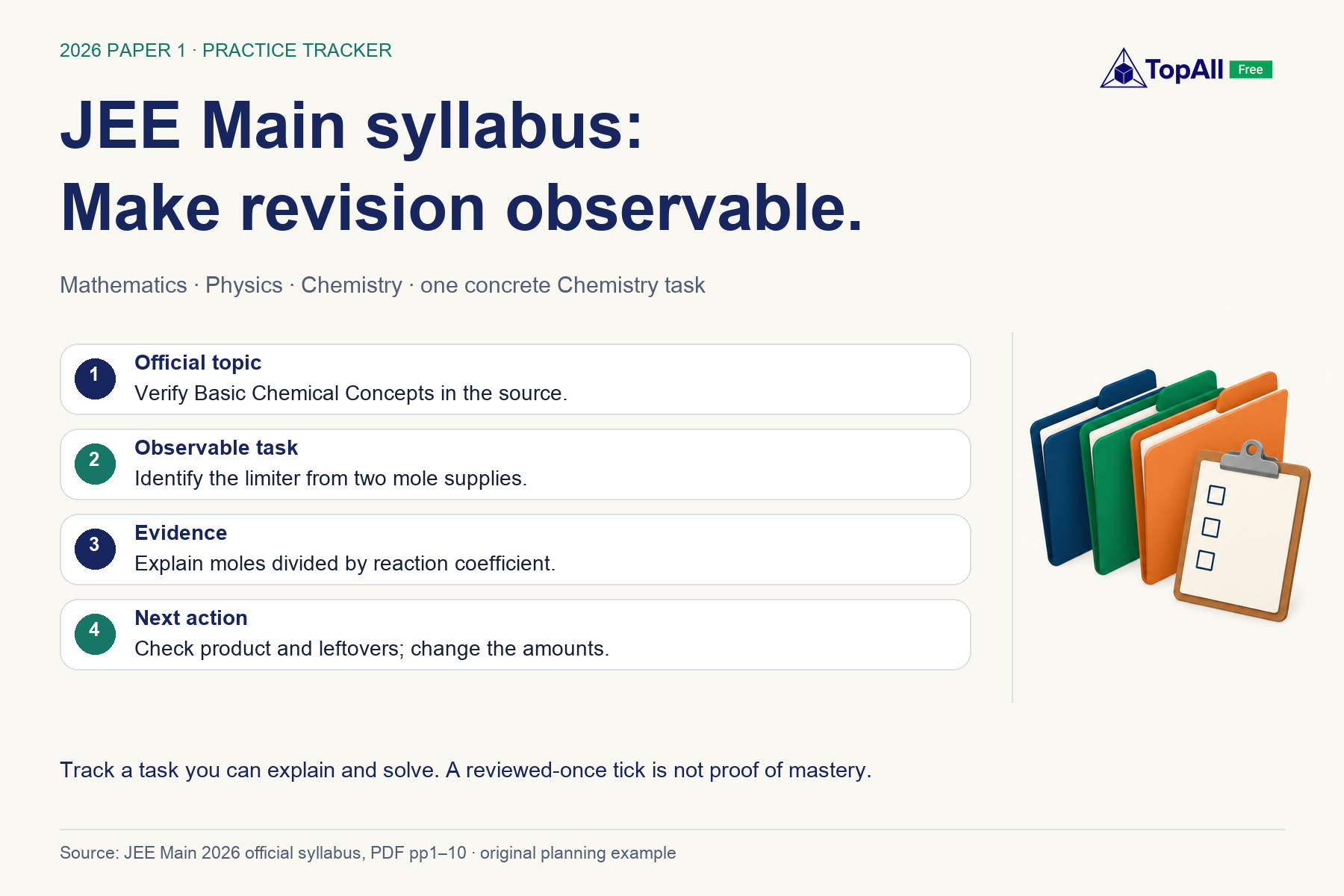
Choose one small, stated subtopic from the source PDF. In a notebook make four columns: official topic and page, one thing you can explain without notes, an original or properly sourced question, and the date/action for your next revisit. Start narrow enough that the task fits one study session.
After answering, write why the correct method works and which mistake you will check next time. If you needed the solution, mark the task “needs another attempt” rather than simply ticking the whole unit. The next revisit should include a fresh question or a changed example.
See what a useful tracker row looks like
| Topic to verify | Observable task | Evidence | Next action |
|---|---|---|---|
| Basic chemical concepts: stoichiometry | Identify limiter from two mole supplies | Solve one original example without notes and explain the assumption | If the assumption or method fails, revisit it and solve a fresh example |
Original planning example. A checked row is evidence of one completed review task. It is not an estimate of chapter weightage, an official question allocation or a readiness score. Keep a separate list of tasks that still need explanation or retesting.
Avoid the “finished chapter” trap
A broad chapter can contain several official subtopics and several different errors. If your notes say “done” but you cannot explain a new example, reopen the specific subtopic rather than copying the whole chapter again. When a syllabus changes, compare the actual topic wording and exclusions; do not infer removals from a missing textbook chapter title alone.
Use the linked practice chapter as a related concept exercise. It is not automatically a complete question set for the entire official unit. Advanced learners should additionally check the actual paper’s section instructions before rehearsing a scored attempt.
Check your understanding
You watched a chapter video, ticked the topic and recognised a solved example. Is that enough evidence to call the whole unit mastered?
Show the reasoning
No. The tick records a review activity. Close the source, explain one concept, solve a fresh task and check the assumptions. Split the unit into smaller tasks where needed; do not turn an activity count into a prediction of exam performance.
Your next study session
Practise, then review your mistakes
Suggested task: choose 10 available chapter questions, allowing about 20 minutes plus error review. Adjust the pace if you are learning the concept for the first time.
- Choose ten available concept questions; this is a suggested task, not a separately filtered paper.
- For each mistake, record the first incorrect step and a brief correction.
- After a break, test the same idea with a fresh example before moving on.
Sources and method
Official sources establish concept or syllabus scope. Examples, calculations and planning routines are original editorial work, not PYQs, chapter-weightage estimates or performance guarantees.
- JEE Main 2026 official syllabus
2026 · PDF pages 1-10: Paper 1 Mathematics, Physics and Chemistry only · Checked 2026-10-20
Frequently asked questions
Start with your question. Open an answer, then choose one study task to try.
Is this a confirmed 2027 syllabus?
No. this guide uses the cited 2026 official documents checked on 20 October 2026. Verify a later edition separately; do not assume its syllabus or rules are unchanged.
Is this Main checklist for B.Arch. or B.Planning?
No. It uses the 2026 Paper 1 B.E./B.Tech. Mathematics, Physics and Chemistry sections. The official PDF contains other paper sections that must be checked separately.
Why does the Physics checklist include experimental skills?
Experimental skills is an explicit unit in the cited 2026 Main syllabus. Read its actual topics rather than assuming Physics preparation is only formula calculation; no fixed question allocation is implied.
Does ticking every topic mean I am ready for the exam?
No. A tick records one review activity. Use fresh questions, explanation and later retrieval to identify remaining gaps; it is not a score or rank prediction.