
What you will take away
- A short method comes from recognising structure, not from rushing algebra.
- Set a personal time checkpoint in mocks and record why you moved on.
- A given number of correct Maths answers does not guarantee a percentile.
Start here if: Know basic integration and substitution; use the explanation slowly if these are new.
Jump to a section
Separate a preparation target from a percentile claim
NTA defines percentile from relative session performance. A statement such as “13 correct Maths answers always means 99+” cannot follow from the marking rule alone. Track your raw score and reasoning quality, but do not label a personal mock target as an official percentile.
Sources: NTA percentile normalization procedure.
For the 2025 Paper 1 format, Mathematics had 20 multiple-choice and five numerical questions. Use that structure when rehearsing that year, and check the applicable bulletin for the examination you will take.
Sources: NTA JEE Main 2025 information bulletin.
Inspect before expanding
Ask whether the problem has symmetry, a known identity, a factorisation or a simpler representation. Write the first useful step. If no defensible step appears at a checkpoint you have rehearsed in mocks, mark the question for a later pass and preserve what you have already deduced.
This is a planning suggestion, not a fixed three-minute rule for every student. Beginners need time to understand the concept. More experienced students can compare time spent with the quality of their chosen method after the session.
Work through this example
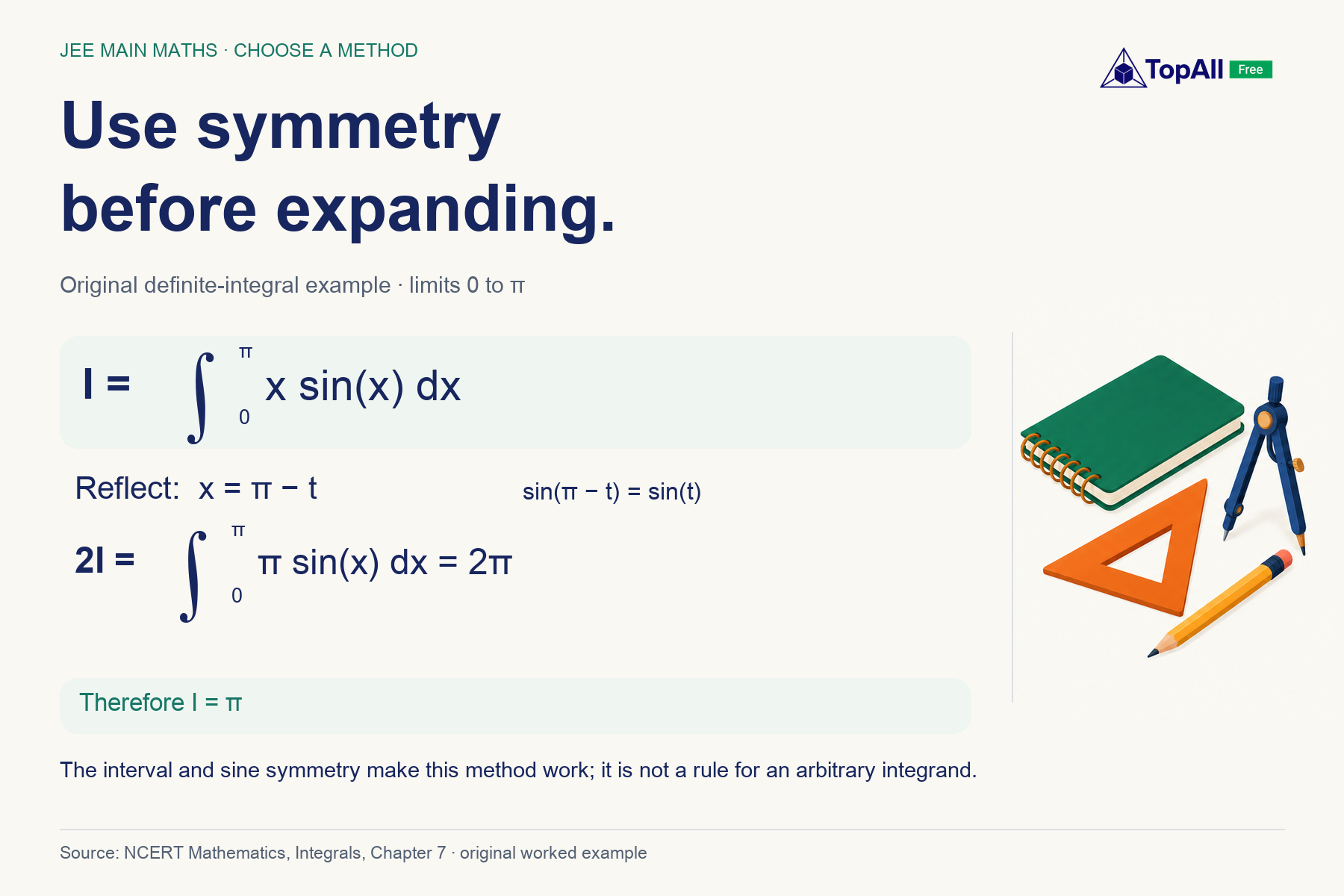
Original teaching example. Let I = ∫0π x sin x dx. Substitute x = π − t: I = ∫0π (π − t) sin t dt. Add this to the original expression: 2I = π∫0π sin x dx = 2π. Therefore I = π. The interval and sin(π − x) = sin x make the method work. Do not apply the same conclusion to an arbitrary integrand.
Connect the method to revision
NCERT’s Integrals chapter develops definite integration and its properties. Work through the property you used, then change one feature of the example: the interval, the multiplying function or the trigonometric factor. Explain whether the shortcut still applies.
Sources: NCERT Mathematics, Integrals.
If you cannot yet set up the substitution, practise that step without a timer. If you can, use the linked Definite Integration chapter to look for symmetry, transform the bounds and check the result. Record both your first proposed method and the method that actually worked.
Check your understanding
Would I = π remain true if the upper limit in the example were replaced by π/2?
Show the reasoning
No. The symmetry used the full interval from 0 to π. On 0 to π/2, direct integration gives 1. The changed bound removes the exact argument used above.
Your next study session
Practise, then review your mistakes
Suggested task: choose 10 available chapter questions, allowing about 15 minutes plus error review. Adjust the pace if you are learning the concept for the first time.
- Answer ten available questions without notes. This is a suggested task, not a separately filtered ten-question paper.
- For each error, record the concept, the step you missed and a short correction.
- Return to the same concept after a break and explain the correction before trying a new question.
Sources and method
Historical examination facts use the cited official documents and exact page locators. Study routines and teaching examples are original editorial suggestions. No question-share percentage or future score, rank or admission guarantee is inferred. Current NCERT reprints support concepts, not historical wording.
- NTA percentile normalization procedure
Archived procedure · Percentile score definition and normalization · Checked 2026-10-19
- NTA JEE Main 2025 information bulletin
2025 · PDF pages 17–21, Paper 1 pattern, marking and duration · Checked 2026-10-19
- NCERT Mathematics, Integrals
2026–27 reprint · Chapter 7, definite integration and its properties · Checked 2026-10-19
- NCERT official textbook catalogue
Current catalogue · Select Class XI or XII and the named subject/chapter; editions can change · Checked 2026-10-19
Frequently asked questions
Start with your question. Open an answer, then choose one study task to try.
Should I start every long integral with expansion or integration by parts?
Inspect the expression and interval first. Symmetry, a substitution or a simpler representation may reduce the work. Write the first defensible step rather than assuming the longest-looking method is necessary.
Why does the integral example change when the upper limit is π/2?
The symmetry argument in the guide uses the full interval from 0 to π. On 0 to π/2, direct integration gives 1 instead of π. The interval is part of the method’s conditions.
Should every student stop after exactly three minutes?
No. A review checkpoint should be rehearsed in your mocks and adapted to your current understanding. A beginner may need untimed concept practice before judging speed.
Which Chemistry task should follow this Main guide?
Try the companion limiting-reagent lesson in this study path. State the balanced equation, compare moles per coefficient and check the leftover amount before returning to chapter practice.