
What you will take away
- Section B offered a choice during 2021–2024; that choice was removed for 2025.
- A raw score and an NTA percentile measure different things.
- Use subject-level errors to plan revision, not a promised score-to-percentile conversion.
Start here if: Know how to calculate a raw score under the marking scheme.
Jump to a section
The documented change
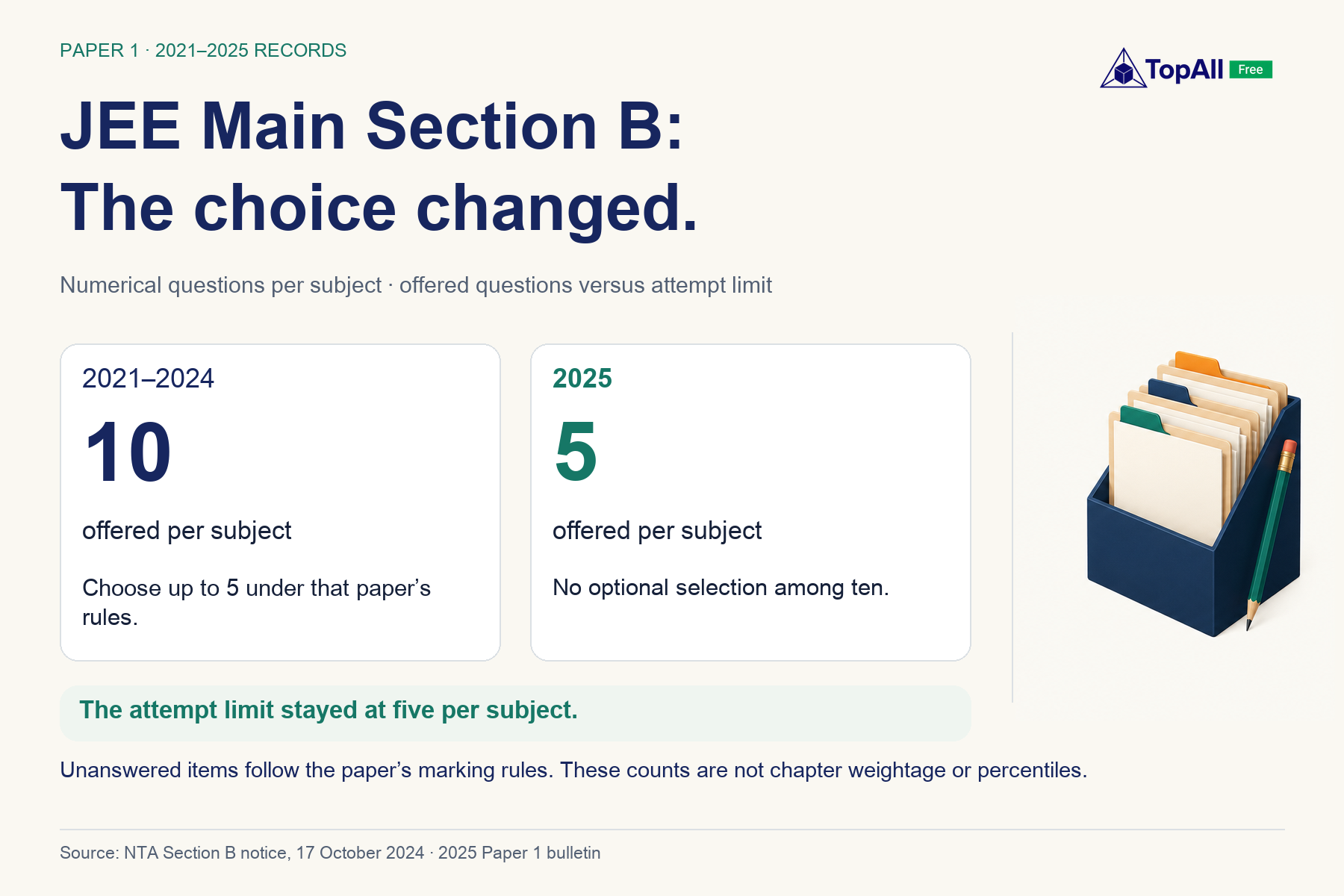
NTA’s October 2024 notice explains that candidates could choose five of ten Section B questions per subject from 2021 through 2024. For 2025, Section B contained five questions per subject without that selection. The change reduced the menu of numerical questions; it did not turn an unanswered item into an incorrect answer.
| Year | Offered | Selection |
|---|---|---|
| 2021 | 10 | Choose up to five under the paper rules |
| 2022 | 10 | Choice continued |
| 2023 | 10 | Choice continued |
| 2024 | 10 | Choice continued |
| 2025 | 5 | No optional selection among ten |
Sources: NTA notice removing optional Section B questions.
The data, explained
JEE Main Section B: choice changed, the limit stayed five
Numerical questions per subject, 2021–2025. Offered and attempt limit are overlapping measures, not parts to add together.
questions · scale starts at zero
Use this in your next mock: The menu narrowed from ten to five numerical questions per subject. In 2025 there was no optional selection among ten.
The attempt limit is the section’s question count under its selection rules; unanswered items follow the paper’s marking instructions. These counts do not measure chapter weightage.
View the exact data
| Year | Offered (questions) | Attempt limit (questions) |
|---|---|---|
| 2021 | 10 | 5 |
| 2022 | 10 | 5 |
| 2023 | 10 | 5 |
| 2024 | 10 | 5 |
| 2025 | 5 | 5 |
Sources: NTA notice removing optional Section B questions
TopAll · Official historical records
Read the data, then try it yourself
Read → interpret → try
- Spot the change
- Section B moved from ten offered numerical questions per subject, with selection of five, to five offered in 2025 without that optional selection among ten.
- What it means for practice
- Record which paper rules you used. Practise reading a numerical prompt, solving it and entering the answer under that paper’s instructions.
- What it cannot tell you
- A change in selection does not establish which chapters will appear next or convert a raw score into a percentile.
Evidence: NTA Section B notice.
Try one numerical-entry exercise
Use the declared +4/−1 rule: eight correct answers, two wrong answers and the rest unanswered. Work out the raw score before opening the explanation.
Reveal the answer and study tip
30 marks: 8 × 4 − 2 = 30. This is a raw score under the stated rule, not a percentile. If you obtained 32, you missed the wrong-answer penalty; if you tried to assign a percentile, separate score calculation from session-relative performance.
Do not grade every historical paper identically
The 2021 Paper 1 bulletin assigns no negative mark to an incorrect numerical answer. The 2025 bulletin assigns negative marking to incorrect numerical answers. Read the instructions on the paper you are actually using, including rounding, unanswered questions and any question-specific directions.
Sources: NTA JEE Main 2021 information bulletin, NTA JEE Main 2025 information bulletin.
In your log, keep paper year/session, standard or approved time allowance, marking rule, attempted questions, score and error categories together. A result from a paper with selection is a different practice experience from one with no selection.
Work through this example
Original teaching example. Using a +4/−1 rule, 18 correct and four wrong gives 72 − 4 = 68 marks. That is a raw score under the declared rule. It is not automatically a subject percentile. A percentile depends on how a candidate performs relative to the relevant session’s candidates, so a fixed “68 means X percentile” statement needs actual session evidence.
Use three different subject reviews
In Mathematics, identify whether a long solution started with an unnecessary expansion. In Physics, write the assumptions before using an equation. In Chemistry, distinguish a missing fact from a unit or reaction-condition error. A strong next session addresses one of these, rather than trying to improve all three subjects with a vague target.
For a beginner, practise one taught concept first. For a student who has completed the syllabus, use a mixed mock and choose the next chapter from the mistakes. The chapter bank below is useful for repair; consult the official archive or bulletin for full-paper format.
Check your understanding
Does the removal of Section B choice establish a fixed raw score for a percentile?
Show the reasoning
No. Pattern rules and normalization are different issues. Compare your practice errors, and consult the official score/rank context before using a historical admission record.
Your next study session
Practise, then review your mistakes
Suggested task: choose 10 available chapter questions, allowing about 15 minutes plus error review. Adjust the pace if you are learning the concept for the first time.
- Answer ten available questions without notes. This is a suggested task, not a separately filtered ten-question paper.
- For each error, record the concept, the step you missed and a short correction.
- Return to the same concept after a break and explain the correction before trying a new question.
Sources and method
Historical examination facts use the cited official documents and exact page locators. Study routines and teaching examples are original editorial suggestions. No question-share percentage or future score, rank or admission guarantee is inferred. Current NCERT reprints support concepts, not historical wording.
- NTA notice removing optional Section B questions
2025 · 17 October 2024 notice, historical 2021–2024 choice and 2025 change · Checked 2026-10-19
- NTA JEE Main 2021 information bulletin
2021 · Examination pattern, Paper 1 · Checked 2026-10-19
- NTA JEE Main 2025 information bulletin
2025 · PDF pages 17–21, Paper 1 pattern, marking and duration · Checked 2026-10-19
- NTA percentile normalization procedure
Archived procedure · Percentile score definition and normalization · Checked 2026-10-19
Frequently asked questions
Start with your question. Open an answer, then choose one study task to try.
What changed in Section B between 2021–2024 and 2025?
The earlier papers offered ten numerical questions per subject with selection of five under their rules. In 2025, Section B offered five per subject without that optional selection among ten. Check each archived paper’s instructions before rehearsing it.
Can I use one marking rule for every past numerical question?
No. The guide contrasts the 2021 and 2025 numerical-answer rules. Keep the paper’s own marking and answer-entry directions beside your practice result.
Does 68 marks in the worked example tell me a percentile?
No. The +4/−1 calculation establishes a raw score. A percentile depends on performance relative to the relevant session’s candidates, so a fixed conversion needs session evidence.
Which Chemistry task should follow this Main guide?
Try the companion limiting-reagent lesson in this study path. State the balanced equation, compare moles per coefficient and check the leftover amount before returning to chapter practice.