What you’ll understand
Distinguish bond order from unpaired-electron count in simple homonuclear diatomic species.
Jump to a section
Quick answer
Use the appropriate molecular-orbital ordering for the species. Fill electrons with Pauli’s principle and Hund’s rule, then calculate bond order . Determine magnetism from unpaired electrons, not from bond order: an unpaired electron indicates paramagnetism. The simple orbital picture below concerns ground-state homonuclear diatomic species.
Work through the reasoning
Example 1: oxygen and its ions. In , the two highest occupied antibonding orbitals each hold one electron. Its bond order is 2 and it is paramagnetic. Adding one electron to form places it in an antibonding orbital: bond order becomes 1.5, with one unpaired electron. Adding a second to form gives bond order 1 and pairs those electrons, giving diamagnetism in this elementary model.
Example 2: remove rather than add. Forming removes an antibonding electron. Bond order rises from 2 to 2.5, while one unpaired electron remains. First identify the orbital that gains or loses an electron; an ion’s charge alone does not tell you whether bond order rises.
See the reasoning
Oxygen ions: bond order and magnetism
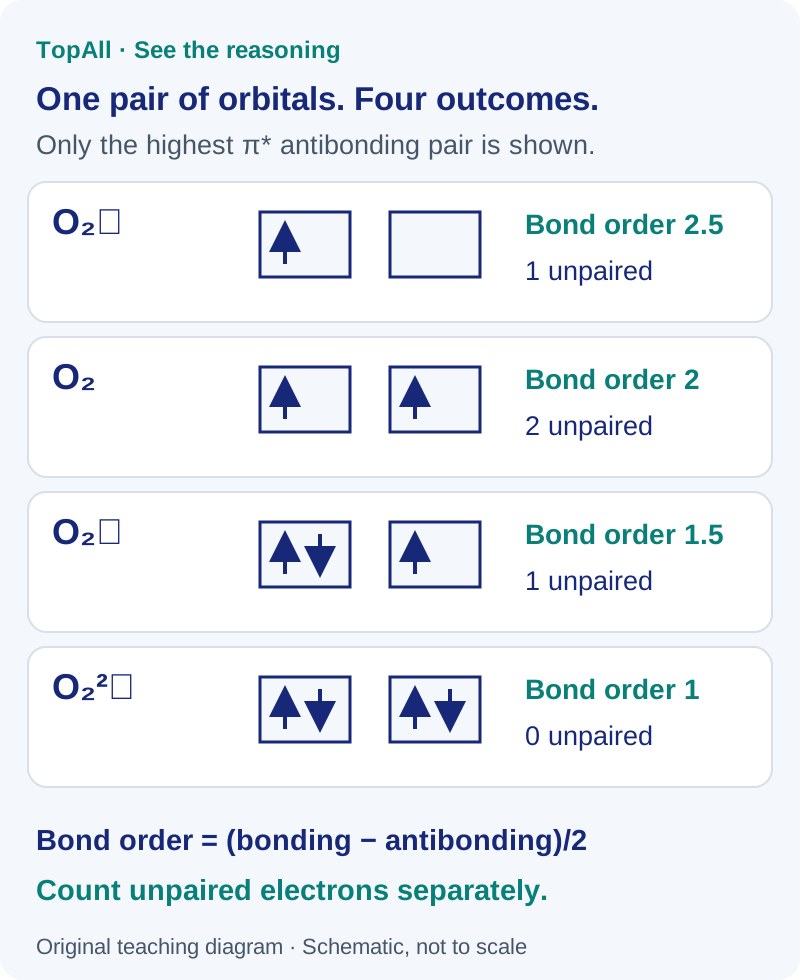 Open full-size diagram ↗
Check it without looking: Explain why adding an electron lowers bond order by ½, then inspect whether it pairs an electron. Do not infer magnetism from bond order.
Common mistakes to catch
- Wrong: a larger bond order must mean diamagnetism. Instead: inspect occupancy separately.
- Wrong: reuse one energy-order diagram for every diatomic species. Instead: choose the ordering appropriate to the elements.
- Wrong: pair electrons in degenerate orbitals before singly occupying them. Instead: apply Hund’s rule.
Try it yourself
1. Reveal the answer: removing an antibonding electron changes bond order by how much?
It increases bond order by , since falls by one while is unchanged. This does not by itself determine the number of unpaired electrons.
2. Reveal the answer: compare O₂⁻ and O₂²⁻.
has bond order 1.5 and one unpaired electron; has bond order 1 and no unpaired electrons in the elementary ground-state molecular-orbital picture. Count occupancy before naming the magnetic behaviour.
JEE · Chemistry
Continue studying Chemical Bonding & Molecular Structure
Understand the concept, practise questions and check your learning.
Practise
Try 474 mixed-difficulty chapter MCQs. Untimed; check answers and available explanations as you go.
Practise chapter MCQsCheck your learning
Prepare a timed chapter quiz. Choose the available question count and pace before starting.
Prepare a chapter quizPractice uses single-correct-answer MCQs. It does not cover every JEE Main or Advanced question format.
Sources and method
The NCERT source supports the underlying concepts. All examples, self-checks and their explanations here are original editorial exercises, not past-paper questions, frequency estimates or promises of marks. Technical review: Codex (automated); human subject review is not claimed.
- NCERT Chemistry: Chemical Bonding and Molecular Structure
NCERT online textbook · Sections 4.7–4.8: molecular-orbital theory and homonuclear diatomic molecules · Checked 2026-10-23
Frequently asked questions
Start with your question. Open an answer, then choose one study task to try.
Are these previous-year examination questions?
No. The worked examples and self-checks are original teaching exercises. Linked practice is chapter concept practice; it is not advertised as a complete verified PYQ collection.
Do I need to sign in?
You can read this guide, browse resources and check chapter practice answers free. Sign in to save practice progress or prepare a chapter quiz.