
What you will take away
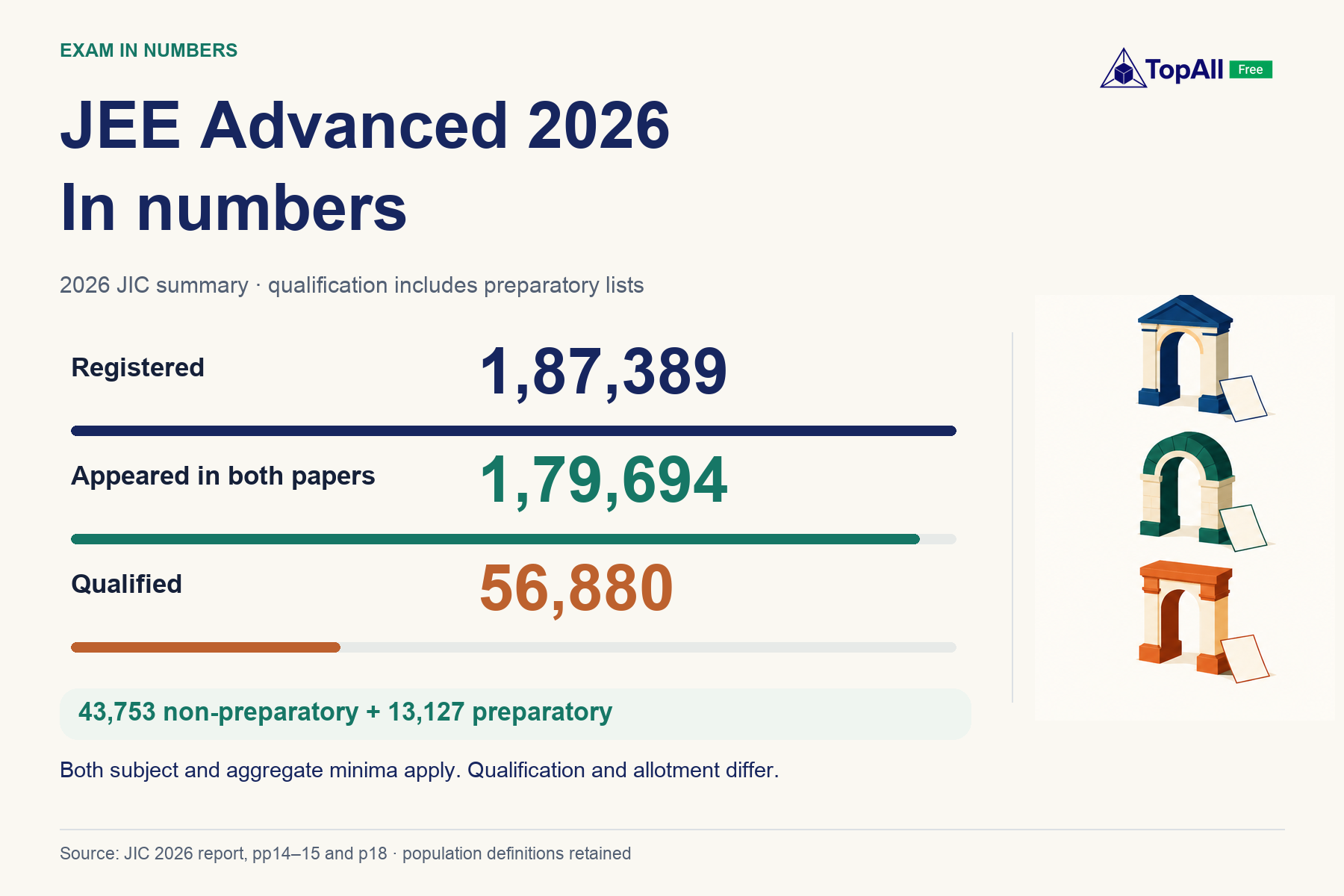
- 1,87,389 registered; 1,79,694 appeared in both papers in the report’s summary.
- The 56,880 qualified total includes 43,753 non-preparatory and 13,127 preparatory candidates.
- Both subject minima and the aggregate minimum matter. Qualification and allotment are separate stages.
Start here if: You want to read exam and counselling records carefully, then apply the same checks to your own research.
Jump to a section
Start with the people at each stage.
A result headline tells only part of the journey. Registration, taking both papers, entering a rank list and receiving an allotment answer different questions. The 2026 JIC summary supplies a count for each stage.
Read the stage labels before comparing the counts. The appeared count is specifically candidates who took both papers. The allotment count is a later administrative outcome, not a count of everyone who qualified.

Read the labels at every stage
2026 JIC · exact published population definitions
2026 JIC summary · stages overlap; do not add their counts.
- Registered1,87,389
Candidates registered for the examination.
- Appeared in both papers1,79,694
The report counts candidates who sat both papers.
- Qualified, including preparatory56,880
43,753 non-preparatory + 13,127 preparatory.
- Allotted seats18,861
The JIC allotment measure is a separate stage.
These populations overlap. Read each definition; do not add the counts or treat the sequence as an admission probability.
View the exact data
| Measure | Count |
|---|---|
| Registered | 1,87,389 |
| Appeared in both papers | 1,79,694 |
| Qualified, including preparatory | 56,880 |
| Allotted seats | 18,861 |
“Qualified” contains two different rank-list groups.
The report’s results table separates 43,753 non-preparatory from 13,127 preparatory candidates. Together they make its 56,880 total. A headline using that total without the split can leave readers thinking every candidate entered the same admission route.
The split is a classification, not two extra groups to add to qualified again. Preparatory provision has its own conditions; it should not be described as immediate entry into an ordinary first-year programme.
Separate the two qualified groups
2026 JIC · exact published population definitions
43,753 + 13,127 = 56,880 qualified in the report. These are the two components of that total.
Bars start at zero; maximum 60,000.
View the exact data
| Measure | Count |
|---|---|
| Non-preparatory | 43,753 |
| Preparatory | 13,127 |
Change the population before interpreting participation.
The same report records male, female and third-gender populations at registration, appearance and qualification. Changing stage changes the denominator. A female share among registered candidates is a different statistic from a female share among qualified candidates.
The table preserves the third-gender row: one registered and appeared, with none qualified. Small counts do not support broad claims about a group’s ability or access.
Read participation using the chosen denominator
2026 JIC · source labels retained; qualified includes preparatory
registered population: 1,87,389. Male: 76.99%; Female: 23.01%; Third Gender: 0.00%. Shares use this displayed denominator and are rounded to two decimals.
Bars start at zero; maximum 2,00,000.
View the exact data
| Measure | Count |
|---|---|
| Male | 1,44,276 |
| Female | 43,112 |
| Third Gender | 1 |
All stages · works without JavaScript
| Gender | Registered | Appeared in both | Qualified |
|---|---|---|---|
| Male | 1,44,276 | 1,39,131 | 46,773 |
| Female | 43,112 | 40,562 | 10,107 |
| Third Gender | 1 | 1 | 0 |
Read category counts within the same stage.
The summary also separates GEN, OBC-NCL, GEN-EWS, SC and ST, with PwD status shown within categories. Here the PwD and non-PwD rows are combined within each source category so the five totals reconcile at every stage.
Change the stage to inspect registrations, both-paper appearance or qualification. The qualified category counts include the report’s preparatory groups; they should not be relabelled as non-preparatory qualification rates.
Compare the five source categories at one stage
2026 JIC · source labels retained; qualified includes preparatory
registered population: 1,87,389. GEN: 21.37%; OBC-NCL: 37.59%; GEN-EWS: 16.09%; SC: 16.87%; ST: 8.08%. Shares use this displayed denominator and are rounded to two decimals.
Bars start at zero; maximum 2,00,000.
View the exact data
| Measure | Count |
|---|---|
| GEN | 40,053 |
| OBC-NCL | 70,432 |
| GEN-EWS | 30,155 |
| SC | 31,613 |
| ST | 15,136 |
All stages · works without JavaScript
| Category | Registered | Appeared in both | Qualified |
|---|---|---|---|
| GEN | 40,053 | 38,436 | 15,883 |
| OBC-NCL | 70,432 | 67,539 | 12,385 |
| GEN-EWS | 30,155 | 29,359 | 6,377 |
| SC | 31,613 | 30,015 | 15,856 |
| ST | 15,136 | 14,345 | 6,379 |
The aggregate is only one part of qualification.
The published CRL minima are 8 marks in each subject and 92 in aggregate. Different lists have their own minima. Check the exact list instead of using a rounded percentage or carrying a previous year’s number forward.
For these records, a high score in one subject cannot compensate for missing another subject’s minimum. The following original exercise uses the CRL thresholds to make that condition visible.
Meet subject and aggregate minima
2026 JIC · exact published population definitions
2026 published minimum marks · all three subject conditions and the applicable aggregate condition must be met. Other eligibility remains separate.
- PhysicsSubject minimum
Meet the minimum for the applicable rank-list group.
- ChemistryAND subject minimum
Meet the minimum for the same group.
- MathematicsAND subject minimum
Meet the minimum for the same group.
- Total marksAND aggregate minimum
Meet the applicable aggregate minimum too.
All four conditions apply together. Use the exact group-specific marks in the table below; other eligibility conditions remain separate.
View the exact data
| Rank-list group | Minimum in each subject | Minimum aggregate |
|---|---|---|
| CRL | 8 | 92 |
| OBC-NCL / GEN-EWS | 7 | 82 |
| SC / ST / PwD lists | 4 | 46 |
| Preparatory | 2 | 23 |
Try it: a total above the threshold can still fail a condition.
Fictional score profile: Mathematics 7, Physics 45, Chemistry 45. The aggregate is 97. Does this satisfy the published 2026 CRL score minima?
Reveal the condition check
No. The aggregate exceeds 92, but Mathematics is below 8. With 8, 44 and 45 the total is still 97 and all score minima are met. Other eligibility conditions and the actual ranking/allocation process remain separate.
Turn the lesson into preparation.
Choose a subject in which your practice is least consistent. Attempt a short set, inspect every error, and then mix it with questions from the other two subjects. An aggregate target should not hide a recurring weakness.
Choose a JEE subject and chapter. The bank supports concept practice; use official papers separately for the full Advanced section and marking format. Compare the JEE Main edition without confusing NTA percentiles with Advanced raw marks.
Check your interpretation.
Someone divides 18,861 allotted seats by 1,87,389 registrations and calls the result your chance of admission. What has been assumed?
Check the reasoning
It treats a historical national ratio as an individual probability and ignores eligibility, rank, programme choices and seat pools. It also changes stages without explaining who participated in allocation. Use the counts to understand scale, then research the relevant route.
Your next data check
Try a five-minute evidence check
Use the explorer and write one careful conclusion. Follow the task below, then check the original source.
- Read the definition of appeared.
- Separate preparatory from non-preparatory qualification.
- Write one sentence explaining why qualification differs from allotment.
The TopAll JEE chapter bank builds concept fluency. Use the official archived papers separately to rehearse their full section and marking format.
Recheck the candidate stages →Sources and method
Official source versions are frozen with SHA256 hashes. Counts retain their year, population and rank/seat pool. Derived summaries are labelled and reconciled; absent records remain unexplained rather than becoming invented outcomes. Original exercises are fictional. No names, roll numbers or candidate-level records are shipped in the reader. Rules and fees are dated source snapshots; check current amendments and the applicable authority before acting.
- JEE Advanced 2026 Joint Implementation Committee report
2026 · PDF pp14–15: summary populations; p17: qualifying marks; p18: non-preparatory and preparatory rank-list counts · Checked 2026-10-20
- JoSAA 2026 business rules
2026–27 · Admission-route and allocation conditions; freeze/float/slide provisions; applicable year only · Checked 2026-10-20
Frequently asked questions
Start with your question. Open an answer, then choose one study task to try.
Does 56,880 mean all qualified candidates were in non-preparatory lists?
No. The report includes 13,127 preparatory candidates in that total; 43,753 are non-preparatory.
What does appeared mean here?
Candidates who appeared in both papers, as labelled in the JIC summary.
Can aggregate marks compensate for a subject minimum?
No. The applicable subject and aggregate conditions must both be satisfied.
Are these JEE Main NTA percentiles?
No. Advanced qualifying marks and Main NTA percentiles are different measures.
Does qualification guarantee an allotted seat?
No. Rank, choices, applicable eligibility and allocation conditions still matter.