
What you will take away
- The comparison uses All India (AI) quota, OPEN seats, Gender-Neutral and JEE Advanced CRL throughout.
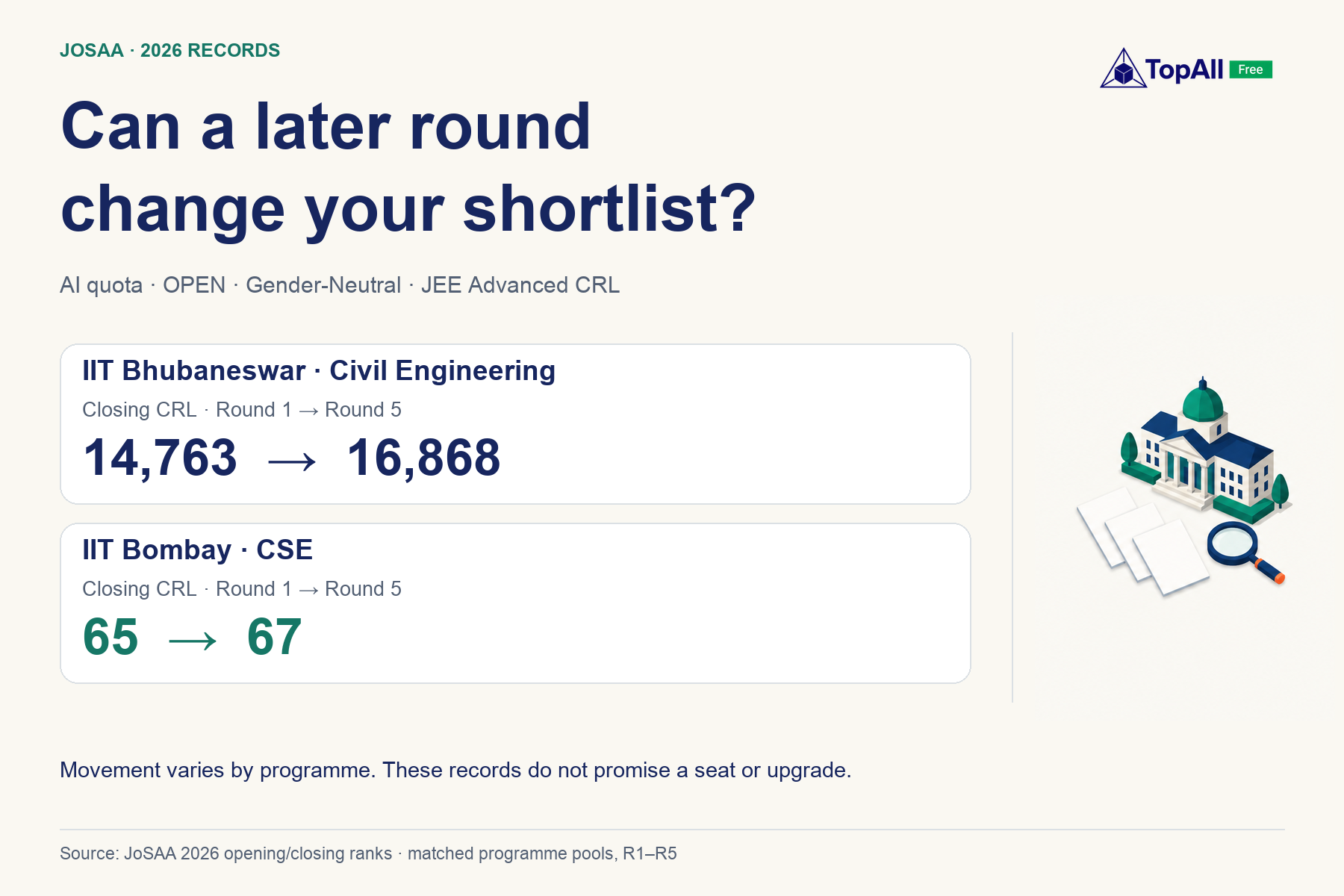
- Bhubaneswar Civil’s closing rank moves from 14,763 to 16,868 in these official records.
- Changes vary by programme; a historical closing rank is not a promise or an individual upgrade history.
Start here if: You want to read exam and counselling records carefully, then apply the same checks to your own research.
Jump to a section
Start with one exact seat pool.
“The cutoff moved” raises several questions. Which institute, programme, category, quota, gender pool and rank list? Change any of them and you may be comparing different allocation opportunities.
This story selects six IIT programme pools from JoSAA’s official 2026 tables. Every comparison uses All India (AI), OPEN, Gender-Neutral, JEE Advanced CRL. It covers Round 1 through the final Round 5 of this edition.

Move through all five rounds of the same pool
2026 · selected IIT examples · AI / OPEN / Gender-Neutral / Advanced CRL
Indian Institute of Technology Bhubaneswar · Civil Engineering (4 Years, Bachelor of Technology) · AI · OPEN · Gender-Neutral · JEE Advanced CRL · Round 1. Closing-rank change from Round 1 to 5: 2,105 positions.
Bars start at zero; maximum 30,000.
View the exact data
| 2026 round | Opening CRL | Closing CRL |
|---|---|---|
| 1 | 6,859 | 14,763 |
| 2 | 10,752 | 15,329 |
| 3 | 10,752 | 15,329 |
| 4 | 10,752 | 15,433 |
| 5 | 10,752 | 16,868 |
All six programme pools and rounds · works without JavaScript
| Exact institute / programme | Round | Opening CRL | Closing CRL |
|---|---|---|---|
| Indian Institute of Technology Bhubaneswar · Civil Engineering (4 Years, Bachelor of Technology) | 1 | 6,859 | 14,763 |
| Indian Institute of Technology Bhubaneswar · Civil Engineering (4 Years, Bachelor of Technology) | 2 | 10,752 | 15,329 |
| Indian Institute of Technology Bhubaneswar · Civil Engineering (4 Years, Bachelor of Technology) | 3 | 10,752 | 15,329 |
| Indian Institute of Technology Bhubaneswar · Civil Engineering (4 Years, Bachelor of Technology) | 4 | 10,752 | 15,433 |
| Indian Institute of Technology Bhubaneswar · Civil Engineering (4 Years, Bachelor of Technology) | 5 | 10,752 | 16,868 |
| Indian Institute of Technology Bhubaneswar · Mechanical Engineering (4 Years, Bachelor of Technology) | 1 | 8,029 | 10,367 |
| Indian Institute of Technology Bhubaneswar · Mechanical Engineering (4 Years, Bachelor of Technology) | 2 | 8,029 | 10,718 |
| Indian Institute of Technology Bhubaneswar · Mechanical Engineering (4 Years, Bachelor of Technology) | 3 | 8,029 | 10,718 |
| Indian Institute of Technology Bhubaneswar · Mechanical Engineering (4 Years, Bachelor of Technology) | 4 | 8,029 | 10,784 |
| Indian Institute of Technology Bhubaneswar · Mechanical Engineering (4 Years, Bachelor of Technology) | 5 | 8,080 | 12,064 |
| Indian Institute of Technology Bombay · Computer Science and Engineering (4 Years, Bachelor of Technology) | 1 | 1 | 65 |
| Indian Institute of Technology Bombay · Computer Science and Engineering (4 Years, Bachelor of Technology) | 2 | 1 | 65 |
| Indian Institute of Technology Bombay · Computer Science and Engineering (4 Years, Bachelor of Technology) | 3 | 1 | 65 |
| Indian Institute of Technology Bombay · Computer Science and Engineering (4 Years, Bachelor of Technology) | 4 | 1 | 66 |
| Indian Institute of Technology Bombay · Computer Science and Engineering (4 Years, Bachelor of Technology) | 5 | 1 | 67 |
| Indian Institute of Technology Delhi · Computer Science and Engineering (4 Years, Bachelor of Technology) | 1 | 35 | 123 |
| Indian Institute of Technology Delhi · Computer Science and Engineering (4 Years, Bachelor of Technology) | 2 | 35 | 123 |
| Indian Institute of Technology Delhi · Computer Science and Engineering (4 Years, Bachelor of Technology) | 3 | 35 | 123 |
| Indian Institute of Technology Delhi · Computer Science and Engineering (4 Years, Bachelor of Technology) | 4 | 35 | 128 |
| Indian Institute of Technology Delhi · Computer Science and Engineering (4 Years, Bachelor of Technology) | 5 | 35 | 128 |
| Indian Institute of Technology Hyderabad · Artificial Intelligence (4 Years, Bachelor of Technology) | 1 | 696 | 906 |
| Indian Institute of Technology Hyderabad · Artificial Intelligence (4 Years, Bachelor of Technology) | 2 | 696 | 917 |
| Indian Institute of Technology Hyderabad · Artificial Intelligence (4 Years, Bachelor of Technology) | 3 | 696 | 917 |
| Indian Institute of Technology Hyderabad · Artificial Intelligence (4 Years, Bachelor of Technology) | 4 | 696 | 917 |
| Indian Institute of Technology Hyderabad · Artificial Intelligence (4 Years, Bachelor of Technology) | 5 | 696 | 917 |
| Indian Institute of Technology Madras · Computer Science and Engineering (4 Years, Bachelor of Technology) | 1 | 67 | 149 |
| Indian Institute of Technology Madras · Computer Science and Engineering (4 Years, Bachelor of Technology) | 2 | 67 | 149 |
| Indian Institute of Technology Madras · Computer Science and Engineering (4 Years, Bachelor of Technology) | 3 | 67 | 149 |
| Indian Institute of Technology Madras · Computer Science and Engineering (4 Years, Bachelor of Technology) | 4 | 67 | 150 |
| Indian Institute of Technology Madras · Computer Science and Engineering (4 Years, Bachelor of Technology) | 5 | 74 | 151 |
A later endpoint can change the historical picture.
For IIT Bhubaneswar Civil Engineering, the recorded closing rank is 14,763 in Round 1 and 16,868 in Round 5, a difference of 2,105 rank positions. The opening rank also changes, so inspect both endpoints.
The same matched pool for Bombay’s four-year CSE closes at 65 in Round 1 and 67 in Round 5, a change of two positions. That contrasts with Bhubaneswar Civil’s 2,105-position movement. Select another programme and move through the rounds. Some steps remain unchanged. The six examples were chosen to contrast programmes and rank ranges, not to estimate an average across all IITs or all JoSAA institutions.
A closing rank is an endpoint, not a candidate’s path.
An OR/CR row describes the ranks at the ends of a seat pool. It does not identify which candidate upgraded, which course they previously held, why movement occurred or how many seats became vacant.
Use the applicable JoSAA rules for freeze, float and slide. Looking at an endpoint moving across rounds is not enough to recommend a particular action to someone holding a seat. Deadlines, eligibility and the consequences of the option matter.
Try it: match the comparison before subtracting.
Fictional example: Round 1 OPEN Gender-Neutral closes at 4,000. Round 5 EWS Gender-Neutral closes at 900. A friend says the closing rank improved by 3,100. Is that subtraction meaningful?
Reveal the pool check
No. OPEN uses CRL and EWS uses the relevant category rank. They are different lists and seat pools. Match programme, year, quota, category, gender pool and rank basis first. Only then compare the endpoints.
Make a research shortlist, not a prediction.
Choose a programme you would accept for its curriculum and practical circumstances. Record the exact pool and all five historical rows, including unchanged rounds. Compare an alternative using the same definitions.
Before acting, read the current official eligibility, dates, seat-acceptance and option rules. Open JoSAA. This historical explorer does not assess your documents or make an admission recommendation.
Check what stayed unknown.
The closing rank moved by 2,105 positions. Can you conclude that 2,105 students received upgrades?
Check the unit
No. Rank positions are not a count of upgrades. A count of transitions requires candidate-level histories or an authority’s compatible transition table. The OR/CR endpoint alone cannot supply it.
Your next data check
Try a five-minute evidence check
Use the explorer and write one careful conclusion. Follow the task below, then check the original source.
- Select one programme and record its full seat-pool label.
- Read all five rounds, including unchanged endpoints.
- Describe the rank-position change without calling it an upgrade count.
The TopAll JEE chapter bank builds concept fluency. Use the official archived papers separately to rehearse their full section and marking format.
Compare Round 1 and Round 5 →Sources and method
Official source versions are frozen with SHA256 hashes. Counts retain their year, population and rank/seat pool. Derived summaries are labelled and reconciled; absent records remain unexplained rather than becoming invented outcomes. Original exercises are fictional. No names, roll numbers or candidate-level records are shipped in the reader. Rules and fees are dated source snapshots; check current amendments and the applicable authority before acting.
- JoSAA 2026 official opening and closing ranks
2026 · Rounds 1–5; IIT type; six selected programme pools; AI quota, OPEN seats, Gender-Neutral, JEE Advanced CRL. Each response frozen locally. · Checked 2026-10-20
- JoSAA 2026 business rules
2026–27 · Admission-route and allocation conditions; freeze/float/slide provisions; applicable year only · Checked 2026-10-20
Frequently asked questions
Start with your question. Open an answer, then choose one study task to try.
Are all JoSAA programmes covered?
No. Six selected IIT programme pools are shown across all five 2026 rounds.
Why only OPEN Gender-Neutral AI rows?
Holding the pool constant makes the within-programme round comparison meaningful.
Does a larger closing rank mean more upgraded students?
No. The change is in rank positions, not a transition count.
Can category ranks be compared with CRL directly?
No. They belong to different rank lists and seat pools.
Does Round 5 predict next year’s admission?
No. Cohorts, choices, capacity and rules can change.