NEET UG · Video

Ferromagnetism NEET Physics
Master Ferromagnetism for NEET with TopAll.
5 min video

NEET UG · Physics
Revise the concepts. Try a question. Understand your next step.
26 easy questions available · Try answers free. Sign in to save progress or take a quiz.
NEET UG · Physics
Understand the concept, practise questions and check your learning.
Understand
Compare magnetic torque and energy, distinguish stable alignment from zero torque, and interpret material response with original diagrams and self-checks. Dipole stability and material response: a NEET decision guide
Read the guidePractise
Try 26 easy chapter MCQs. Untimed; check answers and available explanations as you go.
Practise chapter MCQsCheck your learning
Prepare a timed chapter quiz. Choose the available question count and pace before starting.
Prepare a chapter quizThis is chapter practice, not a full-length NEET mock paper.
These are playable question counts after quality and duplicate checks.
The practice player uses single-correct-answer MCQs. Chapter quizzes are not full-length NEET mock papers. Check the practice guide and official syllabus sources.
Revise before you practise
NEET UG · Video
Master Ferromagnetism for NEET with TopAll.
5 min video
NEET UG · Video
Learn Paramagnetism for NEET with TopAll.
5 min video
NEET UG · Video
Understand Diamagnetism for NEET with TopAll.
4 min video
NEET UG · PDF notes
Read PDF · 10 pages →Master Ferromagnetism for NEET with TopAll.
10 pages
NEET UG · PDF notes
Read PDF · 9 pages →Learn Paramagnetism for NEET with TopAll.
9 pages
NEET UG · PDF notes
Read PDF · 9 pages →Understand Diamagnetism for NEET with TopAll.
9 pages
NEET UG · Mind map
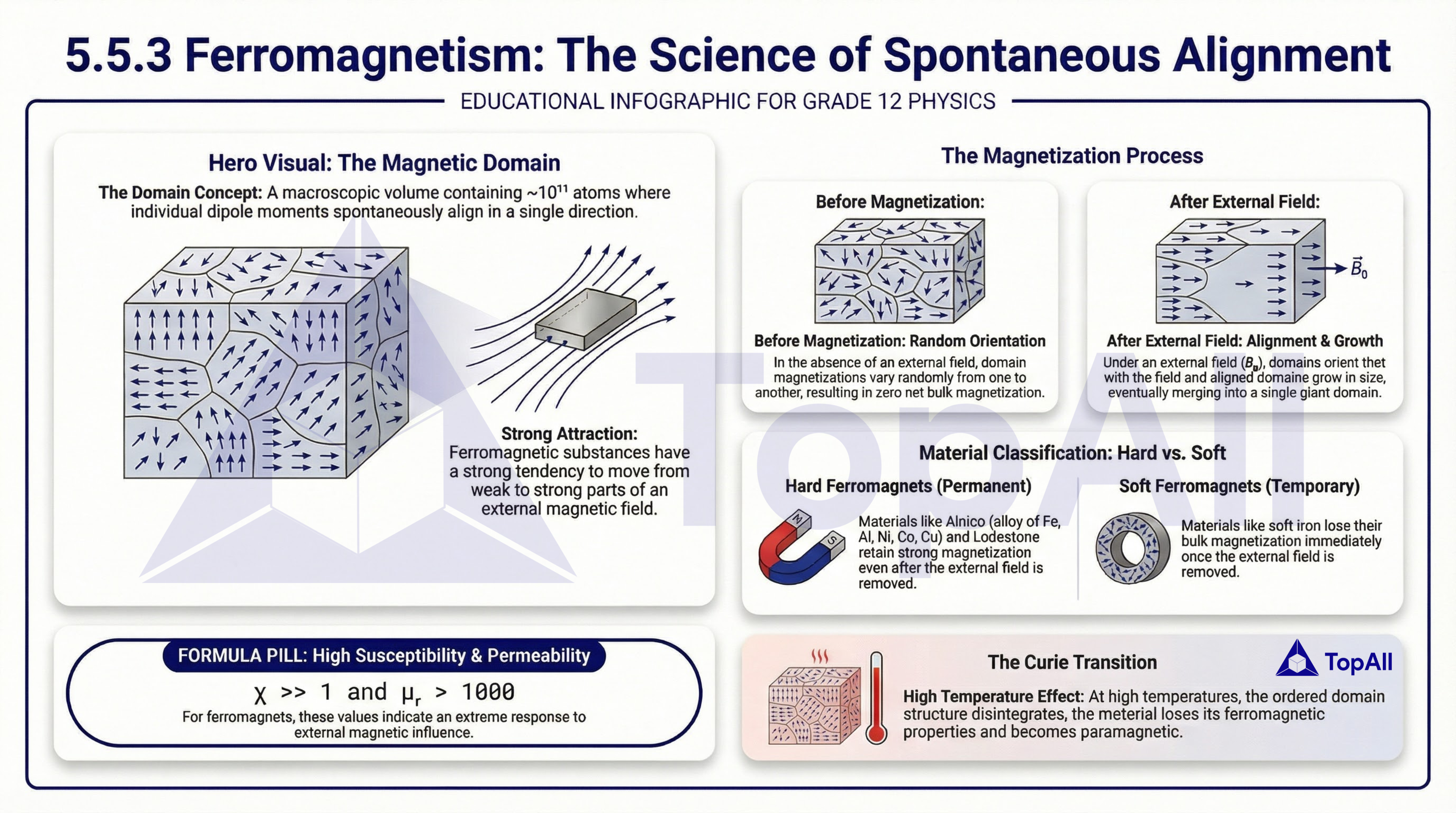
Master Ferromagnetism for NEET with TopAll.
NEET UG · Mind map
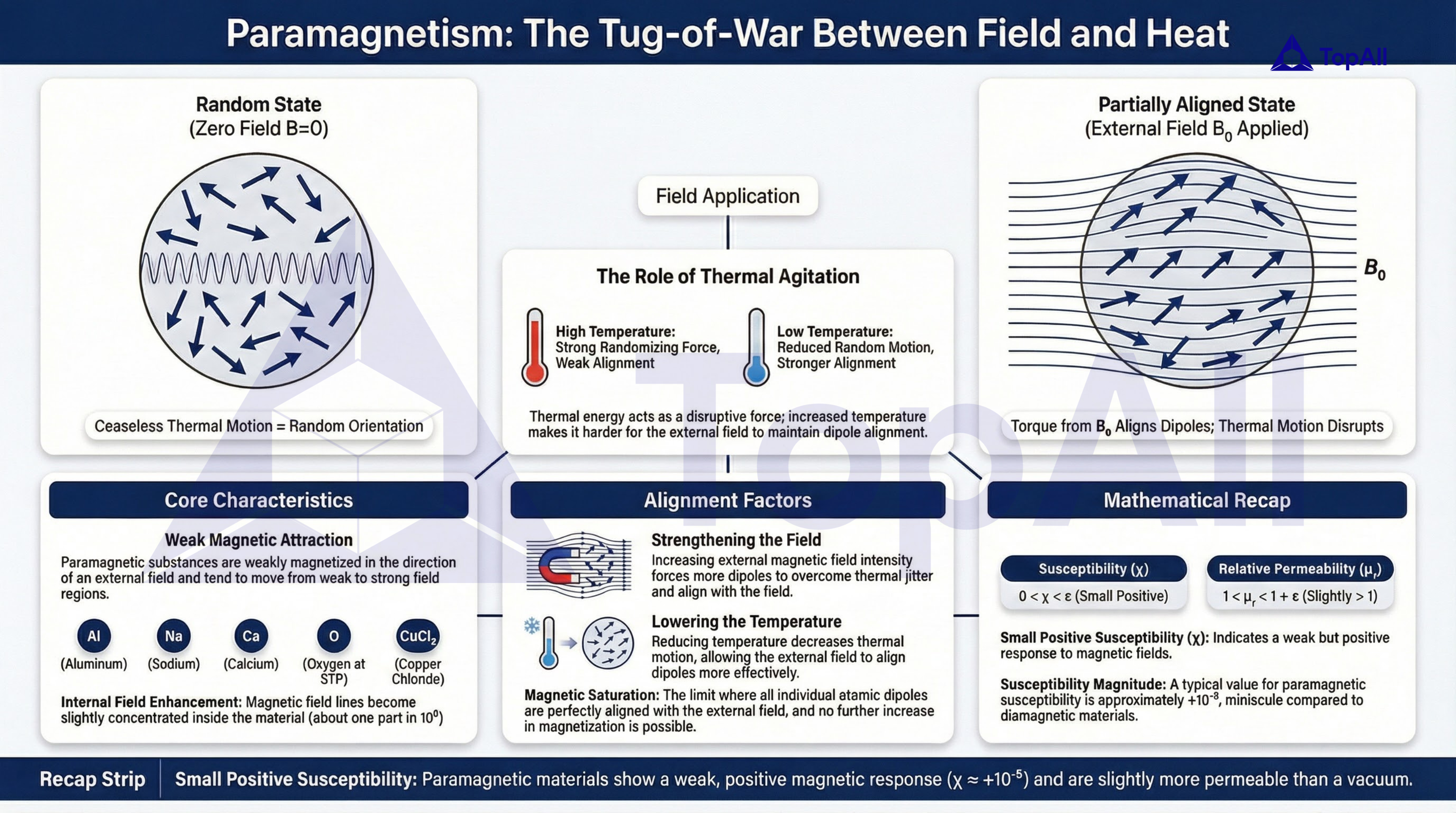
Learn Paramagnetism for NEET with TopAll.
NEET UG · Mind map
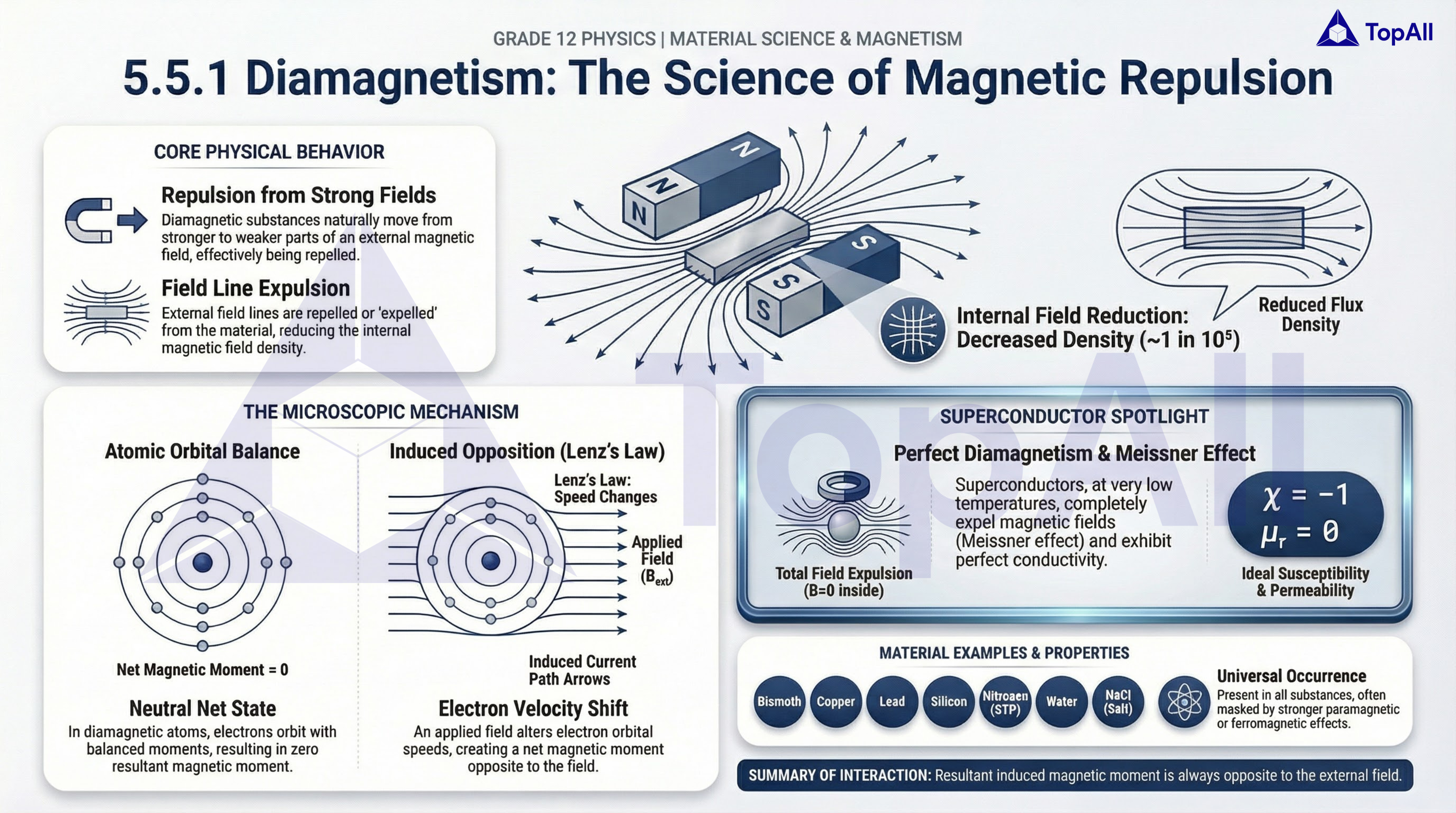
Understand Diamagnetism for NEET with TopAll.
Compare magnetic torque and energy, distinguish stable alignment from zero torque, and interpret material response with original diagrams and self-checks.
For NEET UG students: tell zero torque from stable alignment, calculate dipole energy changes, and distinguish weak diamagnetic or paramagnetic response from ferromagnetic domains.
For a fixed magnetic dipole moment in a uniform external field, and . Torque magnitude is . Here is the angle between m and B. Torque vanishes both when aligned and when opposed, but the energy is minimum at alignment and maximum at opposition. The opposed position is unstable, even though its instantaneous torque is zero.
For a current loop, with the area of one turn and fixed by curling right-hand fingers with conventional current. For a bar magnet, the dipole moment points from its south end to its north end. The unit of m is . A loop plane at to B has its normal at or to B: torque magnitude is the same, but the energy sign needs the directed normal. A uniform field produces no net translational force on an ideal dipole, while it may produce torque.
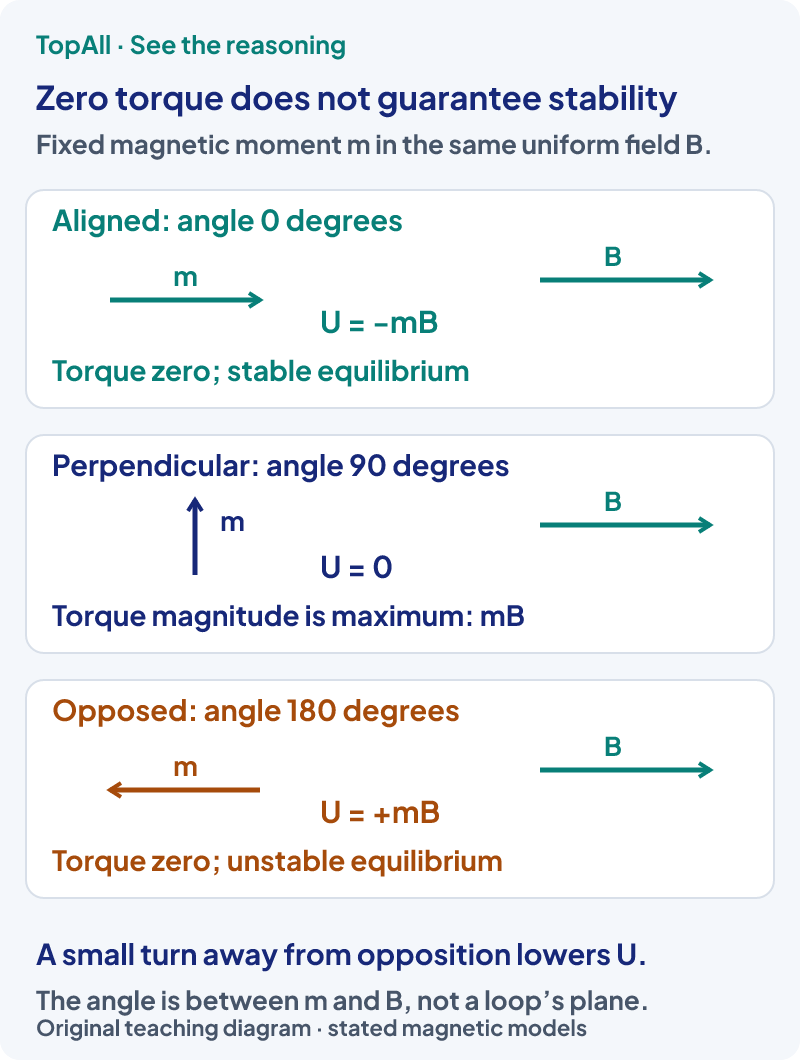
A fixed moment makes with a uniform . Its torque magnitude is , and its potential energy is . Torque tends to reduce the angle toward alignment. Do not substitute into the energy expression: sine and cosine answer different questions.
Quasi-statically rotate the same fixed dipole from alignment at to opposition at in the same fixed uniform field. Initially ; finally . The external work is when rotational kinetic energy does not change and no other work is present. The field’s torque does . The endpoints have zero torque, but the required work depends on the whole rotation. Opposition needs careful holding; a small disturbance lowers the energy.
Magnetic field lines form closed loops; for a closed surface . Zero net magnetic flux does not imply zero B at every point. In the textbook bar-magnet model, cutting a magnet produces smaller magnets with both poles rather than an isolated pole. Far from a small dipole in vacuum, at equal centre-distance r, and in magnitude. The axial field is along m and the equatorial field opposes m. These are far-field point-dipole approximations, not exact near-pole formulas for a finite bar.
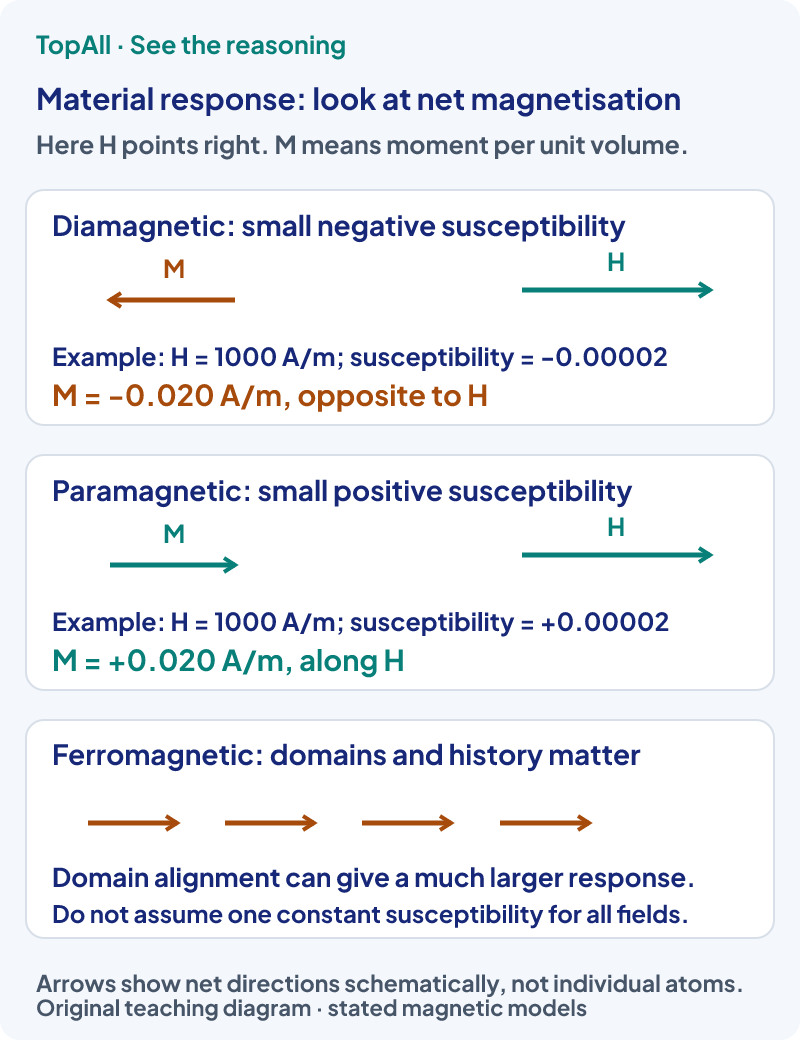
Magnetisation is net magnetic moment per unit volume, measured in . In SI, . For a linear isotropic material in the specified range, , so . Susceptibility is dimensionless. A small negative means induced magnetisation opposite to H (diamagnetic response); a small positive value means weak magnetisation along H (paramagnetic response). H is the internal magnetic field intensity in these relations; a specimen’s shape can affect its internal field, so do not substitute an external-field value without a justified model.
In a ferromagnetic material, many atomic magnetic moments can order together in domains. An unmagnetised specimen can have substantial domain moments that cancel in the overall sample. Applied fields can change domain populations and alignment, giving a large response. The resulting magnetisation can be nonlinear and depend on earlier field exposure; residual magnetisation can remain after the applied field is removed. Do not treat a constant positive susceptibility over all fields as a universal ferromagnetic law. The weak linear examples in the diagram are illustrative numbers, not measurements of iron or another named substance.
A dipole has in a uniform field. Compare torque magnitude and energy at and . Which position has the larger energy, and is either stable?
Here . At , and : torque is maximum, so it is not an equilibrium. At , and , the larger energy and an unstable equilibrium. Stable alignment would be with .
A hypothetical homogeneous linear isotropic material has . Its internal points right. Find the magnetisation and relative permeability. Does the small negative susceptibility make the total B point left?
, so M points left. But is positive, and remains rightward. Thus B points right and is slightly smaller than for this specified model. Negative susceptibility reverses the induced response, not the whole B in this weak-response case.
Rebuild a short table from memory: diamagnetic → small induced response opposite H; paramagnetic → weak response along H; ferromagnetic → collective domain behaviour that can be large and history dependent. Then label aligned, perpendicular and opposed dipoles by both torque and energy. A material-class question and a dipole-orientation question require different reasoning.
Explain why “zero torque means stable” is false using the opposed dipole. Recompute the rotation example from back to ; the ideal quasi-static external work becomes . Finally, explain why zero closed-surface magnetic flux does not mean no magnetic field. Then attempt broad chapter practice below; these are chapter pools rather than dedicated dipole or material-only sets.
Technical review: Codex (automated). Primary textbook sources checked on 23 October 2026. Diagrams, numerical examples and self-checks are original teaching material. Human subject review is not claimed.
Explain the sign or assumption you missed, then try a fresh chapter question.

