NEET UG · Video

Wave Nature of Matter NEET Concepts
Understand wave nature of matter with formulas & MCQs.
4 min video

NEET UG · Physics
Revise the concepts. Try a question. Understand your next step.
22 easy questions available · Try answers free. Sign in to save progress or take a quiz.
NEET UG · Physics
Understand the concept, practise questions and check your learning.
Understand
Separate photon energy from intensity, test emission thresholds and compare matter wavelengths. Dual nature: check the threshold and the momentum
Read the guidePractise
Try 22 easy chapter MCQs. Untimed; check answers and available explanations as you go.
Practise chapter MCQsCheck your learning
Prepare a timed chapter quiz. Choose the available question count and pace before starting.
Prepare a chapter quizThis is chapter practice, not a full-length NEET mock paper.
These are playable question counts after quality and duplicate checks.
The practice player uses single-correct-answer MCQs. Chapter quizzes are not full-length NEET mock papers. Check the practice guide and official syllabus sources.
Revise before you practise
NEET UG · Video
Understand wave nature of matter with formulas & MCQs.
4 min video
NEET UG · Video
Learn photon concepts, energy & MCQs.
4 min video
NEET UG · Video
Master Einstein equation with derivations & MCQs.
5 min video
NEET UG · PDF notes
Read PDF · 9 pages →Understand wave nature of matter with formulas & MCQs.
9 pages
NEET UG · PDF notes
Read PDF · 8 pages →Learn photon concepts, energy & MCQs.
8 pages
NEET UG · PDF notes
Read PDF · 9 pages →Master Einstein equation with derivations & MCQs.
9 pages
NEET UG · Mind map
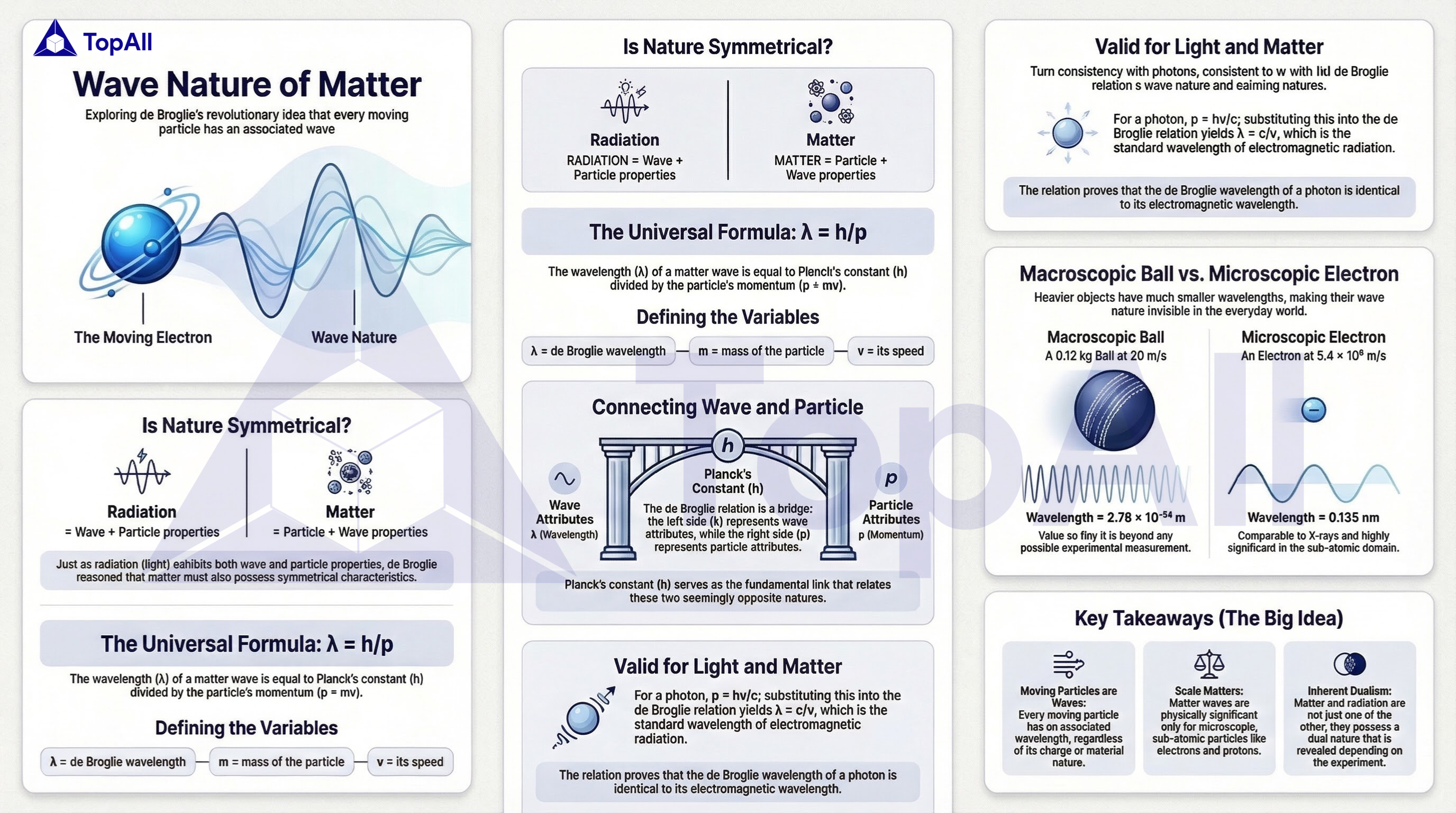
Understand wave nature of matter with formulas & MCQs.
NEET UG · Mind map
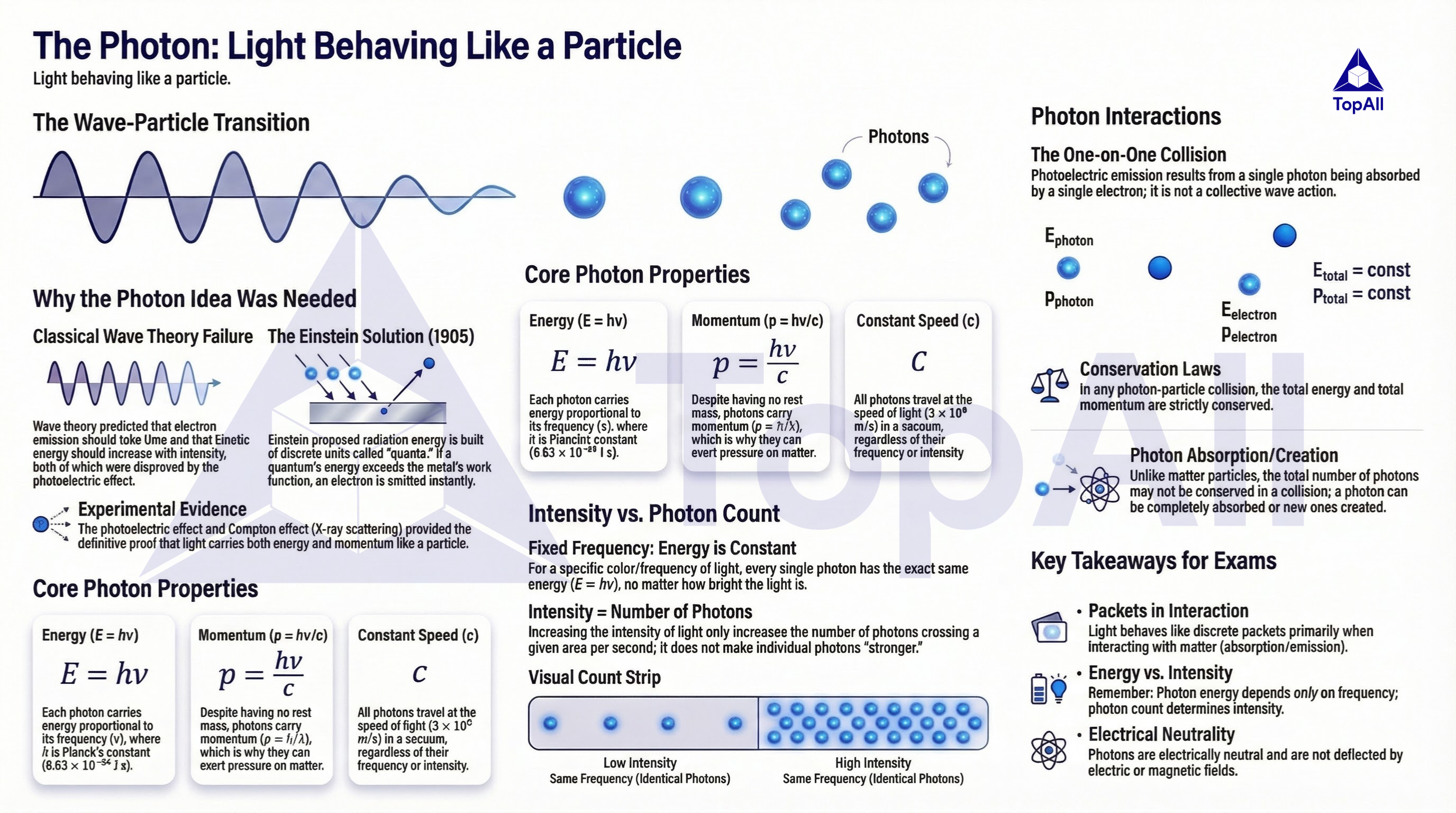
Learn photon concepts, energy & MCQs.
NEET UG · Mind map
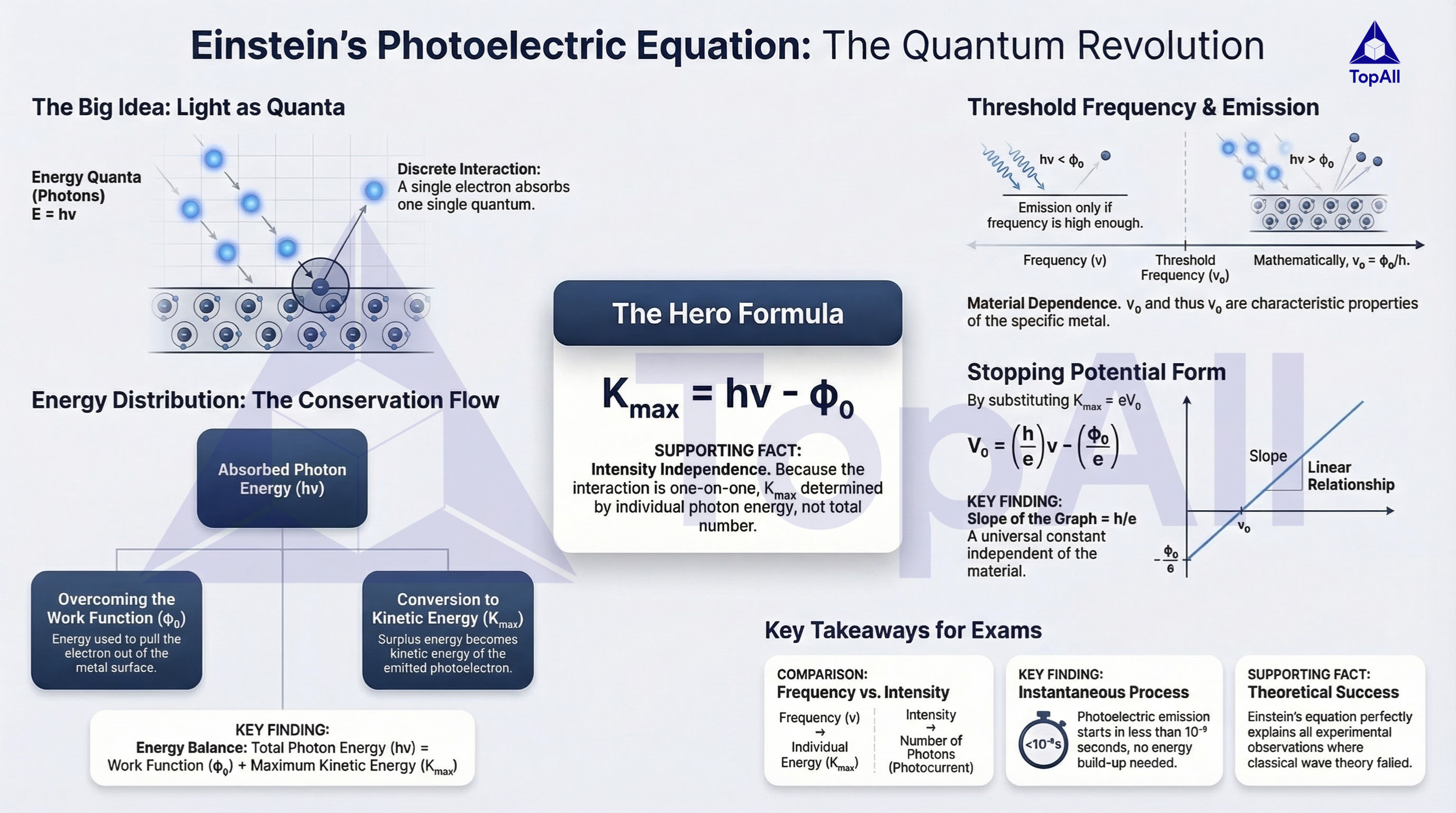
Master the Einstein equation with derivations & MCQs.
Separate photon energy from intensity, test emission thresholds and compare matter wavelengths.
For NEET UG Physics students: test the photoelectric threshold, distinguish intensity from photon energy, interpret stopping potential and choose the correct momentum for a de Broglie wavelength.
In ordinary one-photon photoemission, one absorbed photon supplies energy hν. The maximum emitted-electron kinetic energy is hν−φ only when the threshold permits emission. At fixed frequency and surface, increasing illumination can increase the emission rate under suitable collection conditions without raising that maximum energy. Matter wavelength instead follows λ=h/p, so the momentum relation matters. Do not replace every energy with pc: a photon and a slow electron obey different energy–momentum relations.
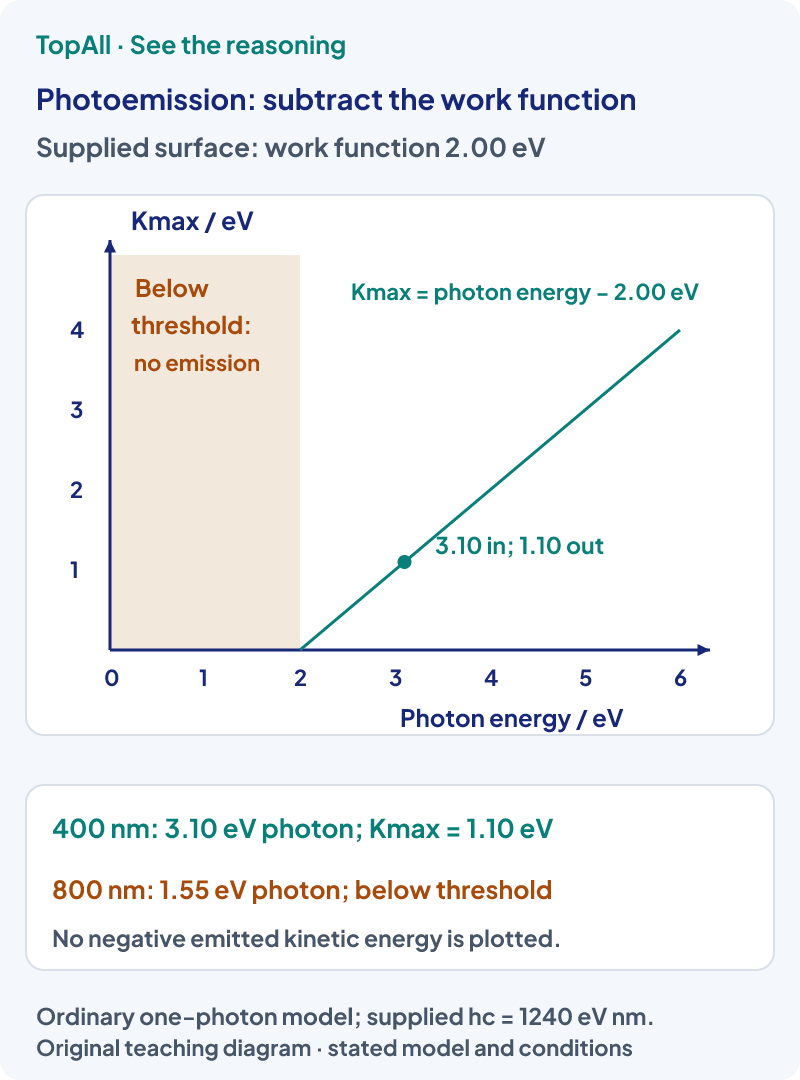
For a supplied surface take φ=2.00 eV and . At λ=400 nm, photon energy is 1240/400=3.10 eV, so . The magnitude of the ideal stopping potential is 1.10 V because . The threshold wavelength is 1240/2.00=620 nm. At 800 nm the photon has only 1.55 eV: no one-photon emission occurs, rather than an emitted electron with −0.45 eV. Contact potentials, detailed surface states and intense-field multiphoton processes are outside this elementary model.
At fixed above-threshold frequency, a higher incident photon rate can increase photocurrent when surface response and collection conditions are unchanged. Saturation current also depends on collection and the available emitted-electron rate. The stopping potential reflects the maximum kinetic energy and is ideally independent of illumination intensity at that fixed frequency. Increasing intensity below threshold does not rescue the ordinary one-photon energy deficit. The reverse-bias voltage sign depends on the stated electrode convention; Vs here denotes its positive stopping magnitude.
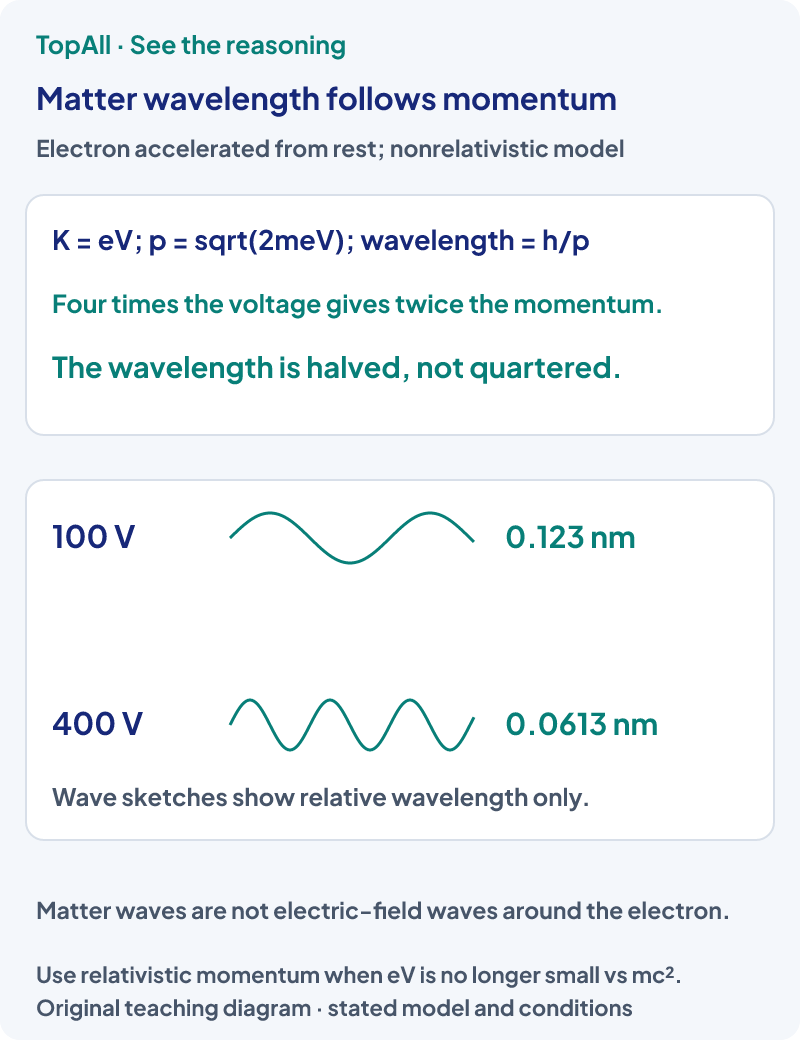
Use supplied , and . For an electron accelerated from rest through 100 V, . The nonrelativistic momentum is about
Two particles with the same momentum have the same de Broglie wavelength h/p. In a nonrelativistic comparison at equal kinetic energy, however, momentum is √(2mK), so the heavier particle has the shorter wavelength. At equal speed, momentum is mv in that approximation, giving a different mass dependence. Read whether the problem fixes momentum, kinetic energy, speed or accelerating voltage. Equal voltage implies equal gained energy only for equal charge magnitude and the stated initial conditions.
Take a photon of energy 100 eV and an electron of kinetic energy 100 eV. With supplied hc=1240 eV nm, the photon wavelength is 12.4 nm because photon energy is pc. The electron, using the previous nonrelativistic calculation, has wavelength about 0.1227 nm because its kinetic energy is , not pc. The photon wavelength is about 101 times larger. The electron also has rest energy; comparing its kinetic energy with the photon total energy does not make their momenta equal. The general wavelength relation h/p is shared, while the energy–momentum relations differ.
Electron diffraction patterns show why a matter-wave description is useful. A sinusoid used to mark a wavelength is not a literal zigzag electron trajectory. A detector records local events, and an interference pattern can build over many events. The conditions of preparation, propagation and detection matter; a classical particle sketch alone does not describe the full experiment.
Shorter wavelength means higher photon energy. Do not report negative emitted kinetic energy below threshold, or treat greater intensity at fixed frequency as greater maximum electron energy. Stopping potential has units of volts; electron energy may be written in eV, but they are different quantities related by charge. For matter wavelength, choose p from the correct nonrelativistic or relativistic model and check what the comparison holds fixed.
For the supplied φ=2.00 eV surface, 800 nm photons have 1.55 eV each. Under the ordinary one-photon model, does doubling intensity produce emission? What changes for 400 nm light if frequency and collection conditions stay fixed?
The 800 nm photons remain below threshold, so doubling intensity does not produce ordinary one-photon emission. At 400 nm, each photon remains 3.10 eV and Kmax remains 1.10 eV. Greater photon rate can increase the photocurrent under unchanged response and collection conditions; it does not raise the ideal stopping magnitude.
In the same initially-at-rest nonrelativistic electron model, how must accelerating voltage change to reduce de Broglie wavelength to one quarter? Why is a factor of four in voltage insufficient?
Wavelength is proportional to V raised to −1/2. A fourfold increase in voltage only halves it. A sixteenfold increase is needed for one quarter, provided the final energy still lies within the nonrelativistic regime.
Explain the threshold before calculating, then compare photon and electron wavelength at one supplied energy. Revisit NEET Atoms for discrete photon gaps, or NEET Electromagnetic Waves to separate field amplitude, energy flux and photon energy.
Chapter practice opens the broad Dual Nature pool.
Technical review: Codex (automated). Primary textbook sources checked on 23 October 2026. Diagrams, questions and numerical examples are original and use supplied rounded constants with explicit models. Human subject review is not claimed. These explanations and chapter catalogues do not establish complete coverage of every current exam format or syllabus.
For the next set, name the quantity that changed and the quantity held fixed. After a mistake, explain the wrong shortcut before calculating again.

